How do you improve a B2B collections process without annoying good customers?
Here’s how to improve collections process results in B2B AR: contact customers before the due date, follow a fixed cadence by risk tier, settle disputes fast, track DSO and CEI, and automate the repetitive follow-up. Every step from day minus 5 to day 90 gets a named owner.
This guide lays out the day-by-day plan we use for accounts receivable collections, with the owner, channel and message at each stage. It is for B2B invoices only. Consumer debt follows different rules, and we flag the legal line below. Updated November 2026.
One caution first. The sources we reviewed agree on the shape of a good process (reminder, follow-up, firm notice, final demand, escalation) but not on exact day counts. Treat the days here as a tested starting design, then tune them to your customers and your terms.
Where does your collections timeline stall?
Walk through your day -5 to day 90 steps with our team and see which reminders an agent can draft while your people approve every escalation.
Quick Answer To improve your collections process, contact customers before the due date, then follow a fixed cadence by risk tier: reminder at day 1, call by day 15, formal demand by day 45, final notice by day 60. Check disputes and unapplied cash before every chase, log every promise to pay, and measure DSO and CEI monthly.
When does the collections process start for B2B invoices?
The collections process starts before the invoice is late. It begins when you set credit terms and send an accurate invoice to the right person, and the first touch lands about five days before the due date.
Most late payments are not refusals. They are a wrong bill-to address, a missing PO number, an invoice stuck in an approval queue, or a payment nobody applied. Fix those and you’ve removed a large share of your past dues before a collector picks up the phone.
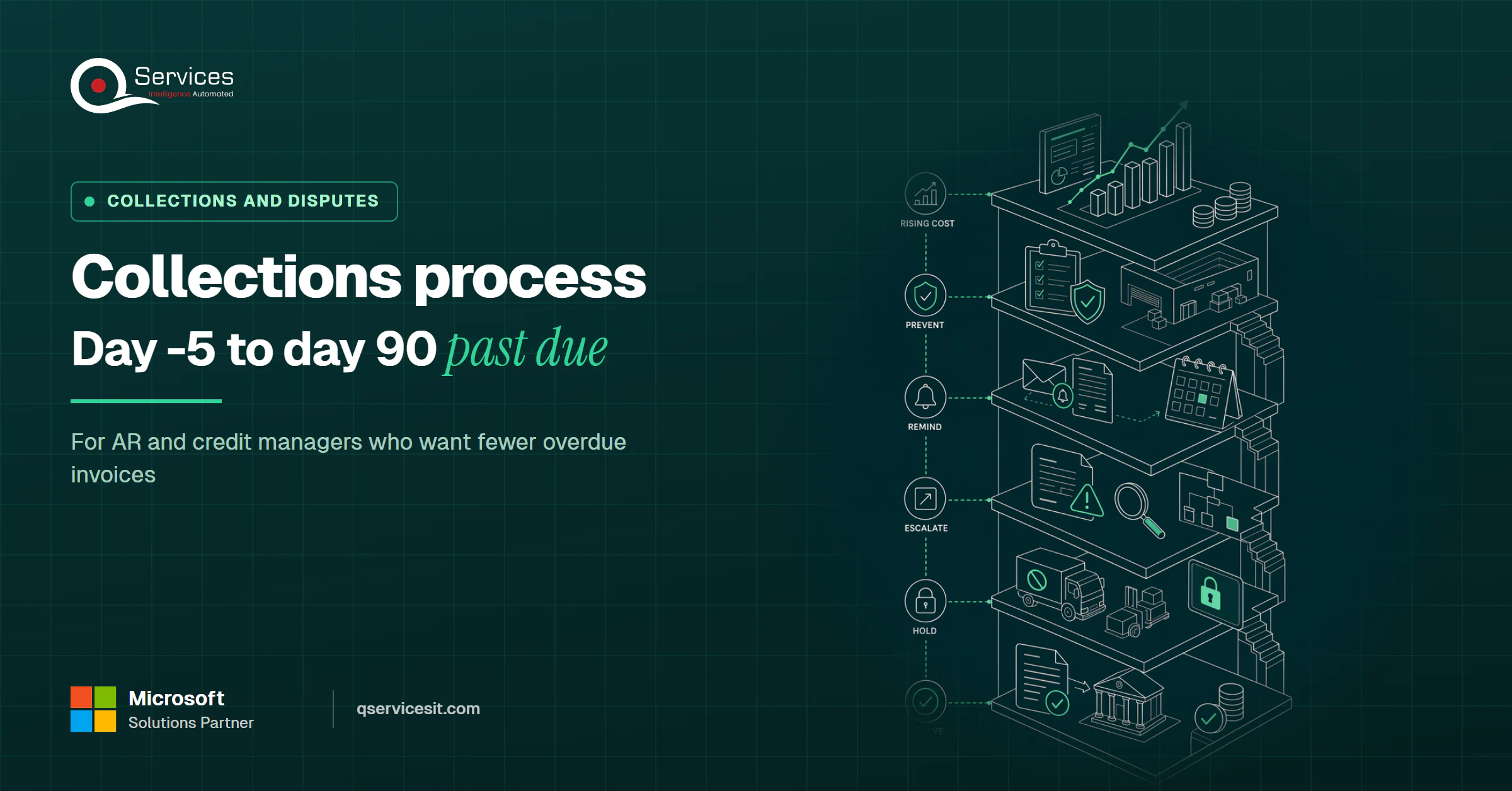
The QServices Framework Collections Cadence = Prevent → Remind → Escalate → Hold → Resolve
The order matters because each stage is cheaper than the next. Prevention costs minutes, a reminder costs an email, and a hold or an agency costs the relationship.
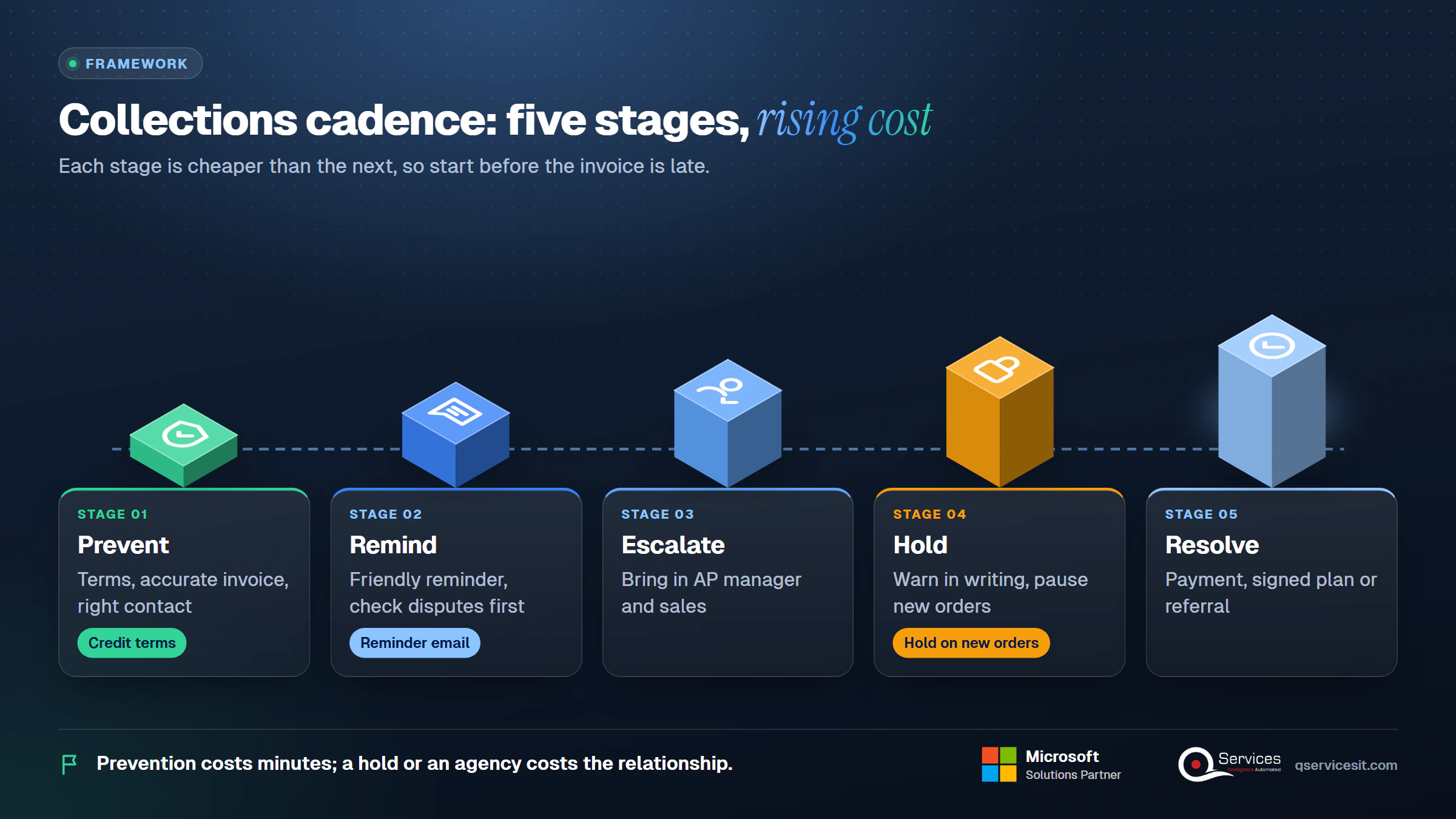
We reuse these five stage names through the rest of this post, so you can map any step in your own policy to one of them.
What should happen before the due date?
Prevention is the first stage, and it has four jobs:
- Credit terms: the customer has agreed to net 30, net 45 or whatever you set, in writing.
- Invoice accuracy: quantities, prices, tax and PO number match the order.
- Right contact: the bill-to address and the AP contact are correct, with a named backup.
- Delivery rules: if the customer needs a portal upload or an e-invoice, you’ve met that requirement.
Then send a short pre-due touch at about day -5. It’s optional for long-standing, reliable payers, and we’d keep it for every new customer and every large invoice.
Why check disputes and unapplied cash before you chase?
Because a false past due burns trust. If the customer paid and your team hasn’t posted the payment, the reminder is wrong and the customer knows it. Before any overdue invoice follow-up, check the open disputes and your unapplied cash backlog.
Key Insight The cheapest collections call is the one you don’t make. Check unapplied cash and open disputes first, and a share of your worklist disappears before anyone dials.
What are the collections steps from day minus 5 to day 90?
The B2B collections timeline runs from day -5 to day 90, with a decision at day 90. This table is the core collections process timeline we recommend. Adjust the days to your terms and your customers’ habits.
| Day range |
Action |
Owner |
Channel |
Goal |
| Day -5 to 0 |
Pre-due touch with invoice and PO check |
Collector |
Email |
Confirm receipt, catch errors |
| Days 1-7 |
Friendly reminder with invoice link and remittance copy; check disputes and unapplied cash first; call the AP contact |
Collector |
Email, phone |
Get a payment date |
| Days 8-15 |
Second email plus a call; find out if it’s a dispute, missing PO or approval hold; log a promise-to-pay date |
Collector |
Email, phone |
Name the blocker |
| Days 16-30 |
Escalate to the customer’s AP manager; offer a payment plan or early settlement where it fits; warn about shipment holds |
Collector, AR manager |
Phone, email |
Firm commitment |
| Days 31-45 |
Formal demand letter; bring in the account executive and the customer’s finance lead; re-check the credit limit |
AR manager, sales |
Letter, call |
Escalate above AP |
| Days 46-60 |
Final notice; hold on new orders; decide on a payment plan with a signed agreement |
AR manager |
Letter, call |
Payment or signed plan |
| Days 61-90 |
Pre-collections notice; set agency or legal referral thresholds; start reserve decisions |
AR manager, controller |
Letter, call |
Last chance to pay |
| 90+ |
Agency or legal referral; write-off and allowance decisions |
Controller, CFO |
Agency, counsel |
Close the item |
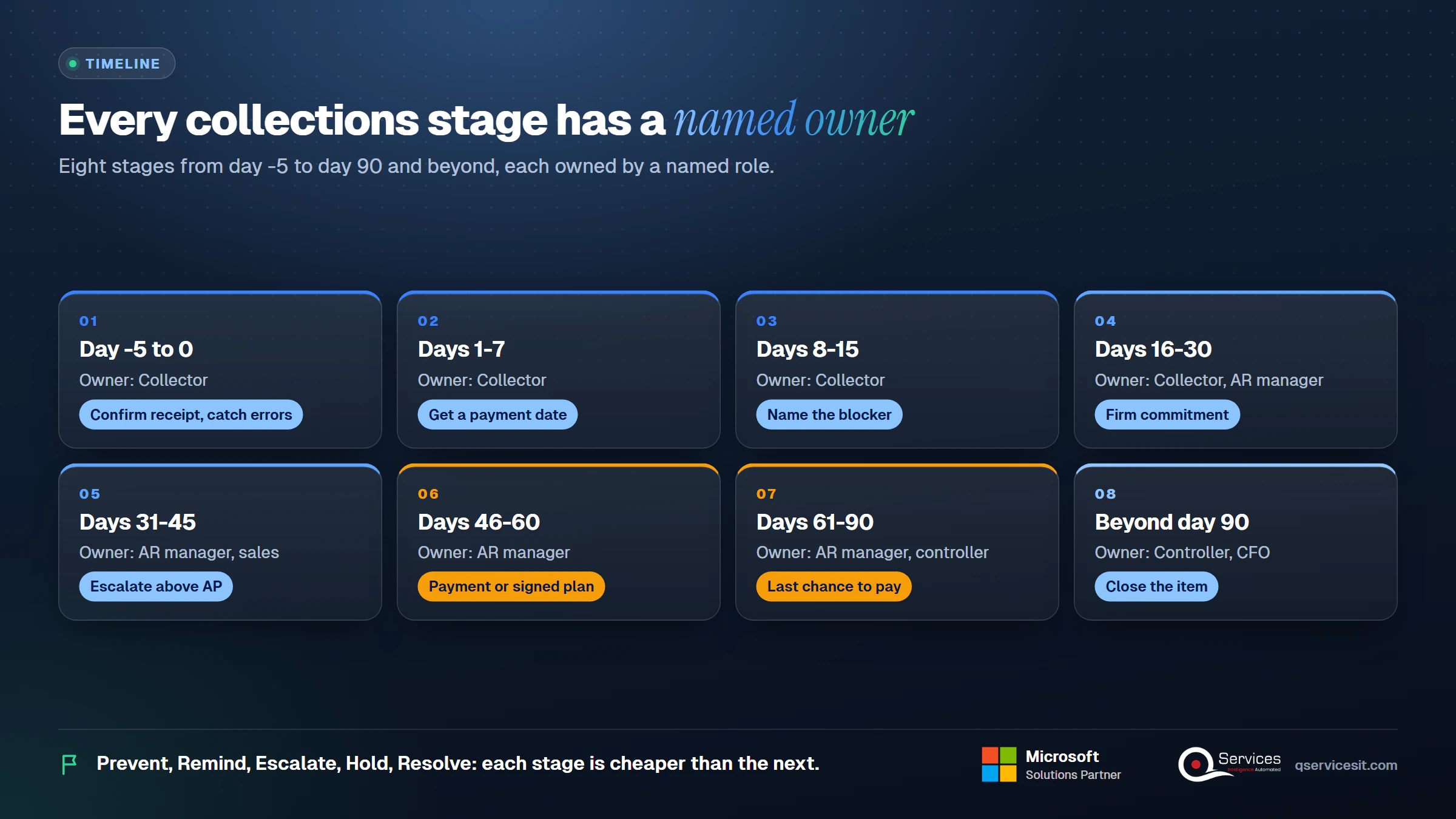
The three early stages are Prevent and Remind. Days 16-45 are Escalate. Days 46-60 are Hold, and days 61-90 and beyond are Resolve.
We’ve kept this table distinct from letter copy. If you want the wording of each notice, see our dunning letter sequence templates. This post is about the process around the letters: who acts, when, and what they check first.
What does one invoice's journey from day 1 to day 90 look like?
Here’s an illustrative case, not a customer result. A $18,400 invoice is due on 14 October on net 30 terms.
- Day -5 (9 Oct): Collector emails the AP contact to confirm the invoice and PO match. No reply.
- Day 1 (15 Oct): Collector checks disputes and unapplied cash, finds neither, and sends the friendly reminder with the invoice and remittance copy.
- Day 9 (23 Oct): Second email, then a call. AP says the invoice lacks a PO line. Collector logs the cause as missing PO, and the customer promises payment by 6 November.
- Day 24 (7 Nov): Promise broken. Collector escalates to the AP manager and notes the new date, 14 November.
- Day 33 (16 Nov): Still unpaid. AR manager sends the formal demand and copies the account executive, who calls the customer’s finance lead.
- Day 47 (30 Nov): Final notice. New orders are held, and the customer is told in writing first.
- Day 52 (5 Dec): Customer signs a three-instalment plan. Each instalment is logged with a date.
Every step has a note in the customer record. That log is what makes the next person’s call short.
What should the emails and the call say?
Keep each message short, specific and calm. Here are three email scripts and one phone script.
Day 3, friendly (about 70 words):
Hi Dana, invoice 20417 for $18,400 was due on 14 October and we can’t see it as paid yet. I’ve attached a copy and the remittance details. If it’s already on its way, a payment reference would let us match it. If something’s holding it up, such as a PO line or an approval, tell me and I’ll fix it today. Thanks, Sam.
Day 15, firm (about 75 words):
Hi Dana, invoice 20417 is now 15 days past due. When we spoke on 23 October you expected payment by 6 November, and we haven’t received it. Please confirm a payment date by Friday. If the invoice has a problem, send me the details and I’ll correct it. Otherwise we’ll ask your AP manager to help, and we may need to review new orders. Thanks, Sam.
Day 45, demand (about 80 words):
Dear Dana, invoice 20417 for $18,400 is 45 days past due despite our reminders on 15 October and 23 October and our call on 7 November. Please pay the full balance within 10 business days, or contact me to agree a written payment plan. If we hear nothing, we’ll place new orders on hold and move the account to final notice. We’d rather settle this directly. Regards, Alex, AR Manager.
Phone script, five lines:
- Introduce yourself and name the invoice number and amount.
- Ask if the invoice reached them and if anything blocks payment.
- Listen, then name the cause back: dispute, missing PO, approval, cash flow.
- Ask for a specific payment date and confirm the amount.
- Repeat the date, say you’ll email a summary, and log it before the next call.
Use the same invoice-level detail when you read an AR aging report by bucket, so each call matches what the worklist shows.
Who owns each step in accounts receivable collections?
No standard fixes these roles, so treat this as a recommended design. In most teams the collector owns days 1-30, the AR manager owns days 16-60 and disputes above a threshold, and sales owns the relationship context. Write the owners and authority limits into your policy.
How should the cadence change by risk tier?
Sending the same email to every customer is the most common mistake we see. A strategic account with a $400,000 balance and a new customer with a thin credit file need different handling.
| Risk tier |
Cadence |
Owner |
Channel |
| Large and strategic |
Pre-due touch, call by day 5, executive contact by day 31 |
Senior collector, AR manager, account executive |
Call first, email second |
| Mid-size |
Standard table above |
Collector |
Email, then phone |
| Small balance |
Automated reminders at days 1, 8, 16; call only past day 30 |
Agent drafts, collector approves |
Email, SMS if agreed |
| High risk |
Pre-due touch, call at day 1, tighter hold rules |
AR manager |
Phone, written confirmations |
Who should own collections: the collector, AR manager or sales?
All three, for different things. The collector works the aging list and logs promises. The AR manager owns disputes over a set value, payment plans and holds. Sales owns relationship context and joins from day 31, because a salesperson can often reach the person who approves payment. Your accounts receivable management guide is the place to write that split into a policy.
When to stop shipping to a past due customer, and when to escalate?
Stop shipping when an invoice is materially past due and the customer hasn’t given a credible payment date. There’s no universal threshold. Many teams start the conversation about a hold around day 16-30 and apply it around day 46-60, but your terms, margin and customer history set the line.
Two rules keep this fair. First, warn the customer in writing before a hold. Second, check that your contract supports pausing work or deliveries. A single disputed invoice is usually something you resolve, not a reason to block every order.
Real-World Scenario A typical case we see: a distributor’s credit manager has a customer with $62,000 across three invoices, all 40 days late. The collector kept sending the same reminder and the customer kept shipping orders on credit. Nobody had logged a promise, so the broken promise went unnoticed. The Hold stage should have applied at day 46 with a written warning at day 31. That would have cut the exposure to the original invoices and forced a payment plan conversation while the relationship was still healthy.
What do you do when a dispute, a broken promise, silence or distress appears?
Use this decision list:
- Dispute: pause the dunning on that line only, assign an owner, give the customer a date for the answer, and log a root-cause code (price, quantity, damage, missing PO, duplicate). Keep chasing undisputed invoices.
- Broken promise: call the same day, ask what changed, take a new date, and move to the next stage if it breaks twice.
- Customer goes silent: switch channel, reach a second contact, and ask the account executive to try. Escalate on schedule.
- Customer in distress: involve the AR manager and credit manager, ask for a payment plan with a signed agreement, tighten credit limits, and consider asking for a deposit on new orders.
Does the FDCPA apply to B2B collections?
Generally no. The Fair Debt Collection Practices Act covers consumer debt, meaning debts incurred primarily for personal, family or household purposes. Business debts fall outside it. State rules and agency licensing do vary, so check with counsel before you send anything to an agency. This isn’t legal advice.
Standards & References
In the UK, that Act sets statutory interest on late commercial invoices, and it’s worth reading the current wording before you quote a rate to a customer.
Is day 30 where your follow-ups go quiet?
Past-due invoices often sit between the first reminder and the first call. Book a call to see how approval-first agents log promises and queue the next step.
How long does the collections process take?
A B2B collections process typically runs 60 to 90 days from the first overdue notice to a decision on referral or write-off. Most invoices should clear in the first 30 days if you’ve prevented the avoidable causes. Anything past day 90 is a different problem, and agency referral rates and recovery odds vary widely by source, so we don’t quote one number.
We’d be wary of referring accounts to an agency at day 15 or 30. It’s usually too early, and it damages a relationship you might still need.
How much cash does a 6-day DSO cut free?
Here’s an illustrative example, not a customer result. A company has $4.2M of monthly credit sales and a DSO of 58 days.
- Daily sales = $4.2M / 30 = $140,000
- Cash freed by 6 days = $140,000 x 6 = $840,000
That money was already earned. It was sitting in receivables. For the formula and benchmarks, see days sales outstanding.
Which metrics show the process is working?
Track these monthly. The targets below are rules of thumb, not published standards.
| Metric |
Formula |
What good looks like |
| DSO |
Receivables / credit sales x days in period |
Close to your payment terms plus a few days |
| CEI |
(Beginning AR + credit sales – ending total AR) / (Beginning AR + credit sales – ending current AR) x 100 |
Above about 80% (rule of thumb) |
| % past due |
Past-due AR / total AR |
Falling quarter on quarter |
| Average days delinquent |
DSO minus best possible DSO |
Single digits to low teens |
| Promise-to-pay kept rate |
Promises kept / promises logged |
Above about 80% (rule of thumb) |
| Dispute rate and cycle time |
Disputed invoices / invoices; days to close |
Cycle time shrinking each month |
CEI example: beginning AR is $1.0M, quarterly credit sales are $3.0M, ending total AR is $1.2M and ending current AR is $0.9M. That gives ($4.0M – $1.2M) / ($4.0M – $0.9M) = 2.8 / 3.1, or about 90%. Our guide on the collection effectiveness index shows why it catches problems that DSO hides.
Where an agent helps in collections workflow, and where a person signs off?
An approval-first collections agent works inside your ERP and CRM and prepares work. A person approves anything that posts money or changes a system. It can rank the worklist, draft the email with the right invoice and context, spot disputes in email threads, flag late-payer patterns, and log promise-to-pay notes. Collections reminders drafted by an agent still go to a collector to approve before they’re sent.
People keep the calls that change terms: holds, payment plans, write-offs and anything touching a strategic account. For a wider view of what works and what’s hype, read AI in accounts receivable.
Manual follow-up vs an approval-first agent: what changes?
|
Manual follow-up |
Approval-first agent |
| Worklist |
Sorted by age in a spreadsheet |
Ranked by balance, risk and promise history |
| Reminder drafting |
Collector writes each email |
Agent drafts, collector approves |
| Promise logging |
Often skipped or in personal notes |
Written to the customer record each time |
| Disputes in email |
Found when someone reads the thread |
Flagged for review |
| Setup effort |
None |
Worse: needs clean customer contacts, reminder rules and a review routine |
The honest downside is the last row. An agent only works as well as your customer data and your rules, and it adds an approval step your team must keep up with.
What does the first 30 days look like in Business Central?
Business Central gives you the building blocks out of the box: customer ledger entries, aging reports, payment terms, credit limit warnings, a blocked status on customers, and reminder terms with levels, grace periods, fees and email text. Reminder levels, timing and wording need configuration. Copilot and agents run only on Business Central online. Here’s a five-step setup:
- Clean customer data: correct the bill-to, the AP contact and the payment terms.
- Set reminder terms: build two or three reminder levels that match the table above.
- Set credit limits and blocking rules: by tier, with a written approval for any release.
- Build the aging view: a report or Power BI page by bucket, tier and owner.
- Add logging: a promise-to-pay note on every call, and a weekly review of broken promises.
If you’re on another ERP, the same logic applies. NetSuite needs its dunning add-on, and SAP derives dunning levels from days in arrears. Map your table to the equivalent fields.
What are the common mistakes in a collections workflow?
- Chasing before checking unapplied cash: the customer paid, you didn’t post it, and the call damages trust.
- Sending the same email to every tier: a strategic account needs a call, not a template.
- No logged promise-to-pay: you can’t tell a broken promise from a new conversation.
- Treating a promise as settlement: the invoice stays open until the cash lands.
- Holding for one disputed invoice: resolve it instead.
How does QServices approach collections?
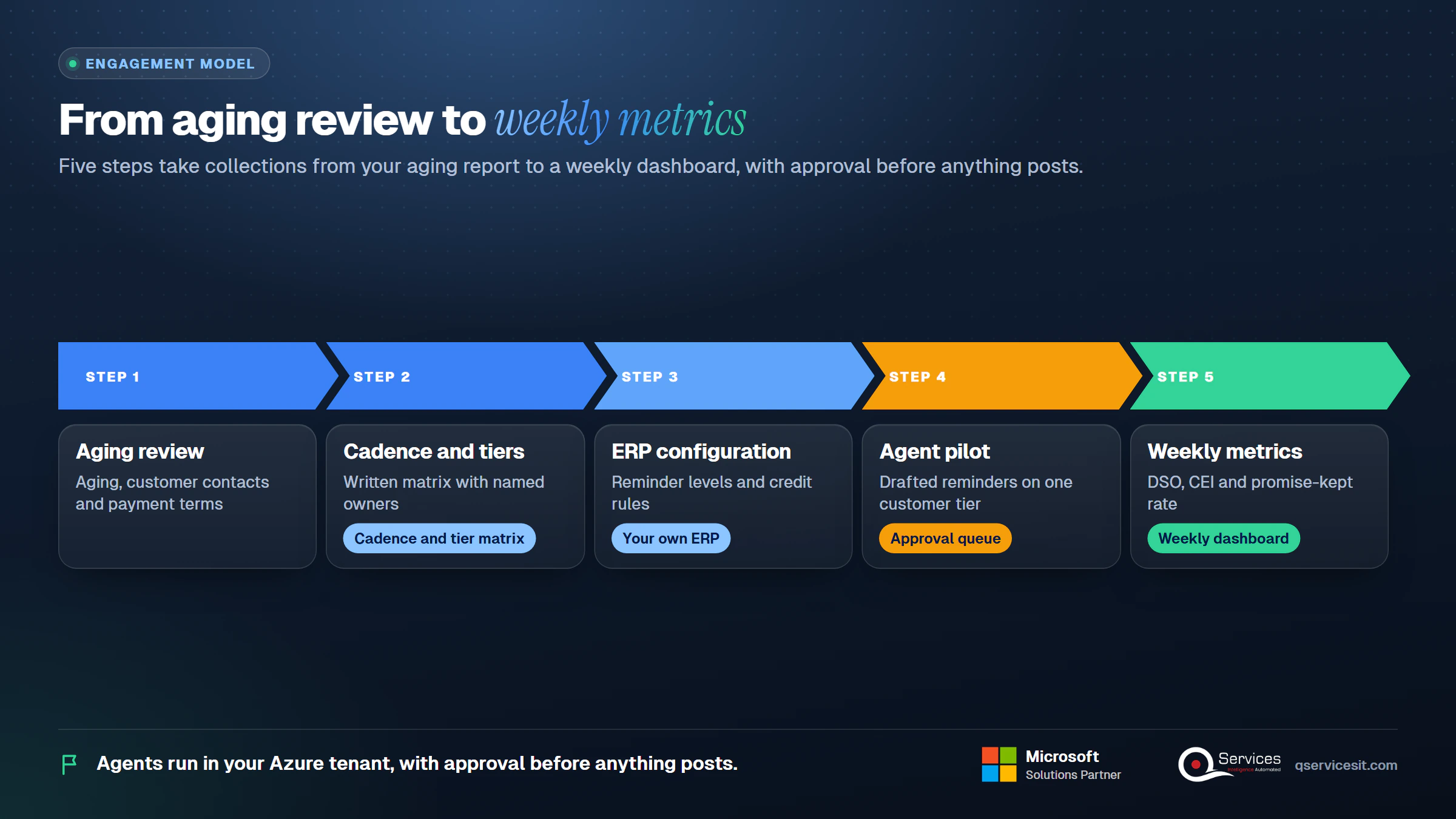
We start with Prevent, because clean invoices and correct contacts cut the worklist before any automation. Then we build the Remind and Escalate stages inside your own ERP, with agents running in your Azure tenant and an approval queue before anything posts. The same team builds it and runs it.
- A review of your aging, customer contacts and payment terms
- A written cadence and tier matrix with named owners
- Reminder levels and credit rules configured in your ERP
- A pilot of drafted reminders on one customer tier
- A weekly dashboard of DSO, CEI and promise-kept rate
Implementation Checklist
- Bill-to and AP contact are verified for every active customer
- Payment terms are written on every invoice
- A pre-due touch is scheduled for new and large customers
- Disputes and unapplied cash are checked before any reminder
- Reminder levels are set to the day ranges in the table
- A promise-to-pay note is logged for every call
- Credit-hold rules have a named approver and a written warning step
- DSO and CEI are reviewed monthly by the AR manager
What should you do first to improve your collections?
Pick one customer tier, set the Prevent and Remind stages, and watch DSO, promise-kept rate and dispute cycle time for 30 days. Then add Escalate and Hold. and we’ll map your own day -5 to day 90 plan.

Written by Rohit Dabra
Co-Founder and CTO, QServices IT Solutions Pvt Ltd
Rohit Dabra is the Co-Founder and Chief Technology Officer at QServices, a software development company focused on building practical digital solutions for businesses. At QServices, Rohit works closely with startups and growing businesses to design and develop web platforms, mobile applications, and scalable cloud systems. He is particularly interested in automation and artificial intelligence, building systems that automate routine tasks for teams and organizations.
Accounts receivableCollections workflowERP integrationFinance automation
Talk to Our Experts
Frequently Asked Questions
Related Topics
Next step
Who signs off on each collections step today?
Bring your current timeline to a short call. We will map which steps stay with a person and which an agent can draft inside your ERP and CRM.
















 Trustpilot5.0★★★★★See reviewsGoodFirms5.0★★★★★45 verified reviews
 G25.0★★★★★See reviewsClutch5.0★★★★★Quality 5.0 · Schedule 4.8
 Google4.7★★★★★Mohali office
 Erik BrownBusiness owner and software engineerClient review
 Zoltan BodnarCFO, Yusen LogisticsGoodFirms
 Ranbeer MakinClientClient review
 Alex VanderElsClientClient review
 Philmore J.ClientClient review
 Michael WilliamsonPresident and CEO, United Way of Southeast LouisianaGoodFirms
 Steven LewisClientClient review
 Brian WallerPresident, Technology Association of IowaGoodFirms