

AI in accounts receivable: what works in 2026 and what's hype

Isometric illustration of an invoice stack, a remittance document and a payment timeline flowing through an AI agent into a ledger, with an approval checkpoint along the way. - ai in accounts receivable
Summarize in:
Get an instant AI summary of this article

Introduction

AI in accounts receivable helps most today with reading remittances, suggesting cash matches and ranking likely late payers. A person still approves anything that posts money or changes a system.

That is the short version. The longer one matters if you’re a controller deciding what to pilot, because vendor claims run well ahead of independent evidence. Our data and AI (supporting) work starts from one rule: agents prepare, your team approves.

Below is a use case roundup of what works, what works only with clean data, and what doesn’t belong in a controlled finance team.

In This Article, You'll Learn
  • Which AR tasks AI handles reliably today, and which are still mostly vendor promises
  • How AI reads remittance advice and where extraction breaks
  • Why suggested matches with approval beat automatic posting
  • What data a late-payment model needs before you can trust it
  • Which controls and audit trail records a controller should ask for

Which AR tasks could an agent take on first?

Walk through your remittances, matching and follow-ups with our team and leave with a clear view of what an AI agent could handle, with your people approving each action.

Book a 30-min call →

Want to see where this fits in your own cash flow? Book the AR Cash Assessment.

Quick Answer AI in accounts receivable is useful today for reading remittance advice, suggesting cash matches and ranking customers likely to pay late. It works best on clean history and clear rules. Anything that posts money, writes off a balance or changes a system should wait for a named person’s approval.

Where does AI help in accounts receivable today?

AI helps with the repetitive, data-heavy steps between a payment arriving and a collector acting on it. It doesn’t make the judgment calls. Independent evidence for AR specifically is thin, so we treat most published accuracy numbers as vendor claims.

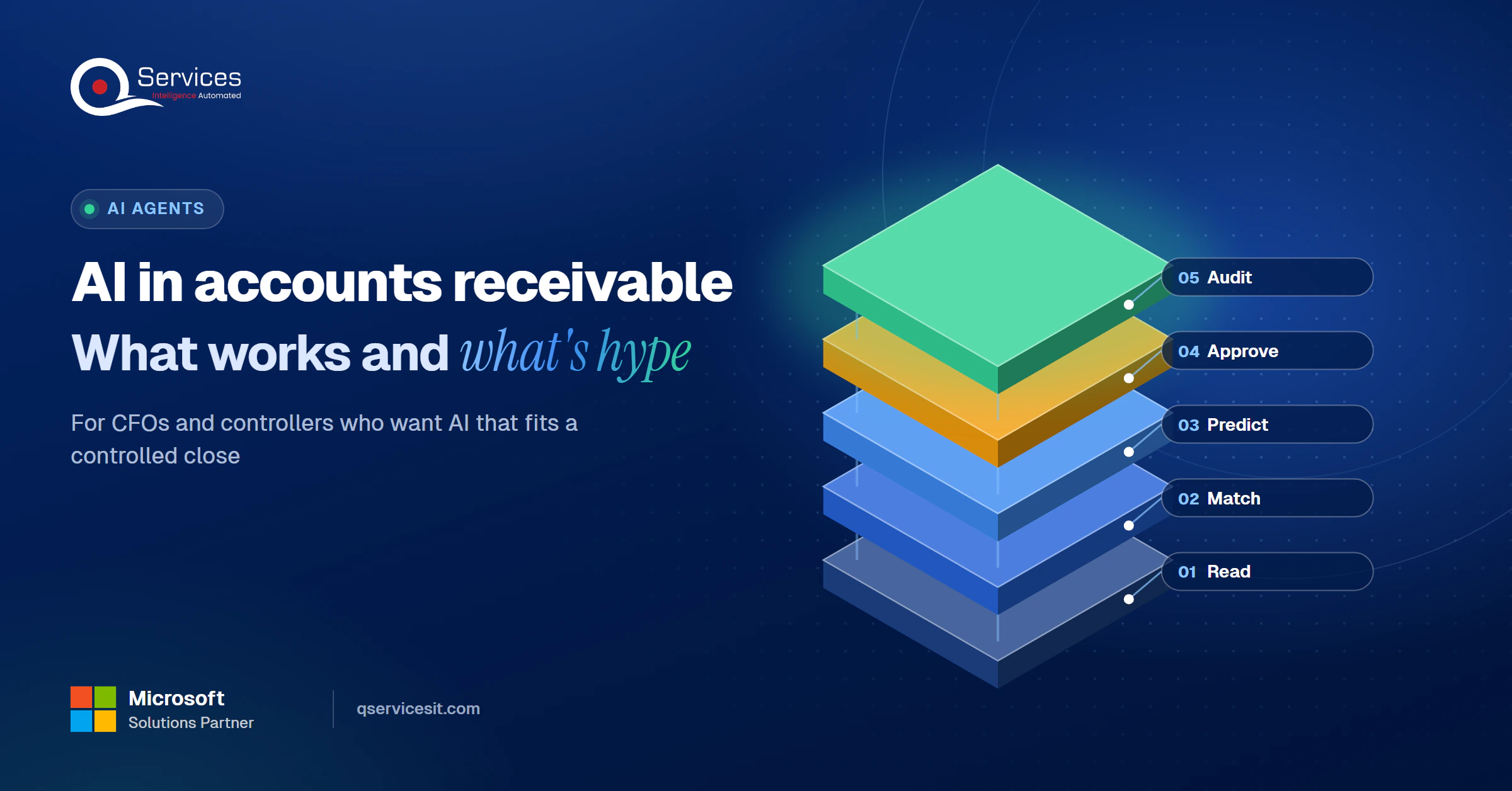
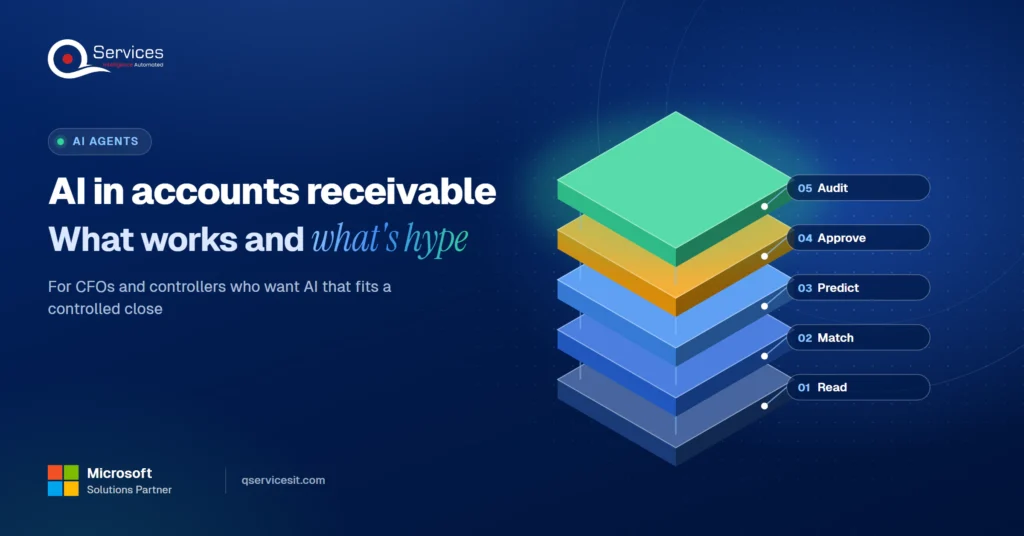
The QServices Framework Safe AR AI = Read → Match → Predict → Approve → Audit

The order matters because each stage feeds the next: a bad read poisons the match, and nothing should post before a person approves it.
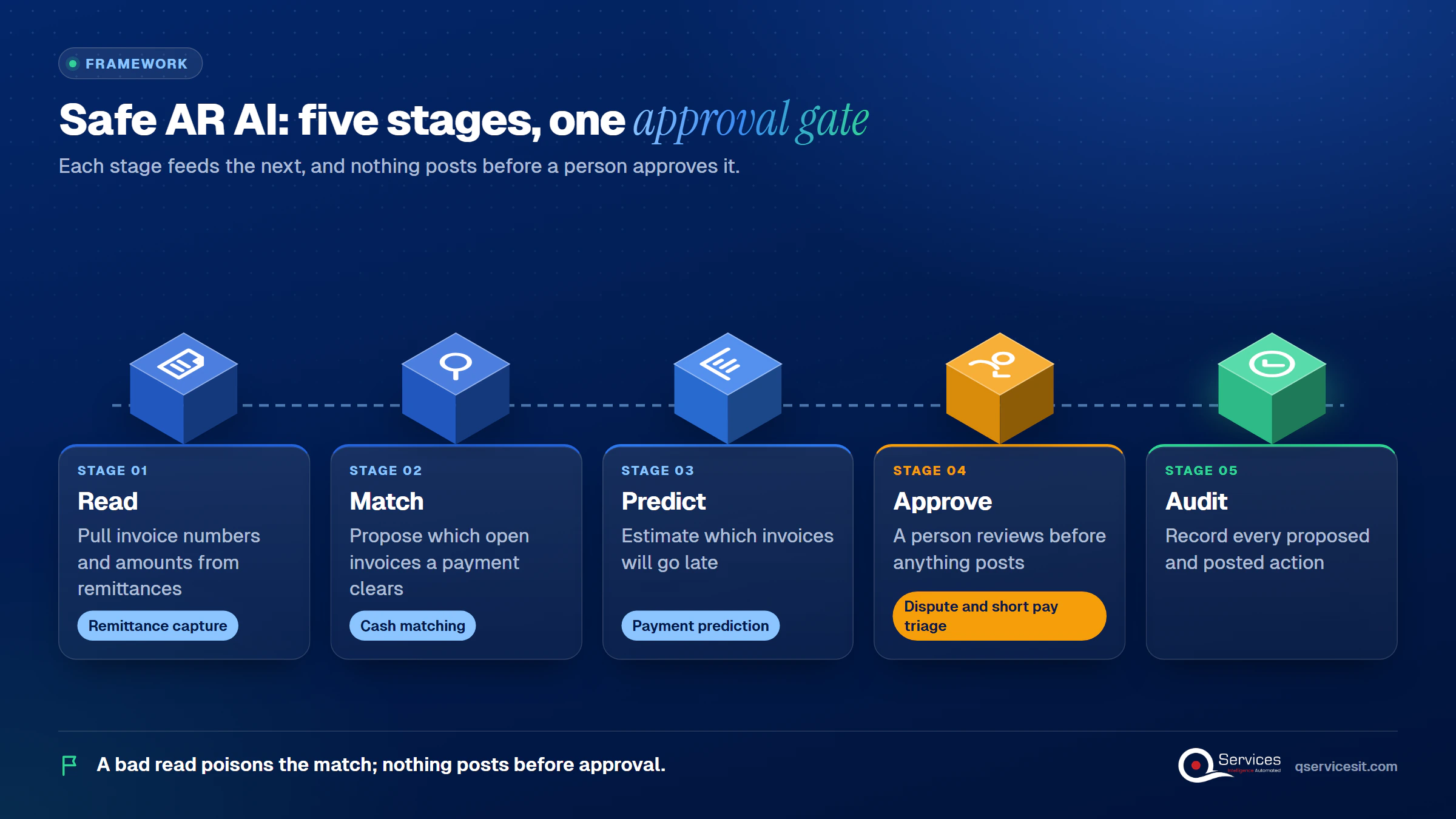
QServices Safe AR AI framework: Read → Match → Predict → Approve → Audit - ai in accounts receivable

What are the AI accounts receivable examples that hold up?

Vendor guides agree on the same short list. Each maps to a stage above.

  • Remittance capture (Read): pulling invoice numbers and amounts from emails, PDFs and bank files
  • Cash matching (Match): proposing which open invoices a payment clears
  • Payment prediction (Predict): estimating which open invoices will go late
  • Collections prioritisation (Predict): ordering the worklist by risk and amount
  • Dispute and short pay triage (Approve): classifying why a customer underpaid
  • Drafted follow-ups (Approve): writing the dunning email for a collector to send

Key Insight If AI prepares the work and a person reviews it, the review is the control. If AI is the control, every miss is a control deviation.

Reading remittances: how AI reads remittance advice

Reading remittances is the most dependable use case, because the task is narrow. The agent pulls payer, invoice numbers, amounts and deductions out of a messy document, then hands structured data to the next stage.

How AI reads remittance advice

AI remittance reading combines text extraction with a model that understands layout and context. It handles email bodies, PDF attachments, portal exports and check images. Garbled scans are where it struggles, and so is anything where PDF text extraction gives the agent wrong answers.

Where extraction breaks

Vendors self-report field-level accuracy of 95% to 99%. Ask whether that figure is field extraction or end-to-end matching, because the second is lower. Four things reliably degrade it:

  • Lump-sum bank payments with no remittance advice at all
  • Customised ERP invoice numbering that customers abbreviate
  • Thin history for a new customer
  • The first month, before the model has seen your patterns

Good input helps more than a better model. Our guide to what a good remittance advice contains is worth sending to your top payers.

Suggesting matches: AI invoice matching with approval

AI invoice matching proposes which open invoices a payment should clear, and learns from the clearing actions your accountants take. Match rates of 80% to 90% are common vendor claims, but they plateau near the share of clean payments. Short pays, overpayments, deductions and lump sums across many invoices still need judgement.

AI suggested cash matching with approval

The safe pattern is a queue. The agent proposes a match with a confidence score, a person approves it, and only then does the payment post. For our cash application services, that approval queue sits in front of every posting. Our cash application process steps show where the queue fits.

Suggest and approve vs automatic posting

Approach Speed Risk Honest downside
Suggest and approve Fast on clean items Low, a person signs off Needs reviewer time every day
Automatic posting Fastest Higher, errors post silently Hard to defend to auditors
Manual only Slowest Low but error-prone Unapplied cash piles up

Suggest and approve is slower than full automation, and that cost is real. We accept it because an unreviewed misposting is more expensive to unwind than a queue is to clear. Automatic posting is only reasonable for high-confidence, low-value clean matches, with sampling.

Predicting late payment: can AI predict late payers?

Yes, when the history is clean and long enough. Prediction ranks collector work. It doesn’t replace the collector.

What data does AI need to predict late payments?

Payment history per customer matters most: invoice dates, due dates, paid dates and terms. Microsoft’s Dynamics 365 Finance payment predictions show on-time, late and very-late probabilities per open invoice and let users check model accuracy and retrain. Dirty customer records or missing paid dates produce confident nonsense.

AI predicting late paying customers: what accuracy to expect

An academic study of 175,552 invoices from 3,725 customers reached roughly 77% to 80% accuracy against a 59% baseline, using invoice and payment-history features. That is useful for ordering a worklist. It is not good enough to trigger a credit hold on its own. Pair it with the collection effectiveness index so you can see whether the ranking actually improves collections.

Still keying remittance data by hand?

Bring a few real remittance emails to a short call. We’ll show how an agent reads them and proposes matches for your team to approve.

Book a 30-min call →

Where a person still decides

A person decides anything with accounting or audit consequences. That includes credit memos, write-offs, refunds, disputes and updates to credit bureaus.

Real-World Scenario A typical case we see: a controller at a distributor gets a 40-invoice lump-sum payment of $186,000 with a one-line remittance. An agent without a queue guesses and posts against the oldest invoices, leaving two customers’ disputes hidden for a month. At the Read stage the agent flags the missing detail, at Match it proposes allocations with low confidence, and at Approve a senior clerk confirms or corrects before anything posts.

Decisions that should stay with a named approver

  • Write-offs and credit memos, ideally with dual approval
  • Short pay classification, see our short pay tracking guide
  • Customer disputes and refunds
  • Any change to master data or credit limits

Scope each agent by transaction type, so a matching agent can’t touch credit memos. Our view on human-in-the-loop AI agent governance covers the reasoning.
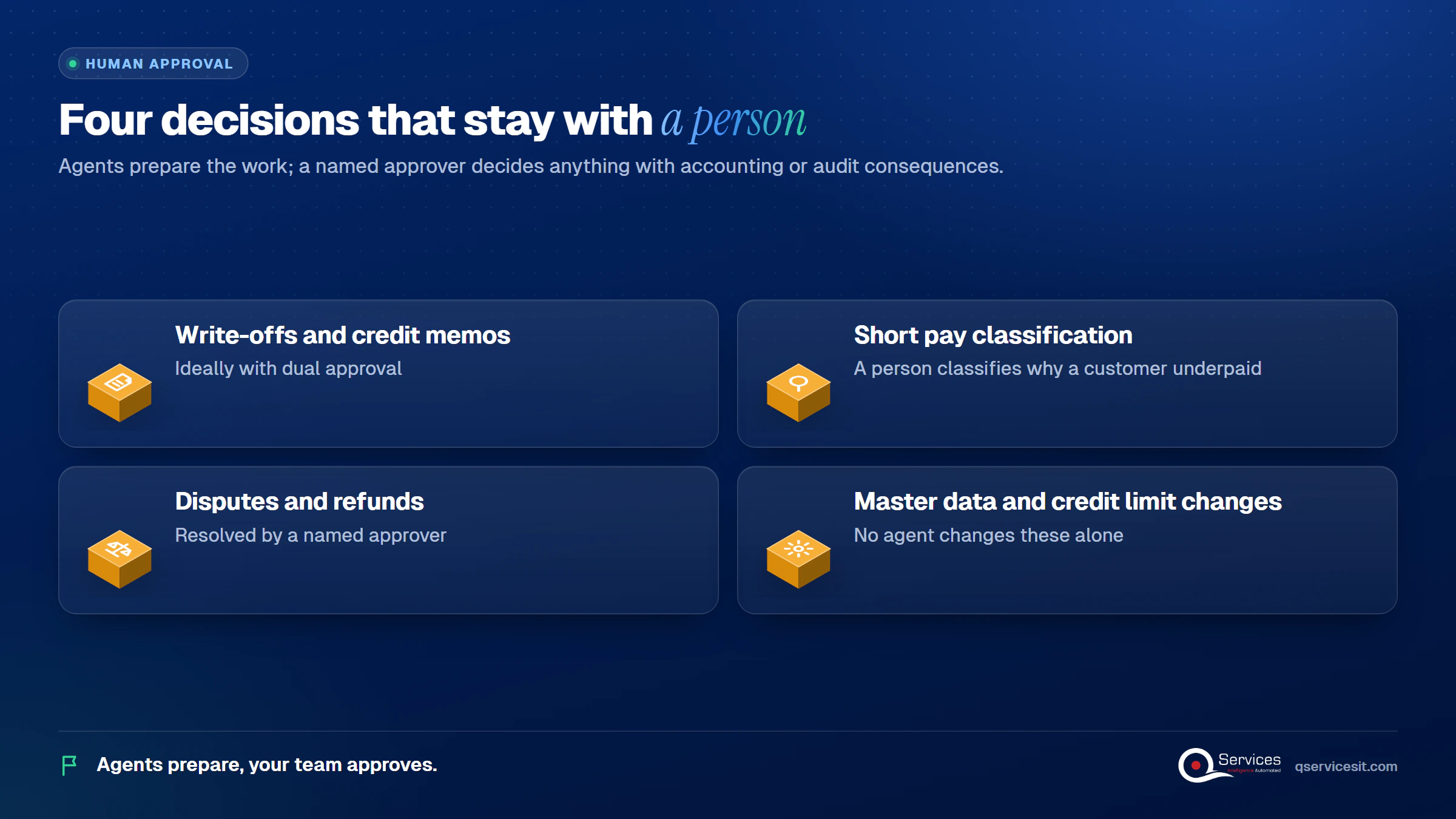
Grid of exactly 4 decisions that stay with a person: Write-offs and credit memos, Short pay classification, Disputes and refunds, Master data and credit limit changes - ai in accounts receivable

Will AI replace accounts receivable staff?

Not in a controlled team. The work shifts from keying and chasing to reviewing and resolving exceptions.

Controls and audit trail

Controllers should ask for the same evidence they’d ask of any control owner. For AI in accounts receivable, that means a record of every proposed and posted action.

Accounts receivable audit trail for AI

Each decision should carry a timestamp, the proposing agent, the approving person, the source document and the model version. Without it, you can’t show an auditor who approved what. This also helps the month end close, because unapplied items are traceable.

AI accounts receivable controls for controllers

  • Approval thresholds by amount and customer
  • Segregation of duties tested across the whole chain, not per system
  • Exception queues reviewed on a schedule
  • Sampling of auto-approved items

AI in AR inside your ERP

Keep the agent inside your ERP and CRM, not in a side spreadsheet. Ours run in the client’s own Azure tenant, and you can read how we secure client data.

Standards & References

How QServices Approaches AI in Accounts Receivable

We start at Read and Match, because those stages are the cheapest to prove and the easiest to audit. The same team builds and runs it, as part of our accounts receivable automation work.
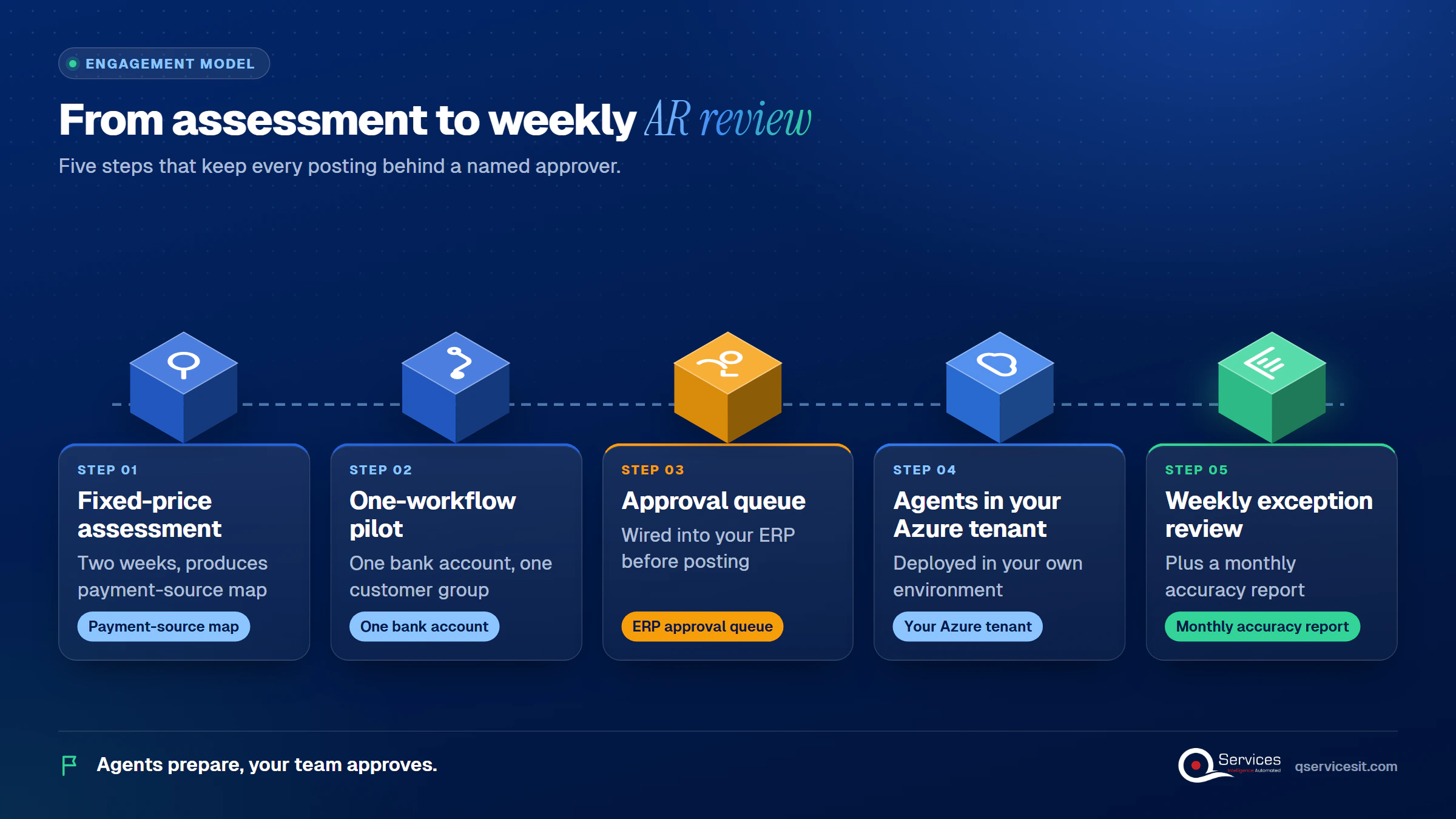
  1. A two-week fixed-price assessment that produces a payment-source map
  2. A pilot on one bank account and one customer group
  3. An approval queue wired into your ERP before anything posts
  4. Agents deployed in your own Azure tenant
  5. A weekly exception review and a monthly accuracy report
How QServices delivers AI in AR: assessment → one-workflow pilot → approval queue → weekly review - ai in accounts receivable

Implementation Checklist

  • Every payment source (email, bank file, portal) is listed
  • Customer payment history includes paid dates and terms
  • Agents are scoped by transaction type
  • No agent can post without a named approver
  • Write-offs require dual approval
  • Each posting logs approver, timestamp and model version
  • Auto-approved items are sampled monthly

Conclusion

AI in accounts receivable pays off when agents prepare the work and your team approves every posting. Pick one bank account, then measure match rate, unapplied cash, review time per item and corrections per week. Book the AR Cash Assessment and we’ll map it against your own remittances.

Rohit Dabra

Written by Rohit Dabra

Co-Founder and CTO, QServices IT Solutions Pvt Ltd

Rohit Dabra is the Co-Founder and Chief Technology Officer at QServices, a software development company focused on building practical digital solutions for businesses. At QServices, Rohit works closely with startups and growing businesses to design and develop web platforms, mobile applications, and scalable cloud systems. He is particularly interested in automation and artificial intelligence, building systems that automate routine tasks for teams and organizations.

Accounts receivableFinance automationERP integrationAI agents
Talk to Our Experts

Frequently Asked Questions

AI in accounts receivable is used to read remittance advice, suggest which invoices a payment clears, predict which invoices will be paid late, rank collections worklists and draft follow-up emails. A person approves anything that posts money or changes a system.

Yes, when payment history is clean and long enough. Published research reached roughly 77% to 80% accuracy against a 59% baseline, which is good for ranking collector work but not for automatic credit decisions.

It is safe when AI suggests matches with approval and a named person signs off before posting. Fully automatic posting without review does not suit a controlled finance team, except for high-confidence, low-value clean matches with sampling.

No. Keying and chasing shrink, while reviewing exceptions, resolving disputes and approving postings stay with your team.

Start with a fixed-price two-week assessment that maps your payment sources, then pilot one bank account with an approval queue before anything posts. You can book the AR Cash Assessment to begin.

Related Topics

Next step

Ready to see AI work inside your AR process?

Talk to our team about the AR Cash Assessment. We’ll map where agents fit in your ERP and where your controllers should keep the final say.

Book a 30-min call →

Recent Articles

Globally Esteemed on Leading Rating Platforms

Earning Global Recognition: A Testament to Quality Work and Client Satisfaction. Our Business Thrives on Customer Partnership

5.0

5.0

5.0

5.0

What clients say

Rated 5.0 by the
people we've built for.

Every quote comes from a published review on GoodFirms, Clutch or our own site. Click a source to read the full review.

★★★★★
“QServices was highly professional, knowledgeable, and approachable. We continue to work with them on other projects.”
NHNicholas HoareCEO, Nextgen ClearingGoodFirms
★★★★★
“Quality assurance is often overlooked, but these guys take that very seriously. … their team of experienced, dedicated developers and highly skilled engineers quickly dissected and decomposed every problem and presented solutions and options that directly met my needs”

Erik BrownBusiness owner and software engineerClient review
★★★★★
“The supplier delivered the application on time and was responsive to our needs. He was also flexible, which allowed us to make changes on the fly.”

Zoltan BodnarCFO, Yusen LogisticsGoodFirms
★★★★★
“Thank you Sahil and team for wonderful collaboration right from day 0. … Highly recommend the developers.”

Ranbeer MakinClientClient review
★★★★★
“They are always looking for new ways to improve their products and services and to deliver value to their customers.”
OFOluwatosin FalolaSenior .NET Developer, POOLCORPClutch
★★★★★
“I have had an excellent experience working with QServices. We have a highly collaborative relationship and I value them not just as contractors but as partners.”

Alex VanderElsClientClient review
★★★★★
“Sahil undertakes every project with a high degree of professionalism. His communication style is unmatched and he is always available to resolve issues or just discuss the project.”

Philmore J.ClientClient review
★★★★★
“Responsive, patient and professional. Consistent weekly attention to our project, and new ideas we hadn't asked for.”

Michael WilliamsonPresident and CEO, United Way of Southeast LouisianaGoodFirms
★★★★★
“I have been working with them on a project for a year now … They have been able to solve problems that come up with bugs or development and able to communicate well with me.”

Steven LewisClientClient review
★★★★★
“We had been working on the app for two years. QServices built it in two months.”

Brian WallerPresident, Technology Association of IowaGoodFirms
★★★★★
“All projects were delivered on time and were fully completed upon delivery.”
RBRaine Marie BuenvendiaSr. Support Specialist, Arc.DevClutch
★★★★★
“They had excellent quality. The hypercare they provided after the project went live is exceptional.”

KKKrish KishorePresident, Zero Hour ConsultantsClutch
Book Appointment
Sahil kataria (1)
Sahil Kataria

Founder and CEO

amit Kumar
Amit Kumar

Chief Sales Officer

Talk To Sales

USA

+1 270-550-1166

flag

+1 270-550-1166

Phil J.
Phil J.Head of Engineering & Technology​
QServices Inc. undertakes every project with a high degree of professionalism. Their communication style is unmatched and they are always available to resolve issues or just discuss the project.​
Assured

Thank You

Thanks, we’ve got your details. A named member of our team will reply within one business day.