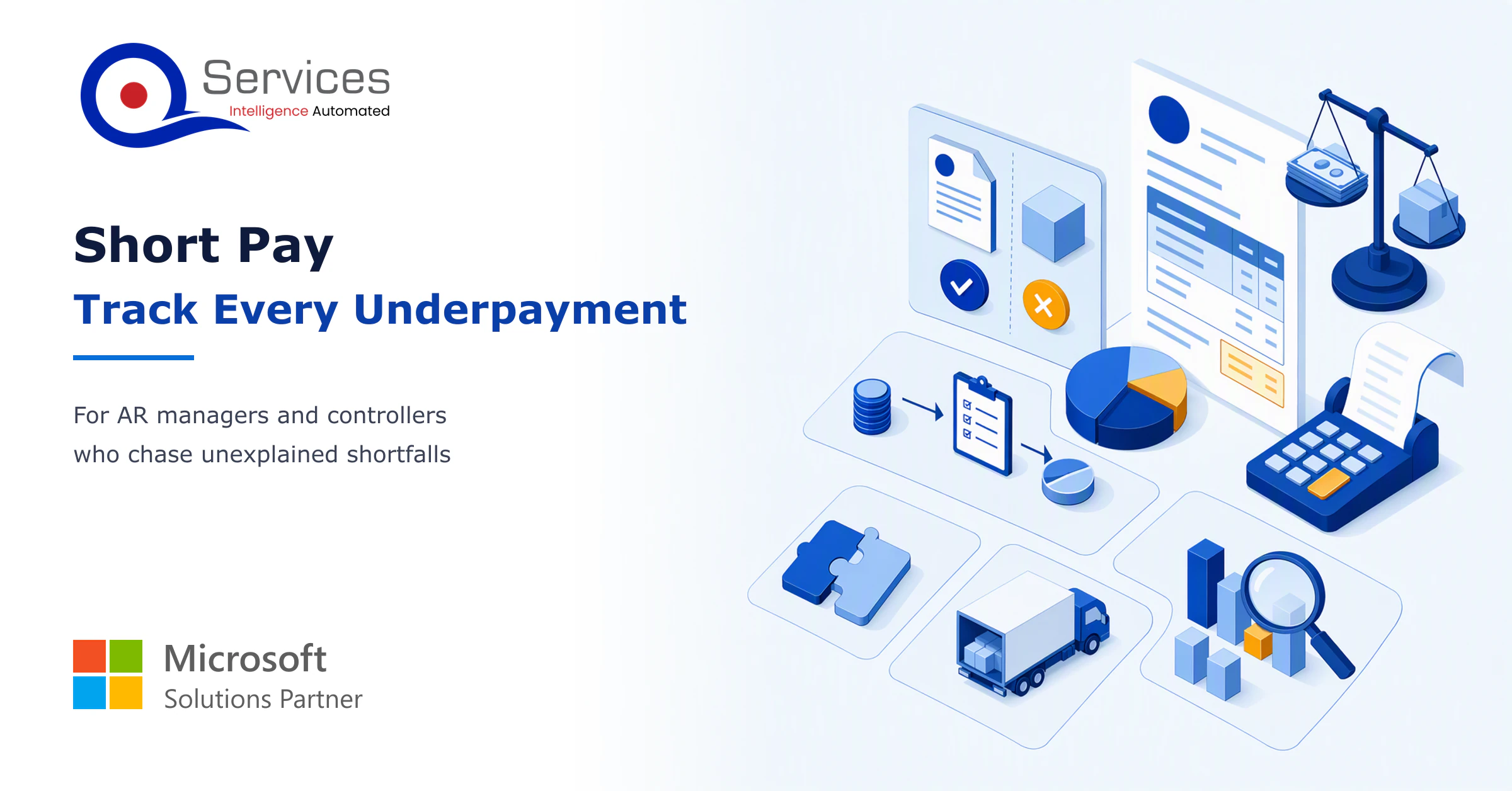
Customers short pay when they dispute a price, freight charge, damage or promotion, and you track each one by logging the amount, a reason code and an owner at cash application. Each short pay then ends as a credit memo, a recovery or a write-off.
Picture a $1,180 short pay that lands on a Tuesday with no note. Nobody on the team can say why the customer paid less, so it sits in the aging report for three months. (This is an illustrative scenario, not a client story.) Good deduction management starts by making sure that never happens.
This guide covers what a short pay is, the usual reasons behind it, and a simple flow for tracking it.
In This Article, You'll Learn
What a short payment is and how it differs from a deduction
The five reason codes that cover most customer short pays
Why a short paid invoice quietly disappears at cash application
A six-step short pay tracking workflow with an owner at every step
When to chase an underpayment and when to write it off
Which short pays are nobody’s job right now?
We walk through your recent underpayments, sort them by reason, and map where each one should end up: credit memo, recovery or write-off.
Quick Answer A short pay is a customer payment below the invoice total that leaves an open balance. Customers short pay because of pricing errors, freight, damage, promotions or their own payment mistakes. Track each one with an amount, a controlled reason code, an owner and a deadline, then close it as a credit memo, a recovery or a write-off.
What Is a Short Pay?
A short pay is a payment smaller than the invoice total. The unpaid remainder stays open in receivables until someone explains it and closes it. NetSuite’s help pages define a short payment the same way: less than the amount due on the invoice.
A short paid invoice needs its own tracking. It is not the same as an invoice with no payment at all, because the customer has already told you something: they disagree with part of the bill.
The QServices FrameworkShort Pay Control = Capture → Classify → Validate → Route → Resolve
Capture first, because a reason you did not record at cash application is the hardest one to find later. Resolve last, because closing a short pay before validating it accepts the customer’s claim by default.
Short pay vs deduction: what is the difference?
In most glossaries, the short pay is the unpaid amount and the deduction is the customer’s stated reason for taking it. In practice teams use the words interchangeably. What matters is that you record both the dollar gap and the reason, every time.
What Are the Usual Short Pay Reasons?
Most underpayment falls into a handful of buckets: pricing, freight, damage, shortage and promotion. Some are your fault and some are the customer’s. You can only tell which after you classify them.
Why do customers short pay invoices?
Customers short pay invoices for a mix of valid and invalid reasons.
Valid: a price that does not match the contract, a duplicate invoice, damaged or partial delivery, a promotion or discount left off the bill, wrong tax, or unclear remittance advice.
Invalid: a discount taken after the window closed, a customer-side payment error, a discount the customer wrongly believes it is owed, or fraud.
The split matters because valid claims usually end in a credit memo and a billing fix. Invalid ones are recoverable cash.
Short pay reason codes worth keeping
Free-text reasons make reporting impossible. Use a controlled list of short pay reason codes instead. Five cover most cases:
Pricing or terms mismatch
Quantity or condition variance (shortage, damage)
Discount outside terms
Contractual allowance (promotion, freight)
Payer data error
Retail suppliers often add compliance codes on top, such as late or mislabeled shipments. Keep the list short enough that a collector can pick one in seconds.
Why Do Short Pays Go Untracked?
They go untracked because nobody owns them and the system hides them. A short payment applied at cash application can leave a small residual item or become a credit memo. In NetSuite, if payment plus deduction equals the amount due, the invoice shows as paid in full. The balance is gone from the aging report, and so is the evidence.
The second cause is time. Some large customers only accept disputes inside a fixed window, so an unreviewed deduction can lapse into a permanent loss. If your cash application process does not capture a reason at the moment of posting, it is already late. Short pays also tend to get mixed up with unapplied cash because both start as a payment that does not match an invoice.
Key Insight A short pay that nobody classifies is a write-off you haven’t booked yet. The loss is real the day the customer pays less, whether or not the ledger shows it.
Real-World Scenario A typical case we see: an AR manager at a distributor receives $12,820 against a $14,000 invoice, with the remittance noting "price." Cash application posts the $1,180 gap as a credit memo to close the invoice fast. At the Validate stage, the price list would have shown the invoice was correct and the customer applied an old price. The $1,180 was recoverable, and the same wrong price would have repeated on the next ten orders.
Seeing short pays pile up with no reason attached?
Our assessment looks at how short pays reach your team today and where the reason gets lost between the remittance and your ledger.
A working short pay tracking workflow is the same sequence every time: record, classify, check, assign, close, review. Each step has one owner.
How to track short payments in accounts receivable
Capture the amount, invoice, payment reference and the customer’s stated reason at cash application.
Classify it with a controlled reason code.
Validate against the PO, contract or price list, proof of delivery, and promotion terms.
Route it by cause: billing errors to billing, damage to operations, pricing to sales.
Resolve it as accepted (credit memo), disputed (rebill with documents), or settled for a partial amount.
Review reason-code trends monthly and fix the root cause.
Track one metric across all of it. Days deduction outstanding is open deductions divided by average daily deduction receipts. With $1.5M open and $50K received a day, that is 30 days.
How to handle a short paid invoice
To handle a short paid invoice, validate before you do anything else. If the claim is valid, post the adjustment and fix the source of the error. If it is not, send the evidence and request the balance. Never close it just to clean up the aging report.
Short pay credit memo process
The short pay credit memo process should run only after validation. A credit memo is right for a valid claim, such as a real price error or damaged goods. Posted blindly, it accepts every claim, valid or not. Pull the reason code, the evidence and an approver onto the memo so the audit trail explains it.
When Should You Chase a Short Pay and When Should You Write It Off?
Chase when the claim is invalid or the amount is worth the effort. Write off when the balance is small, the claim is settled, or collection costs more than the balance. Your days sales outstanding will tell you whether the habit is hurting cash. For disputes that need real follow-up, collections and dispute management should own the case.
When to write off a short pay
Know when to write off a short pay: the amount sits under a threshold your policy sets, and no one expects to collect it. Do not write off a valid claim as bad debt. That hides the root cause and books the loss to the wrong account. Dollar thresholds vary by company, so set yours with your controller.
Short pay recovery versus write-off
Option
Best when
Downside
Credit memo
The claim is valid (price error, damage)
Accepts the claim, so skipping validation is costly
Chase and rebill
The claim is invalid or the amount is large
Takes staff time and can strain the customer
Payment tolerance
The gap is tiny and costs more to fix
Hides patterns if not reviewed monthly
Write-off
Collection is not expected
Books a loss, and tax treatment needs proof
One legal note: under UCC 3-311, a check marked as full satisfaction of a bona fide dispute can settle the claim once cashed. State rules vary, so check with counsel.
UCC 3-311 accord and satisfaction: when a full-satisfaction check discharges a disputed claim
How QServices Approaches Short Pay Tracking
We start at Capture, because everything downstream depends on a reason being recorded. Our AI agents work inside your ERP, and a person approves every action before anything posts or a record changes. This is part of our wider accounts receivable automation work, built and run by the same team.
A review of your last quarter of short pays, with a reason-code list.
A mapping of each code to an owner and a deadline.
A pilot on one customer group, with agents suggesting codes and evidence.
An approval queue where your team confirms each credit memo or dispute.
A monthly report of reason-code trends and recovered cash.
Implementation Checklist
Every short payment is captured with amount, invoice and payment reference
A controlled reason-code list is in use, with no free text
Each code has a named owner and an escalation date
Credit memos require validation evidence and an approver
Residual items cannot close without a reason code
Short pays older than 90 days with no owner are escalated
Reason-code trends are reviewed monthly
Conclusion
Short pay tracking comes down to one habit: record the reason when the cash lands, then validate before you close. Start with one customer group for a month and measure days deduction outstanding, recovered dollars and credit memos issued without evidence. When you want a second pair of eyes on it, Book the AR Cash Assessment.
Co-Founder and CTO, QServices IT Solutions Pvt Ltd
Rohit Dabra is the Co-Founder and Chief Technology Officer at QServices, a software development company focused on building practical digital solutions for businesses. At QServices, Rohit works closely with startups and growing businesses to design and develop web platforms, mobile applications, and scalable cloud systems. He is particularly interested in automation and artificial intelligence, building systems that automate routine tasks for teams and organizations.
Short pay meaning: the customer paid less than the invoice total, leaving an open balance. The short payment definition also covers the reason the customer gives, which is often called the deduction. Record both the amount and the reason.
To record a short payment, apply the cash received, then log the remaining balance with the invoice, payment reference, amount and a reason code. Do not close it to a credit memo until it is validated against the PO, contract or delivery proof.
Only when the claim is valid, such as a real pricing error or damaged goods. A credit memo accepts the short pay, so validate first. If the claim is invalid, send the evidence and request the balance instead.
Write off a short pay when the balance is small, collection costs more than the amount, or the case is settled. Never write off a valid claim as bad debt, because that hides the root cause. Set the dollar threshold with your controller.
Pull the last quarter of underpayments, group them under five to seven reason codes, and name an owner for each code. Then pilot the flow on one customer group. The AR Cash Assessment from QServices maps this to your ERP.
QServices Inc. undertakes every project with a high degree of professionalism. Their communication style is unmatched and they are always available to resolve issues or just discuss the project.
Turn the Microsoft Licenses
You Already Own Into an AI Workplace
Join our live webinar on Sept 24 and see five ways to automate meetings, approvals, and