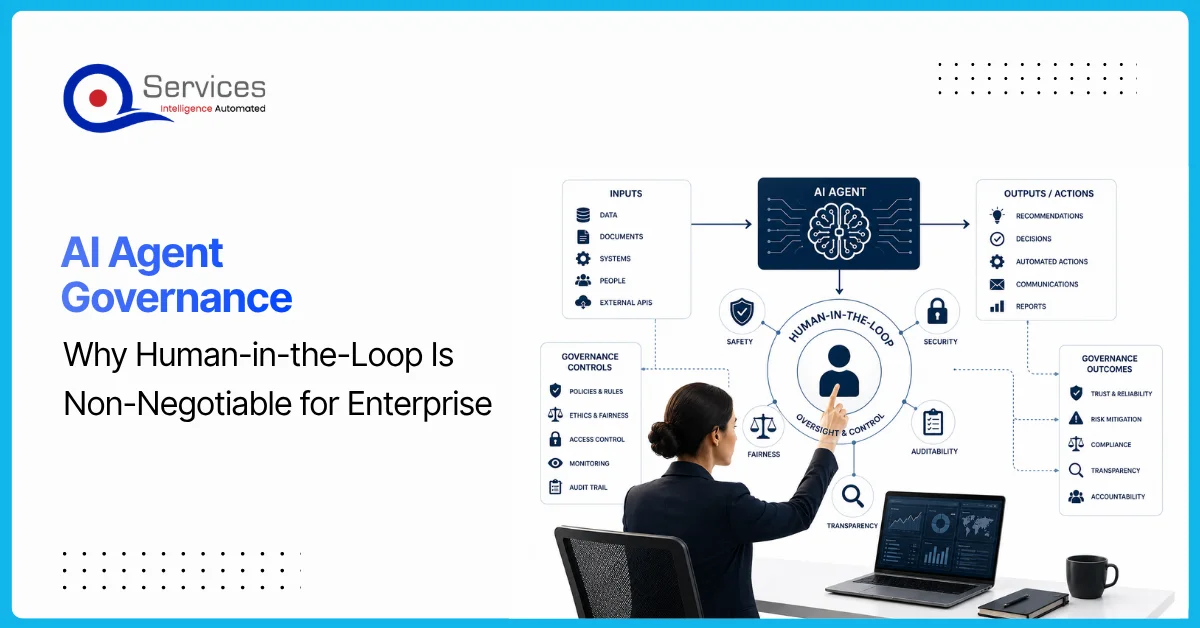
AI agent governance is the practice of establishing policies, controls, and human oversight mechanisms that determine how AI agents operate, make decisions, and interact with business systems. For enterprises deploying AI today, this isn't optional paperwork. It's the difference between AI that delivers measurable value and AI that creates liability.
The pressure to ship AI quickly is real. Microsoft Copilot, Azure OpenAI, and Power Platform's AI Builder have made it easier than ever to wire autonomous agents into workflows. But "easy to deploy" doesn't mean "safe to leave unsupervised." Every enterprise that skipped governance in the rush to launch has eventually paid for it, whether through data leaks, compliance failures, or decisions no one can explain to an auditor.
This post covers why human-in-the-loop (HITL) oversight is non-negotiable for enterprise AI, what a real governance framework looks like, and how QServices approaches this with clients across healthcare, banking, and logistics.
In This Article, You'll Learn
What Is AI Agent Governance and Why Does It Matter Now?
Human-in-the-Loop: The Core of Responsible AI Agent Governance
Azure AI and Copilot Deployments Need a Governance Layer
How an Azure Architecture Review Prevents Governance Blind Spots
The 5 Phases of AI Agent Governance QServices Implements
Eager to discuss about your project?
Share your project idea with us. Together, we’ll transform your vision into an exceptional digital product!
What Is AI Agent Governance and Why Does It Matter Now?
AI agent governance is the set of rules, controls, audit mechanisms, and human approval checkpoints that govern what AI agents can do, when they can act autonomously, and who reviews their outputs before they affect real systems. It sits at the intersection of IT policy, compliance, and AI architecture.
The urgency is scale. A single AI agent connected to your ERP system, customer data, or Azure infrastructure can touch thousands of records in minutes. Without governance, an agent misconfiguration doesn't produce one bad output. It produces thousands.
The Governance Gap in Enterprise AI Deployments
Most enterprise AI projects launch with strong technical execution but weak governance. Teams focus on model selection, API integration, and performance benchmarks. They skip the harder questions: Who approves what this agent outputs? What happens when it acts on bad data? Who audits it next quarter?
The NIST AI Risk Management Framework identifies this as one of the highest-risk patterns in enterprise AI adoption: capability deployment without corresponding accountability structures. Organizations that treat governance as a post-launch concern consistently face higher remediation costs than those that build it in from day one.
Why Autonomous Agents Create New Compliance Risks
Traditional software follows deterministic paths. An autonomous AI agent doesn't. It infers context, fills in gaps, and takes actions based on probabilistic reasoning. That's precisely what makes it useful, and precisely what makes it dangerous without oversight.
In regulated industries, this matters immediately. A healthcare AI agent that auto-populates clinical notes, a banking agent that flags transactions for approval, or a logistics agent that reroutes shipments based on predictive models: all of these create compliance exposure if no human reviews the outputs before they become decisions of record.
Human-in-the-Loop: The Core of Responsible AI Agent Governance
Human-in-the-loop governance ensures human approval at every deployment stage where an AI agent's output could affect systems, data, or stakeholders. This doesn't mean a person reviews every single AI output. It means the right outputs, at the right risk level, get human eyes before they become actions.
What Human-in-the-Loop Actually Means in Practice
HITL is not a binary toggle. In practice, it's a tiered approval architecture:
Tier 1 (Low risk): AI acts autonomously. A human receives a notification log for review within 24 hours.
Tier 2 (Medium risk): AI proposes an action, a human approves or rejects before execution. This is where Power Automate multi-stage approval workflows become critical infrastructure.
Tier 3 (High risk): AI provides analysis only. The human makes the final decision. AI outputs are advisory, not executable.
Most enterprise deployments need all three tiers operating in parallel, mapped to specific workflows. The mistake is applying Tier 1 logic uniformly when some workflows clearly require Tier 3.
Where HITL Checkpoints Belong in an AI Workflow
The practical answer depends on two variables: the reversibility of the action and the quality of the training data. Irreversible actions (sending communications, modifying financial records, executing infrastructure changes) always need human checkpoints. Actions based on narrow, high-quality datasets can tolerate more autonomy than those relying on broad, general-purpose models.
A mature Power Platform governance framework defines these thresholds in writing, assigns ownership to specific roles, and audits them quarterly. Without that structure, individual teams make inconsistent risk decisions, and the organization's overall AI posture becomes impossible to assess from a compliance standpoint.
Azure AI and Copilot Deployments Need a Governance Layer
Microsoft's Azure AI tooling is genuinely powerful. Azure AI Foundry, Copilot Studio, and Power Platform's AI Builder can be wired into business processes in days. But the speed of deployment creates a governance lag. Teams ship AI features faster than policy teams can evaluate them.
This is where azure consulting services that specialize in governance architecture, not just deployment, earn their value. Connecting an AI agent to Azure resources without first completing an azure architecture review is the equivalent of installing electrical wiring without an inspection. It might work. Or it might cause a fire.
Azure AI Foundry and Governance Controls
Azure AI Foundry offers content filtering, model evaluation, and responsible AI dashboards, but these are controls you have to configure. Out of the box, they're not fully active. An azure security assessment before any AI agent deployment should confirm that content safety filters match your risk profile, that logging is enabled for all agent interactions, and that access controls restrict which users and services can trigger agent actions.
The audit trail question deserves specific attention. If an AI agent takes an action that produces a compliance finding, you need logs showing exactly what input triggered the action, what the agent's reasoning chain was, and who had authority to override it. Azure Monitor and Microsoft Purview together provide this, but only if configured during initial deployment, not six months later.
Power Platform Governance for AI-Augmented Workflows
Power Platform's low-code tools are where most enterprise AI agents live initially. Power Automate flows trigger AI actions. Power Apps surfaces AI outputs to end users. Power apps development services focused on AI governance often include building custom approval interfaces that give business users clear visibility into what an agent is proposing before they confirm the action. Power bi consulting services add another layer: governance metric dashboards across all active AI workflows, tracking approval rates, override frequencies, and audit exceptions.
This combination scales quickly and breaks quietly if power platform governance isn't in place. The core risk is connector sprawl. Teams spin up Power Automate flows using premium connectors, AI Builder credits, and external services without central visibility. A Power Platform Center of Excellence setup, combined with Power Platform security controls, gives IT the visibility to see what's running, who owns it, and what data it touches.
Power automate consulting engagements focused on AI governance should address DLP (data loss prevention) policy configuration, AI Builder model access controls, and approval workflow architecture for any flow that connects AI outputs to business-critical systems.
How an Azure Architecture Review Prevents Governance Blind Spots
A complete azure architecture review for AI deployments looks different from a standard infrastructure review. It has to cover identity and access for AI service principals, network isolation for AI workloads, data residency and compliance for training and inference data, and the human approval paths that should exist before agents can modify resources.
An azure infrastructure assessment focused on AI readiness should answer: which of our current Azure resources are accessible to AI agents? Which should be? What's the blast radius if an agent acts on incorrect instructions?
What a Proper Azure Infrastructure Assessment Covers
The scope includes Azure RBAC configurations for AI service identities, private endpoint and network security group settings for AI APIs, Key Vault access policies for secrets that AI agents consume, and log analytics workspace configuration to capture agent activity. An azure managed services provider relationship should include ongoing monitoring for configuration drift, not just point-in-time assessments.
When you migrate on premise to azure or set up a hybrid cloud azure setup, these configuration decisions get made during initial deployment. Coming back to retrofit AI governance six months later means undoing decisions embedded in production workflows. The azure landing zone implementation phase is when governance architecture is cheapest to build. Azure cloud migration services engagements that include governance design upfront consistently show lower total cost of ownership than those that treat governance as a follow-on project.
Azure Security Assessment as a Governance Foundation
Azure security assessment findings frequently surface issues that directly affect AI agent risk. Over-permissioned service principals (a common finding) mean an AI agent inherits excessive access. Disabled diagnostic logging means no audit trail exists. Misconfigured Conditional Access means the humans who should be in the approval loop can be bypassed entirely.
QServices has completed 500+ Azure and Microsoft platform projects since 2014, and azure security assessment work consistently reveals that AI deployment plans were built on infrastructure assumptions that don't match the actual security posture. The gap is almost always larger than the client expected.
The 5 Phases of AI Agent Governance QServices Implements
The five phases of AI agent governance are: discovery, risk classification, control design, implementation, and continuous audit. This framework is what QServices delivers as part of every AI project, designed so that human oversight is built into each phase rather than added afterward.
Phase 1: Discovery and Risk Classification
Every AI agent project starts with a complete inventory of the systems the agent will touch, the data it will access, and the decisions it will influence. Each workflow is classified by risk tier using the Tier 1/2/3 model described above. This step takes one to two weeks and produces the governance blueprint for all subsequent work.
Azure devops consulting services are often involved here because CI/CD pipelines for AI agents need governance gates just like application deployments. An AI model update pushed to production without review is the same problem as a code push without a pull request. That's a pattern we see regularly when teams treat AI deployment as a configuration change rather than a release event.
Phases 2 Through 5: Control Design to Continuous Audit
Phase 2 designs the specific HITL checkpoints, approval routing rules, and escalation paths for each risk-classified workflow. Phase 3 implements those controls in the actual platform, whether Power Automate approval flows, Azure Policy rules, or custom orchestration logic. Phase 4 tests the controls under realistic conditions, including failure scenarios where an agent receives bad input or attempts an out-of-scope action. Phase 5 establishes the ongoing audit cadence: monthly for high-risk workflows, quarterly for medium-risk, annually for low-risk.
What Happens When AI Agent Governance Fails
The honest answer: usually nothing dramatic at first. Governance failures tend to accumulate quietly. An agent takes a small incorrect action. No one notices because there's no audit log. The incorrect action gets repeated because there's no review mechanism. By the time the pattern is visible, remediation is expensive.
The regulatory exposure is increasingly concrete. The EU AI Act classifies certain AI applications as high-risk and requires documented human oversight for those use cases. Organizations operating in EU markets face compliance obligations under this framework that most enterprises haven't fully mapped to their AI deployments yet. Similar requirements are emerging from US financial regulators for AI used in credit decisions and customer communications.
The Audit Trail Problem
Regulators and auditors don't just want to know that a human was in the loop. They want proof. That means timestamped logs showing who approved what, when, with what information available at the time. Building this retroactively is painful. Building it upfront as part of azure infrastructure assessment and governance design adds roughly 15-20% to initial project scope and saves months of remediation effort later.
Key Insight Building it upfront as part of azure infrastructure assessment and governance design adds roughly 15-20% to initial project scope and saves months of remediation effort later.
Compliance Costs of Ungoverned Agents
For companies in healthcare (HIPAA), finance (SOC 2, PCI DSS), or any EU-market business, the cost of a governance failure isn't just the direct fine. It's the audit effort, the remediation project, the reputational exposure, and the potential need to roll back AI deployments entirely. Azure cost optimization consulting often gets called in to reduce cloud spend, but the more expensive bill usually comes from the legal and compliance side when governance wasn't prioritized from the start.
How to Choose an Azure Consulting Partner for AI Governance
Not every azure migration partner has AI governance capability. Many firms that specialize in azure cloud migration services are excellent at lift and shift to azure, azure landing zone implementation, or hybrid cloud azure setup, but lack the policy and compliance depth to design HITL frameworks for regulated industries.
When evaluating a microsoft azure consulting company for AI projects, ask specifically about governance methodology. Can they show you a previous client's governance architecture? Do they have experience with azure devops consulting services that include CI/CD controls for AI model updates? Have they done power platform development company work that includes DLP policy design and AI Builder governance?
QServices delivers HITL governance on every AI project, integrated with azure consulting services across the full deployment lifecycle. Governance isn't a separate workstream. It's the structure every other workstream operates within. Talk to QServices about AI governance before your next AI agent project kicks off, and we'll show you what that looks like in practice.
Key Takeaways
AI agent governance is the set of rules, controls, audit mechanisms, and human approval checkpoints that govern what AI agents can do, when they can act autonomously, and who reviews their outputs before they affect real systems.
Human-in-the-loop governance ensures human approval at every deployment stage where an AI agent's output could affect systems, data, or stakeholders.
Microsoft's Azure AI tooling is genuinely powerful.
A complete azure architecture review for AI deployments looks different from a standard infrastructure review.
The five phases of AI agent governance are: discovery, risk classification, control design, implementation, and continuous audit.
Conclusion
AI agent governance is the infrastructure that makes enterprise AI trustworthy. Without it, even well-intentioned deployments create risk that compounds quietly over time. Human-in-the-loop oversight, combined with a proper azure architecture review, azure security assessment, and power platform governance framework, gives organizations the control layer they need to deploy AI confidently and defensibly.
The organizations that benefit most from AI aren't the ones that deployed fastest. They're the ones that deployed with the right structures in place from the start.
If you're planning an AI agent deployment, or already running agents without a formal governance framework, now is the right time to close that gap. Talk to QServices about AI governance and we'll help you build a HITL framework that fits your risk profile, your regulatory environment, and your existing Azure infrastructure.
Co-Founder and CTO, QServices IT Solutions Pvt Ltd
Rohit Dabra is the Co-Founder and Chief Technology Officer at QServices, a software development company focused on building practical digital solutions for businesses. At QServices, Rohit works closely with startups and growing businesses to design and develop web platforms, mobile applications, and scalable cloud systems. He is particularly interested in automation and artificial intelligence, building systems that automate routine tasks for teams and organizations.
AI agent governance is the practice of establishing policies, controls, and human oversight mechanisms that determine how AI agents operate, make decisions, and interact with business systems. Enterprises need it because a single AI agent connected to ERP systems, customer data, or cloud infrastructure can touch thousands of records in minutes. Without governance, one misconfiguration produces thousands of errors rather than one. Regulated industries in healthcare, finance, and logistics face additional compliance mandates, including the EU AI Act and US financial regulator guidance, that require documented human oversight for high-risk AI applications.
Human-in-the-loop (HITL) means humans are positioned at specific approval checkpoints in an AI workflow to review, approve, or reject agent outputs before they become actions. In enterprise deployments, HITL operates as a tiered system: Tier 1 (low risk) allows autonomous action with after-the-fact log review; Tier 2 (medium risk) requires human approval before the AI action executes; Tier 3 (high risk) makes AI outputs advisory only, with humans making the final decision. The key is mapping each business workflow to the correct tier based on action reversibility and data quality.
An Azure architecture review for AI deployments examines identity and access configurations for AI service principals, network isolation for AI workloads, data residency compliance, Key Vault access policies, and diagnostic logging setup. It identifies over-permissioned service accounts, gaps in audit trails, and misconfigured Conditional Access policies that could allow AI agents to bypass human oversight. This review is most valuable before initial deployment, as retrofitting governance controls into a production Azure environment after launch is significantly more costly and disruptive.
Without formal AI agent governance, organizations face regulatory fines under frameworks like the EU AI Act (which mandates documented human oversight for high-risk AI), audit failures when they cannot produce timestamped approval logs, and expensive remediation projects that may require rolling back AI deployments entirely. In healthcare, HIPAA compliance is at risk. In finance, SOC 2 and PCI DSS auditors expect evidence of human review for AI-influenced decisions. Beyond direct fines, the audit effort and reputational exposure from governance failures typically exceed the cost of building governance into the initial deployment.
QServices delivers HITL governance on every AI project through a five-phase framework: discovery and risk classification, control design, implementation, testing, and continuous audit. The discovery phase produces a risk-tiered inventory of every system, data source, and decision the AI agent will influence. Control design maps specific HITL checkpoints to each workflow based on action reversibility and data quality. Implementation uses Power Automate approval flows, Azure Policy rules, and CI/CD pipeline governance for model updates. Continuous audit schedules monthly reviews for high-risk workflows and quarterly for medium-risk, with audit trail logging configured from day one.
Azure migration cost breaks down by workload strategy, not a single number. See real per-workload ranges, what FastTrack and Azure Migrate and Modernize actually cover, and how a fixed-price Blueprint Sprint replaces a vague estimate with a firm quote.
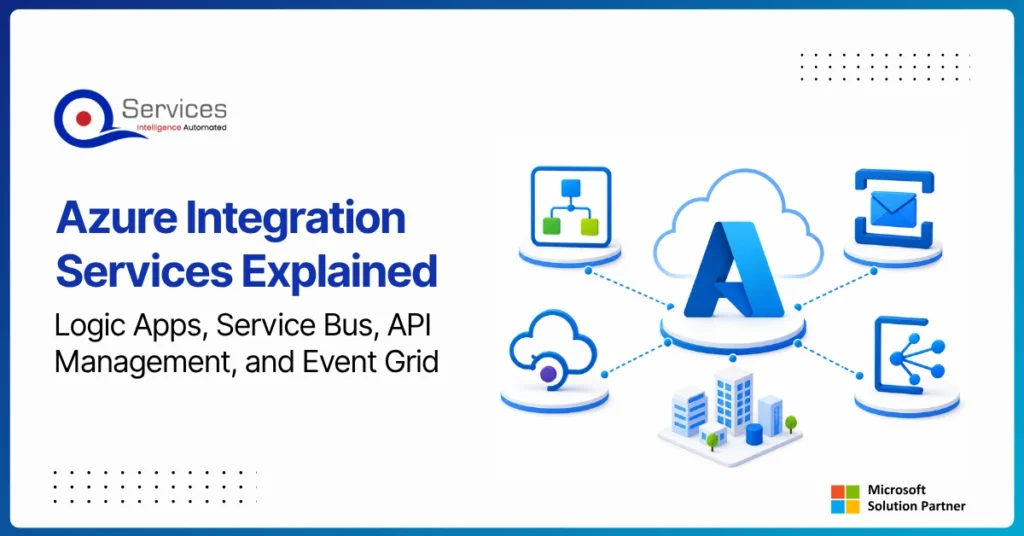
Azure Integration Services is Microsoft’s suite of cloud-native tools for connecting applications, data, and processes across your enterprise. When your organization runs a mix of on-premise systems, SaaS platforms, and custom APIs, getting them to communicate reliably is one of the hardest operational problems you will face. Azure integration services address that directly with four purpose-built components: Logic Apps for workflow automation, Service Bus for reliable messaging, API Management for governing APIs at scale, and Event Grid for event-driven architecture.
Key Insight Azure Integration Services is Microsoft’s suite of cloud-native tools for connecting applications, data, and processes across your enterprise.
This guide breaks down each component, explains how they work together, and covers when azure cloud migration services can bring your entire integration layer into the cloud. Teams evaluating azure consulting services for the first time will find the service breakdowns most useful. Teams already planning a lift and shift to azure should jump straight to the migration section.
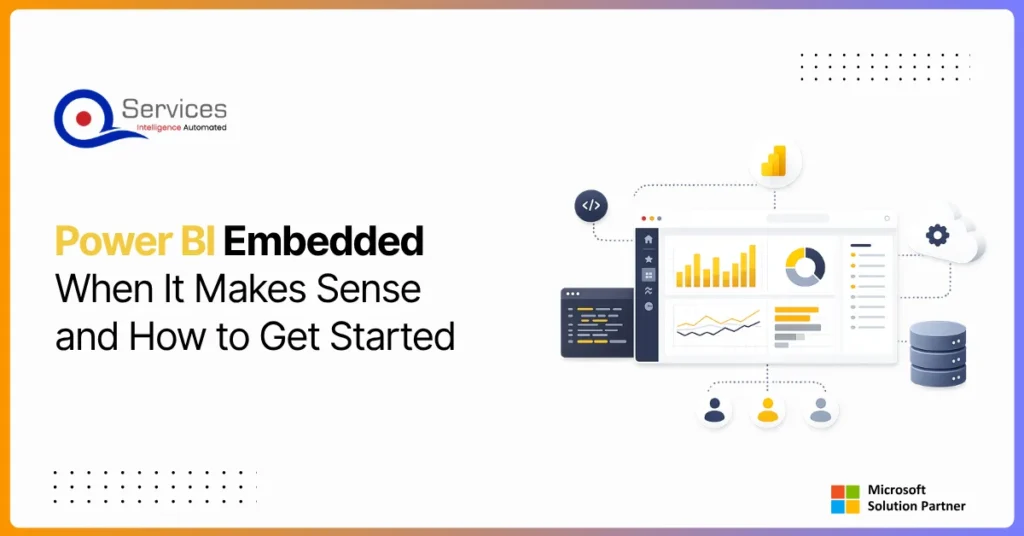
Power BI Embedded is Microsoft’s developer-focused API for embedding interactive analytics directly inside third-party apps, customer portals, and SaaS products. If you are building software and want customers to see live dashboards without logging into the Power BI service, this is where that journey starts. The question is not whether you can embed Power BI reports, you almost certainly can. The real question is whether it makes financial and architectural sense for your specific situation. This guide covers the when, the how, and the cost math that most tutorials skip.
Eager to discuss about your project?
Share your project idea with us. Together, we’ll transform your vision into an exceptional digital product!
Azure migration cost breaks down by workload strategy, not a single number. See real per-workload ranges, what FastTrack and Azure Migrate and Modernize actually cover, and how a fixed-price Blueprint Sprint replaces a vague estimate with a firm quote.
Azure Integration Services is Microsoft’s suite of cloud-native tools for connecting applications, data, and processes across your enterprise. When your organization runs a mix of on-premise systems, SaaS platforms, and custom APIs, getting them to communicate reliably is one of the hardest operational problems you will face. Azure integration services address that directly with four purpose-built components: Logic Apps for workflow automation, Service Bus for reliable messaging, API Management for governing APIs at scale, and Event Grid for event-driven architecture.
Key Insight Azure Integration Services is Microsoft’s suite of cloud-native tools for connecting applications, data, and processes across your enterprise.
This guide breaks down each component, explains how they work together, and covers when azure cloud migration services can bring your entire integration layer into the cloud. Teams evaluating azure consulting services for the first time will find the service breakdowns most useful. Teams already planning a lift and shift to azure should jump straight to the migration section.
Power BI Embedded is Microsoft’s developer-focused API for embedding interactive analytics directly inside third-party apps, customer portals, and SaaS products. If you are building software and want customers to see live dashboards without logging into the Power BI service, this is where that journey starts. The question is not whether you can embed Power BI reports, you almost certainly can. The real question is whether it makes financial and architectural sense for your specific situation. This guide covers the when, the how, and the cost math that most tutorials skip.
Power apps portals sit at an interesting crossroads for IT leaders: they’re fast, deeply integrated with the Microsoft stack, and manageable without a dedicated development team. But they’re also constrained in ways that matter when your business needs a portal that handles complex UI logic, third-party integrations outside the Microsoft ecosystem, or pixel-perfect UX design.
This guide gives you a straight comparison so you can make the right call without spending three months in discovery. We’ll cover what each option actually delivers, where each breaks down, and the governance questions that need answers before you commit either way.
If you’re evaluating your Microsoft stack more broadly, our breakdown of Power Platform vs Custom .NET Development provides useful parallel context.
Globally Esteemed on Leading Rating Platforms
Earning Global Recognition: A Testament to Quality Work and Client Satisfaction. Our Business Thrives on Customer Partnership
5.0
5.0
5.0
5.0
Turn the Microsoft Licenses
You Already Own Into an AI Workplace
Join our live webinar on Sept 24 and see five ways to automate meetings, approvals, and