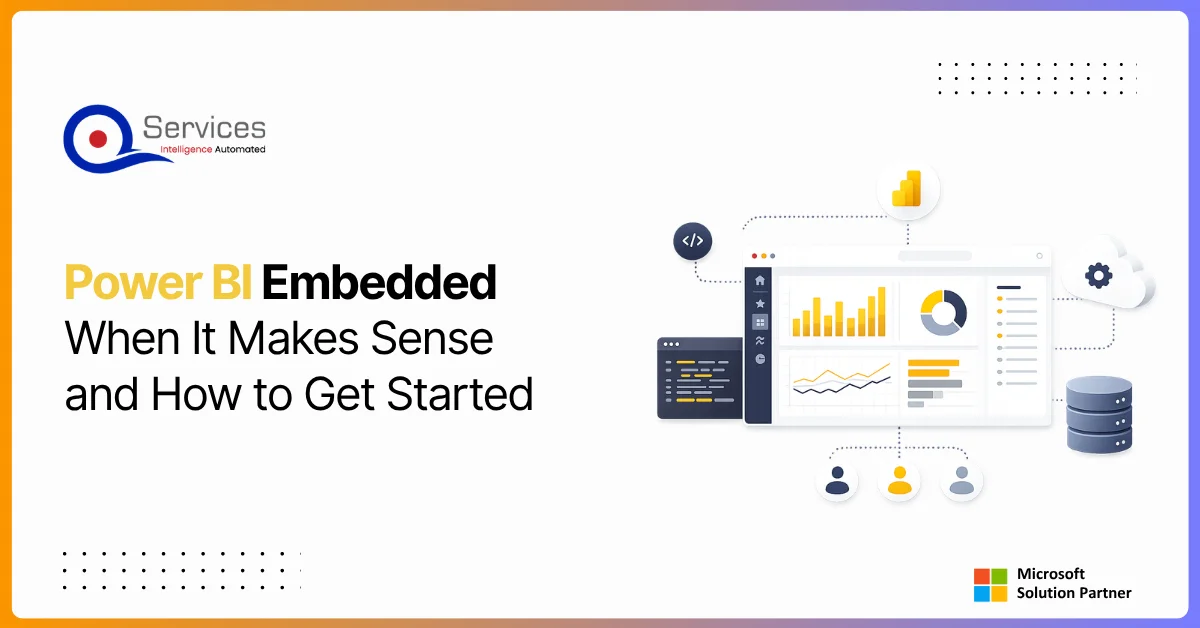
Power BI Embedded is Microsoft's developer-focused API for embedding interactive analytics directly inside third-party apps, customer portals, and SaaS products. If you are building software and want customers to see live dashboards without logging into the Power BI service, this is where that journey starts. The question is not whether you can embed Power BI reports, you almost certainly can. The real question is whether it makes financial and architectural sense for your specific situation. This guide covers the when, the how, and the cost math that most tutorials skip.
In This Article, You'll Learn
What Is Power BI Embedded and When Should You Use It?
Power BI Embedded Licensing and Pricing Explained
How to Get Started with Power BI Embedded in Azure
What Actually Gets Complicated in a Power BI Embedded Project
Power Platform Governance and Embedded Analytics
Eager to discuss about your project?
Share your project idea with us. Together, we’ll transform your vision into an exceptional digital product!
What Is Power BI Embedded and When Should You Use It?
Power BI Embedded is a capacity-based Azure service that lets developers render Power BI reports, dashboards, and Q&A experiences inside any web application without requiring end users to hold a Power BI license. That single detail is what separates it from every other Power BI deployment model.
You publish reports to a workspace in the Power BI service. Your application backend generates a short-lived embed token. The frontend loads the Power BI JavaScript SDK and renders the report inside a container element on your page. From the user's perspective, they are looking at your application, not Microsoft's.
When Power BI Embedded Is the Right Choice
Three scenarios make power bi embedded clearly the right call:
You are an ISV building analytics into a product you sell to customers. Requiring each customer to buy a Power BI Pro license would break your pricing model. Microsoft documents that over 10,000 ISVs embed Power BI reports into their commercial applications, a figure that reflects how standard this pattern has become. See Microsoft's Power BI Embedded documentation for the full ISV guidance and power bi embedded example configurations.
You have a large external user base. If 5,000 customers need to view a report, per-user licensing becomes prohibitively expensive. Capacity-based billing flattens that cost curve significantly.
You need custom UI integration. Power BI Embedded lets you hide the Power BI chrome entirely, apply custom themes, and control which visualizations are visible. For branded portals, that level of control matters.
When It Does Not Make Sense
If your entire user base already has Microsoft 365 E3 or higher licenses, and all report consumers are internal employees, standard Power BI Pro or per-user Premium is often cheaper. Run the numbers before committing to capacity-based billing. The break-even point is typically around 300 to 500 concurrent internal users.
Power BI Embedded Licensing and Pricing Explained
This is where most power bi embedded documentation goes thin, so let's be specific. Power BI Embedded pricing uses Azure A-SKUs (the power bi embedded license you provision), sold on an hourly basis through the Azure portal. No annual commitment is required, which makes it practical for variable or seasonal workloads.
The critical nuance on power bi embedded pricing: A-SKUs can be paused when not in use. If your application serves reports only during business hours, pausing the capacity at night and on weekends cuts monthly costs by 60% or more. That makes A1 viable for many mid-market deployments that look expensive at first glance.
Key Insight If your application serves reports only during business hours, pausing the capacity at night and on weekends cuts monthly costs by 60% or more.
Power BI Embedded in Microsoft Fabric
Microsoft is consolidating its data platform under Fabric, and power bi embedded now integrates with Fabric F-SKU capacities. If your team already uses Fabric for data engineering or lakehouses, you may be able to run Power BI Embedded workloads on existing Fabric capacity rather than provisioning a separate A-SKU. That is a meaningful cost consolidation if you are already invested in the platform.
For teams weighing power bi consulting services options, understanding Fabric's role in the licensing picture is increasingly important. Our post on Power BI vs Tableau vs Looker covers why organizations in the Microsoft ecosystem tend to consolidate on Power BI rather than introducing a second BI tool.
How to Get Started with Power BI Embedded in Azure
Getting power bi embedded running in a development environment takes two to three hours if you follow the steps in order. Here is the practical sequence for using power bi embedded in Azure.
Step 1: Register an Azure AD Application
Your backend service needs an identity to call the Power BI REST API. Register an application in Azure Active Directory, grant it Dataset.ReadWrite.All and Report.ReadWrite.All permissions, and create a client secret. This service principal is what generates embed tokens. A "master user" approach also works, but service principal is recommended for production because it avoids tying the integration to a specific person's account.
Step 2: Provision Capacity in the Azure Portal
Search for "Power BI Embedded" in the Azure portal and create an A1 capacity for development. Assign your Power BI workspace to this capacity from inside the Power BI admin portal. This is the foundational power bi embedded in Azure resource that everything else depends on.
Step 3: Use the Power BI Embedded Playground
Microsoft provides a Power BI Embedded Playground, a browser-based environment where you can experiment with the JavaScript SDK without writing any backend code. Start here before building the full integration. It exposes every configuration option and shows exactly what the embedded experience will look and behave like.
Step 4: Generate an Embed Token Server-Side
Your backend calls the Power BI REST API (/reports/{reportId}/GenerateToken) using service principal credentials. Never generate embed tokens client-side or expose the service principal secret in browser JavaScript. This is the most common power bi embedded security mistake teams make. Tokens have a default lifetime of one hour; longer sessions require token refresh logic in your application.
Step 5: Render the Report with the JavaScript SDK
Load the Power BI JavaScript SDK, configure the embed configuration object with the token and report URL, and call powerbi.embed(container, config). The report renders inside your specified container element. The power bi embedded documentation on Microsoft Learn has working code samples for React, Angular, and vanilla JavaScript.
What Actually Gets Complicated in a Power BI Embedded Project
The power bi embedded tutorial in Microsoft's documentation covers the happy path well. Here is where production projects typically hit real friction.
Row-Level Security: Getting It Right Before Launch
If different users should see different data subsets (which is almost always true in multi-tenant SaaS), you need Row-Level Security (RLS) configured in your Power BI dataset, with the user's identity passed in the embed token. Getting this wrong means all users see all data, that is a compliance problem, not just a UX problem. Test RLS with multiple synthetic user identities before going to production, and document which roles map to which data boundaries.
Gateway Configuration for On-Premises Data Sources
If your dataset pulls from on-premises SQL Server, Oracle, or other non-cloud systems, you need an on-premises data gateway. Most power bi embedded tutorials skip this because it is infrastructure rather than code, but it blocks many enterprise deployments in practice. The gateway runs dataset refresh on its own schedule, separate from your application lifecycle. Understand the refresh window and dataset size before committing to a refresh schedule, because large datasets can take significantly longer than expected.
Power Apps Integration and the Canvas vs Model-Driven Decision
Power BI Embedded rarely exists in isolation. Most organizations deploying it also use Power Apps or Power Automate alongside it. The power apps canvas vs model driven decision matters here because canvas apps can host Power BI tiles natively, while model-driven apps have their own dashboard patterns tied to Dataverse. Our guide to Power Apps vs Power Automate clarifies where each tool fits in a broader custom solution architecture.
Power Platform Governance and Embedded Analytics
Power BI Embedded sits within the broader Power Platform, which means power platform governance decisions affect it directly. Organizations that skip governance setup create problems that are expensive to fix after the fact.
Power Platform governance prevents shadow IT through DLP policies, environment strategies, and approval workflows. When citizen developers build Power BI reports on production datasets without controls, the result is inconsistent metrics, data quality drift, and security exposure. Power platform ALM (application lifecycle management) gives you the environment promotion structure to catch these issues before they reach users.
Building a Power Platform Center of Excellence
QServices implements Power Platform Center of Excellence using Microsoft's CoE toolkit as the foundation for clients who want structured governance without building everything from scratch. For embedded analytics specifically, the CoE toolkit helps teams:
Inventory which reports are embedded in which applications across the organization
Track dataset ownership and scheduled refresh windows
Enforce DLP policies controlling which data connectors reports can access
Set up approval gates before new embedded reports reach production environments
If your organization is scaling Power BI Embedded across multiple applications, a power platform center of excellence is the governance layer that keeps deployments manageable. Our post on Power Platform Security covers the specific steps to structure environments before scaling.
Citizen developer programs need governance guardrails to prevent data silos and compliance gaps. This is particularly acute in regulated industries like healthcare and financial services, where a misconfigured report exposing the wrong data subset is a reportable incident, not just a bug.
For power automate workflow examples that run alongside embedded analytics, approval flows, data refresh triggers, alert notifications, the same environment separation principles apply. Keeping automation and reporting in properly structured development, test, and production environments prevents hard-to-diagnose failures.
When to Work with a Power BI Consulting Partner
Power BI Embedded implementation has a predictable set of decision points where external expertise saves significant time: RLS architecture, gateway setup, capacity sizing, Fabric migration planning, and governance design. Power bi consulting services typically focus on these specific areas rather than the full end-to-end build, though some organizations prefer a complete delivery engagement.
The most common trigger for engaging a power platform development company is an organization that has started an embedded analytics project, hit a performance wall or an RLS problem, and needs an experienced team to diagnose and resolve it quickly. Power bi dashboard development done well requires expertise in dataset modeling, DAX optimization, and multi-tenant security design, skills that take time to develop if your team is new to the platform.
Our Power BI Dashboard Development post walks through what a structured engagement looks like, including typical timelines and deliverables. For teams evaluating Power Platform Premium Connectors vs Standard, connector choice directly affects the cost and complexity of feeding data into embedded reports, and getting that decision wrong early is expensive to unwind.
Dataverse consulting often comes up in the same conversations as embedded analytics, because organizations moving toward a unified data layer want their Power BI reports drawing from Dataverse rather than multiple disconnected sources. A dataverse consulting engagement alongside power bi embedded planning saves significant rework later.
Key Takeaways
Power BI Embedded is a capacity-based Azure service that lets developers render Power BI reports, dashboards, and Q&A experiences inside any web application without requiring end users to hold a Power BI license.
This is where most power bi embedded documentation goes thin, so let's be specific.
Getting power bi embedded running in a development environment takes two to three hours if you follow the steps in order.
The power bi embedded tutorial in Microsoft's documentation covers the happy path well.
Power BI Embedded sits within the broader Power Platform, which means power platform governance decisions affect it directly.
Conclusion
Power BI Embedded makes clear sense for ISVs building analytics into commercial products, organizations with large external user bases where per-user licensing is cost-prohibitive, and teams that need fully branded analytics experiences inside their own applications. For internal reporting where all users already hold Microsoft 365 licenses, standard Power BI Pro or Premium Per User is often the cheaper path.
The technical implementation is well-documented, but the harder parts are RLS design, gateway configuration for on-premises data, capacity sizing, and power platform governance as you scale. Those are the areas where experienced power bi consulting services save the most time and prevent the most expensive mistakes. Whether you are starting from scratch or untangling an existing deployment, getting the architecture decisions right early determines how much pain you avoid later.
Ready to see what power bi embedded analytics could look like inside your application? Request a Power BI Embedded Demo with the QServices team and we will build a working example around your actual data.
Co-Founder and CTO, QServices IT Solutions Pvt Ltd
Rohit Dabra is the Co-Founder and Chief Technology Officer at QServices, a software development company focused on building practical digital solutions for businesses. At QServices, Rohit works closely with startups and growing businesses to design and develop web platforms, mobile applications, and scalable cloud systems. He is particularly interested in automation and artificial intelligence, building systems that automate routine tasks for teams and organizations.
Power BI Embedded is used to render interactive Power BI reports, dashboards, and data visualizations inside third-party web applications without requiring end users to hold a Power BI license. ISVs use it to add analytics to commercial software products. Enterprise teams use it to build custom branded portals where customers or partners can view live data directly inside the application they already use.
Yes. Power BI Embedded is specifically designed for this use case. You provision an Azure A-SKU capacity, register an Azure Active Directory application as a service principal, publish reports to a Power BI workspace, and generate short-lived embed tokens from your backend. The Power BI JavaScript SDK then renders the report inside any web application container. The end user never sees the Power BI service directly.
Power BI Service is a self-service analytics platform where licensed users log in, build reports, and consume dashboards on powerbi.com. Power BI Embedded is an Azure developer API that lets you render those same reports inside your own application without end users needing a Power BI license. The distinction is audience: Power BI Service is for internal analysts, Power BI Embedded is for external users, customers, or any scenario where you control the application shell.
Power BI Embedded uses Azure A-SKUs billed hourly. An A1 (1 vCore, 3 GB RAM) costs approximately $735 per month at 24/7 operation, but can be paused outside business hours to reduce that by 60% or more. Larger tiers scale from roughly $1,470 (A2) to $23,520 (A6) per month at full utilization. Microsoft Fabric F-SKU capacities can also run Power BI Embedded workloads, potentially consolidating costs if your team already uses Fabric for data engineering.
The setup sequence has five steps: register an Azure Active Directory application as a service principal with Power BI API permissions; provision an A-SKU capacity in the Azure portal and assign your workspace to it; experiment with the Power BI Embedded Playground at playground.powerbi.com to understand configuration options before writing backend code; implement server-side embed token generation by calling the Power BI REST API from your backend; then render reports using the Power BI JavaScript SDK. Microsoft’s documentation on learn.microsoft.com includes working code samples for React, Angular, and vanilla JavaScript.
Business intelligence consulting services should give a mid-market company a governed way to make decisions. Attractive dashboards are only the visible part. The useful outcome is a system in which source data, metric definitions, access, releases, ownership, and support still work after the consultants leave.
In a Microsoft Solutions Partner vs Microsoft Partner comparison, the difference is validation. A company can participate in the Microsoft AI Cloud Partner Program without holding a customer-facing Solutions Partner designation. A designated Solutions Partner has met Microsoft’s current threshold in a specific solution pathway: at least 70 out of 100 partner capability points, with more than zero points in every required metric, based on performance, skilling, and customer success data recorded in Partner Center.
How do you build a legacy application modernization strategy for Azure? A legacy application modernization strategy assigns the right treatment to each workload, then sequences the work around business value, technical evidence, and operational risk. For Azure, that means choosing among retire, retain, rehost, replatform, refactor, rearchitect, rebuild, and replace instead of treating cloud migration as a blanket mandate. Direct Answer A legacy application modernization strategy for Azure should classify
Eager to discuss about your project?
Share your project idea with us. Together, we’ll transform your vision into an exceptional digital product!
Business intelligence consulting services should give a mid-market company a governed way to make decisions. Attractive dashboards are only the visible part. The useful outcome is a system in which source data, metric definitions, access, releases, ownership, and support still work after the consultants leave.
In a Microsoft Solutions Partner vs Microsoft Partner comparison, the difference is validation. A company can participate in the Microsoft AI Cloud Partner Program without holding a customer-facing Solutions Partner designation. A designated Solutions Partner has met Microsoft’s current threshold in a specific solution pathway: at least 70 out of 100 partner capability points, with more than zero points in every required metric, based on performance, skilling, and customer success data recorded in Partner Center.