

Dunning letter sequence that gets paid, keeps customers

Isometric illustration of five stacked letters on a timeline moving from a gentle reminder to a final notice, with a phone and a calendar beside them. - dunning letter
Summarize in:
Get an instant AI summary of this article

Introduction

A dunning letter sequence should run five steps on days 1, 7, 15, 30 and 45, moving from a friendly reminder to a final demand, with a phone call before the firm notices. Each letter is a little firmer than the last, and a person approves the final one.

If you run accounts receivable collections in the US, you already know the hard part isn’t the wording. It’s sending the right letter on the right day, every time, without souring a customer you want to keep.

Below are the templates, the timing, and the rules we use for when to call and when to stop.

In This Article, You'll Learn
  • The five-step dunning letter sequence for days 1, 7, 15, 30 and 45, with a template for each
  • How the tone should change at each step
  • When to call instead of sending another letter
  • When to stop dunning and what a final demand must contain
  • Why a US collector should check state law before the day 45 notice

How many overdue invoices wait on a manual follow-up?

Walk through your reminder sequence with us and see where follow-ups stall. Your team approves every message before it goes out.

Book the AR Cash Assessment →

Quick Answer A dunning letter is a written notice about an overdue invoice. Send a sequence, not one letter: a friendly reminder on day 1, then notices on days 7, 15, 30 and 45, each firmer than the last. Add a call around day 15, and send a final demand only after a person reviews the account.

What Is a Dunning Letter?

A dunning letter is a written notice to a customer that an invoice is overdue. In practice it is a series that grows firmer over time, and the goal is to recover the money without losing the customer. "Dunning notice" means the same thing.

A single letter rarely does the job. The sequence does, and it is the part your ERP actually controls. SAP supports up to nine dunning levels per procedure, and Dynamics 365 Finance won’t print collection letter 2 before letter 1. The system manages the order, so you supply the wording.

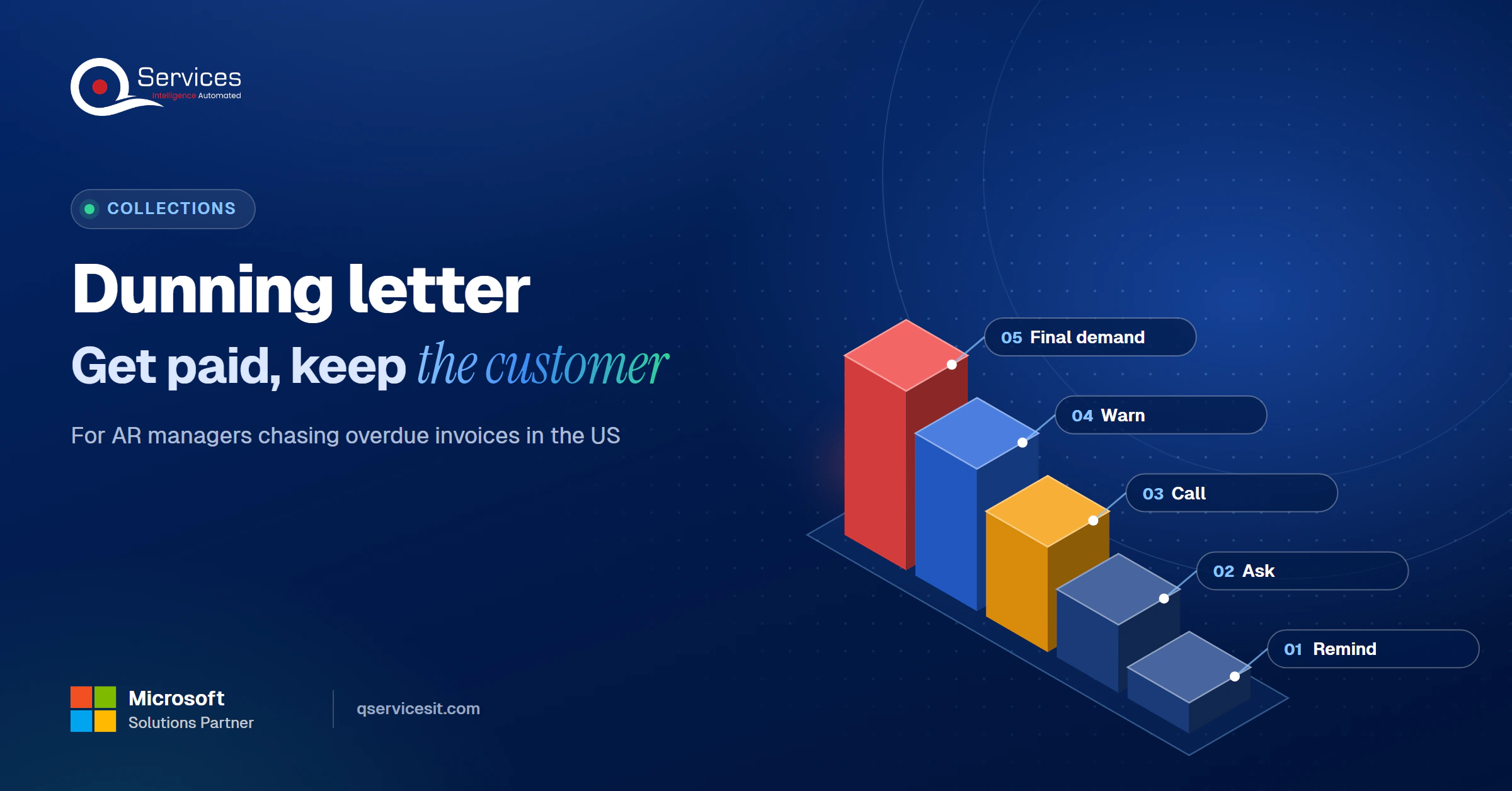
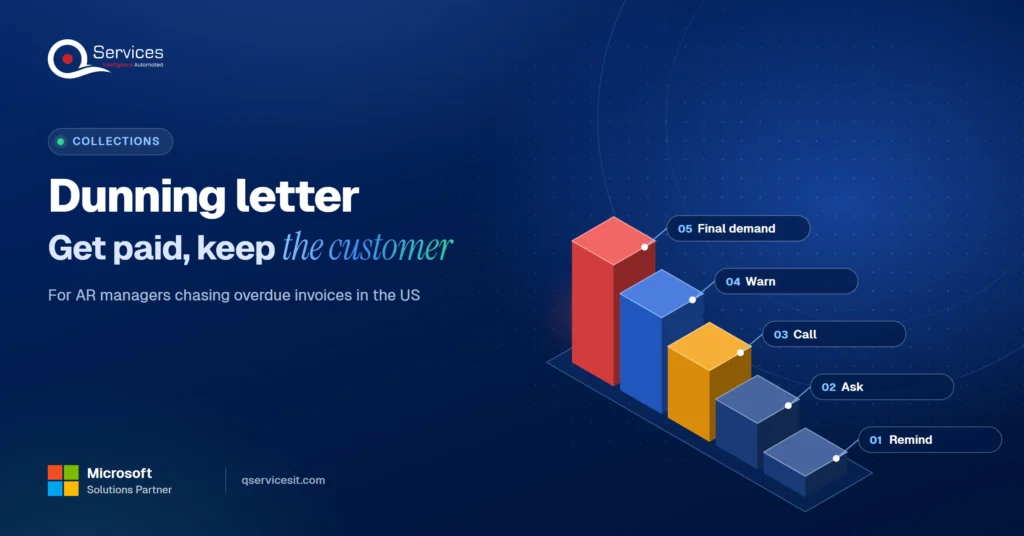
The QServices Framework Dunning Sequence = Remind → Ask → Call → Warn → Final demand

The order matters because every step earns the right to take the next one. A warning that skips the ask and the call reads as a surprise, and surprised customers dispute.
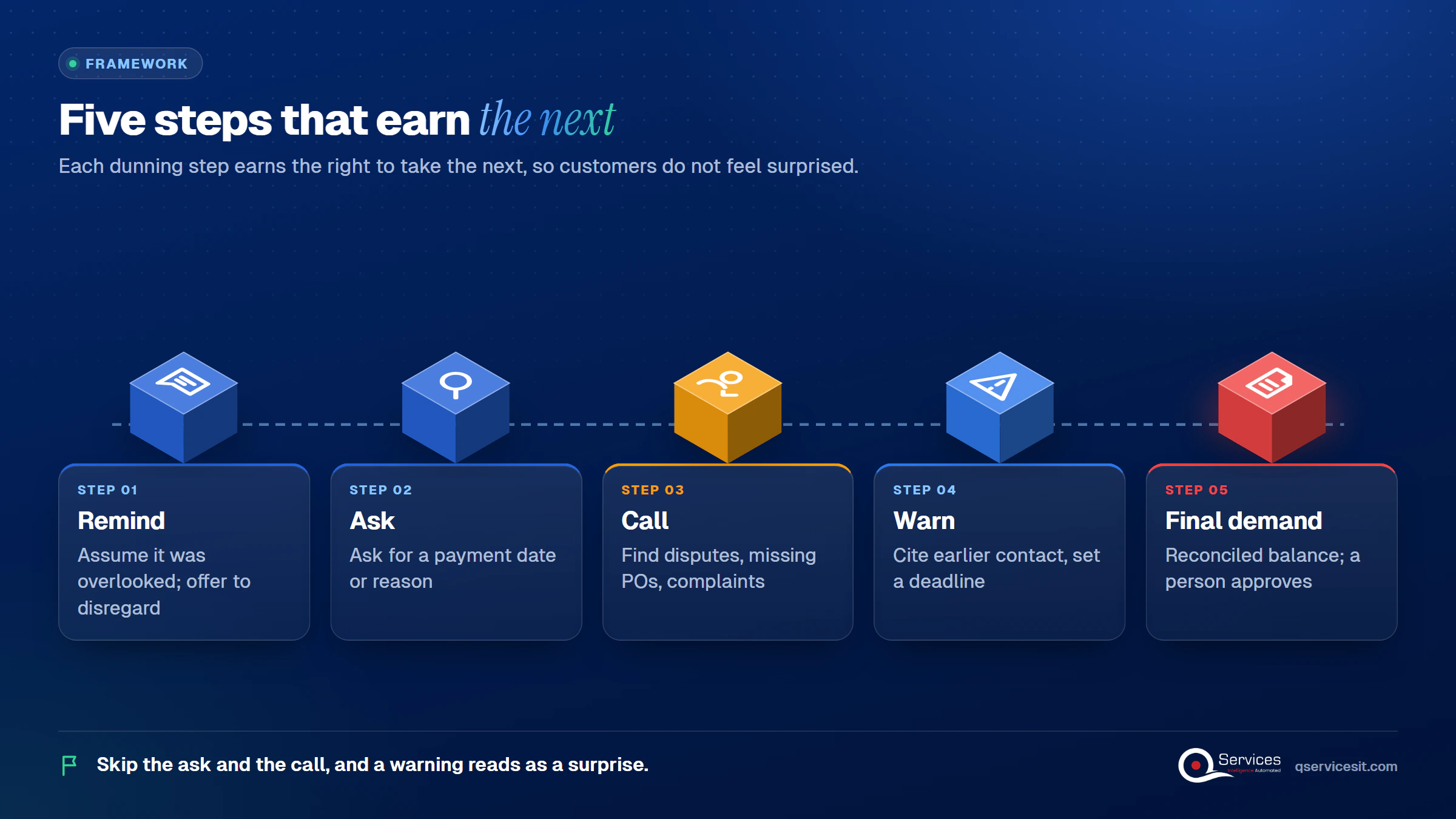
QServices Dunning Sequence framework: Remind → Ask → Call → Warn → Final demand - dunning letter

What should a dunning letter say?

Every letter needs the invoice number, amount, due date, days overdue, how to pay, and a named contact. Early letters offer to disregard the note if payment is already on its way. Later ones add the earlier contact dates and a deadline.

A Five-Step Dunning Letter Sequence With Templates

This collection letter sequence uses days 1, 7, 15, 30 and 45 after the due date. Vendor playbooks disagree on exact day counts and none is a standard, so tie your schedule to payment terms and customer history. The templates below work as an overdue invoice letter you can adapt.

1. Day 1: friendly payment reminder wording

Subject: Invoice [number] was due yesterday

Hi [name], our records show invoice [number] for [amount] was due on [date]. If it’s already on its way, please ignore this note. If not, here is how to pay: [link]. Reply here if anything is holding it up.

This is friendly payment reminder wording: assume the invoice was overlooked, because it usually was.

2. Day 7: payment reminder letter with a question

Hi [name], following up on invoice [number] ([amount], now 7 days past due). Could you let me know the expected payment date? If there’s a missing PO, a routing issue or a question on the invoice, tell me and I’ll sort it today.

This payment reminder letter asks for a date or a reason. The reason is the useful part.

3. Day 15: past due notice

Hi [name], invoice [number] ([amount]) is now 15 days past due, and I haven’t heard back on my earlier notes. I’ll call you this week. If a payment plan would help, say so and we’ll set one up.

This past due notice references earlier contact and previews a call.

4. Day 30: day 30 past due letter example

Dear [name], invoice [number] ([amount]) is 30 days past due. We emailed on [dates] and spoke on [date]. Please pay by [date, 7 days out] or contact [named AR rep] to agree a plan. After that date we’ll need to review the account terms.

That is a day 30 past due letter example: it states the history, a deadline and a consequence you are actually authorized to apply.

5. Day 45: final notice

Dear [name], this is our final notice for invoice [number]. Reconciled balance: [amount]. Earlier contact: [dates]. Payment is required by [date]. Pay by [method] or call [controller or named contact]. If we don’t hear from you, we will refer the account for further collection action.

One reviewer approves this one before it goes. If you want a dunning letter template for overdue invoices that fits your own terms, start with these five and change only the numbers and names.
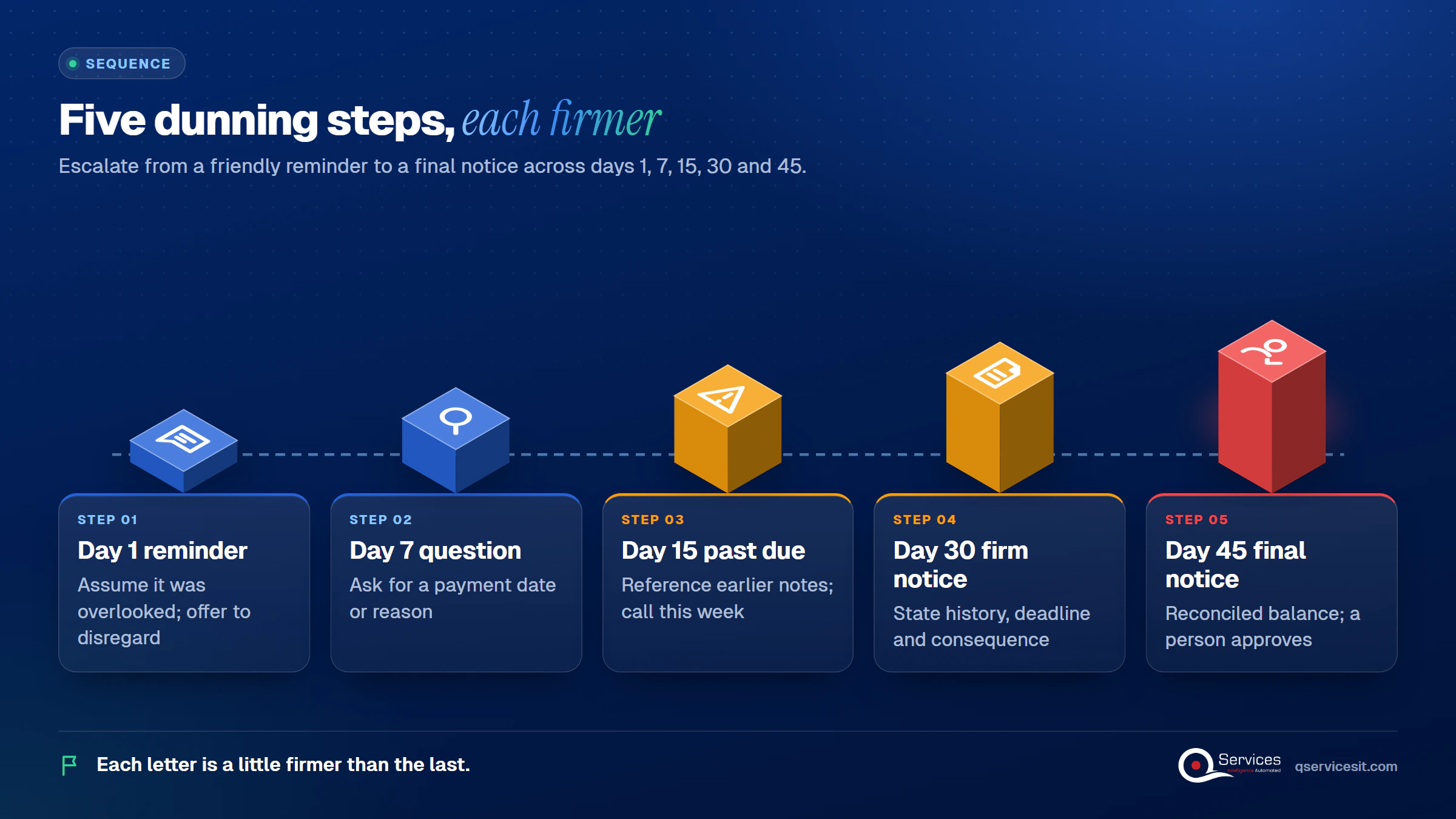
Timeline of exactly 5 dunning steps: Day 1 reminder, Day 7 question, Day 15 past due notice plus call, Day 30 firm notice, Day 45 final notice - dunning letter

Key Insight The sequence, not the wording, is what ERP systems control. SAP, NetSuite and Dynamics 365 Finance all schedule dunning by level and days overdue, so a consistent cadence beats a perfect letter sent late.

Tone at Each Step

The tone rule is simple: friendly at the start, firm in the middle, factual at the end. Atradius Collections recommends a "friendly, yet firm and matter-of-fact" tone throughout, and that holds for B2B.

How tone changes across the dunning letter sequence

  • Day 1 and 7: assume an oversight. Offer to disregard if paid.
  • Day 15 and 30: reference earlier contact, name the consequence, set a deadline.
  • Day 45: mark it final, include the account history, and name who to call.

Escalate the sender too: a generic billing address first, then a named AR rep, then the controller. Threaten only what you have authorized. Allianz Trade warns that threatening legal proceedings can harm the long-term relationship, so don’t.

Is the day 15 letter where your follow-ups go quiet?

Most sequences break in the middle, when nobody owns the next touch. We can review yours and show how agents draft each step for a person to approve.

Book the AR Cash Assessment →

When Should You Pick Up the Phone?

Call around day 15, and again at day 30 if there’s no reply. A short call often settles what three emails couldn’t.

When to call instead of sending a dunning letter

When to call instead of sending a dunning letter comes down to three triggers:

  • The customer has ignored two notices.
  • The invoice is large enough that a lost email is expensive.
  • You suspect a dispute, a missing PO or a complaint.

If service was poor, ask about that before asking for payment, and send a complaint to management first. Allianz Trade suggests calling every 7 to 10 days rather than daily. Offer a payment plan, then email a summary of what was agreed.

Letters only vs letters plus calls

Letters only Letters plus calls
Staff time Lowest Higher: someone must prepare and make each call
Finds disputes early Rarely Often, in the first conversation
Relationship impact Neutral to cold Warmer when done well
Audit trail Automatic Needs call notes logged
Best for Small balances Large or repeat-late accounts

The honest downside is the first row: calls cost real hours. Most teams reserve them for accounts that justify it. Our post on reducing DSO with a stretched AR team covers how to pick those accounts.

Real-World Scenario A typical case we see: an AR manager at a distributor has 40 invoices past 15 days, averaging $6,000 each. The sequence sends the same day 15 letter to all of them, but 9 are late because of a missing PO that no letter mentions. A call at the Call stage finds the gap in minutes, and the invoices are reissued. Without the call, those nine reach day 45 and a final demand over a paperwork error.

When to Stop

Stop when the customer pays, raises a dispute, or reaches the end of your credit policy. No source gives a universal rule, and the day counts here are conventions. Final demand and agency referral usually land around day 60, or 90 or later in slower models.

How many dunning letters before collections?

How many dunning letters before collections? Most sequences send three to five notices, then a final demand. Pause dunning while a dispute is open (NetSuite lets you do this). If a customer goes bankrupt, file a proof of claim and stop sending past-due notices.

Dunning letter vs final demand letter

A dunning letter vs final demand letter comes down to the stage. A dunning letter reminds and asks; a final demand states a deadline and consequence. The final demand should include a reconciled balance, invoice details, earlier contact dates, a clear deadline, payment instructions and a named contact. A person should approve it before it goes.

Standards & References

  • CFPB Regulation F overview: federal debt collection rule under the FDCPA
  • 12 CFR Part 1006 (eCFR): full text of Regulation F

Is a dunning letter legally required before collections? Not as a general rule for trade debt, but check your contract notice clauses. The FDCPA mainly covers consumer debt, not ordinary B2B invoices, yet state law differs. California SB 1286 extends the Rosenthal Act to certain commercial debts owed by natural persons from 1 July 2025. Ask counsel before the day 45 notice.

How QServices Approaches Dunning Letter Sequences

We start by fixing the order of the five stages, then wire it to your ERP so the cadence runs without anyone remembering it. A person still approves every final demand.

  1. A sequence map of your terms, customer tiers and day counts
  2. Letter templates for each stage, reviewed by your AR lead
  3. An approval queue before anything posts or goes out
  4. Agents running in your own Azure tenant that read ERP records and draft each notice
  5. A call list for accounts that need a human at day 15

The same team builds and runs it. That is how our accounts receivable automation works in practice, and our accounts receivable services cover the follow-up work itself.
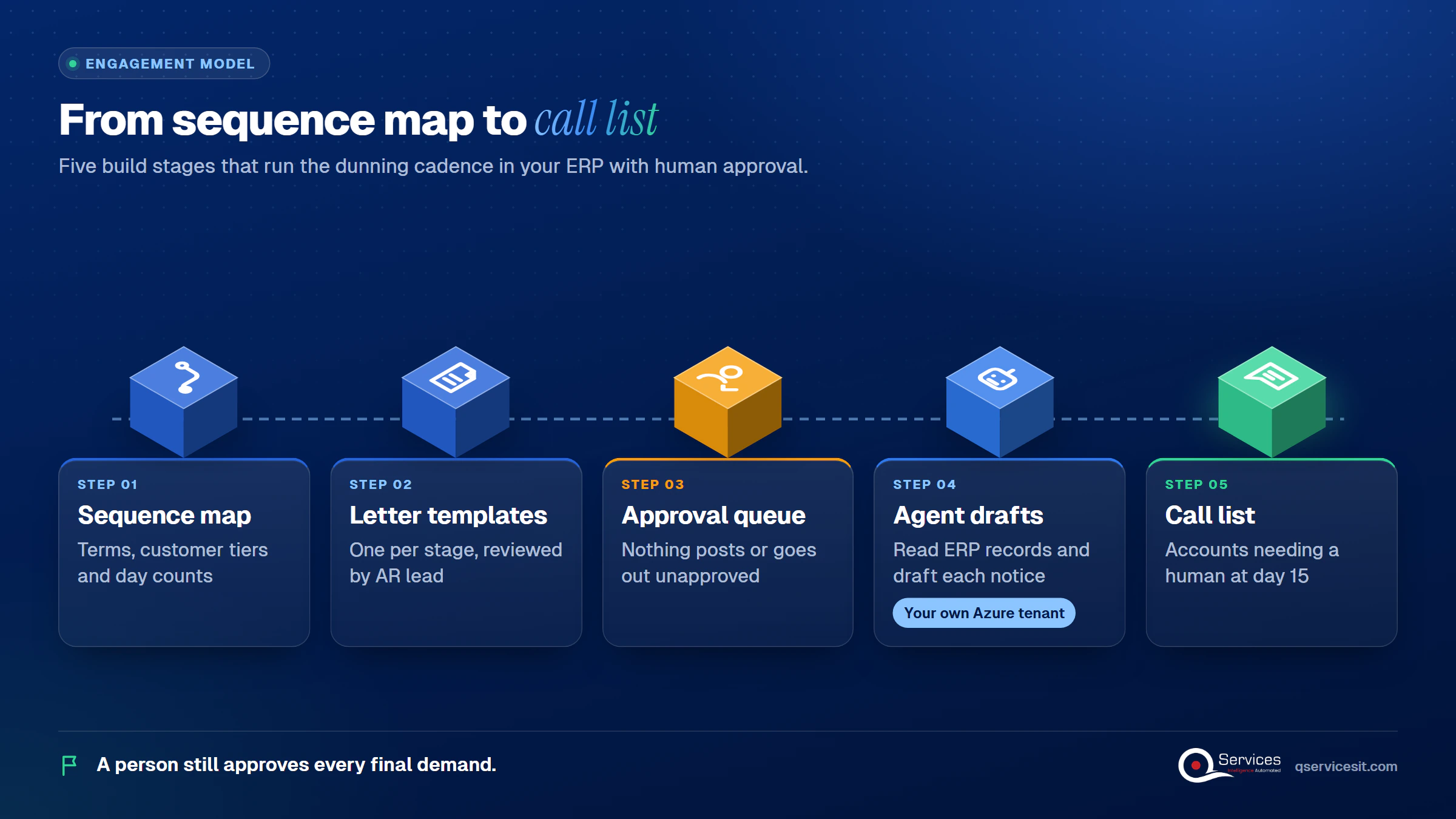
How QServices delivers dunning: sequence map → templates → approval queue → agent drafts → call list - dunning letter

Implementation Checklist

  • Payment terms and due dates are correct on every open invoice
  • Days 1, 7, 15, 30 and 45 are set in your ERP or tool
  • Each letter names the invoice, amount, days overdue and a contact
  • A person approves the final demand before it is sent
  • Open disputes pause dunning automatically
  • Every call and letter is logged on the account
  • State law and contract notice clauses have been checked

For reading buckets, see our AR aging report guide, and for the wider process the accounts receivable management guide.

Conclusion

A dunning letter works when the cadence is fixed, the tone steps up gradually, and a call happens before the warning. Start with the five templates above on one customer group for 45 days, then Book the AR Cash Assessment.

Rohit Dabra

Written by Rohit Dabra

Co-Founder and CTO, QServices IT Solutions Pvt Ltd

Rohit Dabra is the Co-Founder and Chief Technology Officer at QServices, a software development company focused on building practical digital solutions for businesses. At QServices, Rohit works closely with startups and growing businesses to design and develop web platforms, mobile applications, and scalable cloud systems. He is particularly interested in automation and artificial intelligence, building systems that automate routine tasks for teams and organizations.

Accounts receivableCollections workflowERP integrationFinance automation
Talk to Our Experts

Frequently Asked Questions

A dunning letter is a written notice telling a customer an invoice is overdue. In practice it is a sequence of notices that get firmer over time, aiming to recover payment while keeping the customer. Dunning notice and dunning letter mean the same thing.

Most teams send three to five notices, for example on days 1, 7, 15, 30 and 45, then a final demand. Vendor playbooks differ and none is a standard, so follow your credit policy. A person should approve the final demand.

Call around day 15, or sooner when two notices go unanswered, the invoice is large, or you suspect a dispute or missing PO. Allianz Trade suggests calling every 7 to 10 days, not daily, and emailing a summary after each call.

Not as a general rule for ordinary B2B trade debt, since the FDCPA mainly covers consumer debt. Contracts may require notice, and state law differs, including California SB 1286 for certain commercial debts. Check your contract and state law with counsel.

Include a reconciled balance, invoice details, dates of earlier contact, a clear payment deadline, payment instructions and a named contact. Mark it final, and have a person approve it before sending.

Related Topics

Next step

Ready to stop chasing invoices by hand?

Bring your current dunning letters to a short assessment. We’ll map each step to your ERP and show where an agent could draft, with your team approving.

Book the AR Cash Assessment →

Recent Articles

Globally Esteemed on Leading Rating Platforms

Earning Global Recognition: A Testament to Quality Work and Client Satisfaction. Our Business Thrives on Customer Partnership

5.0

5.0

5.0

5.0

What clients say

Rated 5.0 by the
people we've built for.

Every quote comes from a published review on GoodFirms, Clutch or our own site. Click a source to read the full review.

★★★★★
“QServices was highly professional, knowledgeable, and approachable. We continue to work with them on other projects.”
NHNicholas HoareCEO, Nextgen ClearingGoodFirms
★★★★★
“Quality assurance is often overlooked, but these guys take that very seriously. … their team of experienced, dedicated developers and highly skilled engineers quickly dissected and decomposed every problem and presented solutions and options that directly met my needs”

Erik BrownBusiness owner and software engineerClient review
★★★★★
“The supplier delivered the application on time and was responsive to our needs. He was also flexible, which allowed us to make changes on the fly.”

Zoltan BodnarCFO, Yusen LogisticsGoodFirms
★★★★★
“Thank you Sahil and team for wonderful collaboration right from day 0. … Highly recommend the developers.”

Ranbeer MakinClientClient review
★★★★★
“They are always looking for new ways to improve their products and services and to deliver value to their customers.”
OFOluwatosin FalolaSenior .NET Developer, POOLCORPClutch
★★★★★
“I have had an excellent experience working with QServices. We have a highly collaborative relationship and I value them not just as contractors but as partners.”

Alex VanderElsClientClient review
★★★★★
“Sahil undertakes every project with a high degree of professionalism. His communication style is unmatched and he is always available to resolve issues or just discuss the project.”

Philmore J.ClientClient review
★★★★★
“Responsive, patient and professional. Consistent weekly attention to our project, and new ideas we hadn't asked for.”

Michael WilliamsonPresident and CEO, United Way of Southeast LouisianaGoodFirms
★★★★★
“I have been working with them on a project for a year now … They have been able to solve problems that come up with bugs or development and able to communicate well with me.”

Steven LewisClientClient review
★★★★★
“We had been working on the app for two years. QServices built it in two months.”

Brian WallerPresident, Technology Association of IowaGoodFirms
★★★★★
“All projects were delivered on time and were fully completed upon delivery.”
RBRaine Marie BuenvendiaSr. Support Specialist, Arc.DevClutch
★★★★★
“They had excellent quality. The hypercare they provided after the project went live is exceptional.”

KKKrish KishorePresident, Zero Hour ConsultantsClutch
Book Appointment
Sahil kataria (1)
Sahil Kataria

Founder and CEO

amit Kumar
Amit Kumar

Chief Sales Officer

Talk To Sales

USA

+1 270-550-1166

flag

+1 270-550-1166

Phil J.
Phil J.Head of Engineering & Technology​
QServices Inc. undertakes every project with a high degree of professionalism. Their communication style is unmatched and they are always available to resolve issues or just discuss the project.​
Assured

Thank You

Your details has been submitted successfully. We will Contact you soon!