What reason codes should an AR team use for customer deductions?
Customer deductions are easiest to resolve when every short pay gets one of 15 to 20 internal reason codes, each with one owner, required evidence and a closing deadline. Map every customer and X12 code onto that list so the same shortfall is triaged the same way each time.
That mapping is the core of good deduction management: the code decides who looks at the shortfall and which proof they pull. Without it, a pricing claim and a damaged-goods claim wait in the same queue.
This guide gives you a starter code list, a mapping method, owners and SLAs, and the Business Central steps. It’s written for AR managers and distribution finance teams who see hundreds of remittance deductions a month and can’t tell which ones are real.
Which short pays are stuck without an owner?
Bring your top deduction reasons. We’ll show how an agent suggests the code from the remittance while your team approves every credit memo and write-off.
Quick Answer Customer deductions are amounts a buyer subtracts from an invoice payment, with a stated reason. Track them with 15 to 20 internal reason codes, each mapped from the buyer’s own and X12 codes, and each carrying an owner, an evidence list and target days to close. A person approves every write-off and credit memo.
What are deduction reason codes for, and how does a deduction differ from a short pay?
Deduction reason codes are structured labels that explain why a customer paid less than the invoice. They route each shortfall to the person who can prove or concede it, and they let you report on root causes instead of just dollars.
A customer deduction is the amount a buyer takes off a payment, usually explained on the remittance. A short pay is the same event seen from the cash side: the money received is less than the invoice. Our short pay tracking guide covers how to log each one.
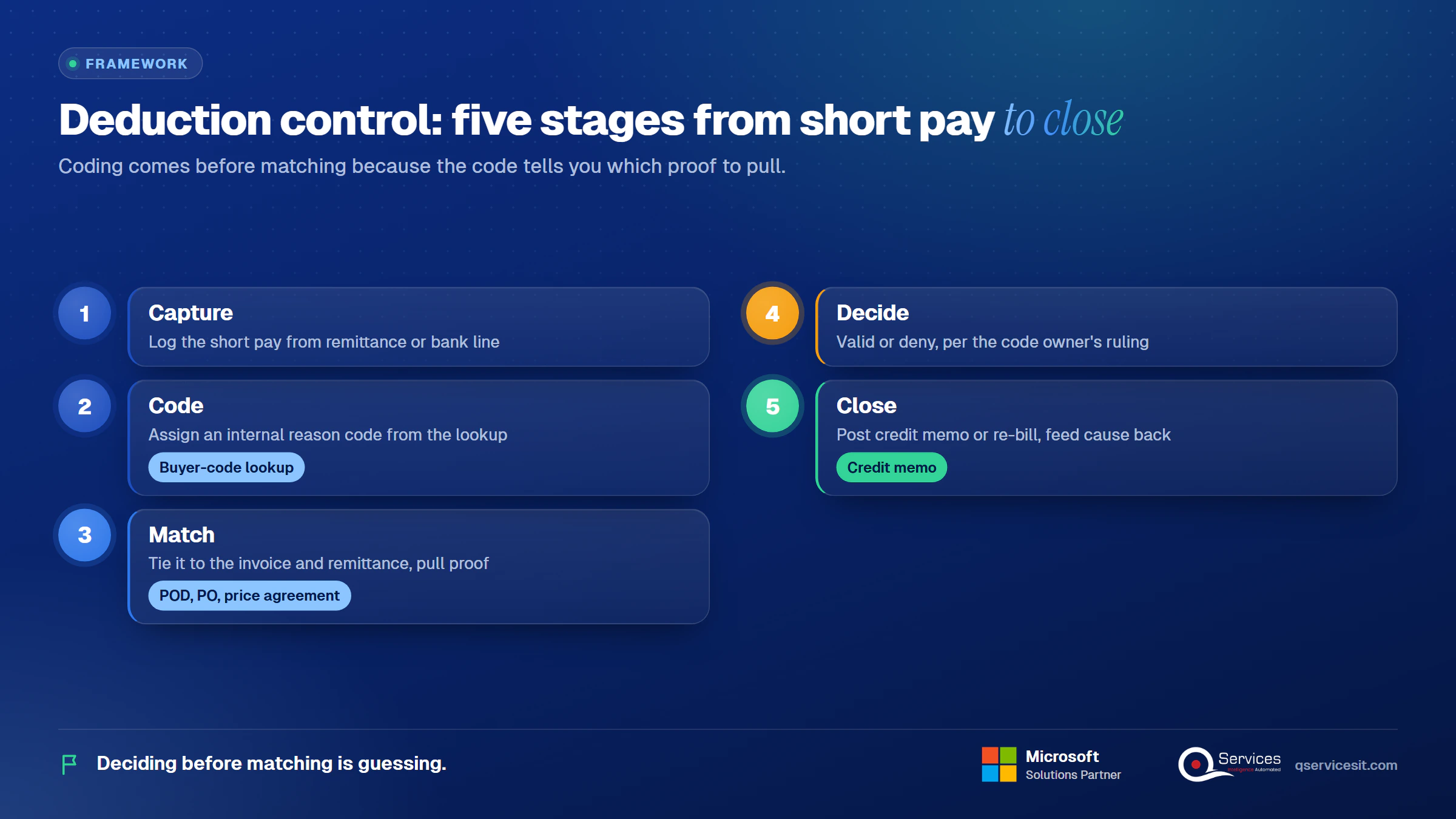
The QServices Framework Deduction Control = Capture → Code → Match → Decide → Close
Coding comes before matching because the code tells you which proof to pull. Deciding before matching is guessing, and closing without feeding the cause back means the same deduction returns next month.
What is the difference between a deduction, a short pay and a chargeback?
| Term |
Who triggers it |
Where it lands in the ledger |
How it closes |
| Deduction |
The buyer, by taking an amount off payment with a reason |
Remaining amount on the invoice, or a separate deduction item |
Credit memo if valid; re-bill or recovery if invalid |
| Short pay |
The buyer’s payment run, with or without a reason |
Invoice stays partly open after cash is applied |
Coded as a deduction, or the buyer pays the balance later |
| Chargeback |
The buyer’s system, after the fact (fine, penalty, claim) |
New debit against you, or an offset on a later payment |
Dispute with evidence, or accept and book as expense |
A dispute is your response to any of these, not a fourth type.
Why does a coded queue beat a free-text one?
| Factor |
Coded queue |
Free-text queue |
| Routing |
By code and owner |
An analyst reads and forwards each one |
| Root-cause reporting |
Top 5 codes by dollars in one report |
Manual tallying |
| Aging |
A clock per code and SLA |
One clock for everything |
| Setup effort |
A few weeks of design, mapping and clean-up before it pays back |
None, which is why teams stay here |
Key Insight A deduction without a code has no owner, and its dispute window keeps running anyway. The cheapest fix in the whole process is giving every short pay a code on the day it arrives.
Why do customer codes never match yours?
Large buyers define the reason codes they accept, so suppliers often end up holding one code list per customer. Even when EDI carries the reason, the standard list is broad and loosely used.
What do X12 812 and 820 adjustment reason codes mean?
X12 data element 426, Adjustment Reason Code, carries the reason in two transactions. The 812 Credit/Debit Adjustment uses the CDD segment, and the 820 Payment Order/Remittance Advice uses the ADX segment. The element 426 code list runs to more than 600 values, with many near-duplicates and little guidance on use. Our EDI 820 explainer shows how to post the payment file.
Buyers who pay by portal or PDF send remittance deductions as free text instead. You need the mapping either way.
Where can you find an X12 820 adjustment reason codes list?
Start with your buyer’s EDI implementation guide, then check element 426 in the current X12 standard. We don’t print code values here on purpose: each buyer uses a subset, and one standard code can fan out to several of a buyer’s own codes. Mapping is rarely one-to-one.
Retailer codes sit on top. Target A030 is a carton shortage, A036 is an invoice-to-PO cost gap, and Walmart code 22 means fewer cases received than invoiced. Treat all three as examples and confirm against each buyer’s current list.
What does a starter list of internal reason codes look like?
Here is a starter list of deduction reason codes for distribution. The days are our suggested targets from client work, not an industry benchmark, so tune them after 90 days of your own data.
| Code |
Meaning |
Typical cause |
Usually |
Owner |
Evidence needed |
Days |
| PRICE-01 |
Price vs PO or contract |
Wrong price on invoice |
Valid |
Pricing |
PO, price agreement |
10 |
| PRICE-02 |
Volume discount not applied |
Tier missed at billing |
Valid |
Pricing |
Tier schedule, order history |
10 |
| QTY-01 |
Quantity short, billed not shipped |
Pick or ship error |
Valid |
Logistics |
Pick ticket, ship confirm |
7 |
| QTY-02 |
Concealed shortage |
Buyer receiving count |
Invalid if POD clean |
Logistics |
Signed POD, carton count |
10 |
| DMG-01 |
Damaged goods |
Carrier or warehouse damage |
Mixed |
Logistics |
Photos, POD notes, carrier claim |
10 |
| DEL-01 |
Late delivery or OTIF fine |
Missed appointment window |
Mixed |
Logistics |
Appointment log, tracking |
7 |
| PROMO-01 |
Promotion or trade allowance |
Agreed promo funding |
Valid if agreed |
Trade |
Trade agreement, promo calendar |
15 |
| PROMO-02 |
Volume rebate |
Rebate earned in period |
Valid if accrued |
Trade |
Rebate contract, accrual |
15 |
| PROMO-03 |
Unauthorized promo deduction |
No agreement on file |
Invalid |
Trade |
Agreement search result |
10 |
| DISC-01 |
Early-pay discount taken late |
Paid after discount date |
Invalid |
AR |
Invoice terms, payment date |
5 |
| FRT-01 |
Freight or shipping |
Freight terms dispute |
Mixed |
Logistics |
Freight terms, carrier bill |
10 |
| RET-01 |
Return or RMA |
Goods sent back |
Valid with RMA |
Sales |
RMA, receiving record |
10 |
| ADMIN-01 |
Duplicate invoice or payment |
Double billing, double pay |
Mixed |
AR |
Invoice register, bank detail |
5 |
| TAX-01 |
Tax error |
Wrong rate, missing exemption |
Mixed |
AR |
Exemption certificate, tax calc |
10 |
| COMP-01 |
EDI or labeling non-compliance fine |
ASN or label rule missed |
Mixed |
Logistics |
Routing guide, ASN log |
7 |
| POD-01 |
Proof of delivery missing |
Buyer can’t confirm receipt |
Valid until proof |
Logistics |
Carrier POD |
7 |
| UNID-01 |
Unidentified |
No reason given |
Unknown |
AR |
Remittance, bank detail |
5 |
How do you design deduction reason codes that stay usable?
- Keep it to 15 to 20 codes. Past that, analysts pick the closest code at random.
- Make codes mutually exclusive. Have two analysts code the same 20 deductions. If they agree on fewer than 18, merge or rename.
- Map each code to an owner and a GL account, so an approved deduction posts to the right place.
- Split valid from invalid. Earned deductions (discounts, rebates) and claims need different handling.
- Cap the catch-all. Keep UNID-01 under 5% of deductions and work it as an aged queue.
How do you map X12 adjustment reason codes to your own?
Build one lookup keyed on buyer, buyer code and internal code, and use the X12 reason as a fallback when the buyer sends none. That deduction code mapping is the step most teams skip, then wonder why reports are useless.
How to map customer reason codes to internal codes?
- Export 90 days of deductions with the buyer’s code and the remittance text.
- Group by buyer and buyer code, then sort by dollars.
- Assign one internal code to each pair and store it in the lookup.
- Flag pairs that hide two causes. For these, the remittance text or an analyst picks the code.
- Send unmapped pairs to UNID-01 and add them to the lookup within a week.
| Buyer code (example) |
What it says |
Internal code |
| Target A030 |
Carton shortage |
QTY-01, then QTY-02 if the POD is clean |
| Target A036 |
Invoice cost differs from PO |
PRICE-01 |
| Walmart 22 |
Fewer cases received than invoiced |
QTY-01 |
| Target VCNA |
Vendor compliance non-adherence |
COMP-01 |
| Any ‘other’ |
No usable reason |
UNID-01 |
Real-World Scenario A typical case we see: an AR lead at a distributor handles 400 deductions a month, and 90 arrive as ‘other’ or with no code. A $5,000 pricing claim sits in that pile for 45 days, and the buyer’s 30-day dispute window closes. With the lookup in place, the Code stage tags it PRICE-01 on day one, the Match stage pulls the PO and price agreement, and the Pricing owner decides inside 10 days.
Who owns each code and how fast should it close?
Who owns customer deductions in finance?
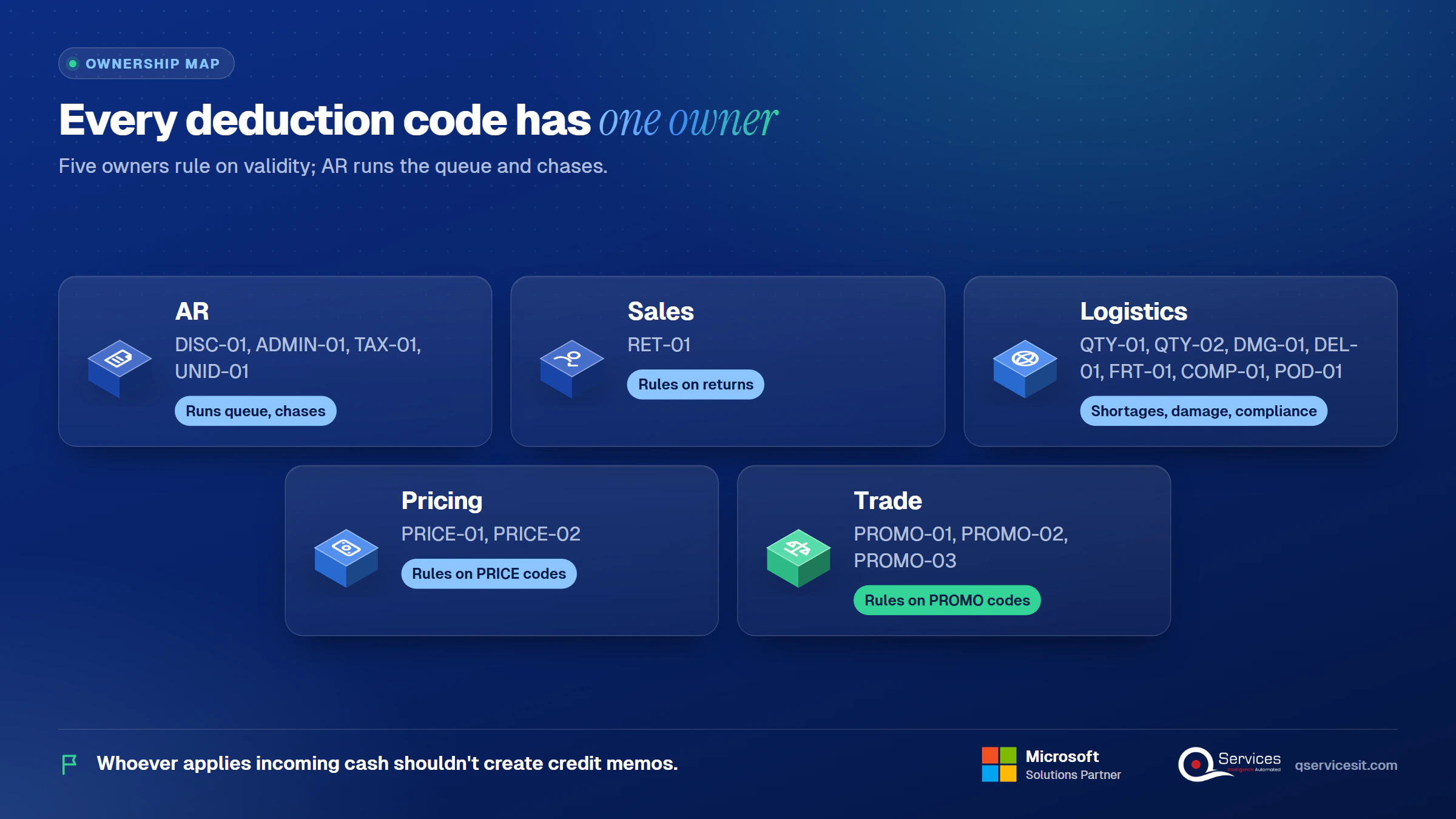
The controller or AR director owns the code list and reviews it twice a year. Each code has a business owner who rules on validity: Pricing for PRICE codes, Trade for PROMO codes, Logistics for shortages, damage and compliance, Sales for returns. AR runs the queue and chases, but doesn’t rule on another team’s evidence. Deduction ownership and SLA belong in writing, one line per code.
One control rule: whoever applies incoming cash shouldn’t create credit memos.
What is a sensible deduction reason code SLA by type?
Set your internal deadline as the buyer’s dispute window minus the time you need for documents and review. Windows differ by buyer and conflict across published sources, so confirm each in the contract before you encode it. Our planning default is 30 days when the contract is silent.
Use three checkpoints per item: documents complete, review complete, submitted. Review open items daily, nearest deadline first, and read each bucket the way our AR aging report guide describes.
| Policy item |
Starting rule |
| Small-balance close |
Up to $50, valid, coded, evidence on file; analyst closes |
| Approval, $50 to $2,500 |
AR manager |
| Approval, $2,500 to $25,000 |
Controller |
| Approval, above $25,000 |
Finance director or CFO |
| Dispute window |
Per buyer contract; 30 days if unknown |
| Aging buckets |
0-15, 16-30, 31-60, 61+ days from deduction date |
| Escalation |
Anything in 31+ days goes to the code owner’s manager |
Do your customers’ codes ever match yours?
If the same short pay shows up under three different reason codes, let’s look at your mapping together and where an agent could suggest the right internal code.
Which deductions should never be auto-written off?
No deduction should be written off automatically unless it’s coded, under the small-balance limit and absent from this list. The list is our reasoning, not a cited standard:
- Unauthorized promo and compliance fines still inside their dispute window
- Pricing disputes that need contract evidence
- Anything above a delegated approval limit
- Repeated short pays from the same customer
- Anything coded UNID-01
What can an AI agent do, and what stays with a person?
An approval-first deduction agent reads the remittance, proposes a reason code, pulls POD and pricing from your ERP and CRM, drafts the dispute or credit memo, and flags repeat offenders. A person approves every write-off and credit memo, and anything that posts money or changes a system waits in an approval queue. Vendors differ here, and some tools close deductions on their own. We don’t, because the costly errors are the ones nobody saw.
How do you stop the same deduction coming back?
Hold a monthly review of the top 5 customers and top 5 codes by dollars. Send pricing errors to Pricing, shipping errors to Logistics and promo errors to Trade, each with the evidence. Freight disputes follow the same loop, and our note on accessorial charges 3PL disputes shows why.
How do you work one deduction from short pay to credit memo?
- Capture the short pay from the remittance or bank line.
- Code it from the lookup.
- Match it to the invoice and the remittance.
- Pull proof: POD, PO, price agreement, promo calendar.
- Decide valid or deny, using the code owner’s ruling.
- Post a credit memo, or re-bill.
- Close it and feed the root cause back to the owner.
What do the worked examples look like?
- Price variance: The buyer pays $45 a unit on 1,000 units, but you invoiced $50. The deduction is 1,000 × $5 = $5,000. If the price agreement says $50, deny and recover. If it says $45, issue the credit memo and fix the price list.
- Case shortage: 95 cases received against 100 invoiced is a 5-case claim. At $24 a case that’s $120. A signed POD showing 100 cases denies it. A pick ticket showing 95 means credit.
- $50,000 claim: With a signed POD you dispute with evidence. Without one, your ground is weak, and the claim usually goes to credit unless the carrier produces proof.
- Promo deduction: A buyer takes 3% off $200,000 of invoices, which is $6,000. If a trade agreement covers that window at 3%, it’s valid and you credit it. If none exists, code it PROMO-03 and deny.
Key Insight DDO = (open deductions ÷ deductions taken in the period) × days in the period. With $180,000 open and $600,000 taken over 90 days, DDO is 0.3 × 90 = 27 days. In our experience, a DDO under 30 days means a healthy queue.
Two more measures, with illustrative numbers:
- Recovery rate = recovered dollars ÷ disputed dollars. $42,000 recovered from $70,000 disputed is 60%.
- Cost per deduction = (analyst hours × loaded hourly cost) ÷ deductions closed. 480 hours at $40 across 1,200 closed deductions is $16 each.
Published estimates of how many deductions are invalid range from a minority to nearly all, and none is verified. Count your own by code for 90 days instead.
How does a short payment appear in Business Central?
In Business Central, a short payment posts in the cash receipt journal and leaves the invoice partly open, shown as the remaining amount on the customer ledger entry. What happens next depends on what’s standard and what isn’t.
Standard:
- Post cash in the cash receipt journal or the payment reconciliation journal, apply it to the invoice, and leave the remaining amount open.
- Create a credit memo, or reverse the entry, once the deduction is approved.
- Add a dimension for the deduction code, so ledger entries and reports can be filtered by code. The Reason Codes setup can also sit on journal lines and credit memos.
- Use payment tolerance carefully. It closes small underpayments within a maximum percentage or amount to tolerance accounts, can be blocked per customer, and isn’t applied by Apply to Oldest. Keep it tiny, or off, for customers with coded deductions, so tolerance never swallows a real claim.
Needs an extension or customization: a forced code on every short payment, a dispute workflow with owners and due dates, remittance-text parsing, and a per-buyer lookup. We found no standard reason-code field on the payment difference itself, so check your version. Deduction aging by code is a Power BI report, like the one in our accounts receivable dashboard guide.
The same design holds in Dynamics GP, NetSuite or Sage: a code table, an owner per code and a queue.
Standards & References
How does QServices approach customer deductions?
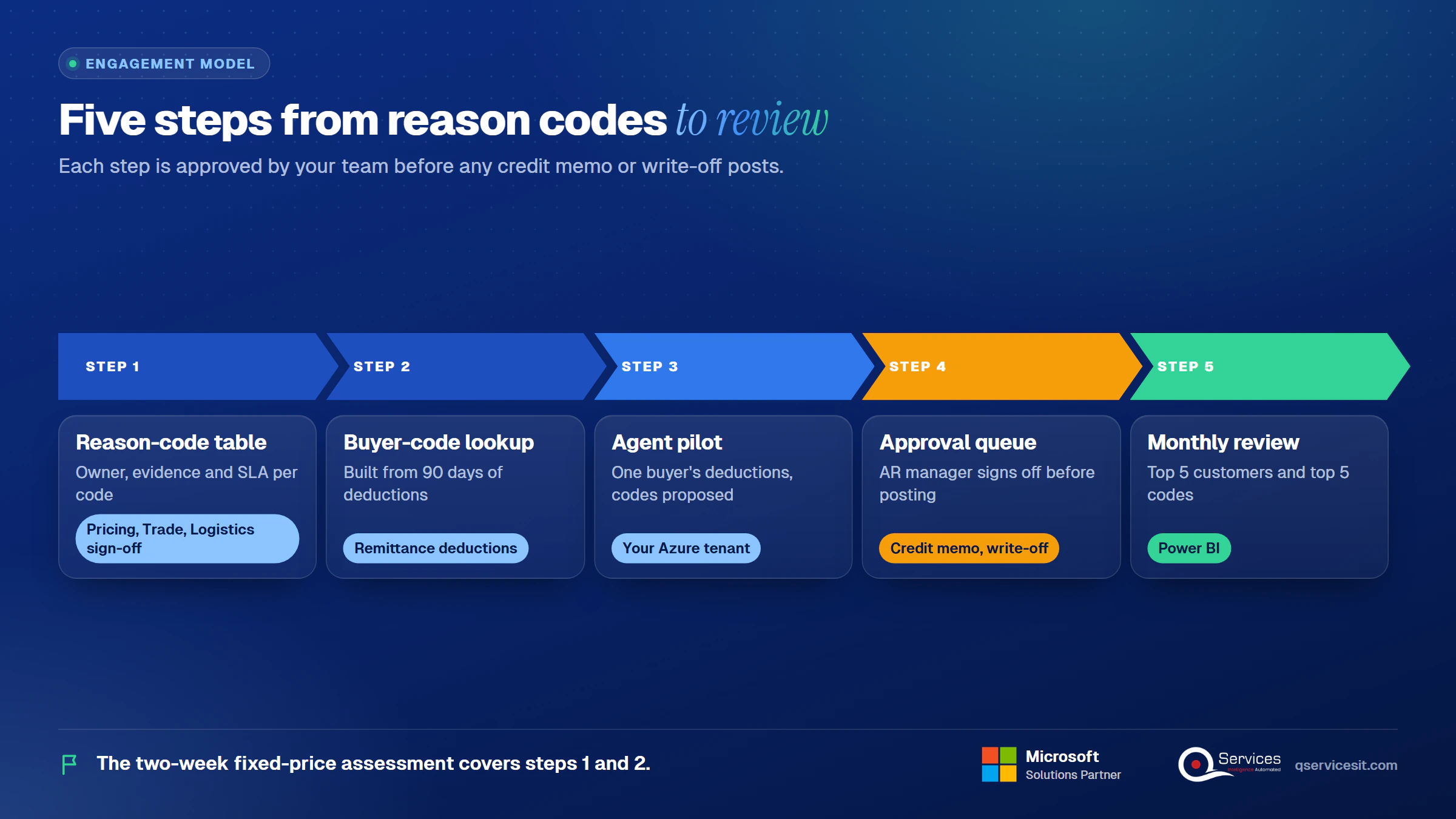
We start at Code and Match, because that’s where most of the delay sits. Our deductions and short pays team runs these steps, and the same team builds and runs the agents:
- A reason-code table with owner, evidence and SLA per code, signed off by Pricing, Trade and Logistics.
- A buyer-code lookup built from 90 days of your remittance deductions.
- A pilot on one buyer’s deductions, with the agent proposing codes inside your own Azure tenant.
- An approval queue where your AR manager signs off before any credit memo or write-off posts.
- A monthly review pack of top 5 customers and top 5 codes in Power BI.
The two-week fixed-price assessment covers steps 1 and 2.
Implementation Checklist
- Internal code list holds 20 codes or fewer, each with one owner
- Each code has a GL account and an evidence list
- Buyer-code lookup covers every code seen in the last 90 days
- UNID-01 is under 5% of deductions by count
- Payment tolerance is off or capped for customers with coded deductions
- Every credit memo needs a second person’s approval
- Dispute windows are stored per buyer
- The weekly review lists open items by nearest deadline
What should you do first to get customer deductions under control?
Pilot your largest buyer’s customer deductions for 30 days and measure DDO, the share coded on day one, recovery rate and cost per deduction. and we’ll review your code list with you.

Written by Rohit Dabra
Co-Founder and CTO, QServices IT Solutions Pvt Ltd
Rohit Dabra is the Co-Founder and Chief Technology Officer at QServices, a software development company focused on building practical digital solutions for businesses. At QServices, Rohit works closely with startups and growing businesses to design and develop web platforms, mobile applications, and scalable cloud systems. He is particularly interested in automation and artificial intelligence, building systems that automate routine tasks for teams and organizations.
Accounts receivableDeduction managementERP integrationFinance automation
Talk to Our Experts
Frequently Asked Questions
Related Topics
Next step
Ready to give every deduction a code and an owner?
Talk with our team about mapping customer codes to yours inside your ERP, with a person approving anything that posts money.


















 Trustpilot5.0★★★★★See reviewsGoodFirms5.0★★★★★45 verified reviews
 G25.0★★★★★See reviewsClutch5.0★★★★★Quality 5.0 · Schedule 4.8
 Google4.7★★★★★Mohali office
 Erik BrownBusiness owner and software engineerClient review
 Zoltan BodnarCFO, Yusen LogisticsGoodFirms
 Ranbeer MakinClientClient review
 Alex VanderElsClientClient review
 Philmore J.ClientClient review
 Michael WilliamsonPresident and CEO, United Way of Southeast LouisianaGoodFirms
 Steven LewisClientClient review
 Brian WallerPresident, Technology Association of IowaGoodFirms