


Accessorial charges: why 3PL customers dispute them
Accessorial charges drive most 3PL billing disputes. See the common fees, the proof that settles each one, and how to track disputes through to payment.
Home » Accessorial charges: why 3PL customers dispute them
Customers dispute accessorial charges because the fee was not in the quote, the service was not used, or the proof is one-sided. Most of these fights are lost on missing paperwork, not on the rate itself.
If you run AR for a US 3PL, you know the pattern. The freight invoice is clean, one disputed line sits on it, and the whole payment waits. This guide is for finance leaders at logistics companies who want fewer of those holds.
We cover the common fees, the evidence that settles each one, and how to track every dispute through to cash.
Which accessorial invoices are stuck in dispute?
In the AR Cash Assessment we trace one charge type from the delivery record to the payment, and show where the proof goes missing and where an agent could assemble it.
Book a 30-min call →Quick Answer Accessorial charges are fees added to the base freight rate for services beyond standard dock-to-dock transport, such as detention, liftgate, residential delivery and re-delivery. Customers dispute them when the fee was not quoted, the service was not requested, or the records are one-sided. Timestamps, photos and signed receipts settle most disputes.
Accessorial charges are the extras that sit on top of the freight rate. Standard LTL service stops at the curb, so anything beyond that, or any delay, becomes its own line.
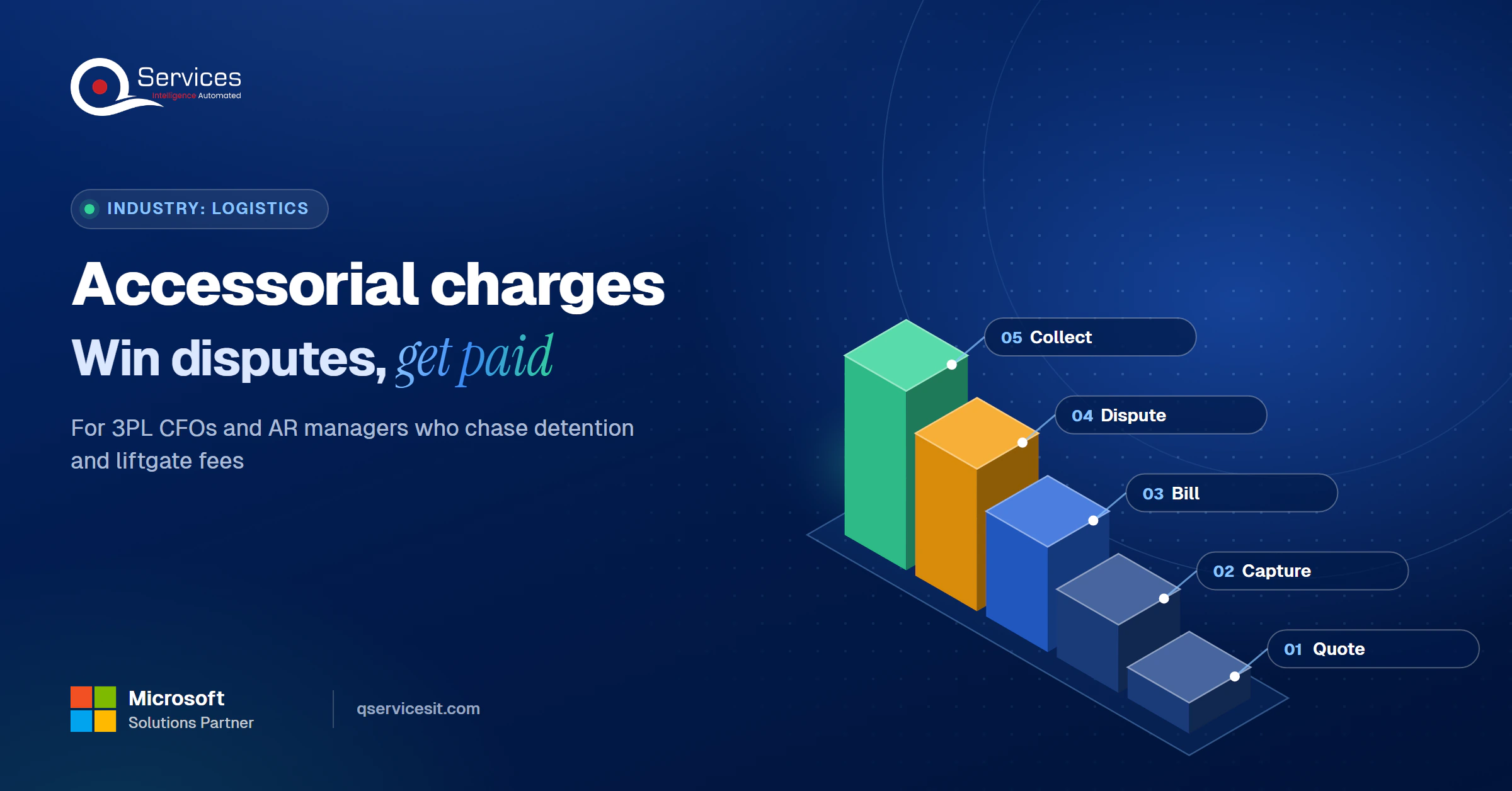
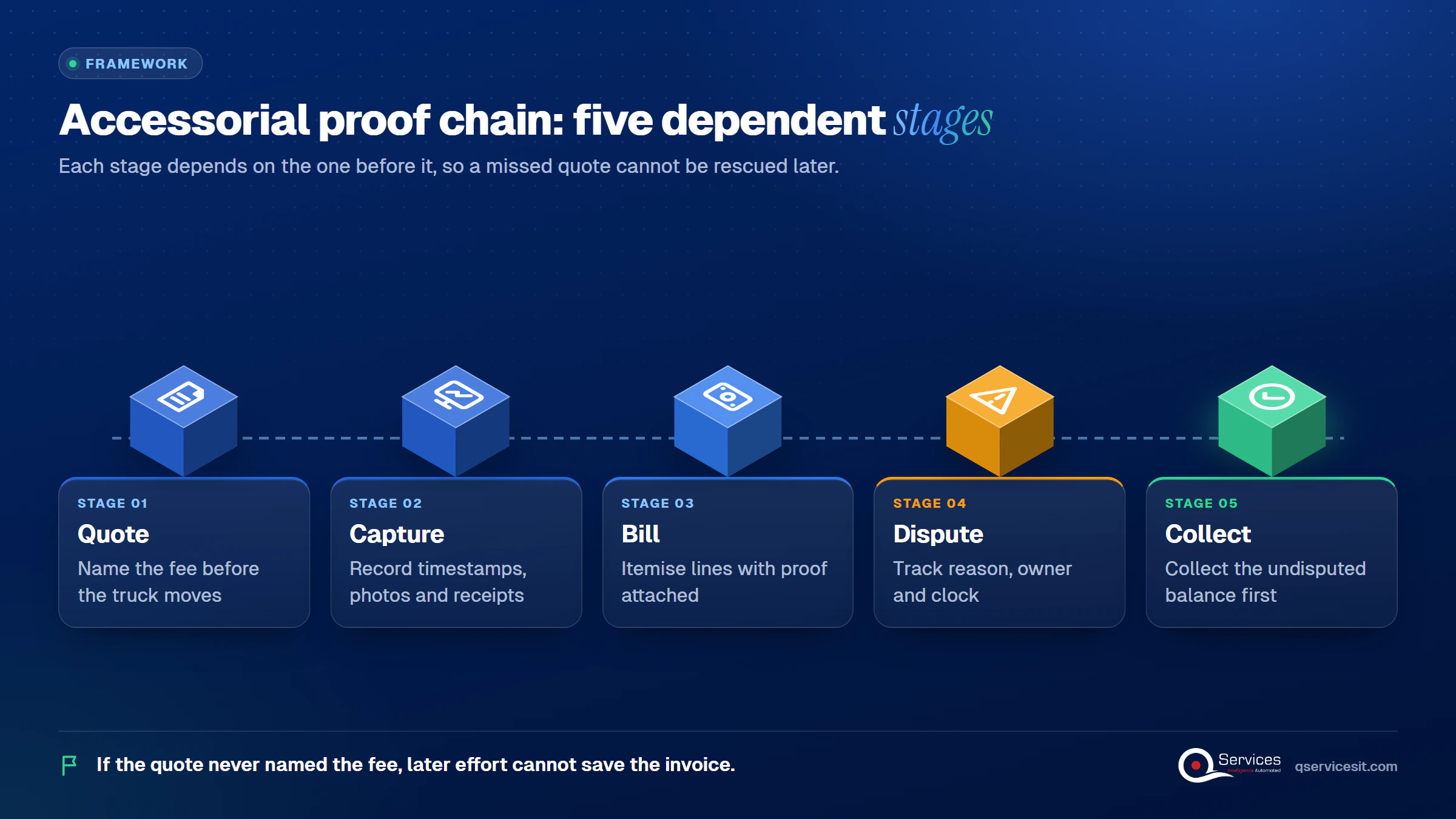
The QServices Framework Accessorial Proof Chain = Quote → Capture → Bill → Dispute → Collect
Each stage depends on the one before it. If the quote never named the fee, no amount of capture or billing effort will save the invoice later.
These are the lines AR teams see most often:
Carrier tariffs and your customer contract set the real amounts. Treat any figure you read online as a range, not a rate.
Understanding the reasons shows which disputes are preventable. Four of the six start before the truck moves.
The customer budgeted from the quote. A surprise line looks like an error even when it is legitimate.
The usual example is a liftgate fee at a site the customer says has a dock.
A business flagged as residential, or a site flagged as limited-access, triggers a fee the customer will not accept.
This is why customers dispute detention charges more than any other fee. With no timestamps, or records from only one side, it is your word against theirs.
The price moved after the shipment left. Customers want the scale ticket and the freight photos.
Some contracts cap accessorials, require pre-approval, or set a dispute window. If you billed outside those terms, you will lose.
Key Insight Of the six dispute reasons, only one (a contested clock) needs evidence gathered after the fact. The other five are fixed by what the quote, contract and address check say before pickup.
The right proof depends on the charge. A proof of delivery alone rarely closes a fee dispute, because it shows the drop, not the extra service.
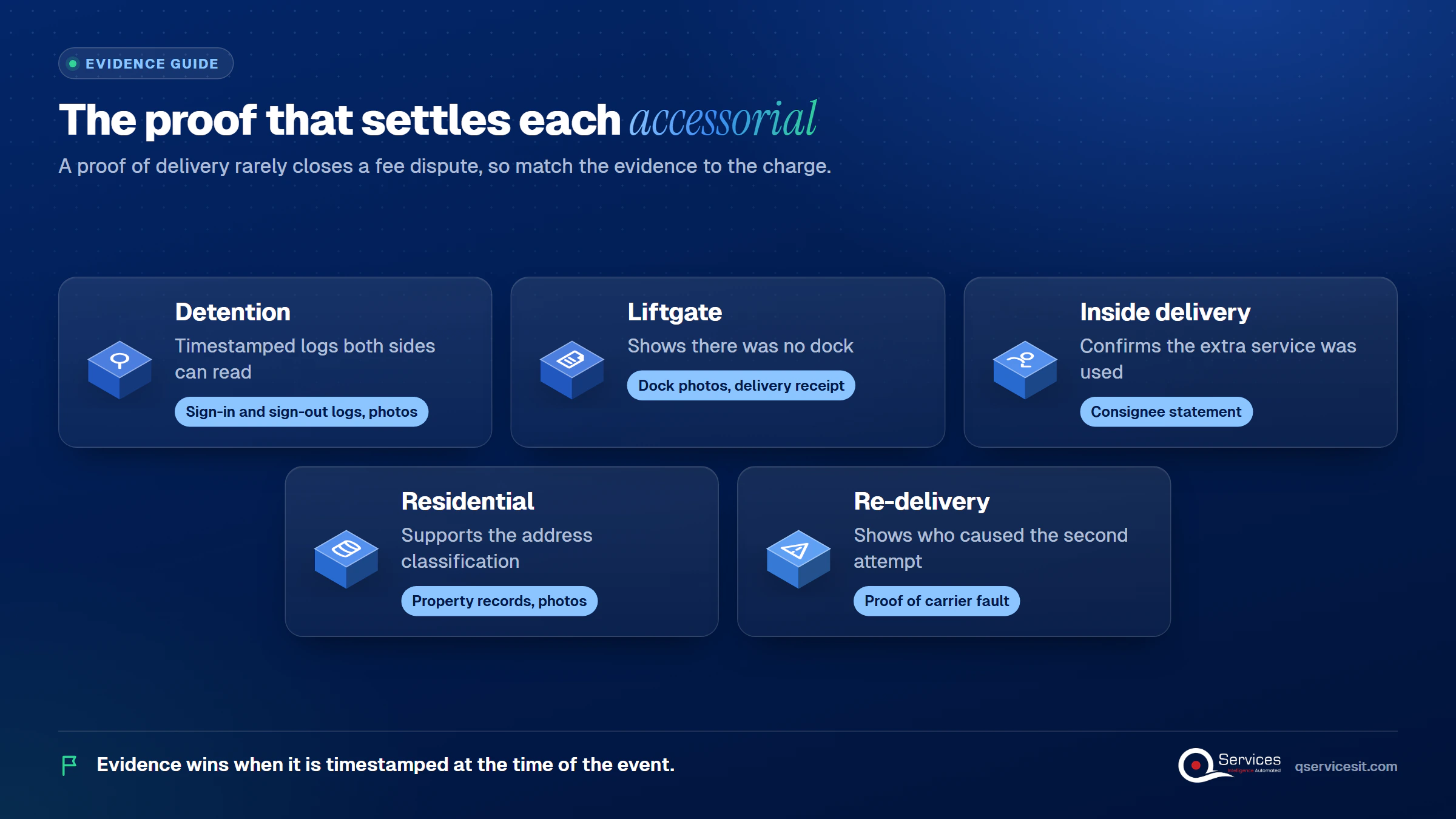
For a liftgate fee, attach dock photos and the signed delivery receipt showing there was no dock. For inside delivery, get a consignee statement. For residential, use property records or photos of the site.
Detention charge proof is a timeline both sides can read. Use the appointment confirmation, arrival and departure timestamps, sign-in and sign-out logs, and photos. A geofence event counts as one signal, so reconcile it with driver confirmation and dock times, because appointment, gate and dock times often disagree.
Two hours of free time is a common starting point, and asking for three is reasonable. Freight accessorial dispute evidence wins when it is timestamped at the time of the event, not rebuilt weeks later.
Real-World Scenario A typical case we see: an AR manager at a regional 3PL sends a $38,000 invoice with $2,400 of accessorials, including four detention lines. The customer short-pays the full $2,400 and says nobody told them about waiting fees. In the naive process, the team hunts for driver notes for a week. With the Proof Chain, the Quote stage already named the two-hour free time, and the Capture stage attached arrival and departure times to each line, so the dispute closes in one reply.
Where does your dispute evidence live today?
Gate logs, signed PODs and driver notes sit in different systems. See how an agent can pull them next to the invoice line for your team to review and approve.
Book a 30-min call →How to bill accessorial charges correctly comes down to accessorial invoicing that explains itself. Define units, rounding and exceptions in the contract. State whether carrier charges pass through at cost or with a markup, and send monthly invoice detail.
| Bundled lump sum | Itemised with evidence | |
|---|---|---|
| Customer questions | Many, because nothing is explained | Fewer, because each line shows its proof |
| Disputed amount | The whole line | Only the line in question |
| Matching to quote | Hard | Direct |
| Invoice preparation effort | Low | Higher: someone must attach proof to every line |
| Pay on undisputed part | Rarely | Usually |
Itemised billing is slower to prepare, and that cost is real. You pay it once at billing instead of repeatedly at collections.
US 3PL accessorial billing also has a records angle. Federal rules require brokers to keep a record of each transaction, so good files help you in two ways.
Standards & References
- 49 CFR 371.3, broker records: what brokers must keep for each transaction
A dispute is an open item with an owner, a reason and a clock. Treat it like one.
A workable 3PL invoice dispute resolution process has five habits:
These cases overlap with short-pay tracking, because many disputes show up as a partial payment first. For the wider workflow, see collections and dispute management and deduction and short-pay management.
We suggest escalating when a disputed invoice passes your contract’s dispute window or when the customer has not replied to the evidence within two weeks. Set the exact rule in the contract.
We start at the Capture stage, because that is where most 3PL accounts receivable disputes are decided. Our AI agents run in your own Azure tenant and a person approves every action before anything posts or changes a system. This is part of our accounts receivable automation work.
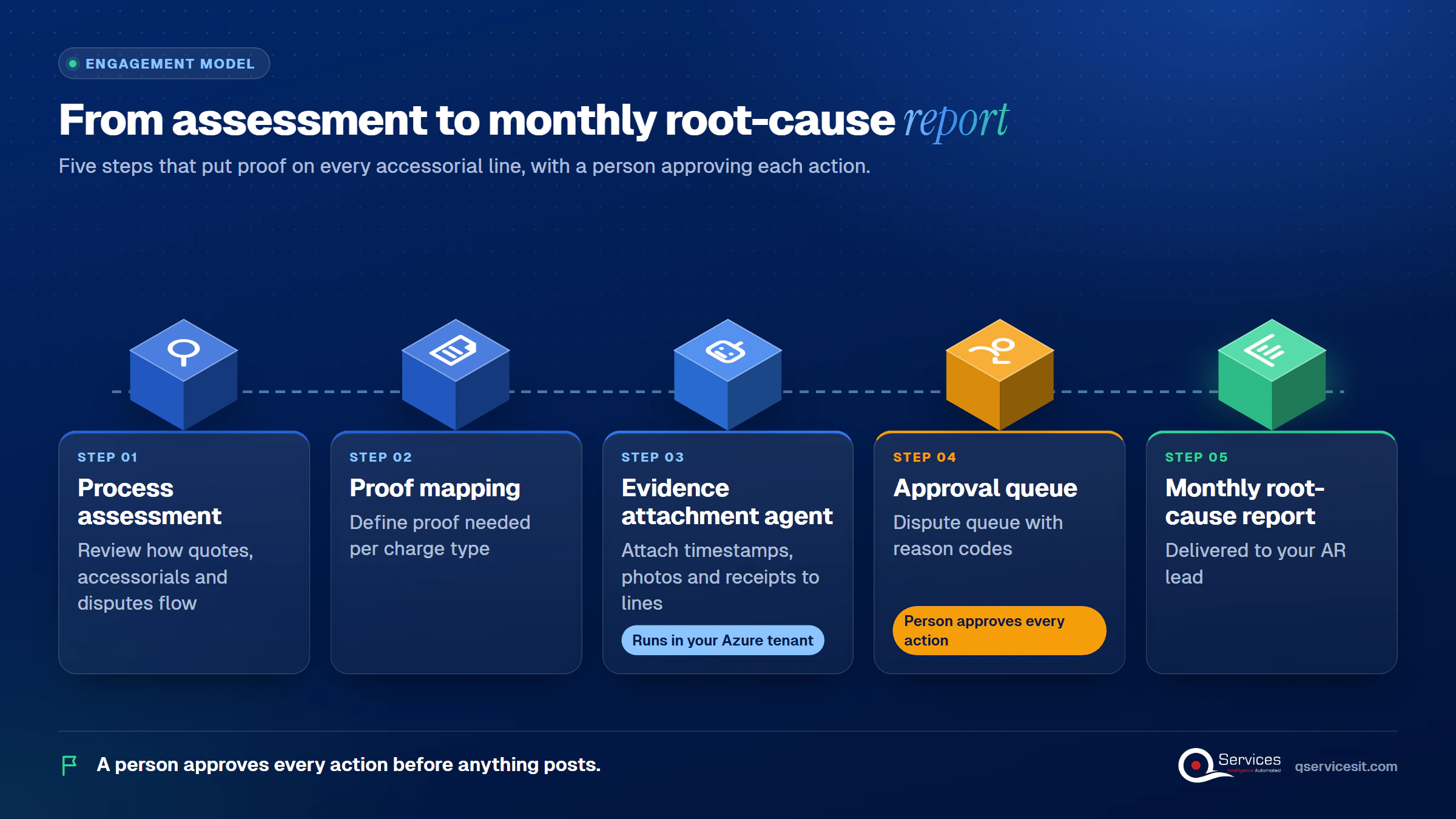
Implementation Checklist
- Every accessorial named in the customer contract and quote
- Free time for detention written down, per customer
- Arrival and departure timestamps stored per stop
- Photos required for liftgate and residential fees
- Invoice lines itemised with proof attached
- Undisputed balance invoiced and collected separately
- Reason codes applied to every dispute
- Disputes reviewed monthly for root cause

Pilot the Proof Chain on the one account with the most accessorial charges for 60 days, and measure the disputed share of invoice value, days from dispute to payment, and the percentage of disputes closed with evidence attached. Then Book a 30-min call and we’ll review your current process with you.

Written by Rohit Dabra
Co-Founder and CTO, QServices IT Solutions Pvt Ltd
Rohit Dabra is the Co-Founder and Chief Technology Officer at QServices, a software development company focused on building practical digital solutions for businesses. At QServices, Rohit works closely with startups and growing businesses to design and develop web platforms, mobile applications, and scalable cloud systems. He is particularly interested in automation and artificial intelligence, building systems that automate routine tasks for teams and organizations.
Accessorial charges are fees added to the base freight rate for services or conditions beyond standard dock-to-dock transport. Accessorial charges examples include detention charges, a liftgate fee, residential or inside delivery, re-delivery charges, and reweigh or reclass adjustments. The amounts come from carrier tariffs and your customer contract.
To dispute accessorial charges, ask the carrier or 3PL for the evidence behind each line, such as timestamps, photos or a signed receipt, and compare it to your quote and contract. Pay the undisputed balance, state your reason in writing, and check whether your contract sets a dispute window.
Detention charge proof is a timeline both sides can verify: the appointment confirmation, arrival and departure timestamps, sign-in and sign-out logs, and photos. A geofence event is one signal, so reconcile it with driver confirmation and dock records. The agreed free time should also appear in the contract.
Name every accessorial in the quote and contract, set free time for detention, capture proof at the time of the event, and itemise each invoice line with its evidence attached. Most disputes come from fees the customer did not expect or cannot verify.
Start with one account that has the most disputes. List its accessorial lines, note which proof each one needs, and check how many invoices carry that proof today. Then pilot itemised billing and a dispute queue with reason codes on that account for 60 days.

Accessorial charges drive most 3PL billing disputes. See the common fees, the proof that settles each one, and how to track disputes through to payment.
Dynamics GP migration planning for CFOs and IT directors: what Microsoft’s 2029 end of support means, your three options, and a quarter-by-quarter 2027 plan.
CRM ERP integration shows your sales team credit limits, holds and open invoices before they quote. See what data to sync and who should own it.
Accounts receivable reconciliation made simple: follow a step-by-step monthly routine, spot the five most common differences and fix them at the source.
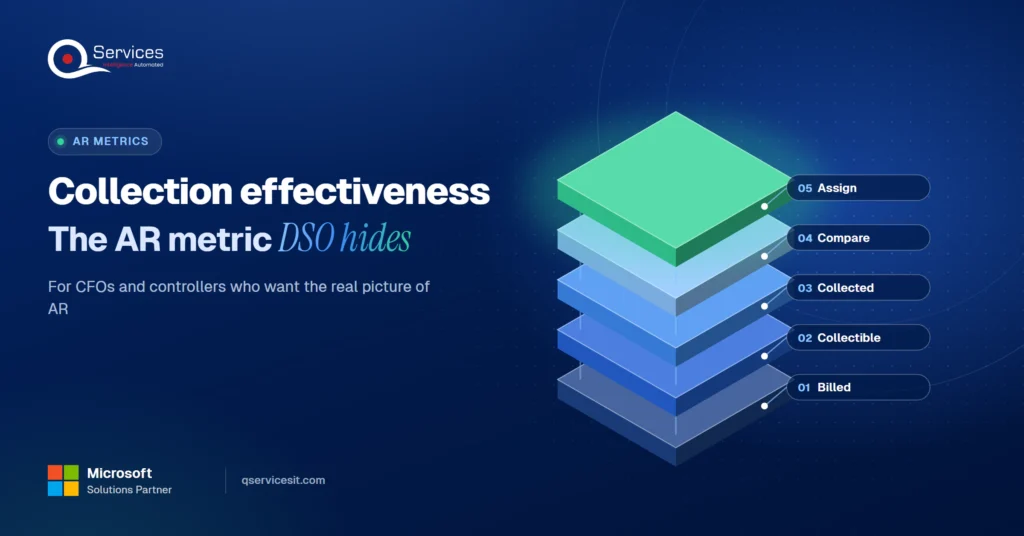
Collection effectiveness index shows what DSO hides. See the CEI formula, a worked example and how to use it to manage collectors in your AR team.
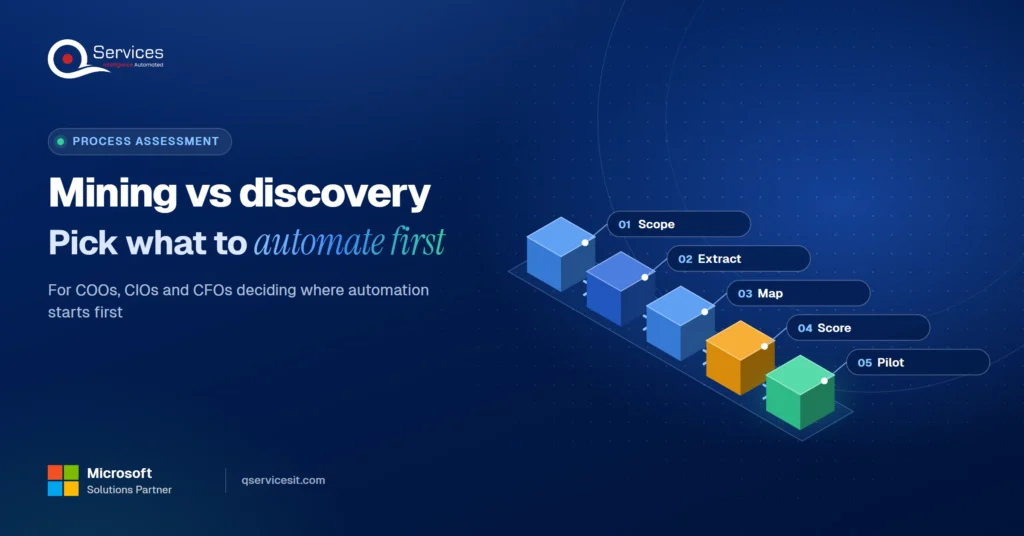
Process mining vs process discovery: see what each needs and delivers, and how your ERP and CRM logs can pick your first automation in two weeks.

Next step
Ready to stop writing off detention and liftgate fees?
Bring your most disputed charge types. We’ll map the evidence each one needs and show how agents gather it while your team approves every step.
Book a 30-min call →
Accessorial charges drive most 3PL billing disputes. See the common fees, the proof that settles each one, and how to track disputes through to payment.

Dynamics GP migration planning for CFOs and IT directors: what Microsoft’s 2029 end of support means, your three options, and a quarter-by-quarter 2027 plan.
CRM ERP integration shows your sales team credit limits, holds and open invoices before they quote. See what data to sync and who should own it.
Accounts receivable reconciliation made simple: follow a step-by-step monthly routine, spot the five most common differences and fix them at the source.
Collection effectiveness index shows what DSO hides. See the CEI formula, a worked example and how to use it to manage collectors in your AR team.
Process mining vs process discovery: see what each needs and delivers, and how your ERP and CRM logs can pick your first automation in two weeks.

Every quote comes from a published review on GoodFirms, Clutch or our own site. Click a source to read the full review.

Trustpilot5.0★★★★★See reviewsGoodFirms5.0★★★★★45 verified reviews

G25.0★★★★★See reviewsClutch5.0★★★★★Quality 5.0 · Schedule 4.8

Google4.7★★★★★Mohali office“QServices was highly professional, knowledgeable, and approachable. We continue to work with them on other projects.”
“Quality assurance is often overlooked, but these guys take that very seriously. … their team of experienced, dedicated developers and highly skilled engineers quickly dissected and decomposed every problem and presented solutions and options that directly met my needs”

Erik BrownBusiness owner and software engineerClient review“The supplier delivered the application on time and was responsive to our needs. He was also flexible, which allowed us to make changes on the fly.”

Zoltan BodnarCFO, Yusen LogisticsGoodFirms“Thank you Sahil and team for wonderful collaboration right from day 0. … Highly recommend the developers.”

Ranbeer MakinClientClient review“They are always looking for new ways to improve their products and services and to deliver value to their customers.”
“I have had an excellent experience working with QServices. We have a highly collaborative relationship and I value them not just as contractors but as partners.”

Alex VanderElsClientClient review“Sahil undertakes every project with a high degree of professionalism. His communication style is unmatched and he is always available to resolve issues or just discuss the project.”

Philmore J.ClientClient review“Responsive, patient and professional. Consistent weekly attention to our project, and new ideas we hadn't asked for.”

Michael WilliamsonPresident and CEO, United Way of Southeast LouisianaGoodFirms“I have been working with them on a project for a year now … They have been able to solve problems that come up with bugs or development and able to communicate well with me.”

Steven LewisClientClient review“We had been working on the app for two years. QServices built it in two months.”

Brian WallerPresident, Technology Association of IowaGoodFirms“All projects were delivered on time and were fully completed upon delivery.”
“They had excellent quality. The hypercare they provided after the project went live is exceptional.”

Founder and CEO

Chief Sales Officer

Thanks, we’ve got your details. A named member of our team will reply within one business day.