What should an AR collector say on a B2B collection call?
A collection call script for B2B accounts opens in under 60 seconds: say who you are, name the invoice, ask one open question, then pause. You leave with three outcomes: the customer confirms they have the invoice, you know the blocker, and you hold a dated promise to pay.
That’s the whole job of the first past-due call. Most teams that run accounts receivable collections well don’t have better phrasing. They prep for two minutes, ask better questions and write the result down before the next dial.
This guide gives you the prep, the exact words, the objection answers and the logging routine. A person makes every call and approves every payment plan.
Is your call brief ready before you dial?
Talk with our team about an agent that preps open items, disputes and last promises in your ERP, while your collector makes the call and approves every step.
Quick Answer A B2B collection call script is a short, repeatable set of lines for calling a business customer about a past-due invoice. It opens with who you are and which invoice, asks one open question, finds the blocker, secures a specific payment date, and ends with a written recap sent within an hour.
What goes into the 2-minute call brief before you dial?
The call brief is a one-screen summary of the account, built before you pick up the phone. A collector who has to hunt for the invoice copy mid-call loses the customer’s attention and usually has to call back.
We use one model for the whole routine, and we reuse its stage names below.
The QServices Framework Call Loop = Prep → Open → Find the blocker → Get the date → Log
The order matters because each stage feeds the next. A good brief shapes the opening, the blocker decides what date is realistic, and the log is what makes the next call shorter.
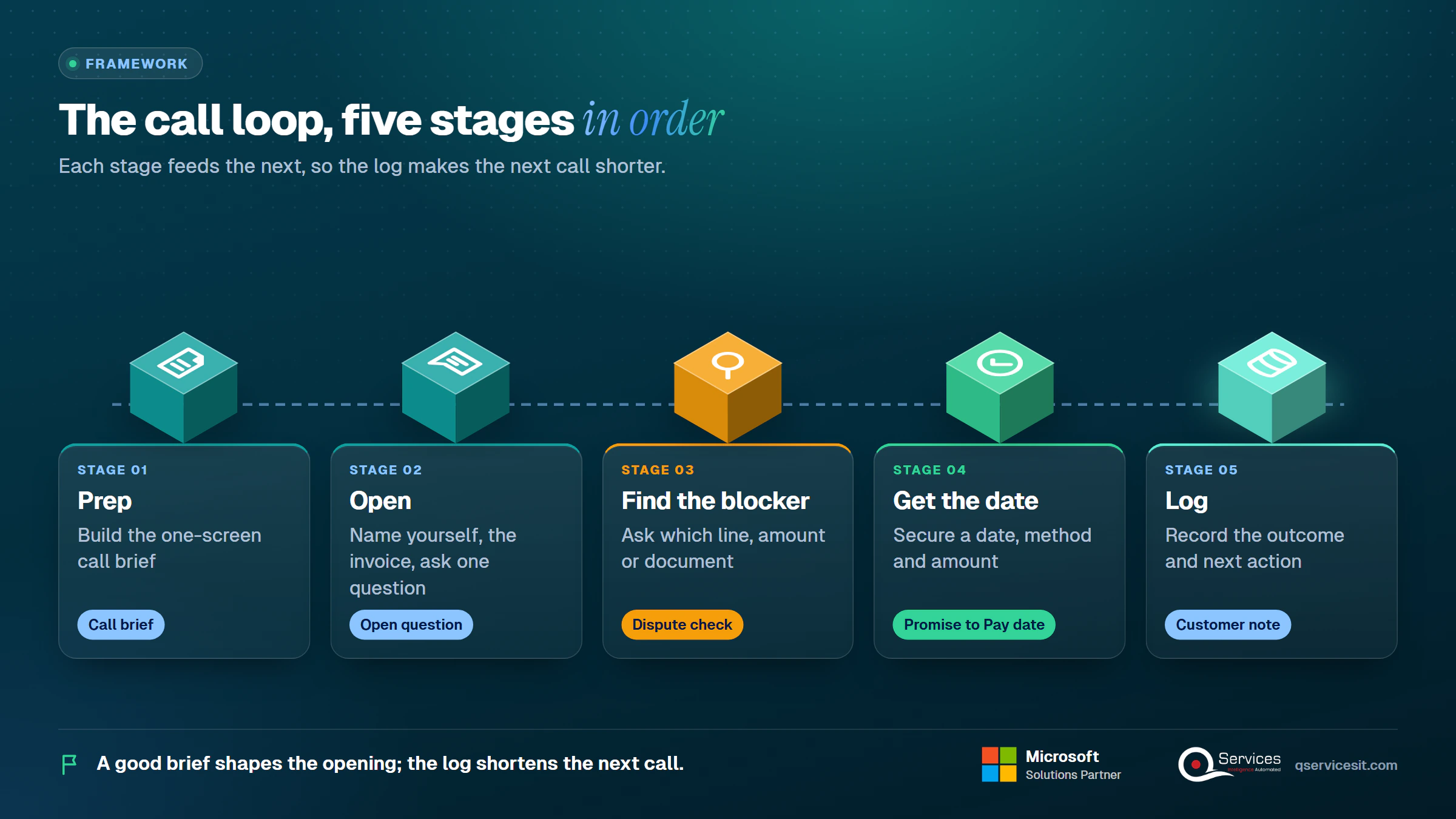
In short: Call Loop = Prep + Open + Find the blocker + Get the date + Log.
What belongs on the pre-call checklist?
Tick these off in about five minutes, or in two if your ERP shows them on one screen:
Our AR aging report guide shows how to read each bucket before you decide who to call first.
What should be on screen in Business Central during the call?
In Dynamics 365 Business Central, we’d have three views ready: the customer card, the Customer Ledger Entries for open items, and the aging for that customer. Check whether any entry is marked On Hold, because Microsoft documents that on-hold entries don’t trigger reminders. Also check the reminder level the account has reached, since levels carry grace periods.
Microsoft Learn says the Finance Agent in Outlook (currently in preview) can show aged balances and open invoices, and lets users access and update the Dispute Status and Promise to Pay date on invoices. We haven’t verified every field name in every Business Central version, so confirm them in your own tenant before you build a routine around them.
Manual brief or agent-built brief: which is better?
|
Manual brief |
Agent-built brief |
| Time per call |
5 to 10 minutes of tab hopping |
About 2 minutes to read and correct |
| Consistency |
Varies by collector |
Same fields every time |
| Disputes and promises |
Missed if notes are scattered |
Pulled from the record and listed first |
| Setup effort |
None |
Worse: needs clean ledger data and consistent notes |
| Risk |
Human error and skipped steps |
A wrong brief if the notes are wrong |
| Who decides |
The collector |
The collector, same as before |
The honest downside is the setup row. An agent only summarises what your records contain, so messy notes produce a messy brief.
When should you make the first past-due call?
Call when the invoice is a few days late and no reply to the first reminder has arrived. Sources differ here: practitioner guides place the first call anywhere from about day 15 to day 60, so treat timing as common practice, not a standard. Our default cadence is below.
| Days past due |
Channel |
Tone |
Owner |
| Before due date |
Email |
Courteous reminder |
Automated, collector reviews |
| Day 1-3 |
Email |
Friendly, factual |
Collector |
| Day 7 |
Email plus call if no reply |
Friendly, curious |
Collector |
| Day 15 |
Call, then recap email |
Direct, helpful |
Collector |
| Day 30 |
Call to the controller |
Firm, specific |
AR manager |
The first call replaces another email when the customer ignored two messages or the balance is large. A fifth reminder email rarely beats a two-minute conversation. Our dunning letter sequence templates show what to send around each call.
Does the FDCPA apply to B2B collection calls?
Usually not. The FDIC’s compliance manual says the FDCPA and Regulation F apply to debt incurred primarily for personal, family or household purposes, not corporate or business debt. State rules, licensing for third-party collectors and your customer contract can still matter. We’re not giving legal advice, so check with counsel before any formal remedy. Stay polite, non-threatening and documented anyway.
Standards & References
What is the first past-due invoice call script?
The first past-due invoice call script is a four-line opening followed by a pause. It’s what to say on a first past-due invoice call when you don’t yet know why the invoice is unpaid.
What is the 60-second opening, word for word?
You: Hi Dana, this is Priya from Northwind Supply. Do you have a minute?
You: I'm calling about invoice 48213 for $14,820, which was due on 3 November.
You: It's 12 days past due. Where does it sit on your side?
(Pause. Let them answer. Don't fill the silence.)
The names are made up, and nothing is left for you to fill in. You identify yourself, state the invoice, ask one open question, then stop talking.
What does a weak opening look like, and how do you fix it?
Weak: ‘Hi, I’m calling because you haven’t paid us and it’s getting really overdue. Why haven’t you paid?’
Better: ‘Hi Dana, it’s Priya at Northwind. I’m calling about invoice 48213. Where does it sit on your side?’
The weak version invites a long defence and sounds like an accusation. The better one asks for information, which is exactly what you need.
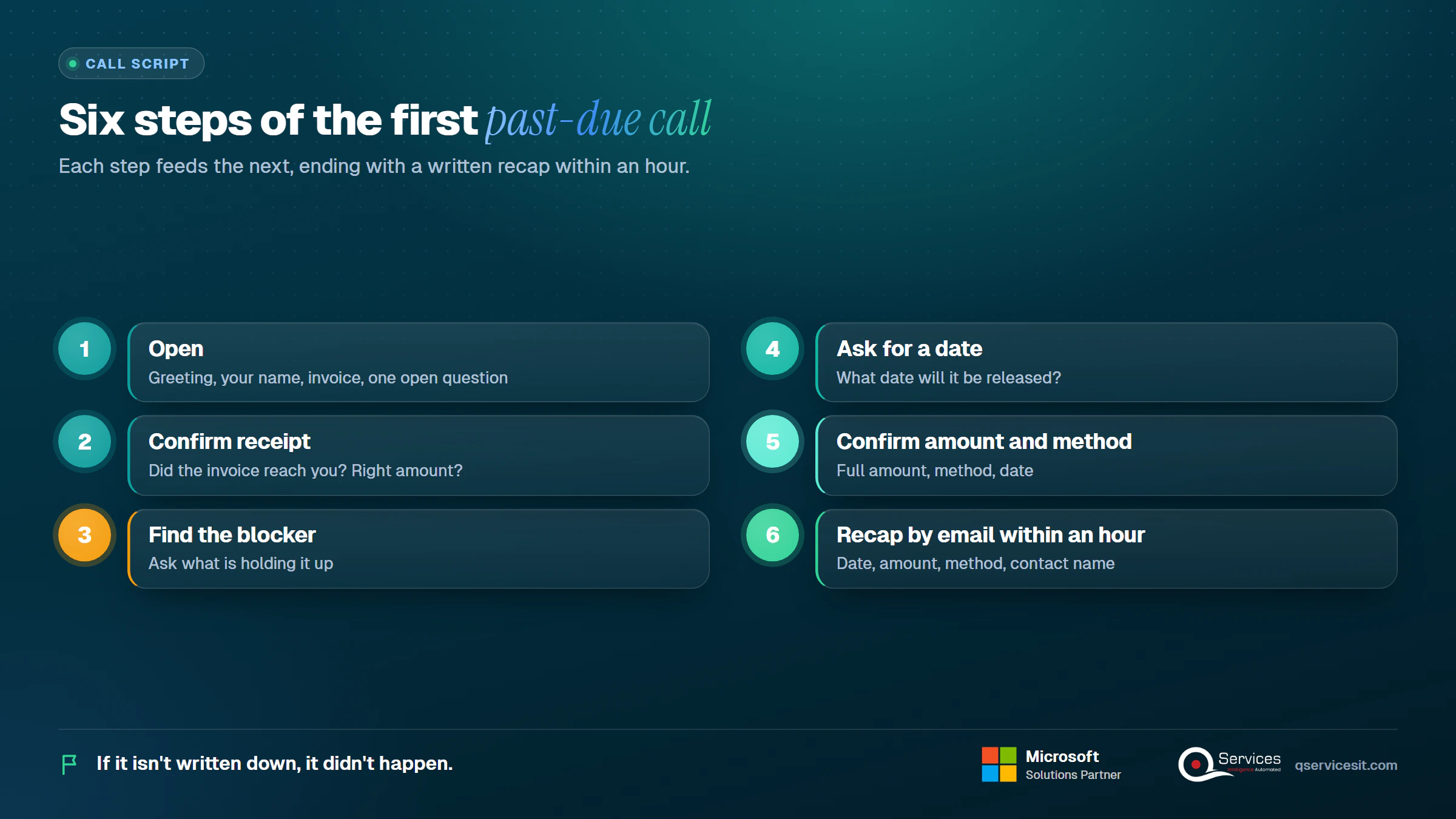
What are the six steps of the call?
- Open: greeting, your name, the invoice, one open question.
- Confirm receipt: ‘Did the invoice reach you, and is it the right amount?’
- Find the blocker: ask what, if anything, is holding it up.
- Ask for a date: ‘What date will it be released?’
- Confirm amount and method: ‘The full $14,820 by ACH on 21 November?’
- Recap by email within an hour: date, amount, method, contact name.
What do you say on voicemail, and what do the email and text say?
Keep voicemail under 20 seconds and never read the balance aloud, since you can’t know who hears it.
Hi Dana, this is Priya at Northwind Supply, calling about an invoice
that's past due. Please call me back on 555-0142. I'll also send
an email with the details. Thanks.
Matching email: ‘Hi Dana, I tried you just now about invoice 48213 for $14,820, due 3 November. A copy is attached. Could you reply with the expected payment date?’
Matching text: ‘Hi Dana, Priya at Northwind. Left you a voicemail about invoice 48213. Email sent with a copy. Call me when you can.’
What questions surface a dispute early?
The best questions are specific and neutral. Avoid opening with ‘why haven’t you paid’, because it invites a long explanation. Ask which line, which amount or which document is the problem instead.
How do you uncover an invoice dispute on a collection call?
To uncover an invoice dispute on a collection call, ask these in order and listen for hesitation:
- ‘Is anything about the invoice itself holding it up?’
- ‘Which line, quantity or amount looks off to you?’
- ‘Is the PO number on the invoice valid in your system?’
- ‘Did you raise this before the due date, and do you have paperwork?’
- ‘If we fix that, can it be paid this week?’
Then assign one owner and a response date. Pause routine reminders while the dispute is open, and don’t promise a credit will be granted. Trade guidance from InsideARM also says a short pay is only acceptable if the customer files the dispute with paperwork and understands the full amount is owed if the dispute is denied.
Key Insight A dispute you find on day 12 costs one phone call. The same dispute found at day 45 costs a month of reminders sent to the wrong person.
What should you say for each of the nine common objections?
| Situation |
Exact sentence |
Listen for |
Next action |
| Forgot or in the payment run |
‘Thanks. Which run is it in, and what date?’ |
A specific run date |
Log the date, confirm by email |
| Never received it |
‘I’ll resend it now. Who should it go to?’ |
A wrong or old address |
Resend to the AP contact, call back in two days |
| Disputed or wrong |
‘Which line or amount is wrong?’ |
One named line |
Open a dispute, one owner, a response date |
| PO or approval missing |
‘Which PO do you have, and who approves it?’ |
A missing or expired PO |
Send the PO copy, ask for a release date |
| Cash-flow problem |
‘Could you pay part now and the rest on a set date?’ |
A realistic amount |
Offer a split plan, route to your manager for approval |
| Already paid |
‘Thanks. What was the date, amount and trace number?’ |
A reference you can check |
Search the bank and unapplied cash, reply within a day |
| Contact has left |
‘Who took over their invoices?’ |
A new name |
Update the customer card, resend |
| Wrong contact |
‘Who releases payments for invoices like this?’ |
A controller or AP lead |
Update the contact, resend, call them |
| Pushback or anger |
‘I hear you. Which part is the problem, so I can fix it?’ |
A real grievance under the tone |
Summarise it back, name an owner, offer a call-back time |
Every row ends with a resolution step. A call that finishes on ‘we’ll look into it’ without an owner and a date hasn’t finished.
For the already-paid row, our guide to unapplied cash explains why a payment you can’t find is often sitting unmatched in your own ledger.
Still chasing disputes after the call?
Learn how an agent can flag dispute signals from past notes and open items before you dial, so the first conversation starts with facts, not guesses.
How do you get a dated promise to pay?
Ask for a date, a method and an amount, in that order. ‘Soon’ and ‘next week’ are not promises, and vague answers extend the payment deadline.
How to get a promise to pay date from a customer?
Use the exact question ‘What date will it be released?’ and then wait. Customers answer a date question with a date more often than a ‘when can you pay’ question, which invites a shrug. Then confirm back:
‘So that’s $14,820 by ACH, released 21 November. I’ll email that to you now. Is that right?’
If they won’t commit to a date, ask what has to happen first and who owns it. That turns an excuse into a task.
Real-World Scenario A typical case we see: a collector at a distributor calls about a $14,820 invoice, 12 days past due. In the naive approach she asks ‘when can you pay?’ and hears ‘later this month’. She logs it as a promise, and nobody follows up until day 40. With Get the date applied, she asks what date it will be released, learns the controller releases on the 21st, and the log carries a real follow-up date.
What do you say when a customer breaks a payment promise?
Reference the earlier date and ask what changed. This is the second-call script:
Hi Dana, it's Priya at Northwind. On 15 November you told me invoice
48213 would be released on 21 November. I don't see it yet.
What changed?
(Listen.) What date can you commit to now?
Be a little firmer than the first call, not angrier. If they say a check is in the mail, ask for the check number and the mail date. Record the broken promise, because a pattern of missed dates should change the account’s risk status and who owns it.
When should you escalate an overdue account to sales?
Escalate to the account owner in sales when a promise has been broken once and the balance is past 30 days, or when the contact keeps changing. In our practice, the ladder looks like this:
- Day 15 to 30, small account: collector, friendly, one more call.
- Day 30 to 45, any account: AR manager calls the controller. Tell the account owner in sales so nothing surprises them.
- Day 45 to 60, large account: account owner joins the call, with the collector’s brief in hand.
- Day 60 or more: your credit policy decides: order holds, final demand, legal review.
These thresholds are our rule of thumb, not a standard. Order blocking in Dynamics 365 is configurable by terms and credit limits, so set it to match your own policy. Sales needs the credit picture early; see how CRM ERP integration gives sales the credit data first.
What to log after every call?
Log these before the next dial: the date and time, who you spoke to, the outcome, the promised date, the amount and method, any dispute and its owner, and your next action with a date. If it isn’t written down, it didn’t happen. Anyone picking up the account tomorrow, including you, will rely on that note.
How to log collection call notes in your ERP?
In Business Central, put the call note against the customer, record the promise on the invoice, and set the dispute where the Finance Agent exposes it. Microsoft documents Dispute Status and Promise to Pay date as updatable on invoices from the Outlook agent. If a dispute is open, mark the entry so reminders stop firing; Business Central doesn’t send reminders for entries marked On Hold.
Use short, structured notes. ‘Spoke to Dana, AP lead. Promise: $14,820 ACH 21 Nov. No dispute. Follow-up 22 Nov.’ beats three paragraphs of narrative.
What does a full call look like on a $14,820 invoice?
This is a made-up scenario. The invoice is $14,820, 12 days past due.
- Priya: ‘Hi Dana, it’s Priya at Northwind. I’m calling about invoice 48213 for $14,820, due 3 November. Where does it sit on your side?’
- Dana: ‘I don’t think we’ve approved it. I don’t see a PO on it.’
- Priya: ‘Which PO number do you have on file?’
- Dana: ‘PO 7731.’
- Priya: ‘That’s the PO on our order, so I’ll resend with it on the invoice. What date will it be released once it’s approved?’
- Dana: ‘Approvals close Thursday, so the run on the 21st.’
- Priya: ‘So $14,820 by ACH on 21 November. I’ll email that now.’
Afterward: the ledger entry gets the promise date of 21 November, the customer card gets a note on the PO gap, and a follow-up task is set for 22 November.
Which metrics show the script is working?
| Metric |
Formula |
What good looks like |
| Promise-to-pay rate |
Calls with a dated promise / connected calls |
Rising month over month |
| Promise-kept rate |
Promises paid on or before the date / promises made |
Close to all of them |
| Days sales outstanding |
Open AR / credit sales x days in period |
Falling against your own baseline |
| Past due over 30 days |
Balance over 30 days past due / total open AR |
Shrinking each month |
| Right-party contact rate |
Calls reaching the AP decision contact / calls attempted |
Rising as contacts are cleaned up |
| Dispute cycle time |
Days from dispute logged to resolved |
Shorter, with one owner per dispute |
We don’t quote industry benchmarks here. The figures we found are vendor-published or undated, so we’d rather you set your own baseline. See days sales outstanding, the collection effectiveness index and how to reduce DSO when your AR team is already stretched.
How does QServices approach a collection call script?
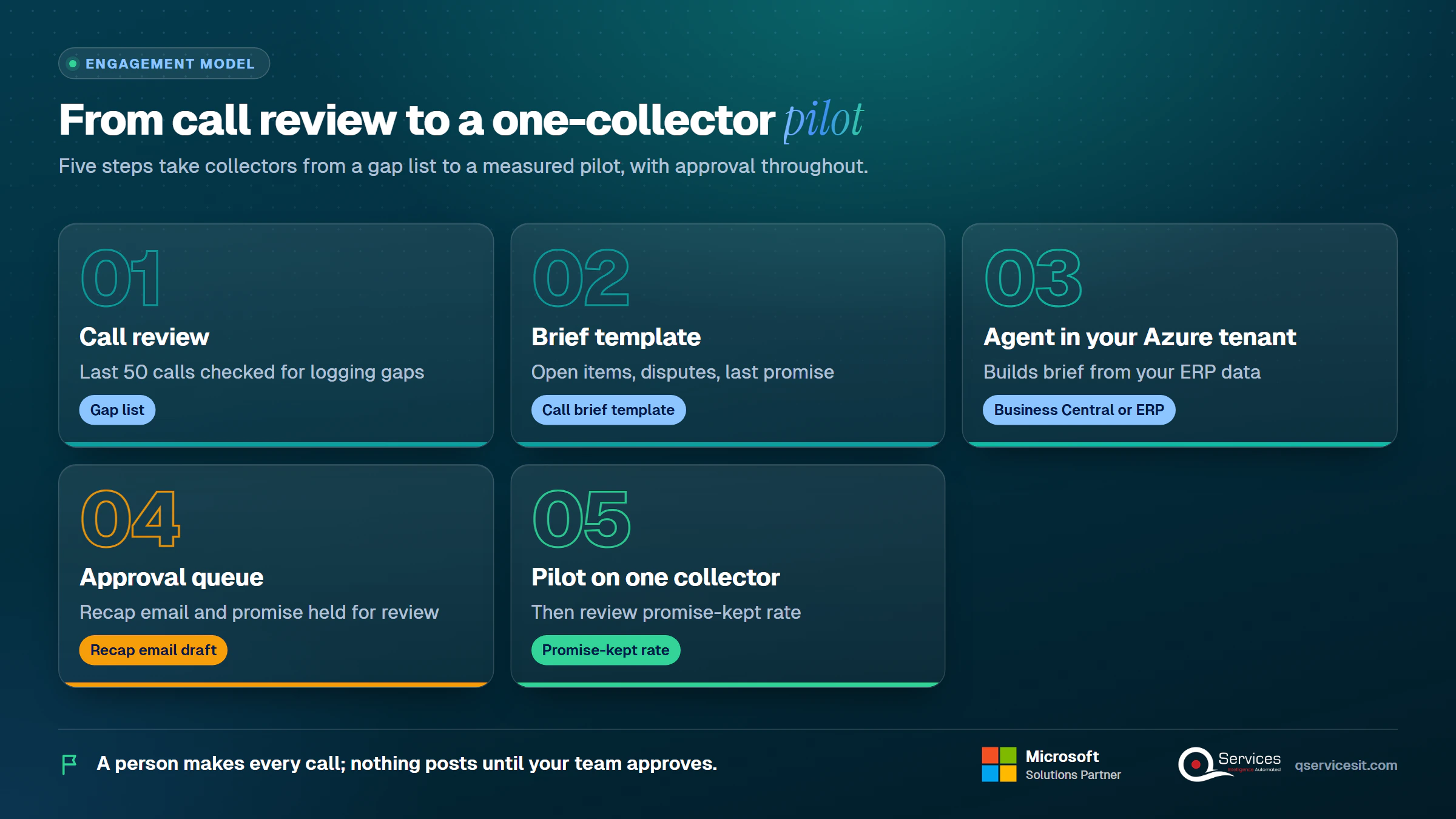
We start with the brief, because a script only works when the collector has the facts in front of them. That is the Prep stage of the Call Loop. Then we add the logging.
- A review of your last 50 collection calls and what got logged, producing a gap list.
- A call brief template covering open items, disputes and the last promise.
- An agent in your own Azure tenant that builds the brief from Business Central or your ERP.
- A recap email draft and a promise written to the customer record, both held in an approval queue.
- A pilot on one collector’s accounts, then a review of promise-kept rate.
A person makes every call, and nothing posts or changes terms until your team approves it. The same team builds and runs it, and our accounts receivable collections work follows the same route.
Implementation Checklist
- First-call opening script saved where collectors can reach it
- Nine objection responses agreed with your AR manager
- Call brief shows balance, aging, last promise and dispute status
- Promise to Pay date is recorded on the invoice after every call
- Reminders paused on entries with an open dispute
- Recap email sent within an hour, checked on five sample calls
- Broken promises tracked and routed to sales on your set rule
- Promise-kept rate measured weekly for the pilot collector
What should you do first to improve your collection calls?
Pilot the script on one collector’s accounts for two weeks and measure promise-to-pay rate, promise-kept rate and dispute cycle time. Then and we’ll review the brief and the log together.

Written by Rohit Dabra
Co-Founder and CTO, QServices IT Solutions Pvt Ltd
Rohit Dabra is the Co-Founder and Chief Technology Officer at QServices, a software development company focused on building practical digital solutions for businesses. At QServices, Rohit works closely with startups and growing businesses to design and develop web platforms, mobile applications, and scalable cloud systems. He is particularly interested in automation and artificial intelligence, building systems that automate routine tasks for teams and organizations.
Accounts receivableCollections workflowERP integrationFinance automation
Talk to Our Experts
Frequently Asked Questions
Related Topics
Next step
Want collectors to start every call prepared?
See how an approval-first agent builds the call brief and logs each outcome, while a person makes the call and approves any payment plan or change to terms.












 Trustpilot5.0★★★★★See reviewsGoodFirms5.0★★★★★45 verified reviews
 G25.0★★★★★See reviewsClutch5.0★★★★★Quality 5.0 · Schedule 4.8
 Google4.7★★★★★Mohali office
 Erik BrownBusiness owner and software engineerClient review
 Zoltan BodnarCFO, Yusen LogisticsGoodFirms
 Ranbeer MakinClientClient review
 Alex VanderElsClientClient review
 Philmore J.ClientClient review
 Michael WilliamsonPresident and CEO, United Way of Southeast LouisianaGoodFirms
 Steven LewisClientClient review
 Brian WallerPresident, Technology Association of IowaGoodFirms