What is a freight audit, and how do 3PLs catch carrier overbilling?
A freight audit checks each carrier invoice against the contracted rate, the shipment record and the proof of delivery before it posts to accounts payable. For a 3PL running Business Central, that means the carrier invoice audit happens before the purchase invoice posts, and only the lines in doubt get held.
3PLs sit in the middle. You pay the carrier and you re-bill the customer, so carrier overbilling you miss on the cost side also corrupts your margin and your customer invoices. Most finance teams pay carriers faster than anyone can check the bills.
This guide walks through the checks, the common overcharges, the Business Central objects involved, and where an approval-first agent fits.
Are carrier invoices paid before they’re checked?
Bring one week of carrier invoices to a short call. We’ll walk through a three-way check in Business Central and where a person approves each line.
Quick Answer A freight audit checks each carrier invoice against the contracted rate, the shipment record and proof of delivery before it posts to accounts payable. For a 3PL, a good freight audit holds only the disputed lines, routes exceptions to a person, and keeps cost errors from corrupting margin and customer re-billing.
What does a freight audit check at a 3PL?
A freight audit is the review of carrier invoices to confirm the bill matches what you agreed to pay. It compares the invoice with the carrier agreement, the shipment documentation and the delivery record. The usual checks are freight rate, discounts, accessorials and duplicate payment.
The method below is the one we use as a mental model for every carrier invoice, whatever the ERP.
The QServices Framework Pre-Posting Freight Audit = Intake → Match → Rate → Hold → Settle
The order matters because every stage before Hold is cheap and reversible, and every stage after posting costs a credit memo and a carrier phone call.
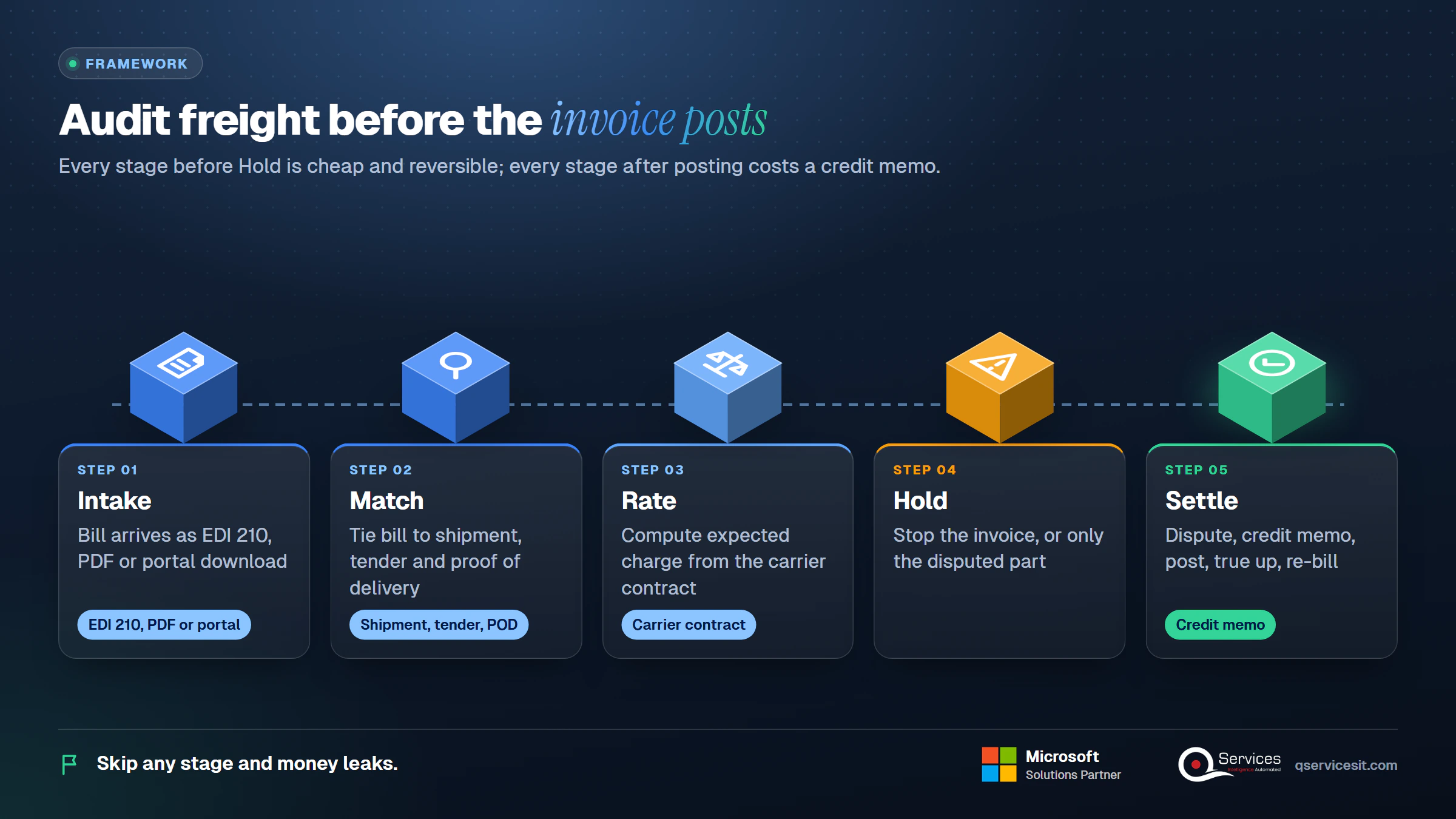
The five stages in plain terms:
- Intake: the bill arrives as an EDI 210, a PDF or a portal download.
- Match: the bill is tied to a shipment, a tender and a proof of delivery.
- Rate: the expected charge is computed from the carrier contract.
- Hold: the invoice, or only the disputed part, is stopped before it posts.
- Settle: dispute, credit memo, post with coding, accrual true-up and customer re-billing.
Put as an equation: freight audit = Intake + Match + Rate + Hold + Settle. Skip any term and money leaks.
Why does a 3PL freight audit differ from a shipper's?
A shipper pays a carrier bill and the story ends. A 3PL runs 3PL freight billing in two directions: it pays the carrier, then re-bills the customer under a contract that can be cost-plus, fixed-rate or pass-through for accessorials.
That changes who loses. Under cost-plus, an unnoticed error gets re-billed to the customer, which invites a credit later. Under a fixed-rate contract, the 3PL eats every dollar it fails to catch. Either way, freight audit for a 3PL is a margin control as much as a cost control.
What is a three-way match for freight invoices?
A three-way match for freight invoices compares the carrier bill with three sources: the contracted rate or tariff, the shipment record, and the proof of delivery. The shipment record means the BOL, PRO number, weight and dimensions as the load left your dock.
The classic purchase order, receipt and invoice match doesn’t map directly, because a freight bill has no PO and no goods receipt. The tender and the POD play those roles. One more point: a POD proves the delivery happened, not that the right tariff version was applied. Rate validation stays a separate step.
How do you audit carrier invoices for a 3PL at invoice level or shipment level?
How to audit carrier invoices for a 3PL comes down to two choices. Invoice-level audit checks the total and the header against the shipment. Shipment-level audit checks every line, such as base rate, fuel and each accessorial, against the contract.
Sampling is enough when spend is small, carriers are few and contract rates are simple. It isn’t enough once you run dozens of carriers, because duplicates and accessorial errors hide in the unsampled invoices. We recommend 100% coverage at shipment level, with the work done by software and the judgment left to people.
Should a 3PL audit freight before or after payment?
Audit before the invoice posts. Pre-payment audit stops the error at the door. Post-payment audit recovers money through carrier claims, and recovery is typically lower than prevention.
| Factor |
Pre-payment audit |
Post-payment audit |
| Fix needed |
Hold or short-pay |
Credit memo or claim |
| Carrier effort |
Low, correct before booking |
High, carrier must reopen a paid bill |
| Claim-window risk |
None |
Rises every week after posting |
| Customer re-billing |
Right the first time |
Re-bill or credit note later |
| Staff effort |
Reviewing exceptions only |
Hunting history in reports |
| When it still makes sense |
Default |
Legacy invoices, carriers without EDI, quarterly sweeps |
Key Insight A freight invoice you hold costs one exception review. A freight invoice you post and then dispute costs a credit memo, a re-bill and a carrier relationship conversation.
What are the overcharges that show up most on carrier invoices?
Carrier overbilling falls into a short list of repeating patterns. We won’t quote an industry overbilling percentage here, because the figures we found are vendor estimates or respondent surveys, not audited transaction data. Measure your own baseline in shadow mode instead.
What are the 8 error types, and where does Business Central hold the evidence?
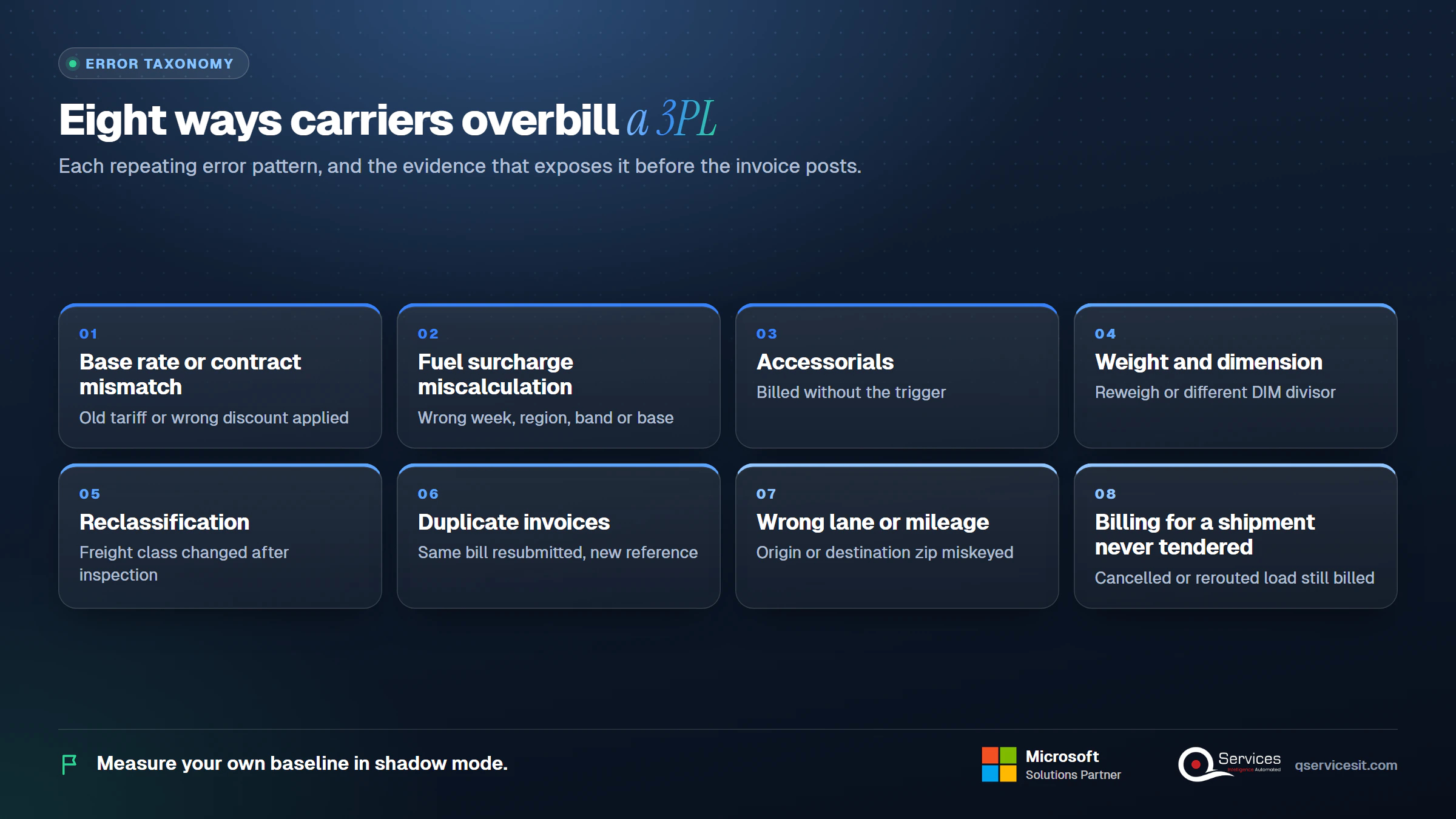
| Error type |
How it happens |
What to check |
Business Central source |
| 1. Base rate or contract mismatch |
Old tariff or wrong discount applied |
Rate per cwt or per mile against the contract |
Rate table loaded per carrier vendor card |
| 2. Fuel surcharge miscalculation |
Wrong week, region, band or base |
Index week, band, and whether accessorials are in the base |
Fuel table plus posted invoice lines |
| 3. Accessorials |
Detention, liftgate, residential, TONU or redelivery billed without the trigger |
POD note, driver timestamps, address type |
Posted warehouse shipment and POD attachment |
| 4. Weight and dimension |
Reweigh or a DIM divisor different from the contract |
Measured weight and dimensions at ship time |
Warehouse shipment lines |
| 5. Reclassification |
Freight class changed after inspection |
NMFC item and inspection report |
Item card and shipment record |
| 6. Duplicate invoices |
Same bill resubmitted under a new reference |
PRO number, carrier, ship date, amount |
Vendor ledger entries |
| 7. Wrong lane or mileage |
Origin or destination zip miskeyed |
Lane against tender |
Shipment header addresses |
| 8. Billing for a shipment never tendered |
Carrier bills a load that was cancelled or went elsewhere |
Tender and BOL exist |
Sales or transfer order and shipment |
How does fuel surcharge drift on carrier invoices happen?
Fuel surcharge drift on carrier invoices is small errors that repeat on every bill. The carrier’s own contract or published table governs the surcharge, so your check is against that table. Verify the index week, the region, the band, and whether accessorials sit inside the percentage base.
In the example below, the carrier applies 24% to linehaul plus accessorials, while the contract applies it to linehaul only. Repeated across thousands of bills, that quiet difference is the largest leak in many audits.
What does one bad LTL invoice look like line by line?
This is an illustrative invoice: 4 pallets, 3,200 lb actual (32 cwt). The contract says class 70 at $38.00 per cwt and a 24% fuel surcharge on linehaul only.
| Line |
Expected |
Billed |
Variance |
| Linehaul |
32 × $38.00 = $1,216.00 |
Class 85, 32 × $44.50 = $1,424.00 |
$208.00 |
| Fuel surcharge |
24% × $1,216.00 = $291.84 |
24% × $1,594.00 = $382.56 |
$90.72 |
| Liftgate |
$0.00 (no POD note) |
$75.00 |
$75.00 |
| Residential |
$0.00 (commercial address) |
$95.00 |
$95.00 |
| Total |
$1,507.84 |
$1,976.56 |
$468.72 |
A $468.72 variance is 23.7% of the expected total, far outside any tolerance, so the invoice goes to the exception queue. The packet goes to the carrier with the contract class, the address record and the POD. In this example the carrier credits the class, fuel and residential lines ($393.72) and upholds the liftgate after producing a signed POD note. The 3PL pays $1,582.84 instead of $1,976.56.
Same pattern, different carrier and charge? The sibling post on accessorial charges 3PL disputes goes deeper on detention, liftgate and residential evidence.
What does a 3PL month look like in dollars?
Here is an illustrative model, not a benchmark. A 3PL processes 1,200 carrier invoices and $480,000 of spend in a month. Assume a 2% error rate on dollars, which is about $9,600 of leakage.
- $5,280 sits on cost-plus customer accounts, where you either re-bill an error and risk a credit later, or absorb it.
- $4,320 sits on fixed-rate accounts, where the 3PL absorbs all of it as lost margin.
At that rate the leak is $115,200 a year. If your real rate is 0.5%, it’s still $28,800. The point of the model is to make you measure.
How do you match invoice, shipment and rate in Business Central?
Freight audit in Business Central starts with an honest limit. Standard Business Central does not audit rates against carrier contracts natively. It gives you the posting, hold and approval machinery, and the audit logic has to come from a rate table, a Power Automate flow, an API integration or an agent.
What are the 10 steps of an audit tied to Business Central objects?
- Intake the invoice as an EDI 210, PDF or portal file, and create a draft purchase invoice under the carrier’s vendor card.
- Match to the shipment or posted warehouse shipment, plus the tender, using PRO number and BOL.
- Check the rate against the contract loaded for that carrier, lane and class.
- Validate accessorials against the POD or detention log.
- Apply tolerance rules per invoice and per line.
- Send exceptions to the exception queue with the variance by line.
- Hold the invoice before posting, or split it so only the disputed amount is held.
- Dispute and receive a purchase credit memo from the carrier.
- Post with the right G/L account and dimensions for lane, customer and warehouse, then true up the accrual.
- Re-bill the customer for pass-through charges at the correct amount.
Business Central logistics teams already have the posting preview on the purchase invoice, the Payment Journal, and the approval workflows. The audit adds the evidence in front of them.
How does proof of delivery matching for freight audit work?
Proof of delivery matching for freight audit ties each accessorial to its trigger. A liftgate needs a POD note or driver record. Detention needs timestamps and the contract’s free time. A residential fee needs the address type. If the POD is incomplete or the rate confirmation can’t be found, the invoice stays held.
How do you catch duplicate carrier bills in Business Central?
To catch duplicate carrier bills in Business Central, match on PRO number, carrier, ship date and amount, not on invoice number alone. The standard duplicate check looks at the vendor’s invoice number, so a resubmission under a new number can slip through.
Example: invoice 118-442-9071 posts for $1,582.84. Weeks later the carrier sends INV-88213R with the same PRO number, ship date and amount. The match key flags it before posting, the agent proposes a hold, and a person confirms it’s a duplicate. An EDI 210 carries only one original per bill, and corrections should carry an amendment or rebill indicator.
How do you set tolerance rules?
Tolerance rules decide which variances pass and which become exceptions. These are starting points to tune, not benchmarks:
| Rule |
Starting point |
Effect if wrong |
| Per-invoice dollars |
$5 to $10 |
Too tight floods the queue |
| Per-invoice percentage |
1% to 2% |
Too loose leaks money |
| Accessorials |
$0, always needs evidence |
Largest leak if waived |
| Duplicates |
$0, always held |
None worth allowing |
Key Insight Set tolerances per line type, not just per invoice. A $60 variance can be harmless on linehaul and unacceptable on a single liftgate charge.
What do the G/L entries look like when a credit memo posts?
Using the LTL example, the invoice is posted with the disputed amount parked in a clearing account, then settled when the dispute closes. The account name is ours, not a Business Central default.
| Moment |
Debit |
Credit |
| Invoice posts |
Freight expense $1,507.84, Freight disputes pending $468.72 |
Carrier payable $1,976.56 |
| Credit memo for $393.72 posts |
Carrier payable $393.72 |
Freight disputes pending $393.72 |
| Liftgate upheld, $75.00 cleared |
Freight expense $75.00 |
Freight disputes pending $75.00 |
Net result: expense $1,582.84, payable $1,582.84, clearing account zero. Dimensions for lane, customer and warehouse stay on the expense lines, so margin reporting stays honest. Where freight is landed cost on inventory, assign it as an item charge to the receipt lines instead; item charges are financial only.
How do you hold a disputed freight line without holding the whole invoice?
How to dispute carrier charges starts with a hold on the right thing. Holding the whole invoice delays payment on lines you agree with, and carriers notice late payment.
Can Business Central hold part of a vendor invoice?
Not natively. Business Central lets you mark a vendor ledger entry On Hold, and Suggest Vendor Payments skips those entries. The Payments on Hold report lists them. The hold is per invoice entry, and we found no documented per-line hold.
So holding a disputed freight line without holding the invoice is a design decision. Our approach is to split the carrier bill into two purchase invoices with the same external reference plus a suffix, for example -A for undisputed and -D for disputed. Pay -A and put -D on hold. That’s our method, not a standard feature.
Real-World Scenario A typical case we see: a 3PL finance manager receives a $2,400 carrier invoice with two liftgate fees ($150 total) and a fuel surcharge $60 over the contract table. The naive approach is to hold the whole invoice, which delays $2,190 the carrier is owed and triggers a call from their collections team. At the Hold stage of the framework, the invoice is split instead. The $2,190 pays on normal terms, the $210 sits on hold with evidence attached, and the dispute ages on its own clock.
How do you dispute a freight invoice line?
A dispute packet should contain: the invoice and line in question, the contract rate or tariff page, the shipment record (BOL, PRO, weight and dimensions), the POD or detention log, any inspection report or photos, and the variance calculation. Send it in writing and track it by age.
Track each dispute with an open date, amount, carrier, line type, status and next action. Aging reports tell you which carriers resolve in days and which stall for months.
How long do you have to dispute carrier charges?
The window depends on the contract first and the law second. Carriers often publish claim windows in their tariffs, and some contracts set shorter periods for reclass disputes, so read each carrier’s terms.
On the statute side, 49 U.S.C. 14705 sets limits for carrier and shipper actions, including an 18-month limit for charge and overcharge actions. FMCSA’s 49 CFR Part 378 covers overcharge and duplicate-payment claims, which must be in writing and, for overcharge claims, accompanied by the freight bill. Check the current wording before you rely on either.
Standards & References
- 49 U.S.C. 14705: limitation periods for carrier and shipper charge actions
- 49 CFR Part 378: FMCSA rules for overcharge and duplicate-payment claims
- Business Central item charges: assigning freight to receipt lines as landed cost
Which carrier lines do you pay without a check?
Duplicate bills and accessorials slip through when payment outruns review. A 30-minute call shows how disputed lines can be held on their own.
What does an agent propose and what does a person approve?
An approval-first freight audit agent works inside Business Central and your CRM, not in a separate portal. It does the reading and arithmetic. A person approves anything that posts money or changes a system.
Where do agents help and where don't they?
The agent reads the invoice, pulls the contract rate, matches it to the shipment, computes the expected charge, flags variances by line, drafts the dispute and learns recurring carrier patterns. It doesn’t approve holds, short-pays or dispute submissions, and it never changes a rate agreement.
| Agent proposes |
Person approves |
| Match result and variance by line |
Holds and short-pays |
| Evidence pack from the shipment and POD |
Dispute submission |
| Draft dispute text |
High-value exceptions |
| Hold flag or split suggestion |
Any rate-agreement change |
| Duplicate candidate |
Carrier relationship calls |
Business Central’s own Payables Agent (in preview) reads vendor invoices and creates draft purchase documents that need human approval before posting. It doesn’t audit freight rates, so that role is custom. Copilot and agents also run only on Business Central online.
Which audit approach fits: in-house, vendor, TMS module or ERP-native agent?
3PL carrier invoice matching can be built four ways:
| Factor |
Spreadsheets |
Audit and payment vendor |
TMS audit module |
ERP-native agent |
| Coverage |
Samples |
100% of submitted bills |
Bills in the TMS |
100% inside Business Central |
| Cost structure |
Staff time |
Percentage of recovery or per-invoice fee |
Licence tied to TMS |
Build plus run |
| ERP integration depth |
Manual keying |
Export or import files |
Varies by TMS |
Native posting, holds, dimensions |
| Time to value |
Days |
Weeks to months |
Depends on TMS rollout |
Weeks, with shadow mode first |
| Honest downside |
Doesn’t scale |
Your data sits elsewhere |
Only as good as TMS data |
Needs clean vendor master and loaded contracts up front |
The last row is the trade-off. An ERP-native agent asks more of your data hygiene on day one than a vendor who absorbs the mess.
Which metrics show a freight audit is working?
These are targets for you to set against your own baseline, not industry benchmarks. We found no independent benchmarks worth quoting.
| KPI |
Definition |
Target direction |
| Invoices audited |
Share of invoices that get a full audit |
Aim for 100% |
| First-pass match rate |
Invoices that match with no exception |
Rises as contracts load |
| Exception rate |
Invoices sent to the queue |
Falls, then stabilises |
| Dispute rate |
Disputed lines as a share of total lines |
Falls as carriers correct |
| Recovery |
Dollars recovered as a share of freight spend |
Track monthly |
| Dispute cycle days |
Average days to close a dispute |
Shorten |
| Aged disputes |
Disputes open past 60 days |
Near zero |
| Days to pay |
Average days to payment by carrier |
Stable or shorter |
| DSO impact |
Days to collect re-billed charges |
No increase |
What does a 30/60/90-day freight audit rollout look like?
- Days 1 to 30: clean the carrier vendor master, load contract rates for your top carriers by spend, and define tolerances.
- Days 31 to 60: run in shadow mode for two weeks, comparing the agent’s flags with what your team finds, then tune tolerances.
- Days 61 to 90: turn on holds with approval, start disputes, and track the KPIs above.
How does QServices approach freight audit?
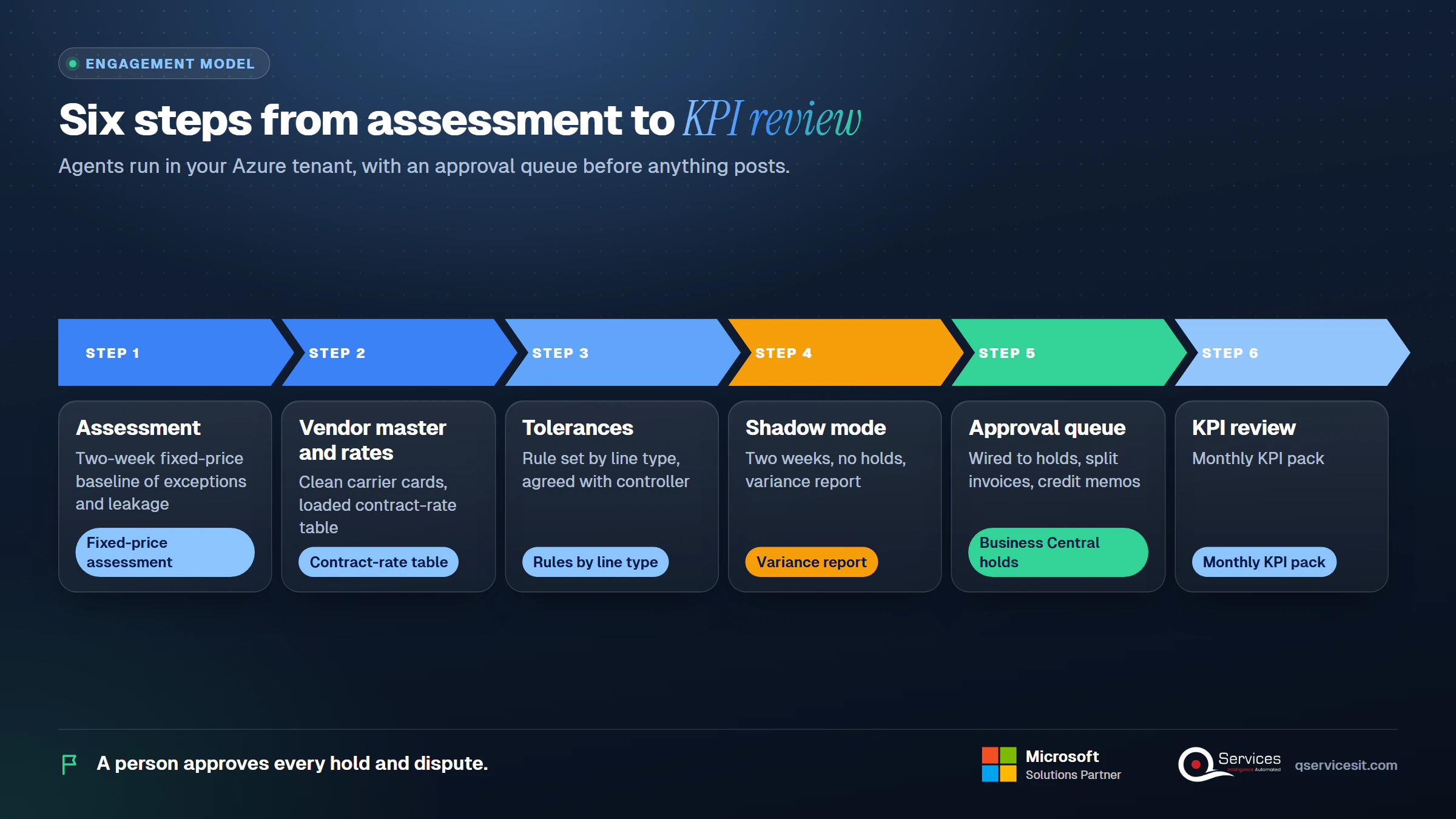
We start at the Match stage, because contract rates can’t be checked until every invoice ties to a shipment. The delivery is the same team building and running it, with agents running in your own Azure tenant and an approval queue before anything posts. Our AI agent development work on this follows these steps:
- A two-week fixed-price assessment with a baseline of your exception rate and leakage.
- A cleaned carrier vendor master and a loaded contract-rate table.
- A tolerance rule set by line type, agreed with the controller.
- A two-week shadow-mode run with no holds and a variance report.
- An approval queue wired to Business Central holds, split invoices and purchase credit memos.
- A monthly KPI pack covering the table above.
Implementation Checklist
- Every carrier has one vendor card with payment terms set
- Contract rates are loaded for the top carriers by spend
- Tolerance rules are written down per line type
- Accessorial lines require a POD note or log before approval
- Duplicate match key (PRO, carrier, ship date, amount) is active
- The G/L clearing account for disputes pending exists
- Two weeks of shadow mode are complete and reviewed
- A named person approves every hold and dispute
What should you do first to stop carrier overbilling?
Pilot freight audit on your three largest carriers in shadow mode for two weeks, and measure first-pass match rate, dollars flagged and dispute cycle days. A person approves every hold and dispute, so nothing posts without you. and we’ll scope the pilot against your own carrier invoices.

Written by Rohit Dabra
Co-Founder and CTO, QServices IT Solutions Pvt Ltd
Rohit Dabra is the Co-Founder and Chief Technology Officer at QServices, a software development company focused on building practical digital solutions for businesses. At QServices, Rohit works closely with startups and growing businesses to design and develop web platforms, mobile applications, and scalable cloud systems. He is particularly interested in automation and artificial intelligence, building systems that automate routine tasks for teams and organizations.
Freight auditBusiness CentralERP integrationFinance automation
Talk to Our Experts
Frequently Asked Questions
Related Topics
Next step
Ready to audit freight before it posts?
Talk with our team about an approval-first agent that checks carrier bills against rates, shipments and PODs, while your people approve what posts.













 Trustpilot5.0★★★★★See reviewsGoodFirms5.0★★★★★45 verified reviews
 G25.0★★★★★See reviewsClutch5.0★★★★★Quality 5.0 · Schedule 4.8
 Google4.7★★★★★Mohali office
 Erik BrownBusiness owner and software engineerClient review
 Zoltan BodnarCFO, Yusen LogisticsGoodFirms
 Ranbeer MakinClientClient review
 Alex VanderElsClientClient review
 Philmore J.ClientClient review
 Michael WilliamsonPresident and CEO, United Way of Southeast LouisianaGoodFirms
 Steven LewisClientClient review
 Brian WallerPresident, Technology Association of IowaGoodFirms