What should a month end close checklist include?
Free Excel month end close checklist: 42 tasks, 12 areas, owners and due dates that calculate from your period end. A close takes 3 to 5 business days, and each task shows its day. Get it by email.
Enter your work email and the Excel file arrives in your inbox: 42 close tasks in 12 areas, a status dropdown, a progress summary, a filled-in October 2026 example and a short how-to.
Excel workbook · 42 tasks · works in Excel and Google Sheets
Not there in a few minutes? Check spam, or .
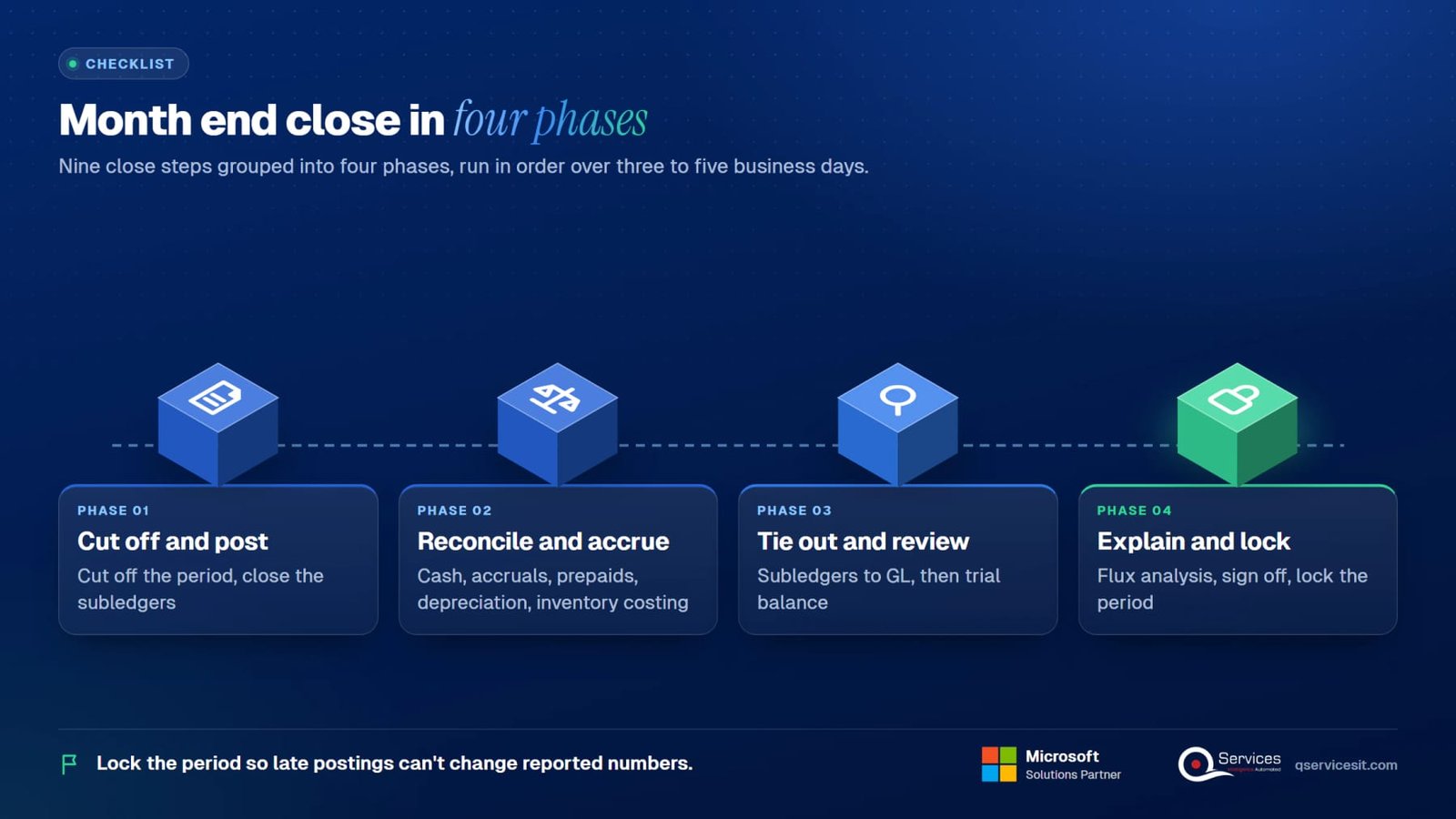
Three to five business days is a realistic target for a single-entity company with clean subledgers. Here's the plan, from Day -1 to Day 5. The template turns each step into dated tasks with owners.
Confirm receiving, shipping and billing cut-offs. Tell approvers when the last expense report and invoice must land. Day 1 starts with the same data everyone saw on the last day of the month.
Finish AR, AP, inventory and fixed asset postings. Run the recurring journals. Nothing else can be reconciled until the subledgers stop moving.
Match the bank statement to the cash ledger. List outstanding cheques and deposits in transit with dates, so the next person can clear them.
Accrue what you used but haven't been billed for: utilities, payroll, goods received not invoiced. Amortize prepaids. Reverse last month's accruals first.
Post monthly depreciation. Run the inventory cost adjustment and post cost to the GL. Both feed the trial balance.
AR, AP and inventory subledger totals must equal their control accounts. A difference is a posting that bypassed the subledger or a timing gap. Find it today.
Scan for odd balances: credits in asset accounts, debits in liabilities, accounts that should be zero. Fix errors before analysis.
Compare this month to last month. Explain every line over your threshold, in writing, with a source document.
Preparer, reviewer and controller sign. Issue statements. Lock the period in the ERP so late postings can't change reported numbers.

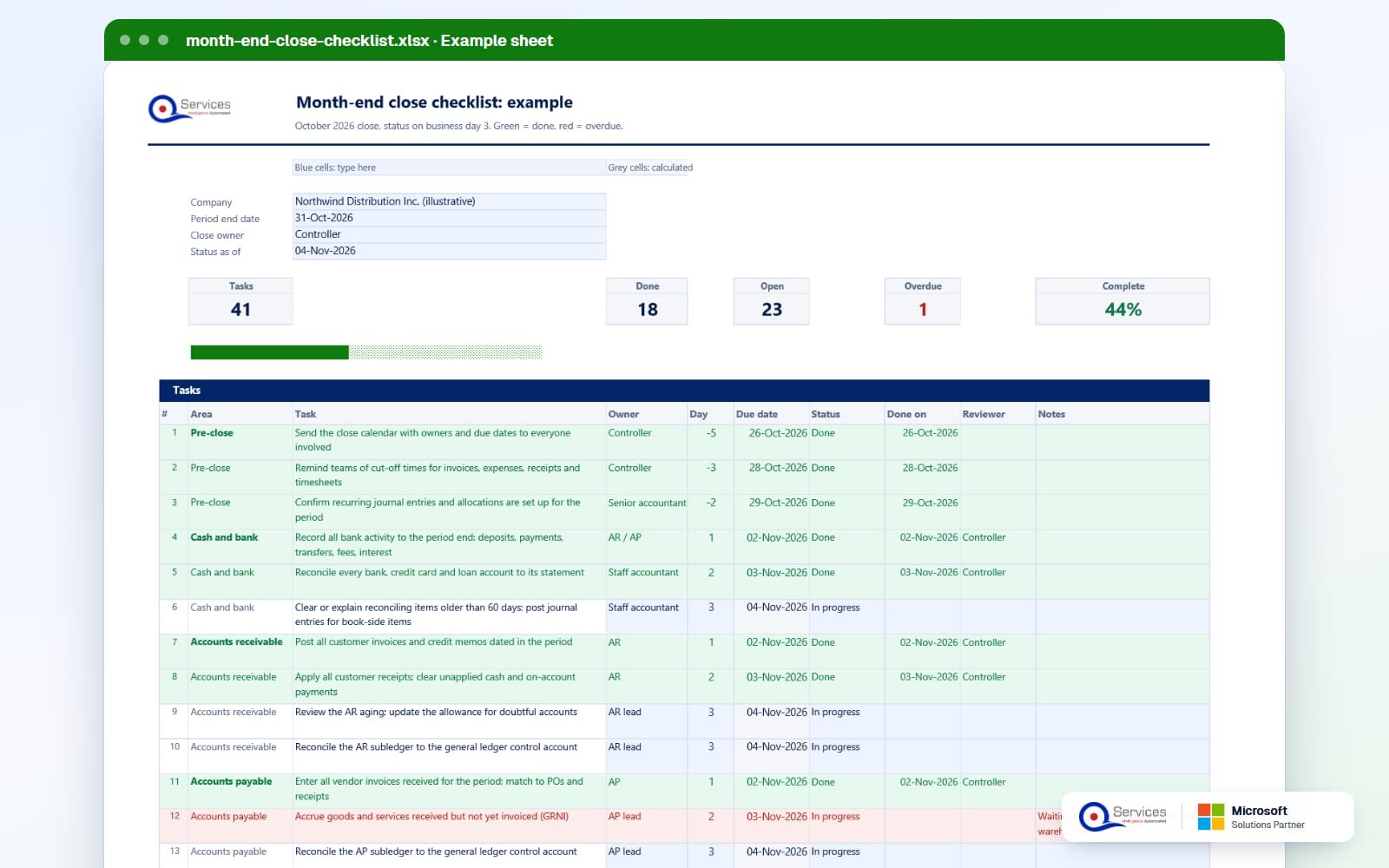
The template ships with this example filled in: the October 2026 close for Northwind Distribution Inc. (illustrative). Period end is Saturday 31 Oct 2026, so business day 1 is Monday 2 Nov. The status below is as of Wednesday 4 Nov.
| Line | Northwind, status on business day 3 |
|---|---|
| Period end | Saturday 31 Oct 2026; business day 1 is Monday 2 Nov |
| Tasks in the checklist | 42 |
| Marked N/A | 1 (intercompany charges, single entity this month) |
| Tasks in scope | 41 |
| Done | 18 |
| Open | 23, including the overdue one |
| Overdue | 1: the GRNI accrual (goods received not invoiced), due business day 2 (3 Nov), still in progress |
| Why it's late | Waiting on the receiving report from the warehouse |
| % complete | 44% (18 of 41 in scope) |
| Pre-close tasks | Ran on days -5, -3 and -2 |
| Statements | Due day 5 |
| Management review and period lock | Day 6 |
| Retrospective | Day 7 |
One overdue row turns red and the summary counts it, so the controller sees the problem on day 3 instead of day 6.
Six items from the same fictional company, each with debit and credit lines. The amounts are illustrative. Use them to sanity-check your own entries.
| Entry and lines | Debit or credit | Amount |
|---|---|---|
| 1. Accrue unbilled October utilities: Utilities expense | Debit | $4,200 |
| 1. Accrued expenses | Credit | $4,200 |
| 2. Prepaid insurance, $36,000 annual premium, one month: Insurance expense | Debit | $3,000 |
| 2. Prepaid insurance | Credit | $3,000 |
| 3. Monthly depreciation: Depreciation expense | Debit | $12,500 |
| 3. Accumulated depreciation | Credit | $12,500 |
| 4. Bank rec: statement balance | Start | $248,300 |
| 4. Add deposit in transit | Plus | $9,500 |
| 4. Less outstanding cheque | Minus | $6,800 |
| 4. Adjusted bank balance equals GL cash | Match | $251,000, difference $0 |
| 5. Accrue payroll for days worked but unpaid: Salaries expense | Debit | $18,600 |
| 5. Accrued payroll | Credit | $18,600 |
| 6. AR subledger vs GL control account | Tie-out | $412,350 vs $412,350, difference $0 |
| 6. AP subledger vs GL control account | Tie-out | $287,900 vs $287,900, difference $0 |
The bank reconciliation needs no entry here: an outstanding cheque and a deposit in transit are timing items, and they clear next month. The four entries total $38,300 in debits and $38,300 in credits.
Selected accounts before and after the four entries. Expenses rise by $38,300 and the matching credits land in the balance sheet.
| Account | Before entries | After entries |
|---|---|---|
| Cash | $251,000 Dr | $251,000 Dr |
| Accounts receivable | $412,350 Dr | $412,350 Dr |
| Prepaid insurance | $24,000 Dr | $21,000 Dr |
| Accumulated depreciation | $300,000 Cr | $312,500 Cr |
| Accounts payable | $287,900 Cr | $287,900 Cr |
| Accrued expenses | $9,000 Cr | $13,200 Cr |
| Accrued payroll | $0 | $18,600 Cr |
| Utilities expense (October) | $7,000 Dr | $11,200 Dr |
| Insurance expense (October) | $0 | $3,000 Dr |
| Depreciation expense (October) | $0 | $12,500 Dr |
| Salaries expense (October) | $142,000 Dr | $160,600 Dr |
| Entries total | n/a | $38,300 debits = $38,300 credits |
If your trial balance doesn't move by the same debit and credit totals, an entry posted one-sided or hit the wrong period.
Set a rule and apply it the same way every month. This one flags a line only when it moves more than 10% and more than $5,000 against last month.
| Line | Oct 2026 | Sep 2026 | Variance | Flag |
|---|---|---|---|---|
| Revenue | $1,840,000 | $1,795,000 | +$45,000 (2.5%) | No |
| Inventory | $1,204,000 | $1,131,000 | +$73,000 (6.5%) | No: over $5,000, under 10% |
| Freight-in expense | $96,000 | $71,000 | +$25,000 (35.2%) | Yes: explain |
| Bad debt expense | $9,000 | $3,000 | +$6,000 (200%) | Yes: explain |
| Utilities expense | $11,200 | $10,900 | +$300 (2.8%) | No |
| Salaries expense | $160,600 | $158,900 | +$1,700 (1.1%) | No |
Requiring both tests keeps small accounts from drowning you in noise and large accounts from hiding real swings. Pick thresholds that fit your own volumes.
A close isn't done when the numbers look right. It's done when someone other than the preparer has checked them and the proof is filed. The COSO framework treats this separation of duties as a core control activity.
Most late closes trace back to the same few habits. Fix these before buying anything.
Menu names shift by version, role and setup, so use each product's search to confirm yours. These are the pages and routines the close touches. For Business Central, see our Business Central practice; for GP, Dynamics GP.
An agent works inside your ERP and does the matching and drafting. A person approves every action. It doesn't post anything on its own. See how month-end close automation works.
Reads the subledgers, bank lines and trial balance through the ERP's own interfaces, with a read-only role to start.
Proposes accruals, matches bank lines, runs the tie-outs and flags variances over your threshold, each with its source.
The preparer and reviewer see each proposed entry and approve, edit or reject it. Nothing posts until they do.
Approved entries go to the ERP with the evidence attached, and every step lands in an audit trail.
We map your close tasks, set the permissions and tune thresholds with your controller. Start with a process assessment and see human-in-the-loop agents.
Three to five business days is a common target for a single-entity company with clean subledgers. Multi-entity groups, heavy inventory or manual bank feeds take longer. Track your own days and shorten them one task at a time. Our month end close process guide covers the sequence in more detail.
A soft close lets you produce management numbers while the period stays open for adjustments. A hard close locks the period so nothing posts to it. Many teams soft close on day 3 and hard close after review.
Accrue an estimate at month end, supported by the receiving report or contract. Book the difference when the invoice arrives, in the open period. Don't reopen a locked period for a small variance.
No. Reconcile cash, AR, AP, inventory and payroll liabilities monthly. Lower-risk accounts can follow a schedule by risk and balance, if your controller documents it. For AR, see our accounts receivable reconciliation routine.
Revenue recognition under FASB ASC 606 and lease accounting under ASC 842 both generate month-end entries, such as deferred revenue releases and lease amortization. Your auditors will expect them to follow documented policy.
Find the difference before moving on. Check for postings straight to a control account, items in the wrong period, and unposted batches. The template's status column keeps the item open and visible until it's cleared.
Bring your checklist and your ERP. We'll show where an approval-first agent fits and where it doesn't.
Facts on this page checked on 19 November 2026.

Founder and CEO

Chief Sales Officer
Thanks, we’ve got your details. A named member of our team will reply within one business day.
Talk to a QServices solutions architect about your ERP. You'll leave with two or three automation ideas you can act on, even if you never work with us.