What is a suspense account, and how do you clear it?
A suspense account is a temporary general-ledger account that holds an amount until you know which account it belongs to. It should clear to zero by period end. Any balance left over is a finding for your controller, not a normal part of the books.
A suspense account is a temporary general-ledger account used to park a transaction whose correct account is not yet known. A person identifies the item, posts a clearing journal to the right account, and the suspense balance returns to zero. A suspense account that holds the same amount for months is a control problem, not a parking space.
Entries below are illustrative. Account names and numbering vary by chart of accounts.
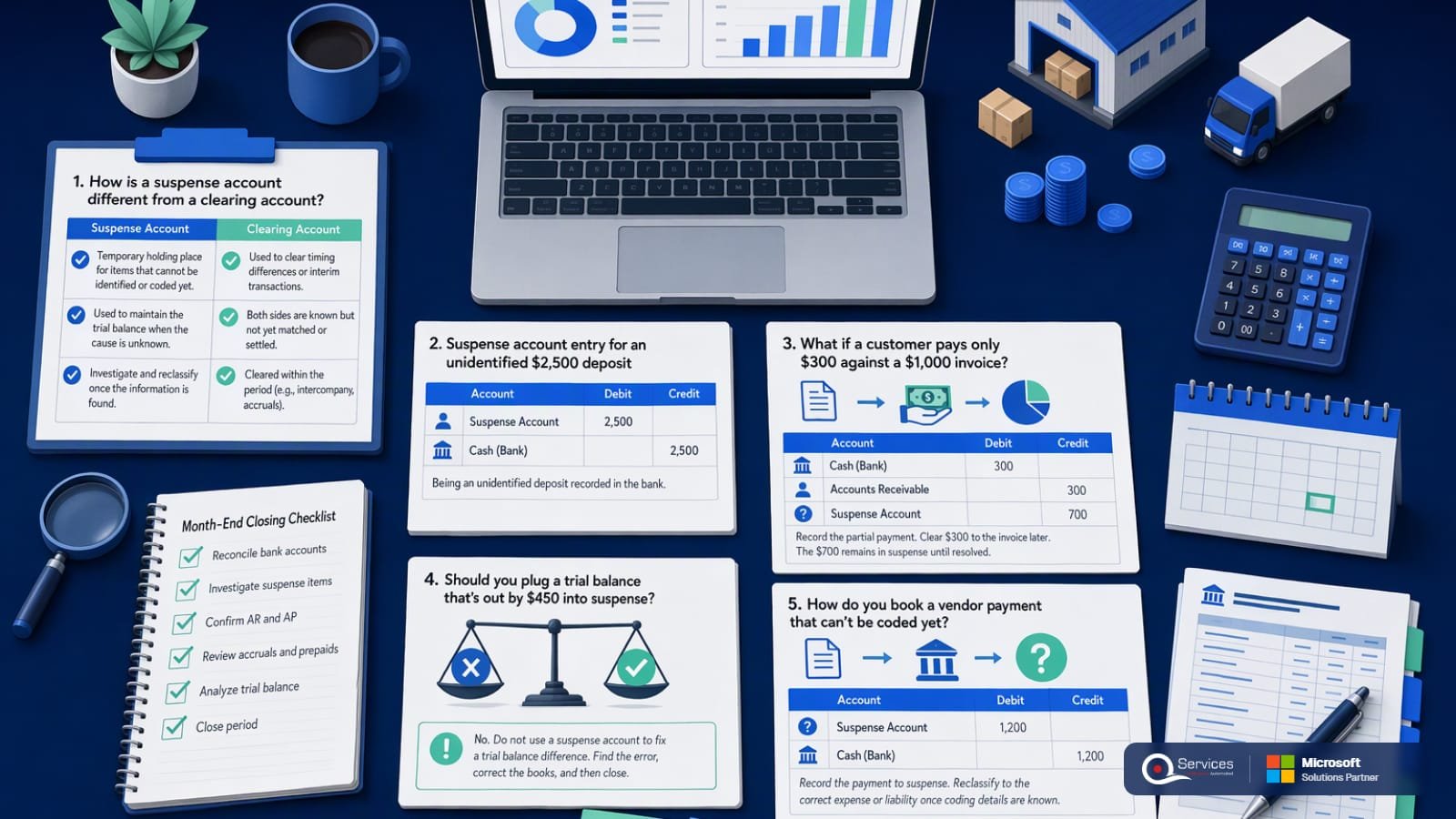
A suspense account holds items you can't yet classify. Nobody knows where the money belongs.
A clearing account holds items you can classify, but that settle later. Think payment processor batches or payroll liabilities. The destination is known and the timing differs.
Many teams use the two names loosely. That's fine in conversation. In the ledger, keep them as separate accounts, because they have different owners and different review rules.
The test is simple. If you know the right account and are only waiting for settlement, it's a clearing account. If you don't know the right account, it's suspense.
Why it matters. A suspense account keeps the trial balance honest while research is under way. Without one, teams plug unknowns into revenue, expenses or the bank account, and the error gets harder to find.
A customer wire for $2,500 lands in the bank with no remittance. You can't name the customer. Illustrative numbers.
| Step | Account | Debit | Credit |
|---|---|---|---|
| 1. Receipt arrives, payer unknown | Bank | $2,500 | |
| 1. Receipt arrives, payer unknown | Suspense | $2,500 | |
| 2. Payer identified as a known customer | Suspense | $2,500 | |
| 2. Payer identified as a known customer | Accounts Receivable | $2,500 | |
| 3. Result | Suspense balance | $0 |
Suspense carries a credit balance between steps 1 and 2, so it sits as a current liability on the balance sheet. The credit to Accounts Receivable in step 2 then gets applied to the customer's open invoice in the sub-ledger. Your subledger and the general ledger should agree after both steps.
If the customer and invoice are clear, don't use suspense. Post the $300 against the invoice and leave $700 open. Use suspense only when you can't tell what the $300 is for. Illustrative numbers.
| Case | Account | Debit | Credit |
|---|---|---|---|
| A. Invoice is clear | Bank | $300 | |
| A. Invoice is clear | Accounts Receivable | $300 | |
| B. Purpose unclear, park it | Bank | $300 | |
| B. Purpose unclear, park it | Suspense | $300 | |
| B. Later, matched to the invoice | Suspense | $300 | |
| B. Later, matched to the invoice | Accounts Receivable | $300 |
In both cases the invoice shows $700 open once the $300 is applied. Never apply a partial payment to make an invoice look paid. If the short pay is a dispute or a deduction, route it to deductions and short pays.
The old rule was yes: post the difference to suspense so the trial balance balances, then hunt for the error. Modern practice says find the error first. A plug hides it. Illustrative numbers.
| Step | Account | Debit | Credit |
|---|---|---|---|
| Trial balance: debits exceed credits by $450 | (no entry yet) | ||
| Old plug, only if policy allows it | Suspense | $450 | |
| Error found: a $450 cash sale was debited to Bank, but the sales credit was never posted | Suspense | $450 | |
| Error found: a $450 cash sale was debited to Bank, but the sales credit was never posted | Sales revenue | $450 |
Modern ERPs post balanced journals, so a one-sided entry like this is rare in current systems. It still shows up after data migrations and manual imports. Treat any plug as a short-lived exception with a named owner and a due date.
A $1,800 payment leaves the bank, but nobody can confirm the expense account or cost center. Illustrative numbers.
| Step | Account | Debit | Credit |
|---|---|---|---|
| 1. Payment made, coding unknown | Suspense | $1,800 | |
| 1. Payment made, coding unknown | Bank | $1,800 | |
| 2. Coding confirmed as freight expense | Freight expense | $1,800 | |
| 2. Coding confirmed as freight expense | Suspense | $1,800 |
Here suspense carries a debit balance. A debit balance is an asset-like holding until it's cleared, but don't leave it there. Reclassify it before you issue financials, and confirm the presentation with your auditors.
It depends on the side of the balance. The account type is not fixed.
Credit balance: money received that you can't yet assign. It's a liability to the unknown payer or customer. Show it as a current liability.
Debit balance: money paid out or costs incurred that you can't yet classify. It behaves like a current asset until cleared.
Pick one description and keep it. Some guides call the account 'Other Assets' in one place and say it holds debits and credits in another. Both can be true on different dates. Pick the treatment per balance side, document it, and apply it every period.
No accounting standard defines the account. US GAAP and IFRS don't have a rule named for it. What they require is that the financial statements are accurate and complete, so a material unresolved balance needs to be explained or reclassified.
Most balances come from a handful of sources. Knowing the source tells you who should clear the item.
| Source | Typical cause | Usual owner |
|---|---|---|
| Unidentified receipts | Wire or ACH with no remittance, or a payer name that doesn't match any customer | Cash application |
| Bank feed items | Fees, interest or transfers with no matching ledger entry | Treasury or accounting |
| Payroll | Differences between payroll provider totals and posted journals | Payroll accountant |
| Intercompany | One entity posted a transfer and the counterparty hasn't yet | Consolidation team |
| GRN and invoice mismatch | Goods received without a matching invoice, or the reverse | Accounts payable |
| Mortgage suspense | Servicer holds partial payments until they add up to a full periodic payment | Loan servicing |
| Brokerage suspense | Client cash or securities not yet allocated to an account (practice varies by firm) | Operations |
Mortgage and brokerage suspense accounts are real uses, but they sit in the servicer's or broker's own books and follow their rules and regulators. For a controller in a normal company, the first five rows are the ones you'll see.
These are examples of a sound policy. Set the thresholds with your controller and auditors.
It shouldn't. The goal is a zero balance when you close the period.
If a balance remains, document why, show what you've done to clear it and reclassify it to the best-supported account. Don't carry it forward quietly.
Auditors will ask. An old, unexplained suspense balance suggests weak reconciliation controls. Material amounts can lead to adjustments or a deficiency finding.
Don't write it off to clear the books. Releasing a credit balance to income without evidence can break the rules on unclaimed property in some jurisdictions. Get tax and legal advice first.
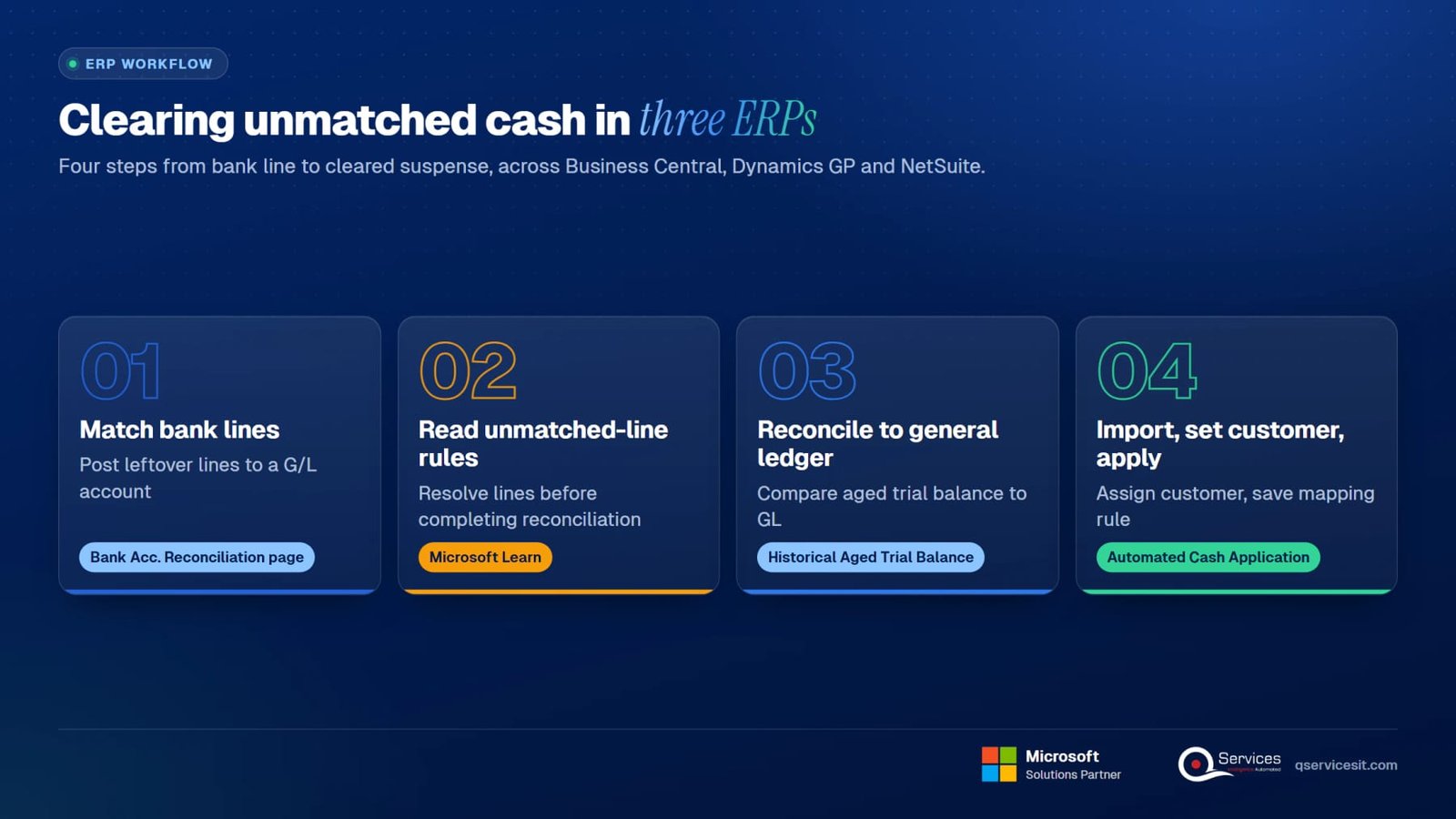
Each system gives you tools to hold, find and clear unapplied cash. Check the points flagged in each step against your own setup before you rely on them.
On the Bank Acc. Reconciliation page, Match Automatically and Match Manually link bank lines to ledger entries. Lines with a Difference stay on the page. Use Transfer to General Journal to create the missing entries, then match them. In the Payment Reconciliation Journal, payments apply to open customer or vendor ledger entries, and you can map recurring payment text to accounts. Flag to check: which G/L account you use for unidentified cash, and that bank posting groups don't allow direct posting, as Microsoft advises. See Business Central partner services.
Microsoft Learn says lines that can't be matched remain on the page and must be resolved before you complete the reconciliation. It also says Business Central can't post many-to-one matches that carry differences, even when the differences net to zero. Post the differences first, then match them. Flag to check: whether your version offers Reconcile with Copilot, which Microsoft describes as a preview feature.
Receipts can post unapplied in Receivables Management and be applied later. Compare the Historical Aged Trial Balance to the GL trial balance. Microsoft says that is the true reconciliation. Reconcile to GL (Tools, Routines, Financial) produces an Excel file of matched, potentially matched and unmatched distributions. Microsoft describes it as a troubleshooting aid, not a true reconciliation. Common causes of differences include unposted GL batches and edits to batches after posting. Flag to check: your posting setup and whether unposted batches are open. See Dynamics GP consultant services.
Oracle's Automated Cash Application creates customer payments from imported bank lines and lists lines it couldn't match. You can assign a customer to an unmatched line and NetSuite can save a mapping rule for later lines. Remaining items go through Match Bank Data before reconciliation. Flag to check: how your account handles customer deposits and unapplied payments, since Oracle's pages don't treat the two as one thing. Confirm your own account setup. For integration work, see ERP integration.

The agent does the research and the typing. A person approves every journal, application and write-off. Nothing posts on its own.
The agent reads the suspense account and the unapplied cash list in your ERP each day. It builds the aging report you'd otherwise assemble by hand.
It compares amount, payer name, reference text, remittance files and EDI 820 remittances against open invoices. It ranks candidates and shows its evidence.
It prepares the application or the reclass journal with the proof attached. It does not post.
A cash application analyst or the controller reviews the draft, edits it if needed and approves. Preparer and approver stay separate people.
The approved action posts in the ERP with a full audit trail. Rejected items go back with a reason the agent learns from.
We set thresholds, owners and approval limits with your finance team, and map them to your ERP. See human-in-the-loop agents and how we clear unapplied cash.
Get better remittance data. Most unidentified receipts lack a payer reference. Use a standard remittance advice template and ask large payers for EDI 820.
Tighten matching rules. Map recurring payer names and bank text to customers. Review the rules each quarter.
Fix the process, not just the item. Track why each item landed in suspense. If one source causes half the balance, fix that source. Our cash application process steps show where leaks usually start.
Go deeper on the process. The full picture is on the cash application page, and the month-end close and reconciliation page covers the close side.
It depends on the balance. A credit balance, such as money received from an unknown payer, is a current liability. A debit balance, such as a payment you can't code yet, behaves like a current asset until cleared. Document the treatment and apply it consistently.
It shouldn't. Aim for zero at every period end. If a balance remains, document why, reclassify it to the best-supported account and tell your auditors. Old unexplained balances often draw audit questions.
It's an account a loan servicer uses to hold partial payments until they add up to a full periodic payment. Servicers follow their regulator's rules on how long they can hold funds and when they must apply them. It sits in the servicer's books, not the borrower's.
A suspense account holds items you can't yet classify. A clearing account holds items you can classify but that settle later, like card processor batches. Keep them as separate accounts with different owners.
There's no accounting rule on a number. A common policy is 30 days for research, escalation at 60 and controller review at 90. Set your own limits, write them down and test them each close.
Avoid it. A plug hides the error. Find the cause first. If policy allows a temporary plug, give it an owner and a due date, and clear it before you issue financials.
They usually ask for the open item list, the aging, support for clearing journals and evidence of who approved them. For SOX, they evaluate the controls over reconciliation and journal entries. PCAOB AS 2201 describes that audit approach.
It's a normal G/L account in your chart of accounts. Business Central doesn't force one. You choose the account for unidentified cash, use the Bank Acc. Reconciliation or Payment Reconciliation Journal to work items, and post clearing entries from a general journal.
Bring your open item list and your ERP. We'll show where the items come from and what an approval-first agent would draft for your team to approve.
Facts on this page checked on 17 November 2026.

Founder and CEO

Chief Sales Officer
Thanks, we’ve got your details. A named member of our team will reply within one business day.
Talk to a QServices solutions architect about your ERP. You'll leave with two or three automation ideas you can act on, even if you never work with us.