Security is that one area where banks and financial institutions invest heavily. According to the reports, more than 25% of bank assets are in the form of investment securities. As the need for cybersecurity becomes more important, cloud infrastructure comes out as a universal solution to safeguard investments. Azure compliance offerings stand out in this ecosystem as a robust building block for millions of developers and IT professionals. Its comprehensive infrastructure provides the necessary tools and frameworks that enable financial institutions to address complicated security compliance challenges with ease.
Why banks need to follow Regulatory compliance
Compliance is a fundamental principle for banks and financial institutions. It keeps them within legal, ethical and financial parameters while safeguarding customers, investors, and the economy. Regulatory compliance involves following laws that are designed to prevent fraud, increase transparency, and promote stability of the financial system.
Governments and regulatory bodies enforce strict rules to minimize risks like money laundering, cybersecurity threats, and financial mismanagement. Compliance helps banks build trust, avoid legal issues, and maintain smooth operations. Ignoring these regulations can lead to severe consequences.
Banks failing to comply with regulatory standards may face challenges, including:
Heavy Fines: Banks that fail to comply with regulatory bodies have to pay heavy penalties, which sometimes even reaches in billions.
Loss of Reputation: Failing to comply with regulatory standards may lead to negative publicity and customer distrust.
Legal Consequences: Violations can result in lawsuits, investigations, and other increased problems.
Operational Disruptions: Non-compliance may lead to restrictions, affecting a bank’s ability to operate efficiently.
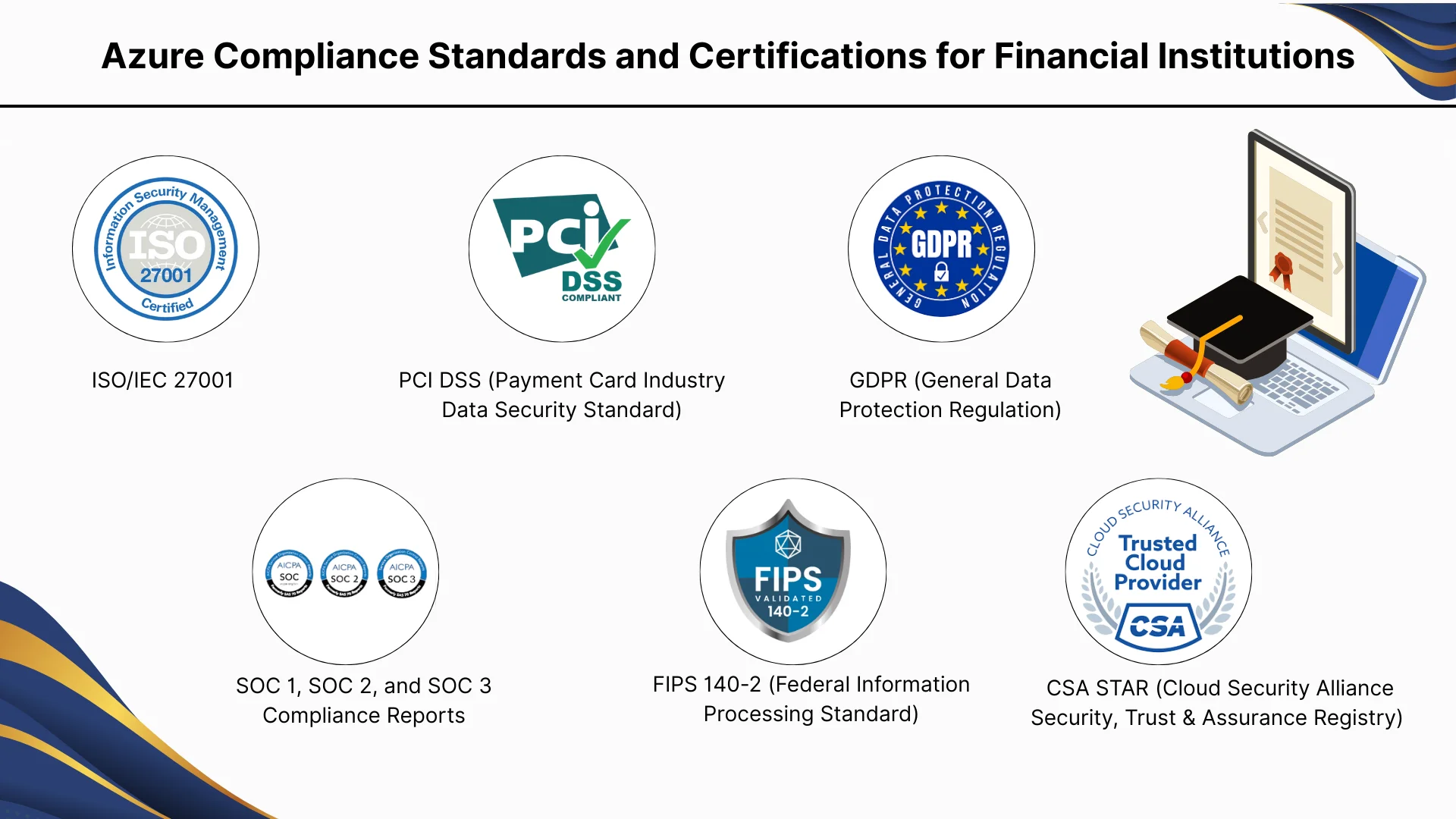
Azure Compliance Standards and Certifications for Financial Institutions
Microsoft Azure’s security framework comply with most of the global security and regulatory requirements. It provides an easy framework for financial institutions to secure their operations as well as adhere to industry regulations. Here are some of the most important financial regulations that Azure meets:
ISO/IEC 27001
This international standard ensures financial institutions manage security risks and protect sensitive data. Azure follows it to provide a secure environment for financial operations.
PCI DSS (Payment Card Industry Data Security Standard)
Financial institutions handling credit and debit card transactions must follow PCI DSS. Azure provides a secure infrastructure that helps banks meet payment security and compliance requirements.
GDPR (General Data Protection Regulation)
Banks must protect customer data under GDPR rules. Azure offers tools that help financial institutions manage data security, ensure privacy, and meet regulatory compliance requirements.
SOC 1, SOC 2, and SOC 3 Compliance Reports
Azure conducts independent audits to assess security and operations. These Azure compliance reports help financial institutions prove compliance and meet audit requirements set by regulatory authorities.
FIPS 140-2 (Federal Information Processing Standard)
Azure meets FIPS 140-2 encryption standards to secure financial data. This ensures sensitive banking information is protected from unauthorized access and potential security threats.
CSA STAR (Cloud Security Alliance Security, Trust & Assurance Registry)
CSA STAR provides transparency into Azure’s security controls and risk management processes, helping banks assess cloud security before migration. Moreover, Azure also supports compliance with country-specific financial regulations, including:
U.S. Federal Financial Institutions Examination Council (FFIEC) requirements.
MAS (Monetary Authority of Singapore) Technology Risk Management (TRM) Guidelines.
UK Financial Conduct Authority (FCA) Cloud Guidelines.
Let's Discuss Your Project
Get free Consultation and let us know your project idea to turn into an amazing digital product.
Key Azure Security Tools for Banking and Financial Services
Azure provides a comprehensive set of tools and solutions that helps banks and financial institutions protect their cloud infrastructure from cyberthreats and maintain compliance with regulatory standards. Here are its five pillars that strengthens financial operations:
1. Identity and Access Management (IAM) Solutions
Controlling who can access financial data is crucial for preventing unauthorized access and fraud. Azure Active Directory (Azure AD) is the foundation of identity management in Azure. It helps banks:
Enable Multi-Factor Authentication (MFA), which adds an extra layer of protection to prevent unauthorized logins.
Activate Role-Based Access Control (RBAC) that ensures only designated employees get access to the necessary data whenever they need.
Use Conditional Access for an extra layer of security to restrict access based on user location, device, or risk level.
Fact: Strict identity and access controls allow banks to minimize the risk of insider threats by up to 90%.
2. Data Security and Encryption
Protecting sensitive customer information is a top priority for financial institutions as a single breach can harm their reputation significantly. Azure provides tools that encrypt data at every stage:
When data is at rest, Azure automatically encrypts data using Azure Storage Service Encryption (SSE) and Azure Key Vault to prevent unauthorized access.
When data is in transit, it is still protected using TLS (Transport Layer Security) and Azure VPN Gateway encryption protocols.
Even when data is in use, it can be still protected with Confidential Computing, which secures sensitive data during processing.
With these encryption mechanisms, banks ensure that even if data is intercepted, it remains unreadable to attackers.
3. Threat Protection and Security Monitoring
Financial institutions are prime targets for cybercriminals, hence banks need to adopt extremely secure solutions. Azure offers advanced threat protection and real-time monitoring tools, including:
Microsoft Defender for Cloud, which detects online vulnerabilities and provides security recommendations.
Azure Security Center that monitors security posture and compliance across cloud workloads.
Azure Sentinel, a cloud-native SIEM (Security Information and Event Management) solution, that analyses security events and detects potential breaches.
Facts: The average cost of a financial organization’s breach in 2023 was $4.45 million. Banks can stop cyberattacks and identify threats early by utilising Azure security tools.
4. Compliance and Risk Management
Managing multiple regulatory standards becomes overwhelming for banks. However, Azure makes it easy with its set of tools, including:
Compliance Manager– This tool from Microsoft provides a unified platform to manage regulatory assessment reports and can also automate compliance tracking.
Azure Blueprints– This tool provides several blueprint definitions that help deploy secure cloud environments aligned with industry regulations.
Fact: Banks can reduce operating expenses by up to 30% by utilising Azure’s compliance and automation tools efficiently.
5. Network Security and Infrastructure Protection
A secure cloud infrastructure is critical for financial services. Azure offers strong network security controls, including:
Azure Firewall, a cloud-native firewall that filters and blocks unauthorized network traffic.
Azure DDoS Protection, that shields banking applications from Distributed Denial-of-Service (DDoS) attacks.
Virtual Private Networks (VPNs) which establish encrypted connections between on-premises data centres and the cloud.
Azure Private Link that secures sensitive banking services by keeping them off the public internet.
Did you know that applying basic security principles like multi-factor authentication, zero trust principles, and keeping systems updated can protect against 99% of cyberattacks.
Best Practices for Implementing Azure Compliance Solutions in Banking
Complying with regulatory standards is really important for financial institutions and Azure makes it easy do so. By following Azure’s security best practices, banks can protect sensitive data, prevent fraud, and meet industry regulations. Here are some key steps to implement Azure compliance solutions effectively.
Enforce Strong Authentication Measures
Banks must implement Multi-Factor Authentication (MFA) to add an extra security layer beyond passwords. Azure AD enables seamless MFA integration, requiring users to verify their identity through additional methods like biometrics or authentication apps, reducing the risk of unauthorized access.
Encrypt Financial Data at Every Level
Protecting sensitive financial information requires strong encryption. Azure Key Vault securely manages encryption keys, secrets, and certificates, while Azure’s built-in encryption tools ensure data is protected at rest, in transit, and in use, preventing unauthorized exposure.
Monitor Security Threats in Real Time
Banks need proactive security monitoring to detect threats early. Microsoft Defender for Cloud identifies vulnerabilities, while Azure Sentinel uses AI-driven analytics to detect and respond to suspicious activities, helping financial institutions prevent cyberattacks before they escalate.
Restrict Access with Role-Based Permissions
Financial institutions must control access to critical data. Role-Based Access Control (RBAC) ensures employees only access the data required for their role, reducing the risk of insider threats and minimizing the exposure of sensitive banking information.
Automate Compliance Audits
Compliance audits can be time-consuming, however automation simplifies the process. Azure Compliance Manager works as a helping hand that allows financial institutions to generate real-time compliance reports, track regulatory requirements, and streamline audits.
Implement Secure Network Infrastructure
Banks must safeguard their networks against cyber threats. Azure Firewall, VPNs, and DDoS Protection provide multiple layers of security, preventing unauthorized access, encrypting data transmission, and protecting applications from large-scale attacks.
Keep Cloud Services and Security Patches Updated
Old systems make banks more open to attacks. Keeping Azure cloud services, safety updates, and money programs up-to-date helps banks lower risks, stop break-ins, and follow changing rules. This allows banks to protect themselves better and stay compliant with laws.
Eager to discuss about your project ?
Share your project idea with us. Together, we’ll transform your vision into an exceptional digital product!
Compliance is the survival secret of banks and financial institutions. Azure security and compliance gives a complete solution that streamlines regulatory management while keeping customers safeguarded against cyber threats. By leveraging Azure’s tools like multi-factor authentication, data encryption, and more, financial institutions can protect themselves from cyber risks and legal challenges in the future.
Many banking institutions waste costly resources when implementing Azure technology due to a lack of expertise. To avoid heavy fines and adopt Azure efficiently, financial institutions must collaborate with Microsoft-certified companies like QServices.
Azure provides multi-layered security including identity management, data encryption, threat protection, real-time monitoring, and network security tools to prevent and detect cyber risks.
Yes, Azure’s advanced security features like multi-factor authentication, encryption, and AI-driven threat monitoring can help banks reduce data breach risks by up to 90%.
Azure AD provides multi-factor authentication, role-based access control, and conditional access to ensure only authorized personnel can access sensitive financial information.
Azure encrypts data at rest, in transit, and during processing using Storage Service Encryption, TLS protocols, Azure Key Vault, and Confidential Computing technologies.
By implementing role-based access control (RBAC) and multi-factor authentication, banks can restrict data access and significantly reduce the risk of unauthorized internal data exposure.
Non-compliance can result in heavy fines reaching billions, reputation damage, legal consequences, operational disruptions, and loss of customer and investor trust.
Azure offers tools like Azure Policy, Compliance Manager, and Azure Blueprints to help financial institutions automate and track regulatory compliance efficiently.
Azure Key Vault securely manages encryption keys, secrets, and certificates, helping banks protect sensitive financial data across different stages of processing.
Every bank today is trying to do more with the same teams. Customer emails are increasing, compliance checks are getting stricter, and service expectations are becoming instant. Yet most internal processes still depend on manual steps. Employees move data from one screen to another, verify documents by hand, and follow long approval chains.
Many enterprise teams treat identity and access as if they are the same thing. They aren’t. Identity confirms who a user is. Access defines what that user is allowed to do. Assuming that an authenticated identity automatically deserves access is one of the most common—and costly organizational security mistakes.
Most enterprises did not choose to be here. Core systems were built to be stable, not adaptable. Over time, layers of customization, integrations, and workarounds turned reliability into rigidity. Today, every new digital initiative feels harder than it should be.
QServices Inc. undertakes every project with a high degree of professionalism. Their communication style is unmatched and they are always available to resolve issues or just discuss the project.
Turn the Microsoft Licenses
You Already Own Into an AI Workplace
Join our live webinar on Sept 24 and see five ways to automate meetings, approvals, and






 Azure provides a comprehensive set of tools and solutions that helps banks and financial institutions protect their cloud infrastructure from cyberthreats and maintain compliance with regulatory standards. Here are its five pillars that strengthens financial operations:
 Complying with regulatory standards is really important for financial institutions and Azure makes it easy do so. By following Azure’s security best practices, banks can protect sensitive data, prevent fraud, and meet industry regulations. Here are some key steps to implement Azure compliance solutions effectively.