Every bank today is trying to do more with the same teams. Customer emails are increasing, compliance checks are getting stricter, and service expectations are becoming instant. Yet most internal processes still depend on manual steps. Employees move data from one screen to another, verify documents by hand, and follow long approval chains.
Traditional automation helped in the past, but it solved only small parts of the problem. Rule-based tools could copy data or trigger simple actions, but they could not understand documents or customer intent. This gap is why generative AI in banking has become a major focus area for financial institutions.
Why banks need more than basic automation
Banks handle a mix of structured and unstructured information. Loan files, customer emails, invoices, and KYC documents rarely follow a fixed format. Older systems were never designed for this complexity. As a result, teams spend hours on tasks that should take minutes.
Industry reports indicate that a large portion of banking delays come from manual reviews and decision steps. This is exactly where AI automation in finance can create real value. Instead of replacing people, AI can assist them with understanding data, drafting responses, and suggesting next actions.
The promise of generative AI in banking
Generative AI in banking introduces a new way of working. It can read long documents, summarize key points, and respond in natural language. When connected with power platform workflow automation, these abilities can be embedded directly into daily operations.
Imagine a customer service agent using power apps AI integration to get instant answers while speaking to a client. Think about a compliance officer using microsoft power platform AI to review documents faster without missing risks. These are not future ideas. They are practical scenarios already taking shape.
Power Platform as the bridge
The Microsoft ecosystem brings these capabilities together. Tools like power automate AI and copilot for power platform allow banks to combine automation with intelligence. Workflows no longer remain static. They start adapting to real situations.
Many banking leaders describe the same feeling. They want innovation that fits inside their existing systems and governance. They want AI that supports employees instead of confusing them. This is exactly the space where generative AI in banking and Power Platform meet.
What this blog will address
This blog looks at the problem from a banker’s point of view. It focuses on real pain points, practical use cases, and achievable steps. If you are exploring generative AI for banking workflows, this discussion will help you connect technology with everyday operations.
Market Reality and Pain Points of Banks
Banks today face pressure from all sides. Customers want quick answers. Regulators ask for more checks. New fintech companies offer smooth digital experiences. But inside many banks, work still moves slowly. Teams jump between systems and spend hours on routine tasks. This is the daily state of AI in banking / finance.
A recent industry survey showed that most banking leaders see process delays as the biggest barrier to growth. The issue is not effort. The issue is the way workflows are designed.
What employees struggle with every day
Look at a normal banking day. A customer sends an email about a loan. An officer downloads statements, checks identity documents, and updates core systems. Another team reviews the same file for compliance. Each step takes time.
This is why banks are turning toward generative AI in banking to support real work instead of adding more software.
Where old automation fails
Older automation followed strict rules. It could copy data but could not understand meaning. Banking work rarely follows fixed patterns. Documents arrive in different formats. Customers ask questions in their own words. Fraud cases change often.
Because of this, many automation projects stopped halfway. Teams still needed to read, think, and decide. This gap opened the door for AI automation in finance that can handle language and context.
Impact on customers
Customers feel these problems directly. Loan approvals take days. Support chats give generic replies. Business clients repeat the same details again and again. These experiences push customers toward digital-first competitors.
Banks know they must respond faster. Staff need tools that can assist them in real time. This need is driving interest in power platform workflow automation and intelligent assistants.
Compliance makes the challenge bigger
Banks cannot move fast without safety. Every action must be recorded. Every decision must be explained. This makes leaders careful about new technology. They need AI that works inside secure platforms such as Microsoft power platform AI.
The clear need
The message from the market is simple. Banks need workflows that are:
Fast for customers
Easy for employees
Safe for regulators
Traditional tools cannot deliver all three together. This is why attention is shifting toward generative AI in banking as a practical path forward.
Generative AI for banking workflows
Banks are not looking for another tool. They are looking for a better way to work. Generative AI in banking becomes valuable only when it fits inside real workflows used by relationship managers, operations teams, and compliance officers. This section explains in depth how AI changes everyday banking activities instead of remaining a technology concept.
From doing tasks to understanding tasks
Traditional banking systems were built to follow instructions. Generative AI in banking is different. It can read, understand, and respond like a knowledgeable assistant. This shift changes how workflows are designed. Instead of asking employees to fit work into rigid systems, the system begins to fit around the employee.
Think about a relationship manager receiving a customer email. Earlier, the manager had to read the message, open the core system, check policy documents, and then draft a reply. With AI for banking workflows, the email can be understood instantly. The system can suggest the right response, highlight missing details, and even prepare the next steps.
How understanding replaces manual effort
Generative AI works with three abilities:
1. Reading unstructured data such as PDFs, emails, and forms
2. Generating human-like responses for customers and teams
3. Suggesting decisions based on past patterns
When these abilities connect with power automate AI, routine work starts disappearing. Employees focus on judgment instead of typing and copying.
Real workflow scenarios
1. Customer service requests
A customer asks about charges on an account. Without AI: The agent checks multiple screens and replies after several minutes. With power apps AI integration: The system reads the query, pulls account details, and drafts a clear response instantly. The agent only reviews and sends.
2. KYC document review
Without AI: Manual comparison across documents. With generative AI in banking: The system extracts key fields, flags mismatches, and prepares a summary for the officer.
3. Loan processing
Without AI: Hours of reading and data entry. With Microsoft power platform AI: Statements are summarized, risks are highlighted, and the officer receives a structured recommendation.
The role of Power Platform in the flow
Through power platform workflow automation, banks can connect core systems, emails, and portals with AI models.
A simple flow:
Power Apps collects customer input
copilot for power platform understands intent
Power Automate moves data
AI drafts responses
Employee reviews and approves
Humans remain in control while every step becomes faster.
Questions banks usually ask
While exploring generative AI for banking workflows, leaders ask:
Will AI understand local banking language?
Can decisions remain explainable?
How is customer data protected?
Can this work with current systems?
These questions shape responsible adoption.
What changes for employees
Employees no longer start from blank screens. They start with AI suggestions, summaries, and drafts. This is why AI automation in finance is seen as a support layer that improves daily life.
Let's Discuss Your Project
Get free Consultation and let us know your project idea to turn into an amazing digital product.
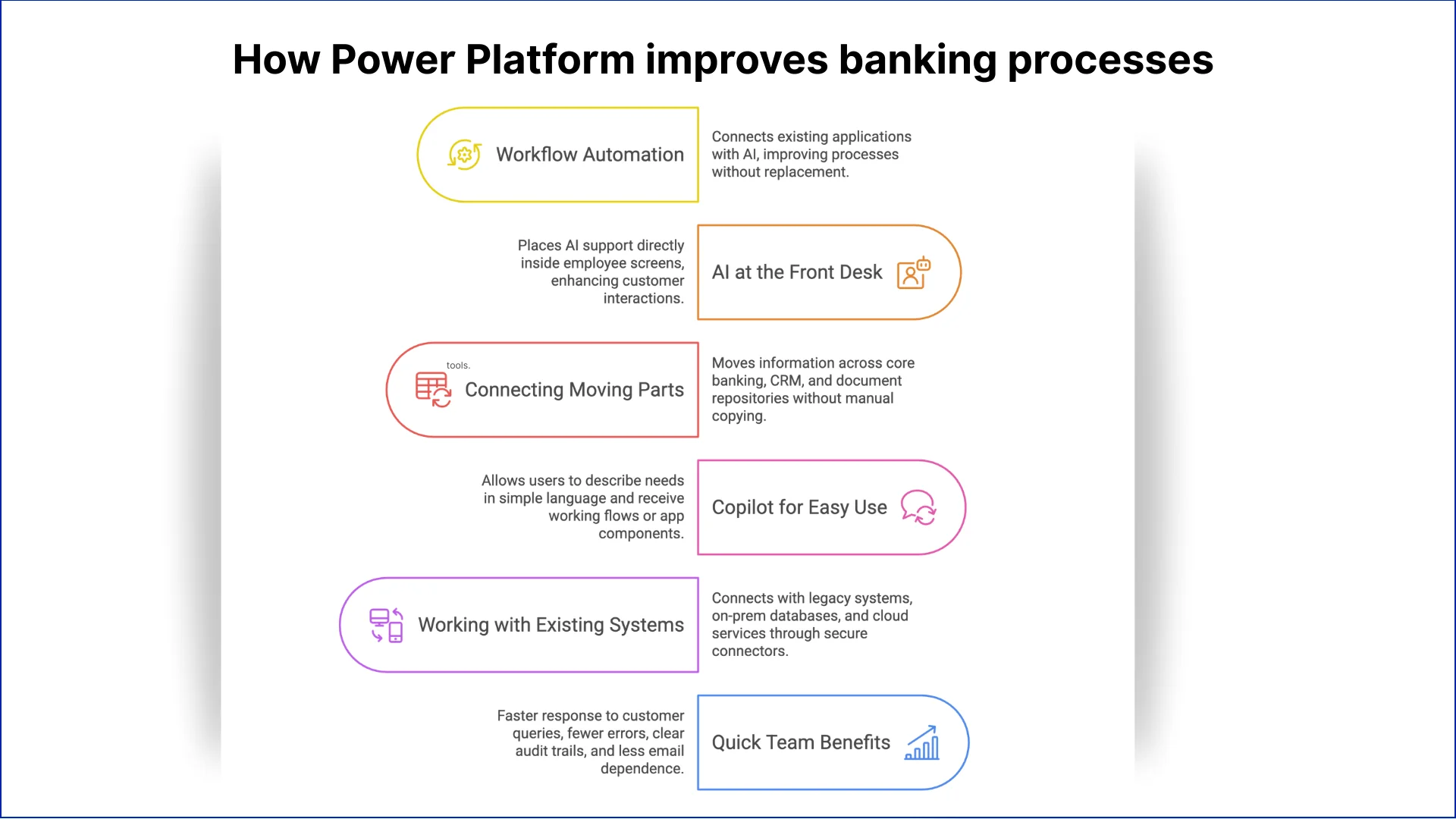
Many banks already own strong core systems, CRM tools, and data platforms. The problem is not the absence of technology. The problem is that these systems work in silos. Power platform workflow automation acts as a connecting layer that links existing applications with intelligence from generative AI in banking. It allows banks to improve processes without replacing what already works.
Instead of launching large transformation programs, teams can start with small improvements. A form can be enhanced with AI suggestions. An approval step can receive automated summaries. This gradual approach reduces risk and builds confidence.
Power Apps brings AI to the front desk
Frontline employees interact with customers, not with code. Through power apps AI integration, banks can place AI support directly inside the screens employees already use. A service agent opening a case can see AI-generated answers. A branch officer can receive guidance while filling a form.
For example, when a customer asks about account closure, the app can show required documents, draft the email, and create the checklist automatically. The employee only verifies.
Power Automate connects the moving parts
Most banking delays happen between systems. Data waits in inboxes or queues. With power automate AI, workflows can move information across core banking, CRM, and document repositories without manual copying.
Consider a retail loan request. Power Automate can collect customer details, trigger credit checks, and call AI to summarize statements. The process continues even when staff are busy. Employees step in only where judgment is needed. This is how AI automation in finance becomes practical.
Copilot makes AI easy to use
Many employees fear new technology because it looks complex. Copilot for power platform changes this experience. Users can describe what they need in simple language and receive working flows or app components.
A compliance officer might say, “Create a review step for high-risk customers.” Copilot can suggest the logic, screens, and notifications. This lowers the barrier for adopting generative AI in banking across departments.
Working with existing banking systems
Banks cannot replace core platforms overnight. Power Platform respects this reality. It connects with legacy systems, on-prem databases, and cloud services through secure connectors. This allows microsoft power platform AI to enhance current investments rather than compete with them.
A payments team can continue using the core system while Power Platform adds intelligent reconciliation on top. A trade finance unit can keep its specialized software while AI handles document checks around it.
Benefits that teams notice quickly
When Power Platform and generative AI in banking work together, banks see practical results:
Faster response to customer queries
Fewer errors in data entry
Clear audit trails for compliance
Less dependence on email
Power Platform use cases in banking
Banks do not run on single tasks. They run on connected processes that touch customers, risk, compliance, and operations at the same time.
Power Platform becomes the operating layer that connects people, data, and decisions. Instead of building separate AI tools for each department, banks can create one environment where workflows grow gradually.
1. Customer support transformation
Customer support is often the first test for any technology. Research across retail banks indicates that over 60 percent of customer queries are repetitive in nature. Yet agents spend most of their day searching for answers.
With power apps AI integration, the service desk can work in this model:
AI reads customer message in natural language
Past interactions are summarized
A reply is drafted with compliance-approved tone
Agent reviews and sends
This reduces average handling time and improves consistency and the everyday face of AI for banking workflows.
2. Deep dive into KYC and AML
KYC and AML reviews remain one of the costliest parts of banking. Analysts estimate that banks spend billions annually on customer due diligence. Most of this cost is human reading time.
Through microsoft power platform ai, banks can design a structured KYC cockpit:
1. Documents are uploaded from any channel
2. Generative AI in banking extracts entities such as name, address, and dates
3. The system compares data across files
4. Risk indicators are presented to the officer
The officer still approves or rejects, but the preparation work is automated. Audit logs from Power Platform keep every action traceable, which answers regulatory concerns.
3. Loan origination with context
Credit decisions require both data and judgment. Traditional systems deliver data but not context. Officers read bank statements line by line to understand customer behavior.
Using power automate AI, a smarter flow can be built:
Statements are converted into clear summaries
Income trends are highlighted
Policy checks run in the background
A recommendation note is generated
This does not replace credit expertise. It supports it. The officer spends time on risk discussion rather than document reading. This is a strong example of AI automation in finance adding depth to human decisions.
4. Reconciliation and finance operations
Operations teams manage thousands of daily transactions. Even a small mismatch can trigger long investigations. According to back-office studies, teams spend up to 30 percent of their time only on searching for reasons.
With power platform workflow automation, AI can:
Group similar exceptions
Explain likely causes in plain language
Create tickets for follow-up
Employees move from detective work to resolution work. Productivity improves without changing core accounting systems.
5. Branch and relationship management
Branch employees handle mixed requests from customers who expect quick service. Training new staff on every product is difficult.
Through copilot for power platform, branch applications can act like a digital colleague:
Suggest next best action during conversation
Draft emails and forms
Remind policy requirements
The relationship manager feels guided rather than overloaded. This human-centered design is at the heart of generative AI in banking.
6. Regulatory reporting with clarity
Regulatory reporting often turns into a yearly struggle. Data comes from many sources and narratives must be written carefully.
Power Platform with AI enables:
Automatic collection of required fields
Generation of management commentary
Early detection of risk trends
Teams review insights instead of compiling raw data. This reduces last-minute pressure and improves accuracy.
AI Workflow Automation in Financial Services
Banks do not run on single tools. They run on workflows. A loan application, a compliance review, or a fraud case moves through many hands and systems. When any step slows down, the entire experience breaks. This is where AI workflow automation in financial services becomes critical.
Recent industry research from IBM shows that bank employees spend nearly 40 percent of their time on document handling and repetitive data entry. Customers experience this as long queues, repeated questions, and delayed decisions. The promise of generative AI in banking is to remove these friction points without removing human judgment.
How Generative AI Changes Banking Workflows
Generative AI in banking understands language and context. It can read a customer complaint, a KYC document, or an audit note the same way a human does. This ability turns static processes into adaptive workflows.
A Gartner report in 2024 noted that banks using AI-assisted workflows reduced average processing time by 30 to 50 percent while keeping compliance controls intact.
Core Layers of an AI-Driven Banking Workflow
Every intelligent workflow built on power platform workflow automation follows four layers:
Banks are moving from experiments to real adoption. The future of banking operations with AI will not be about replacing core systems. It will be about improving how people work inside those systems. Success will depend on practical steps rather than large promises.
A realistic adoption roadmap
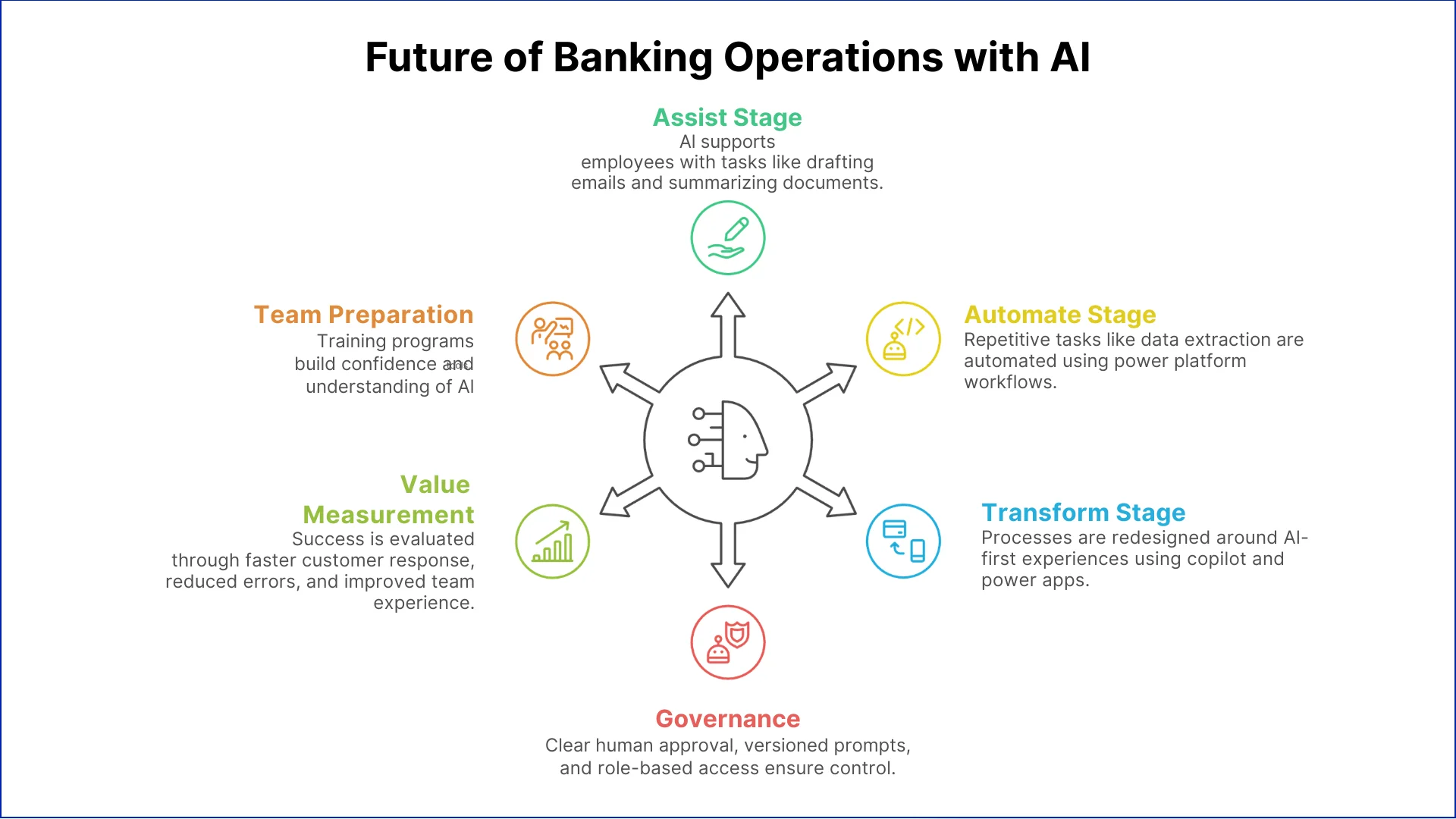
Most banks are beginning with focused use cases instead of enterprise-wide change. A simple roadmap for generative AI for banking workflows usually follows three stages:
1. Assist stage – AI drafts emails, summarizes documents, and guides employees while they still control every decision.
2. Automate stage – Repetitive steps such as data extraction and ticket creation move through power platform workflow automation.
3. Transform stage – Processes are redesigned around AI-first experiences using copilot for power platform and power apps AI integration.
This step-by-step model reduces risk and builds trust among teams.
Governance that fits banking
Financial institutions cannot adopt technology without control. Practical governance around generative AI in banking includes:
Clear human approval for high-risk actions
Versioned prompts and responses
Role-based access to AI features
Storage of decision logs for audits
These measures allow innovation while respecting regulatory expectations.
Measuring real value
Banks evaluate success through everyday outcomes rather than technical metrics. Common indicators include:
Faster response to customer requests
Reduction in manual data entry
Fewer errors in KYC and operations
Better experience for frontline teams
Even small improvements in these areas create visible impact across branches and back offices.
Preparing teams for change
Technology alone does not transform banks. Employees need confidence to work with new tools. Training programs focused on real scenarios help staff see AI as a partner. When teams understand how AI workflow automation in financial services supports their goals, adoption becomes natural.
The next few years will shape how banks deliver services. Institutions that combine human expertise with generative AI in banking and the Microsoft ecosystem will respond faster to customers and regulators alike. The goal is simple: smarter workflows, clearer decisions, and better banking experiences.
Conclusion
Banking workflows are changing because customer expectations and regulatory pressure are growing together. Generative AI in banking does not replace core systems. It adds understanding to them. When combined with power platform workflow automation, routine work becomes faster while human control remains intact. Employees spend less time searching for data and more time solving real problems. Customers receive clearer and quicker responses. Banks that adopt this approach step by step can modernize operations without risky transformations. The future of workflows will belong to institutions that treat AI as a daily assistant rather than a distant experiment.
IAM is a security framework that verifies user identities and controls their system permissions. It ensures the right people access appropriate resources at the right time, protecting sensitive data through authentication and authorization controls.
Is identity management the same as access management?
No, they serve distinct functions. Identity management confirms who users are through authentication, while access management determines what they can do through authorization. Both components work together within IAM security frameworks.
What's the core difference between identity and access management?
Identity management validates user credentials and maintains user profiles. Access management enforces permissions based on roles and responsibilities. Identity answers “who are you” while access controls “what can you do.”
How do identity and access management work together?
Identity management authenticates users first, then access management applies authorization rules. This sequential process ensures verified identities receive appropriate permissions, creating layered security that prevents unauthorized actions even from authenticated users.
Do you need identity management without access management?
No, authentication alone creates security gaps. Verified identities without controlled permissions lead to over-privileged accounts and compliance failures. Effective IAM requires both components to enforce least privilege and protect enterprise resources.
What happens when former employees retain system access?
Delayed access revocation creates security vulnerabilities and compliance violations. Former employees can leak sensitive data, access confidential systems, or compromise accounts. Immediate deprovisioning upon termination prevents unauthorized access and audit findings.
Which banking processes benefit the most from AI automation in finance?
Customer support, KYC reviews, loan origination, reconciliation, and regulatory reporting show the fastest results. These areas involve heavy document handling where generative AI in banking can reduce manual effort.
How quickly can banks implement generative AI in banking?
Banks can start within weeks by automating a single workflow using power platform workflow automation. Gradual adoption is recommended instead of large one-time transformations.
Can generative AI in banking work with legacy core systems?
Yes. Power Platform provides secure connectors that allow AI capabilities to sit on top of existing core banking, CRM, and on-prem systems without replacing them.
How does AI improve customer experience in banks?
AI provides instant, accurate responses, reduces waiting time, and ensures consistent communication. With power apps AI integration, agents receive suggested replies while talking to customers.
Generative AI in banking can maintain logs of every action and data source. Decision summaries and audit trails help banks meet regulatory expectations for transparency.
What is the first step to adopt generative AI in banking?
The best starting point is identifying one high-volume pain area, such as email handling or KYC checks, and automating it through Power Platform with human approval in the loop.
Business intelligence consulting services should give a mid-market company a governed way to make decisions. Attractive dashboards are only the visible part. The useful outcome is a system in which source data, metric definitions, access, releases, ownership, and support still work after the consultants leave.
In a Microsoft Solutions Partner vs Microsoft Partner comparison, the difference is validation. A company can participate in the Microsoft AI Cloud Partner Program without holding a customer-facing Solutions Partner designation. A designated Solutions Partner has met Microsoft’s current threshold in a specific solution pathway: at least 70 out of 100 partner capability points, with more than zero points in every required metric, based on performance, skilling, and customer success data recorded in Partner Center.
How do you build a legacy application modernization strategy for Azure? A legacy application modernization strategy assigns the right treatment to each workload, then sequences the work around business value, technical evidence, and operational risk. For Azure, that means choosing among retire, retain, rehost, replatform,
QServices Inc. undertakes every project with a high degree of professionalism. Their communication style is unmatched and they are always available to resolve issues or just discuss the project.
Turn the Microsoft Licenses
You Already Own Into an AI Workplace
Join our live webinar on Sept 24 and see five ways to automate meetings, approvals, and