Selecting the right database is one of the most significant decisions in modern application development. Whether you are building a startup product, scaling an enterprise system, or designing cloud-native architecture, the debate around sql vs nosql continues to be highly relevant. The database you choose directly impacts performance, scalability, data consistency, and long-term maintenance.For years, relational databases dominated application development. However, with the rise of real-time applications, microservices, big data, and cloud platforms, non-relational systems have gained significant adoption. This shift has made the sql vs nosql decision far more complex than simply choosing between structured and unstructured data.Today, developers and architects must evaluate multiple factors such as scalability requirements, data growth patterns, transaction handling, and system availability. Understanding the difference between a relational vs non relational database is no longer optional. It has become essential for building reliable, future-ready systems.This blog explores sql vs nosql databases from a practical and decision-oriented perspective. Instead of focusing only on definitions, it breaks down how each database model works, where each performs best, and how to choose the right option based on real-world use cases. By the end, you will have a clear framework to evaluate sql vs nosql and confidently decide which database aligns with your application goals.
What Is SQL Database
To understand the sql vs nosql comparison clearly, it is important to first understand how SQL databases work and why they are still widely used today.
Definition of SQL Database
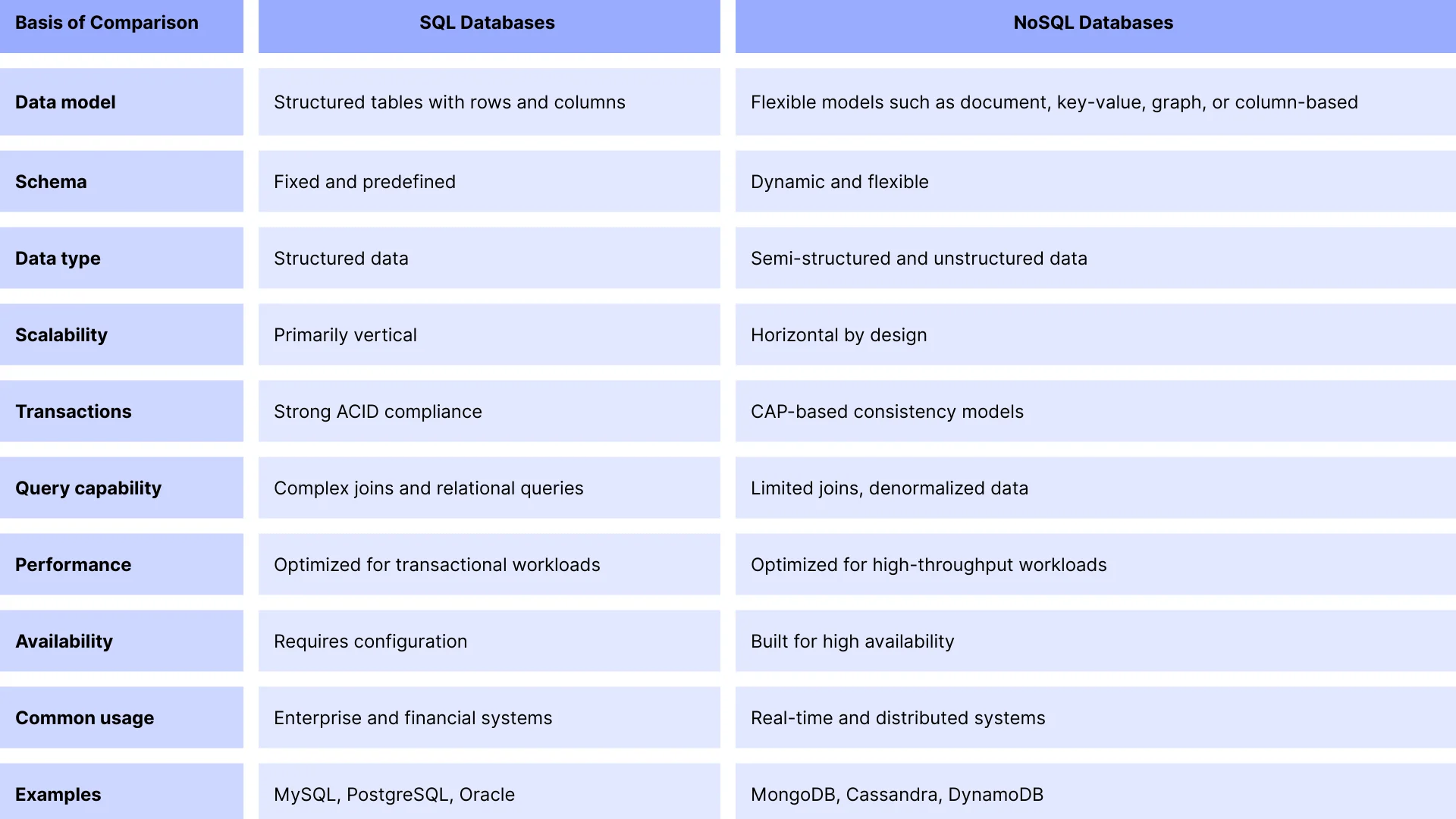
When people ask what is sql database, the answer lies in its structured and relational nature. A SQL database, also known as a relational database, stores data in tables consisting of rows and columns. Each table represents a specific entity, and every record follows a clearly defined format.Before storing any data, the schema must be defined in advance. This schema specifies data types, constraints, and relationships, ensuring consistency across the entire database.
Relational Data Model
SQL databases follow the relational model, where data is connected using relationships. Tables are linked through primary keys and foreign keys, allowing multiple datasets to interact logically.This approach makes relational databases ideal for scenarios where data accuracy, validation, and structured relationships are required. In the relational vs non relational database discussion, this strong relationship handling is one of the biggest advantages of SQL systems.
Querying and Data Management
SQL enables developers to perform complex operations such as joins, aggregations, filtering, and reporting using readable and standardized queries.Because SQL is standardized, developers can apply similar query logic across different platforms, which strengthens SQL’s position in the sql vs nosql debate.
Common SQL Database Examples
Some widely used sql database examples include:
MySQL
PostgreSQL
Microsoft SQL Server
Oracle Database
These databases are commonly used in enterprise systems, financial platforms, internal applications, and business-critical systems where reliability and consistency are mandatory.
When SQL Databases Are Commonly Used
SQL databases are typically chosen when:
Data structure is predictable
Transactions must be accurate and reliable
Complex queries and reporting are required
Data integrity is a top priority
These characteristics define SQL’s role in the broader sql vs nosql databases discussion and explain why relational systems continue to power many core business applications.
What Is NoSQL Database
To evaluate sql vs nosql properly, it is equally important to understand how NoSQL databases differ in structure, flexibility, and usage.
Definition of NoSQL Database
When discussing what is nosql database, NoSQL refers to a category of databases designed to handle large volumes of data that do not fit well into rigid table structures. The term NoSQL stands for “Not Only SQL,” highlighting that these systems are not limited to traditional relational models.NoSQL databases do not require a fixed schema. This allows data to be stored in flexible formats that can evolve over time without major structural changes.
Non-Relational Data Model
In the relational vs non relational database comparison, NoSQL databases fall under the non-relational category. Instead of tables and rows, they use alternative data models that support modern application needs.Common NoSQL data models include:
Document-based databases
Key-value stores
Column-family databases
Graph databases
This flexibility makes NoSQL suitable for applications dealing with semi-structured or unstructured data.
Schema Flexibility and Data Evolution
One of the strongest advantages in the sql vs nosql discussion is schema flexibility. NoSQL databases allow each record to have a different structure, which is especially useful when application requirements change frequently.This approach enables faster development cycles, easier experimentation, and smoother handling of evolving data types such as JSON documents, logs, and event data.
NoSQL Database Examples
Some widely used nosql database examples include:
MongoDB
Cassandra
Redis
DynamoDB
Couchbase
These databases are commonly used in applications that demand high availability, real-time processing, and large-scale data distribution.
Where NoSQL Databases Are Commonly Used
NoSQL databases are typically selected when:
Data volume grows rapidly
Data structure is unpredictable
Horizontal scalability is required
Applications need real-time responsiveness
These characteristics make NoSQL systems a key part of modern architectures and an essential component in the broader sql vs nosql databases conversation.
Let's Discuss Your Project
Get free Consultation and let us know your project idea to turn into an amazing digital product.
SQL vs NoSQL Performance, Scalability, and Security
When evaluating sql vs nosql in real-world systems, performance, scalability, and security often carry more weight than data structure alone. These three factors directly influence user experience, system stability, and long-term growth.
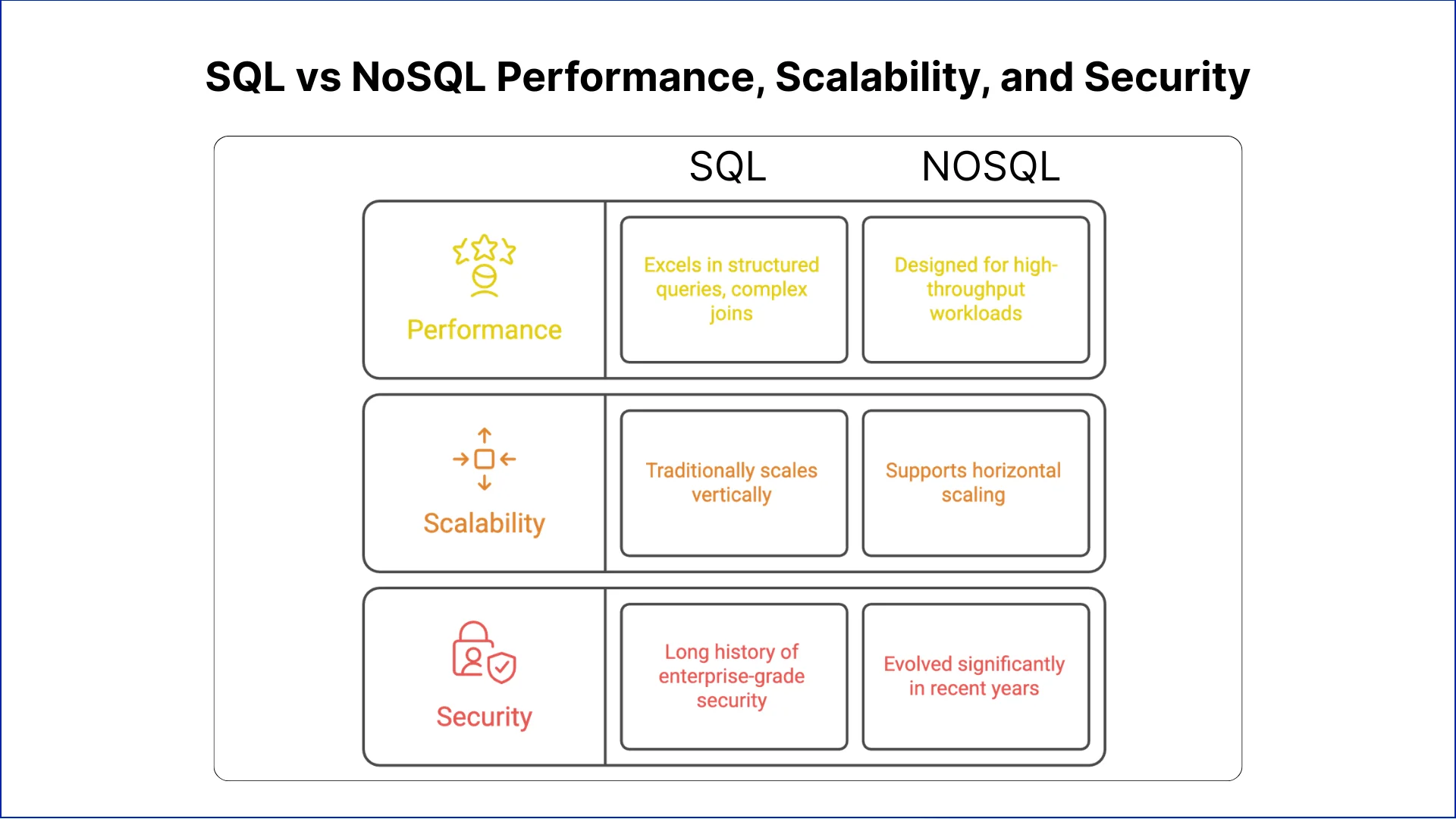
SQL vs NoSQL Performance
Performance behavior differs significantly in the sql vs nosql comparison because each database is optimized for different workload patterns.
SQL databases perform exceptionally well in scenarios involving structured queries, complex joins, and transactional operations. Since data is normalized and relationships are clearly defined, SQL systems can execute precise queries efficiently, especially for reporting and analytical workloads.
However, as data volume increases and concurrency grows, performance can become constrained by the centralized nature of relational systems. Heavy write operations or large join queries may introduce latency if not carefully optimized.
In contrast, NoSQL databases are designed for high-throughput workloads. By storing data in denormalized formats and minimizing joins, NoSQL systems can deliver faster read and write operations at scale. This makes them highly effective for real-time applications, event-driven systems, and large user-facing platforms.
From a performance standpoint, sql vs nosql performance is less about speed alone and more about workload alignment. SQL excels in complex transactional queries, while NoSQL thrives in high-volume and low-latency environments.
SQL vs NoSQL Scalability
Scalability is one of the most decisive factors in the sql vs nosql debate.
SQL databases traditionally scale vertically. This means improving performance by increasing server resources such as CPU, memory, or storage. While vertical scaling is straightforward, it has practical limits and often becomes expensive at large scale.
Some modern SQL systems support horizontal scaling, but it typically requires additional complexity and careful architectural planning.
NoSQL databases, by design, support horizontal scaling. Data is distributed across multiple nodes, allowing systems to scale simply by adding more servers. This approach improves fault tolerance and supports consistent performance even as traffic grows.
Because of this architecture, sql vs nosql scalability often favors NoSQL for applications that anticipate unpredictable growth, global user distribution, or massive concurrent workloads.
This scalability advantage is a major reason NoSQL databases are commonly used in microservices, cloud-native platforms, and large-scale consumer applications.
SQL vs NoSQL Security
Security is a critical concern in any database decision, especially for regulated industries. In the sql vs nosql security discussion, both models offer strong protections, but their approaches differ.
SQL databases have a long history of enterprise-grade security features. These include role-based access control, strong authentication mechanisms, granular permissions, and mature auditing capabilities.
NoSQL databases have evolved significantly in recent years. Modern NoSQL platforms now support encryption at rest, encryption in transit, access control, and audit logging. However, security implementation often depends heavily on correct configuration and deployment practices.
From a governance perspective, SQL systems typically provide stricter enforcement by default, while NoSQL systems offer flexibility that must be managed carefully to avoid misconfigurations.
Expert Perspective on Trade-Offs
From an architectural standpoint, the sql vs nosql decision is rarely about choosing one over the other universally. Instead, it involves evaluating trade-offs:
SQL prioritizes consistency, control, and reliability
NoSQL prioritizes scalability, availability, and flexibility
In modern systems, it is increasingly common to use both approaches together. SQL may handle core transactional data, while NoSQL manages high-volume or real-time workloads. This hybrid strategy allows organizations to leverage the strengths of each model without forcing a one-size-fits-all solution.
Understanding performance behavior, scalability limits, and security implications provides the clarity needed to move forward confidently in the sql vs nosql databases selection process.
SQL vs NoSQL Pros and Cons
Evaluating the advantages and limitations of each database model is a critical step in the sql vs nosql decision-making process. Rather than treating one approach as superior, it is more effective to understand where each database excels and where it may introduce constraints.
Advantages of SQL Databases
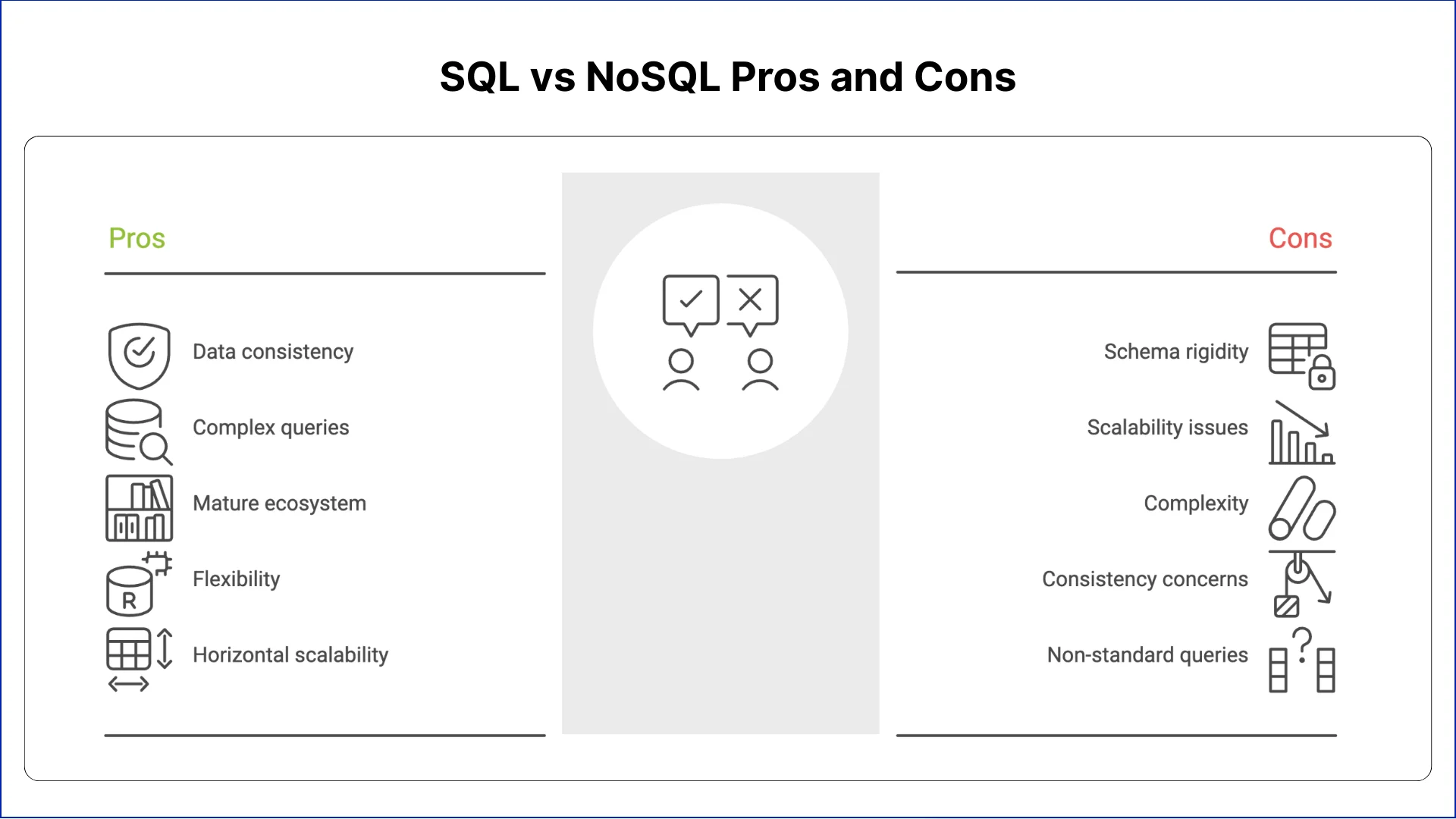
SQL databases are widely valued for their strong emphasis on data consistency and accuracy. Their structured schema ensures that all stored data follows predefined rules, reducing the risk of invalid or inconsistent records. This reliability makes SQL databases especially suitable for transactional systems where correctness is essential.
Another major strength of SQL systems lies in their ability to support complex queries. Through joins and relational mapping, SQL databases can retrieve interconnected data efficiently, which is critical for reporting, analytics, and business intelligence use cases. Their mature ecosystem, backed by decades of development, also provides robust tools, documentation, and long-term stability.
Limitations of SQL Databases
Despite their strengths, SQL databases can face challenges in rapidly changing environments. Schema rigidity often makes frequent structural updates difficult and time-consuming, especially when applications evolve quickly.
Scalability can also become a concern in high-traffic systems. Traditional relational databases rely heavily on vertical scaling, which can increase costs and introduce performance bottlenecks under heavy load. These constraints often emerge during sql vs nosql evaluations for fast-growing applications.
Advantages of NoSQL Databases
NoSQL databases are built with flexibility and scale in mind. Their schema-less or schema-flexible design allows applications to adapt to changing data requirements without complex migrations. This capability supports faster development cycles and easier experimentation.
Another significant advantage is horizontal scalability. NoSQL databases can distribute data across multiple nodes, enabling systems to handle large volumes of traffic and data growth efficiently. This design aligns well with cloud-native architectures and distributed systems, making NoSQL a strong contender in many sql vs nosql databases comparisons.
Limitations of NoSQL Databases
While NoSQL databases offer flexibility, this same flexibility can introduce complexity if not managed properly. The absence of enforced relationships may require additional logic at the application level, increasing development responsibility.
Consistency behavior can vary depending on the database design, which may not suit applications that require strict transactional guarantees. Query capabilities are also less standardized, meaning developers must adapt to database-specific approaches. These factors become important when assessing the sql vs nosql difference beyond performance alone.
So what to choosing between them ?
From an architectural standpoint, the sql vs nosql pros and cons discussion reinforces a key principle. SQL databases prioritize structure, reliability, and control, while NoSQL databases emphasize flexibility, scalability, and availability.
Choosing between them is not about preference but alignment. The optimal decision depends on how your application manages data, how it scales, and how critical consistency is to your business operations. This understanding leads naturally into evaluating real-world SQL vs NoSQL use cases, which is explored in the next section.
SQL vs NoSQL Use Cases
Understanding real-world scenarios is essential when evaluating sql vs nosql. Instead of choosing a database based on popularity, the decision should be guided by how the application handles data, transactions, and scale. This section explains when to use SQL vs NoSQL through common use cases.
When to Use SQL Databases
SQL databases are best suited for applications where data accuracy and consistency are non-negotiable. Systems that rely on structured records and strong relationships benefit significantly from the relational model.
Use cases such as financial systems, billing platforms, inventory management, and enterprise reporting require strict transactional integrity. In these scenarios, SQL databases ensure that every operation follows consistent rules, making them a reliable choice in many SQL vs NoSQL use cases.
SQL is also well suited for applications that depend heavily on complex queries, aggregations, and multi-table relationships. When reporting and analytics are central to business decision-making, relational databases continue to deliver strong performance.
When to Use NoSQL Databases
NoSQL databases are preferred when flexibility and scalability are primary requirements. Applications that generate large volumes of rapidly changing data often struggle within rigid schemas.
Real-time systems such as activity feeds, messaging platforms, IoT applications, and recommendation engines benefit from NoSQL’s ability to ingest and process data at scale. These workloads commonly appear in modern architectures where availability and speed matter more than immediate consistency.
In the broader sql vs nosql discussion, NoSQL becomes the stronger option when applications must scale horizontally across regions and handle unpredictable traffic patterns.
SQL vs NoSQL in Mixed Workloads
Many modern systems do not rely on a single database model. Instead, organizations often combine both approaches to meet different operational needs.
For example, SQL databases may manage core transactional data, while NoSQL databases handle logs, events, user activity, or session data. This hybrid approach addresses diverse requirements without forcing a single solution across all workloads.
This model reflects a practical answer to the common question of which database to use SQL or NoSQL, especially in large or evolving systems.
Choosing Based on Application Behavior
The most reliable way to evaluate sql vs nosql use cases is to analyze how the application behaves in production. If the system demands strict consistency, structured data, and relational integrity, SQL is typically the right choice. If the application requires rapid scaling, flexible data models, and real-time responsiveness, NoSQL often provides better alignment.
Understanding usage patterns, growth expectations, and operational complexity is far more valuable than choosing a database based solely on trends.
Eager to discuss about your project ?
Share your project idea with us. Together, we’ll transform your vision into an exceptional digital product!
The sql vs nosql decision should be driven by application behavior rather than database popularity. Each system handles data differently, and understanding these differences helps avoid scalability and performance issues later.For web applications, SQL databases work well for structured workflows such as authentication, orders, and transactions. NoSQL databases perform better when applications handle dynamic content, high traffic, or rapidly changing data models. This is why many teams combine both when evaluating the best database for web applications.When data volume increases, scalability becomes critical. SQL databases can scale effectively but often require careful planning and optimization. NoSQL platforms are commonly chosen as the best database for scalability and best database for large data because they are built for horizontal expansion from the start.In startup environments, flexibility and speed are essential. NoSQL allows rapid iteration, while SQL ensures accuracy for business-critical records. This balance defines most real-world approaches to SQL vs NoSQL for startups.Enterprise systems prioritize stability, governance, and long-term reliability. SQL remains foundational, with NoSQL supporting analytics and high-throughput workloads. The same pattern applies to SQL vs NoSQL for enterprise applications.For modern architectures such as microservices and cloud platforms, database selection depends on service responsibility. Some services require relational consistency, while others benefit from distributed NoSQL systems. This practical separation shapes decisions around SQL vs NoSQL for microservices and SQL vs NoSQL for cloud applications.In ecommerce and fintech systems, SQL typically manages transactions and financial data, while NoSQL supports catalogs, sessions, and real-time processing. This combined approach reflects how SQL vs NoSQL for ecommerce and SQL vs NoSQL for fintech applications are implemented in production environments.Ultimately, the strongest systems do not choose sides in the sql vs nosql debate. They select the right database for each workload, ensuring both performance and long-term scalability.
Conclusion
The sql vs nosql decision depends on how your application stores, processes, and scales data. SQL databases are ideal for structured data, strong consistency, and transaction-heavy systems. NoSQL databases suit applications that require flexibility, high availability, and horizontal scalability.Rather than treating nosql vs sql as a one-size-fits-all debate, modern systems often combine both. This balanced approach helps organizations handle diverse workloads while maintaining performance and reliability.Understanding when to use SQL vs NoSQL ensures better architectural decisions and supports long-term application growth.
What is the difference between SQL and NoSQL databases?
The difference between sql vs nosql lies in how data is stored and managed. SQL databases use structured tables, while NoSQL databases allow flexible data formats, making them suitable for different application needs.
What is a SQL database used for?
A SQL database is commonly used for applications that require structured data, strong consistency, and reliable transactions such as banking systems, ERP platforms, and order management systems.
What is a NoSQL database mainly used for?
A NoSQL database is mainly used for handling large volumes of dynamic or unstructured data, including real-time applications, content platforms, and cloud-based systems.
Which is better, SQL or NoSQL?
There is no universal answer in the sql vs nosql debate. SQL works better for structured and transactional data, while NoSQL performs better for scalability and fast-changing workloads.
When should I choose SQL vs NoSQL?
You should choose SQL when data relationships and accuracy are critical. NoSQL is a better choice when your application needs flexibility, speed, and horizontal scalability.
Is NoSQL faster than SQL databases?
NoSQL can be faster for high-volume and distributed workloads, while SQL often performs better for complex queries. Speed in sql vs nosql depends on how the database is used.
Which database is best for web applications?
The best database for web applications depends on the application structure. Many systems use SQL for core data and NoSQL for caching, sessions, and real-time features.
Is NoSQL more scalable than SQL?
NoSQL databases are generally easier to scale horizontally, which is why they are often chosen for large-scale and cloud-native applications.
Should startups use SQL or NoSQL databases?
Startups often use NoSQL for rapid development and SQL for business-critical data. This combined approach helps balance speed with reliability.
Can you use SQL and NoSQL be used together in one system?
Yes. Many modern architectures use both databases together, selecting the right one based on specific workloads rather than choosing only one.
Business intelligence consulting services should give a mid-market company a governed way to make decisions. Attractive dashboards are only the visible part. The useful outcome is a system in which source data, metric definitions, access, releases, ownership, and support still work after the consultants leave.
In a Microsoft Solutions Partner vs Microsoft Partner comparison, the difference is validation. A company can participate in the Microsoft AI Cloud Partner Program without holding a customer-facing Solutions Partner designation. A designated Solutions Partner has met Microsoft’s current threshold in a specific solution pathway: at least 70 out of 100 partner capability points, with more than zero points in every required metric, based on performance, skilling, and customer success data recorded in Partner Center.
How do you build a legacy application modernization strategy for Azure? A legacy application modernization strategy assigns the right treatment to each workload, then sequences the work around business value, technical evidence, and operational risk. For Azure, that means choosing among retire, retain, rehost, replatform,
QServices Inc. undertakes every project with a high degree of professionalism. Their communication style is unmatched and they are always available to resolve issues or just discuss the project.
Turn the Microsoft Licenses
You Already Own Into an AI Workplace
Join our live webinar on Sept 24 and see five ways to automate meetings, approvals, and