An enterprise IT survey reported that over 70% of large organizations say legacy systems directly slow down digital initiatives, and nearly half admit these systems prevent them from responding to market change. For decision makers this is no longer a technical inconvenience. It is a business constraint.Most enterprises did not choose to be here. Core systems were built to be stable, not adaptable. Over time, layers of customization, integrations, and workarounds turned reliability into rigidity. Today, every new digital initiative feels harder than it should be.This is why legacy system modernization has moved to the top of executive agendas. Not because legacy platforms suddenly stopped working, but because they no longer support how modern enterprises need to operate.Modernization is often misunderstood. It is not just migrating applications to the cloud. It is not replacing everything at once. It is a structured shift from technology that resists change to platforms designed for continuous evolution.This article provides a practical, end-to-end roadmap. It explains what modernization really means, how it differs from migration and transformation, and how enterprises move deliberately toward becoming a digital-first organization.
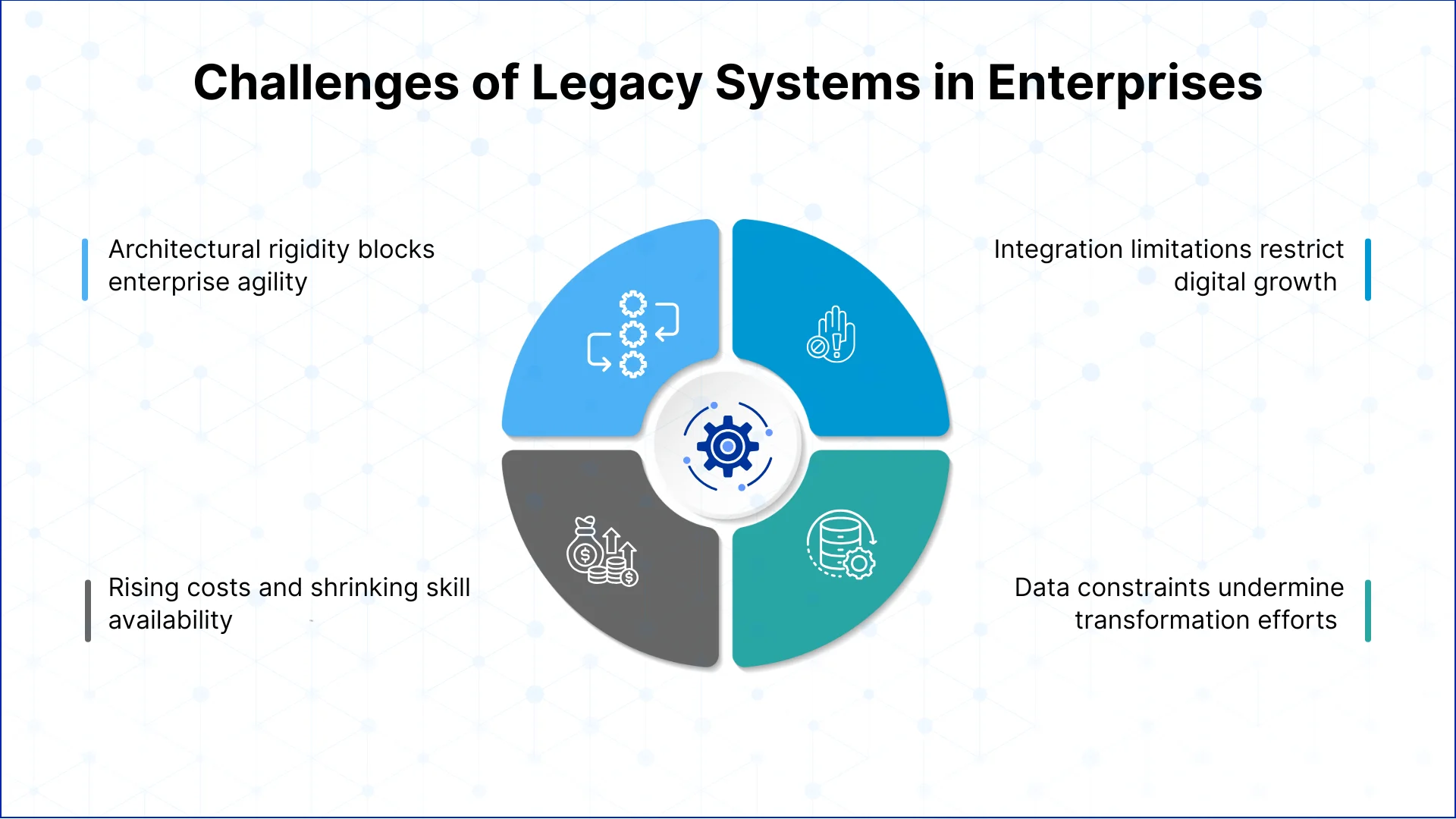
Challenges of Legacy Systems in Enterprises
Legacy platforms were built for stability, not speed. Most rely on tightly coupled architectures where business logic, data, and infrastructure are inseparable. This rigidity makes change slow and risky, which is why legacy system modernization becomes unavoidable as enterprises scale.
Architectural rigidity blocks enterprise agility
Monolithic designs prevent independent updates. A minor change often requires full regression testing and coordinated releases. This slows delivery and increases failure risk. Over time, IT becomes reactive instead of enabling growth. This is a common early signal that modernizing legacy applications is no longer optional.
Integration limitations restrict digital growth
Legacy systems struggle to support modern integration patterns. Without APIs, enterprises depend on batch jobs or point-to-point connections. These fragile links increase downtime and complicate enterprise IT transformation. As digital channels grow, integration debt grows faster than delivery capacity.
Rising costs and shrinking skill availability
Maintaining legacy environments is expensive. Infrastructure, licensing, and specialist talent costs rise every year. Knowledge is often concentrated with a few individuals, creating operational risk. These pressures force leaders to reassess their IT modernization strategy.
Data constraints undermine transformation efforts
Legacy platforms were not designed for real-time data access. Analytics, automation, and AI initiatives suffer as a result. Without accessible data, enterprise digital transformation remains superficial. This is where legacy application modernization directly impacts business insight and decision-making.These challenges compound over time. Ignoring them does not preserve stability. It quietly increases risk.
Legacy Systems vs Modern Platforms
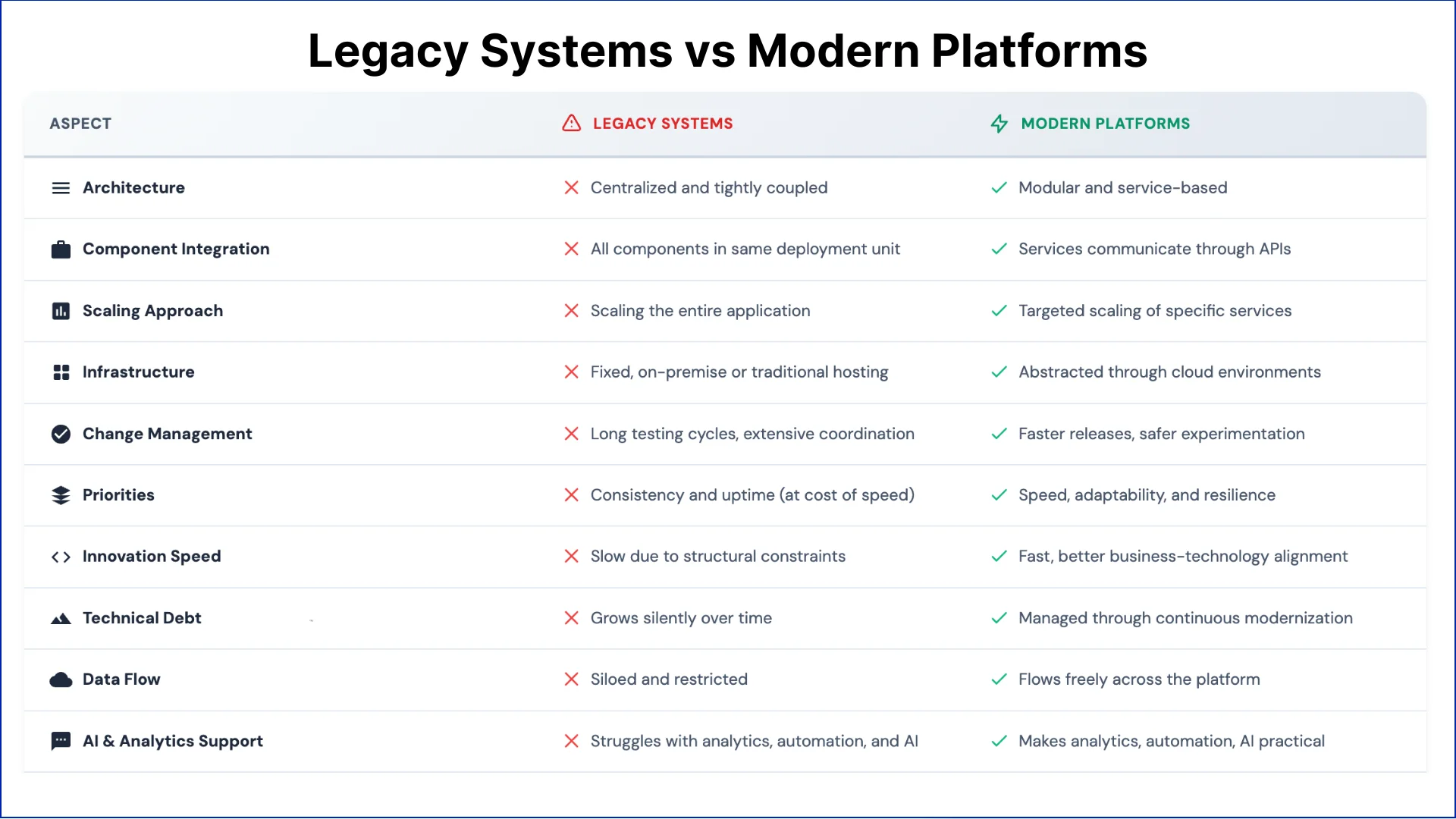
Understanding the difference between legacy systems and modern platforms helps leaders see why incremental fixes are no longer enough. This contrast explains the real objective of legacy system modernization.
How legacy systems are designed
Legacy systems are typically centralized and tightly coupled. Business logic, data storage, and user interfaces live in the same deployment unit. Scaling usually means scaling the entire application. Changes require coordination across teams and long testing cycles. These systems prioritize consistency and uptime, often at the cost of speed and adaptability.Because of these constraints, legacy platforms struggle to support a modern digital transformation strategy. Innovation becomes slow, and technical debt grows silently.
How modern platforms operate
Modern platforms are modular by design. Capabilities are broken into services that communicate through APIs. Infrastructure is abstracted through cloud environments. Scaling is targeted. Resilience is built into the platform.This approach supports enterprise digital transformation by enabling faster releases, safer experimentation, and better alignment between business and technology. Data flows more freely, making analytics, automation, and AI practical.
Why the gap keeps widening
The gap between legacy systems and modern platforms grows every year. Digital products evolve quickly. Customer expectations change constantly. Legacy architectures cannot keep pace without structural change.This is where legacy system modernization plays a critical role. It does not discard existing systems immediately. It progressively reshapes them into components of a modern enterprise IT architecture that supports a digital-first enterprise.
Let's Discuss Your Project
Get free Consultation and let us know your project idea to turn into an amazing digital product.
Successful legacy system modernization is not a single technical action. It is a structured execution model that balances business priority, risk, and architectural change. Enterprises that skip this structure often stall midway through modernization.
Assess systems for business value and modernization fit
Start by classifying applications based on business criticality and technical debt. Systems that directly impact customers, revenue, or operations should be prioritized for legacy application modernization. This assessment anchors the broader IT modernization strategy in real business outcomes.
Choose modernization over simple migration
Many enterprises default to legacy system migration as the first step. While migration can reduce infrastructure overhead, it rarely improves agility on its own. Without refactoring, legacy constraints remain embedded.
Effective modernizing legacy applications requires selecting the right path. Rehosting for stability. Refactoring for agility. Rebuilding only when the system no longer supports future needs.
Decouple legacy systems using APIs
API-led modernization allows enterprises to separate core logic from user experiences. Legacy systems expose capabilities through APIs while new services evolve independently. This approach reduces risk and enables gradual enterprise IT transformation.
Apply cloud and microservices deliberately
A well-defined cloud modernization strategy supports scalability and resilience. Microservices modernization enables independent deployment and faster change. Together, they form the foundation of a modern enterprise IT architecture.
Automate and prepare for intelligent capabilities
Automation in legacy modernization reduces manual intervention and operational errors. Once systems are modular and accessible, AI-driven digital transformation becomes practical rather than aspirational.
Executed correctly, legacy system modernization evolves systems incrementally while preserving business continuity.
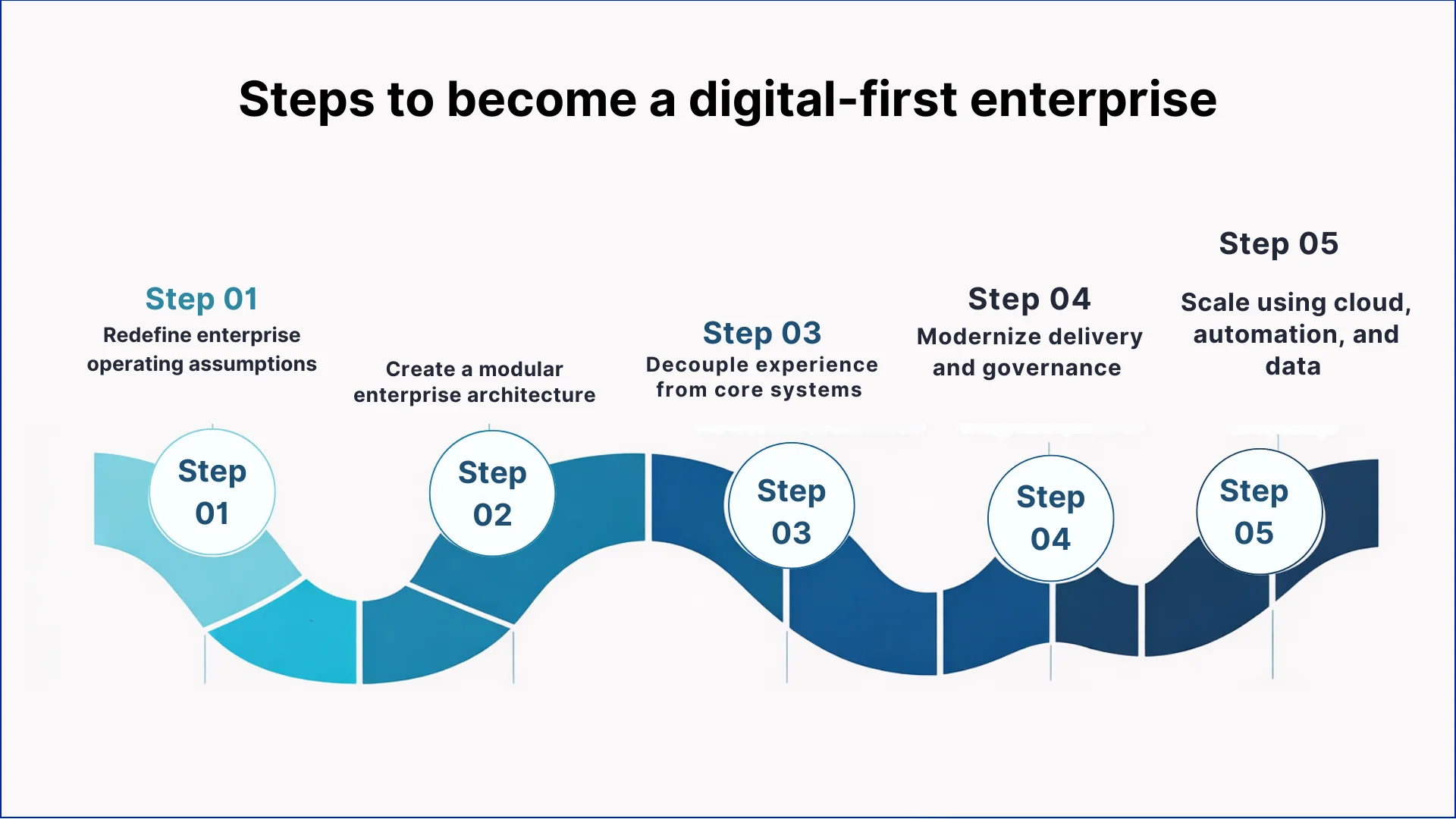
Steps to become a digital-first enterprise
A digital-first enterprise is built on the ability to change continuously. Technology enables this, but architecture, operating models, and decision-making determine success. This is where legacy system modernization directly shapes enterprise outcomes.
Step 1: Redefine enterprise operating assumptions
Digital-first organizations assume constant change. Release cycles shorten. Business and IT collaborate continuously. Systems are designed for evolution, not permanence. This mindset shift is foundational to enterprise digital transformation and must be established before large-scale modernization begins.
Step 2: Create a modular enterprise architecture
Modern enterprises replace tightly coupled systems with modular capabilities. Core functions are isolated. Interfaces are standardized. This forms the basis of a modern enterprise IT architecture and reduces dependency risk during legacy software modernization.
Step 3: Decouple experience from core systems
Customer and employee experiences should evolve faster than systems of record. API-led modernization enables this separation. Digital channels innovate independently while legacy systems continue operating. This step is critical for scaling a digital transformation roadmap without destabilizing operations.
Step 4: Modernize delivery and governance
Digital-first enterprises modernize how systems are built and governed. Agile delivery, automated testing, and continuous deployment replace manual release processes. Governance shifts from approval-heavy control to architecture-led guardrails. This accelerates enterprise IT transformation.
Step 5: Scale using cloud, automation, and data
Cloud adoption supports elasticity and resilience, but only after architectural readiness. A disciplined cloud modernization strategy, combined with automation in legacy modernization, reduces operational friction. Accessible data enables analytics and AI-driven digital transformation.
Each step compounds value. Together, they transform legacy system modernization into a sustainable enterprise capability.
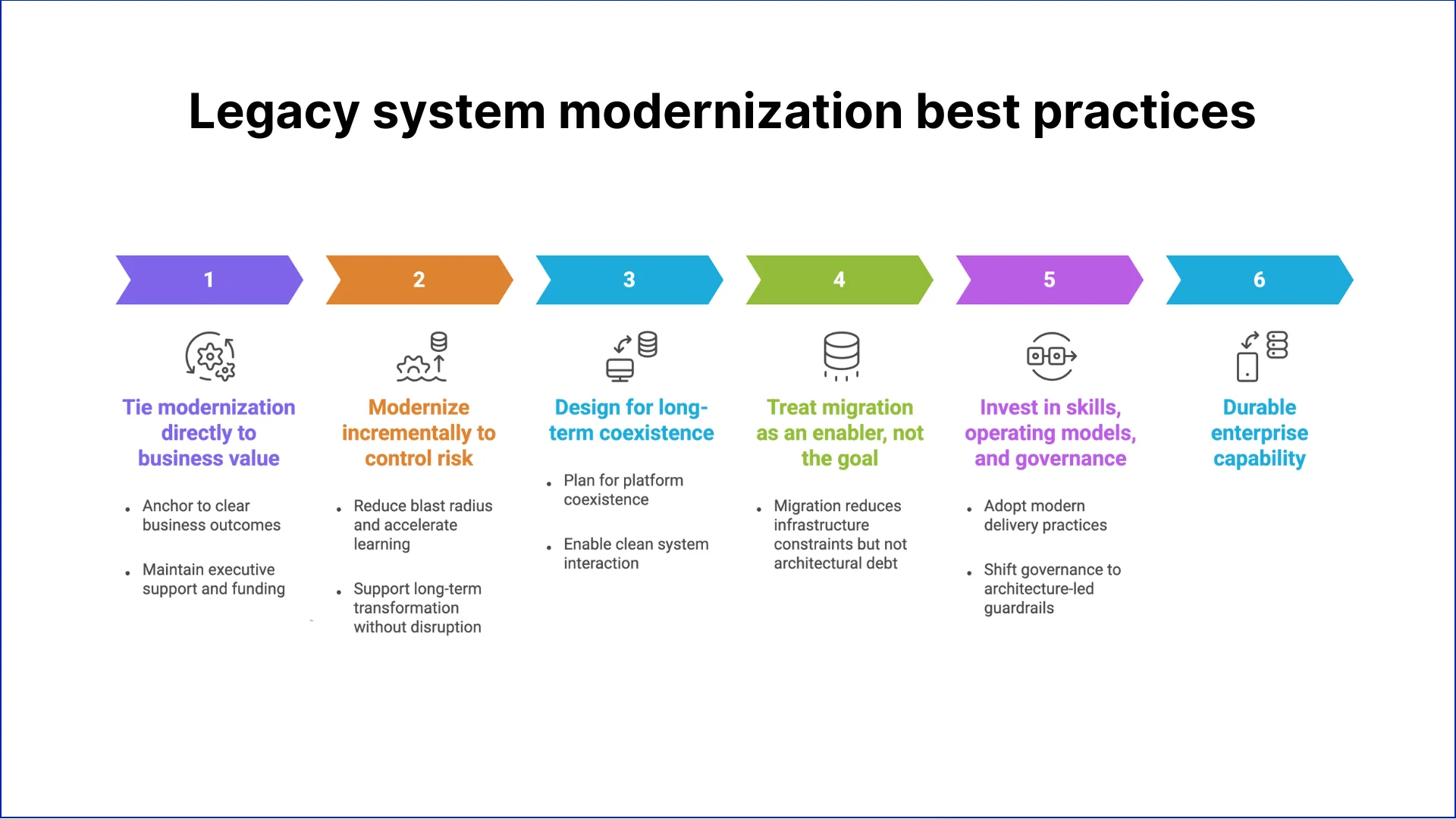
Legacy system modernization best practices
Enterprises that succeed with legacy system modernization follow a consistent set of practices shaped by failure, recovery, and iteration. These are not optional guidelines. They are safeguards against stalled transformation.
Tie modernization directly to business value
Modernization initiatives must be anchored to clear outcomes such as faster product delivery, improved resilience, or reduced operational risk. When legacy software modernization is treated as a purely technical exercise, executive support fades and funding becomes fragile. Business alignment keeps momentum intact.
Modernize incrementally to control risk
Large-scale rewrites introduce high uncertainty. Incremental legacy application modernization reduces blast radius and accelerates learning. Deliver value in stages. Validate assumptions early. Adjust continuously. This approach supports long-term enterprise IT transformation without disrupting core operations.
Design for long-term coexistence
Legacy and modern platforms will coexist far longer than expected. Best-in-class programs plan for this reality. API-led modernization enables systems to interact cleanly while evolving independently. This design principle is critical during legacy to cloud migration and avoids brittle integrations.
Treat migration as an enabler, not the goal
Many organizations mistake legacy system migration for modernization. Migration reduces infrastructure constraints but does not address architectural debt. Migration must support the broader IT modernization strategy, not replace it.
Invest in skills, operating models, and governance
Technology change without organizational change fails. Teams must adopt modern delivery practices. Governance should shift from approval-heavy processes to architecture-led guardrails. This cultural shift sustains modernization beyond the initial roadmap.
When applied together, these best practices turn legacy system modernization into a durable enterprise capability rather than a one-time transformation effort.
Eager to discuss about your project ?
Share your project idea with us. Together, we’ll transform your vision into an exceptional digital product!
Enterprises rarely fail at legacy system modernization because they lack intent or funding. They fail because decisions made early, often with good intentions, lock them into patterns that are hard to unwind later. The following mistakes show up repeatedly across large modernization programs.
Mistake 1: Lift-and-shift presented as strategic progress
A common scenario involves moving a monolithic core application to the cloud to “gain agility.” Infrastructure costs initially drop, leadership declares success, and the program moves on. Six months later, release cycles are unchanged, integrations remain fragile, and scaling is still expensive.
This happens because legacy system cloud migration was treated as the goal rather than a step. Without refactoring or decoupling, the same architectural constraints simply operate in a new environment.
Mistake 2: Modernizing individual systems without an enterprise view
Many organizations modernize application by application. Each team makes local decisions. Different integration patterns emerge. Data models diverge. Over time, the environment becomes harder to manage than before.
This is a failure to define a coherent modern enterprise IT architecture upfront. Enterprise IT transformation requires shared principles around APIs, data ownership, and service boundaries. Without this, modernization creates fragmentation instead of clarity.
Mistake 3: Big-bang replacements driven by frustration
Frustration with legacy platforms often leads to ambitious rebuild programs. These initiatives promise a clean slate. In practice, they underestimate embedded business rules, edge cases, and dependencies accumulated over decades.
Several years later, the new system is incomplete, while the old system remains critical. Incremental legacy application modernization avoids this trap by delivering value while preserving operational continuity.
Mistake 4: Treating integration as a secondary concern
In many failed programs, integration is addressed late. Teams modernize systems but leave legacy interfaces intact. Digital channels grow, but performance degrades under load.
API-led modernization should lead, not follow. Clean interfaces allow legacy and modern systems to coexist safely during legacy to cloud migration and beyond.
Mistake 5: Ignoring delivery and governance change
Enterprises often adopt cloud platforms while retaining approval-heavy governance and manual release processes. Teams gain new tools but operate under old constraints. Velocity barely improves.
A successful IT modernization strategy modernizes how work flows, not just where systems run. Governance must shift toward guardrails and architectural standards.
Mistake 6: Underestimating data and intelligence readiness
Organizations frequently delay data modernization until late stages. As a result, analytics and automation remain disconnected. AI initiatives stall because systems cannot expose clean, timely data.
Preparing for AI-driven digital transformation early ensures modernization compounds value instead of deferring it.
These mistakes are costly because they feel reasonable at the time. Avoiding them requires discipline, architectural leadership, and patience. Enterprises that learn these lessons execute legacy system modernization with far greater control and credibility.
Conclusion
Legacy systems are the product of deliberate engineering and business decisions made to meet the demands of their time. What has changed is not their reliability, but the context in which enterprises now operate.
What has changed is the environment. Markets move faster. Customer expectations shift continuously. Regulatory, operational, and competitive pressures evolve in parallel. In this context, legacy system modernization is no longer about technology renewal. It is about preserving enterprise relevance.
Enterprises that approach modernization as a finite program often stall. They migrate systems, adopt new platforms, and declare progress, only to find that agility remains elusive. This happens because modernization is not a destination. It is a sustained architectural and operational discipline.
The roadmap outlined here reflects what actually works at scale. Start by confronting the structural limitations of legacy systems. Align modernization to business intent, not tools. Decouple before replacing. Modernize incrementally while protecting continuity. Evolve delivery models and governance alongside architecture.
Most importantly, recognize that becoming a digital-first enterprise is not defined by cloud adoption or AI usage. It is defined by the enterprise’s ability to change safely, repeatedly, and with confidence.
Organizations that treat legacy system modernization as a continuous capability build systems that adapt as strategies change. Those that do not eventually find their technology dictating their options.
The strategic takeaway is simple and unavoidable. Modernize deliberately. Lead architecturally. Execute patiently. That is how legacy-bound enterprises become truly digital-first.
Legacy system modernization is the process of evolving existing enterprise systems to improve scalability, agility, integration, and maintainability. It focuses on architectural change rather than simply replacing or migrating applications.
Why do enterprises need legacy system modernization?
Enterprises need modernization because legacy systems slow delivery, increase operational risk, and limit digital innovation. As customer expectations and business models evolve, outdated architectures prevent organizations from responding effectively.
What are the biggest challenges of legacy systems in enterprises?
Common challenges include rigid architectures, fragile integrations, rising maintenance costs, limited data accessibility, and dependence on shrinking skill sets. These constraints often block enterprise digital transformation initiatives.
How is legacy system modernization different from digital transformation?
Digital transformation focuses on business outcomes such as improved experiences and new operating models. Legacy system modernization enables those outcomes by addressing the underlying technology, architecture, and delivery capabilities.
What are the common approaches to modernizing legacy applications?
Approaches include rehosting, replatforming, refactoring, and rebuilding. The right choice depends on business criticality, technical debt, and future relevance. Modernizing legacy applications often requires a mix of these strategies.
Is legacy system migration to the cloud enough?
No. Legacy system migration alone rarely improves agility. Without architectural refactoring, the same constraints persist in the cloud. Migration should support a broader IT modernization strategy, not replace it.
How long does legacy system modernization take?
Modernization is not a fixed-duration project. Most enterprises execute it incrementally over multiple phases. Treating legacy system modernization as a continuous capability delivers better long-term results than aiming for a single end date.
What role do APIs play in legacy system modernization?
API-led modernization decouples legacy systems from digital channels and new services. APIs enable safer integration, faster innovation, and coexistence between legacy and modern platforms during enterprise IT transformation.
How does legacy system modernization support AI and automation?
AI and automation require modular systems and accessible data. Automation in legacy modernization reduces manual effort, while architectural changes prepare systems for ai-driven digital transformation initiatives.
What are the best practices for successful legacy system modernization?
Best practices include aligning modernization to business outcomes, modernizing incrementally, designing for coexistence, avoiding lift-and-shift defaults, and evolving operating models alongside technology.
Business intelligence consulting services should give a mid-market company a governed way to make decisions. Attractive dashboards are only the visible part. The useful outcome is a system in which source data, metric definitions, access, releases, ownership, and support still work after the consultants leave.
In a Microsoft Solutions Partner vs Microsoft Partner comparison, the difference is validation. A company can participate in the Microsoft AI Cloud Partner Program without holding a customer-facing Solutions Partner designation. A designated Solutions Partner has met Microsoft’s current threshold in a specific solution pathway: at least 70 out of 100 partner capability points, with more than zero points in every required metric, based on performance, skilling, and customer success data recorded in Partner Center.
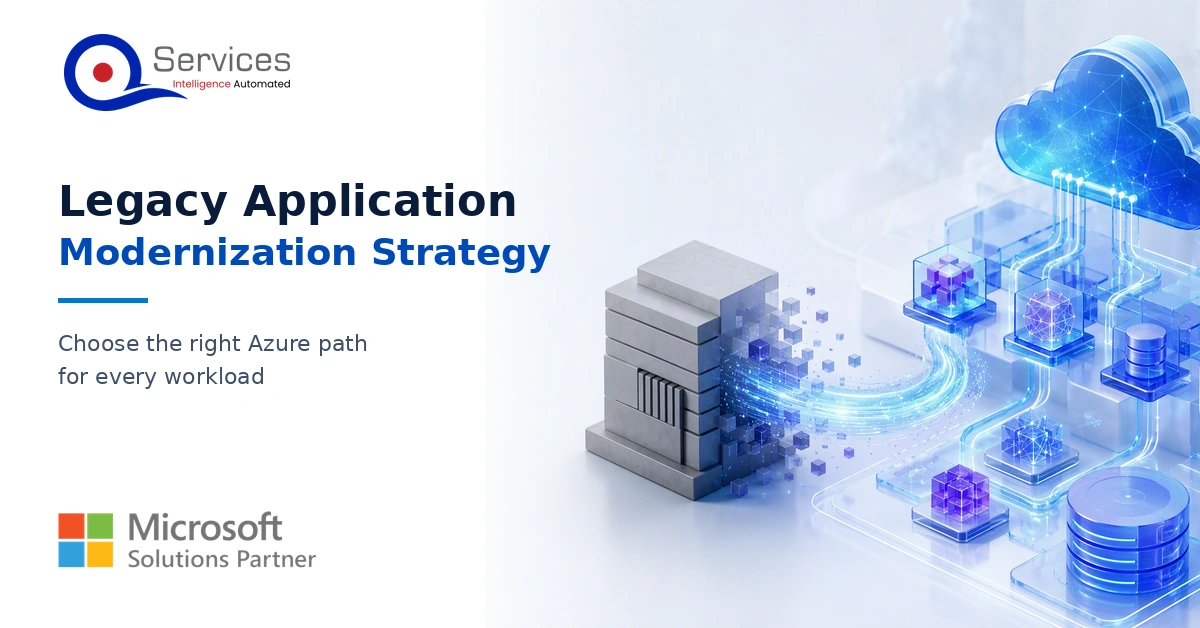
How do you build a legacy application modernization strategy for Azure? A legacy application modernization strategy assigns the right treatment to each workload, then sequences the work around business value, technical evidence, and operational risk. For Azure, that means choosing among retire, retain, rehost, replatform,
QServices Inc. undertakes every project with a high degree of professionalism. Their communication style is unmatched and they are always available to resolve issues or just discuss the project.
Turn the Microsoft Licenses
You Already Own Into an AI Workplace
Join our live webinar on Sept 24 and see five ways to automate meetings, approvals, and