 About us
 Who We are
 Our Products
 E-books
 Contact us
 Skilled Tasker
 Speedo Delivery
 Best Match
 Locate Bee
 Load Near Me
 Hire dotnet Developer
 Hire Flutter Developer
 Hire Hybrid Developer
 Hire Android Developer
 Hire Frontend Developer
 Hire ReactJS Developer
 Hire NodeJS Developer
 Hire Xamarin Developer
 Hire iOS Developer
 Hire WordPress Developer
 Power BI
 Power Pages
 Copilot Studio
 Power Automation
 Power Apps
 Power Virtual Agents
 Developer Tools
 Databases
 DevOps
 Identity
 Integration
 Management and Governance
 Internet of Things
 Migration
 Mobile
 Security
 Web
Web
 Analytics
 Sales
Sales
 Marketing
 HR
HR
 Supply Chain Management
 Intelligent Order Management
 Flutter Development
 Ionic Development
 Angular JS
 JavaScript
 Wearable
 AR VR
AR VR
 MongoDB
 Amazon Web Services
 MySQL
MySQL
 MSSQL
MSSQL
 Azure Development
 User Experience
 User Interface and Evaluation
 User Experience Review
 Digital Marketing
 Social Media Marketing
 PPC
PPC
 SEO
SEO
 IT consultation services
 Dev Ops
 Launching and Growth Hacking
 Scope of Work
 Product Discovery Workshop
 Strategic Business Analysis
 Food And Beverage
 Banking and Financial
 Travel and Tourism
 Oil and Gas
 Energy and Utility
 E-commerce
 Media and Social
 Healthcare
 Hospitality
 Education
 Real Estate
 quincy
 Customer Support
 Lead Generation
 Appointment Setter
 E-Commerce

ABOUT Us
our Products
Power Platform
Digital & App Innovation
Supply Chain
Technology
Design
Online Presence
Scaling
Redefining

Introduction
Selecting the right software platform should never be a technical choice. For businesses, it is a risk decision that affects speed to market, cloud costs, team productivity, and long-term system stability.
In the .NET Core vs Node.js debate, the focus should be less on which technology is “better” and more on which one fits business needs in 2026. Companies now balance rapid product delivery and remote development with stricter regulations, data protection requirements, and uptime expectations.
While Node.js remains popular among startups, SaaS companies, and digital platforms, .NET Core often aligns better with organizations operating in regulated and security-sensitive environments.
This article takes a practical, use-case driven approach to Node.js vs .NET Core, helping you choose based on real operational priorities, not developer preferences or short-term trends.
ASP.Net vs Node.JS: Key Differences That Matter in 2026
ASP.NET Core, developed and supported by Microsoft, is widely used for building enterprise-grade applications that require strong security controls, structured development practices, and long-term platform stability. In contrast, Node.js is built on JavaScript and is widely adopted for services that require fast delivery and frequent updates, especially in API-driven products.
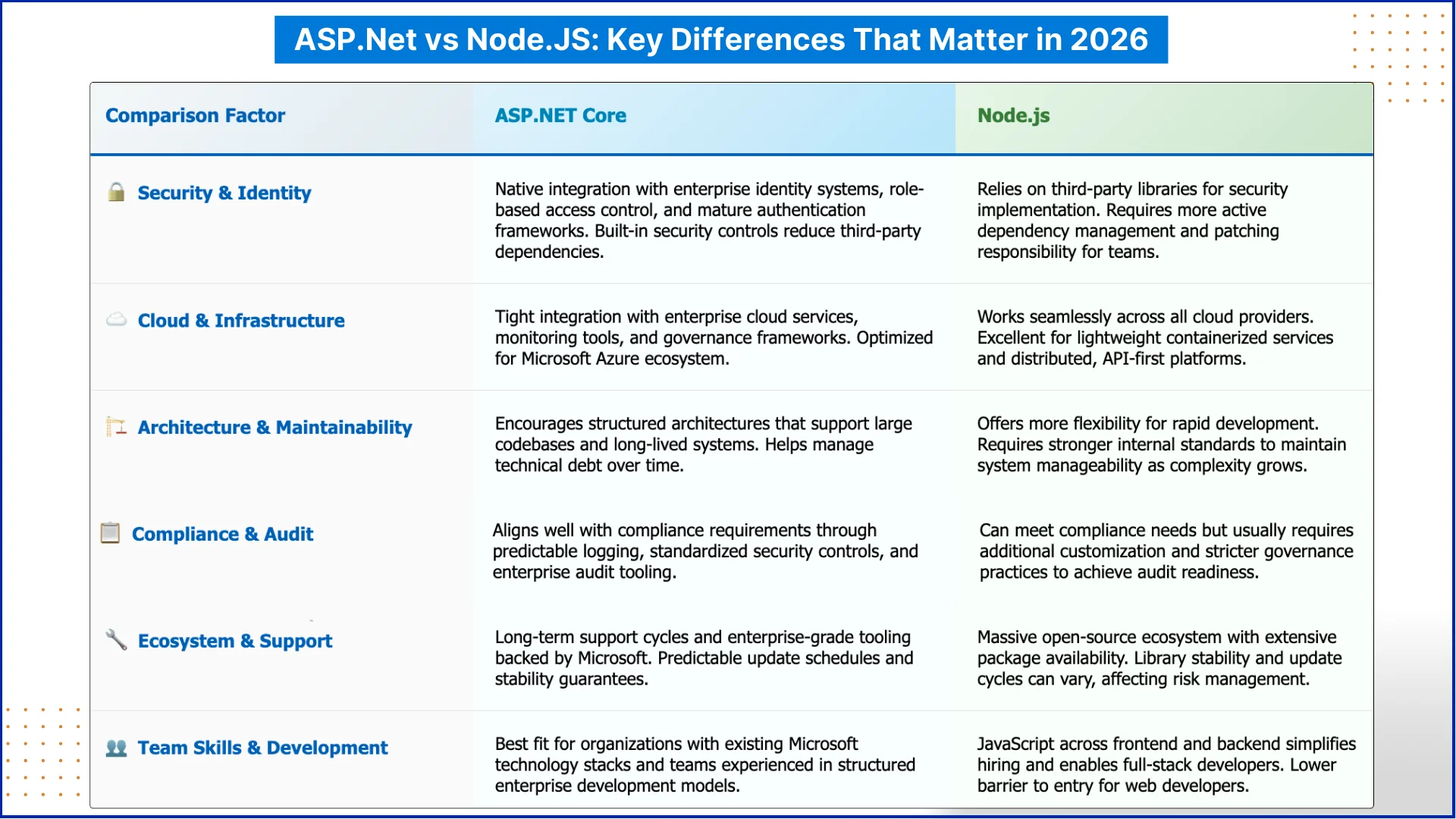 The practical differences between these platforms become clearer when they are compared across areas:
1. Robust Security and Identity Integration
ASP.NET Core offers native integration with enterprise identity systems, role-based access control, and mature authentication frameworks. This makes it easier to enforce security policies across applications and services. Node.js can be secured effectively, but it often relies on third-party libraries, which increases dependency management and patching responsibility for internal teams.
2. Cloud and Infrastructure Alignment
Both platforms support cloud-native deployment, but ASP.NET Core integrates tightly with enterprise cloud services, monitoring tools, and governance frameworks. Node.js works well across cloud providers and supports lightweight containerized services, which appeals to teams building distributed and API-first platforms.
3. Application Structure and Long-Term Maintainability
ASP.NET Core encourages structured architectures that support large codebases and long-lived systems. This helps organizations manage technical debt over time. Node.js offers more flexibility, which can speed up early development but may require stronger internal standards to keep systems manageable as teams and products grow.
4. Compliance and Audit Readiness
For regulated industries, ASP.NET Core aligns well with compliance requirements through predictable logging, standardized security controls, and enterprise audit tooling. Node.js environments can meet compliance needs, but usually require additional customization and stricter governance practices.
5. Ecosystem Stability and Vendor Support
Microsoft provides long-term support cycles and enterprise-grade tooling for ASP.NET Core. Node.js benefits from a massive open-source ecosystem, but library stability and update cycles can vary, which affects long-term risk management.
6. Team Skills and Cross-Platform Development
Node.js allows teams to use JavaScript across both frontend and backend, simplifying hiring and collaboration. ASP.NET Core often fits organizations with existing Microsoft technology stacks and teams experienced in structured enterprise development models.
Overall, the advantages of Node.js often show up in speed and flexibility, while ASP.NET Core stands out in environments where security, compliance, and long-term system reliability are higher priorities. In 2026, these operational differences matter more than raw technical capabilities.
Secondary Considerations: Development Speed, Talent Availability, and Maintenance Costs
Putting .NET vs Node.js in a broader perspective, organizations must weigh how quickly teams can deliver features, the availability of skilled developers, and the predictability of long-term maintenance costs.
For .NET Core Backend
- Structured Development for Complex Workflows– ASP.NET Core supports structured workflows and enterprise patterns, which can slightly slow initial feature delivery but reduces errors and rework in complex applications. Large-scale systems in banks like JPMorgan Chase or healthcare platforms rely on this predictability.
- Enterprise Talent Availability– Globally, there are roughly 350,000–400,000 .NET Core developers, mainly in Europe, North America, and Asia, making it easier to hire teams for enterprise and regulated environments.
- Predictable Maintenance and Upgrade Costs– Microsoft’s long-term support cycles and formal release schedules help organizations plan upgrades and patches, keeping operational and compliance costs predictable over time.
For Node.js Backend
- Rapid Feature Delivery– Startups and SaaS companies like Netflix and LinkedIn use Node.js to quickly release new features and respond to user feedback, making it ideal for API-driven and real-time applications.
- Large Global Talent Pool– Node.js has over 1.2 million developers worldwide. Its JavaScript foundation allows companies to hire full-stack developers who can work across frontend and backend, simplifying team scaling for fast-growing products.
- Flexible Maintenance– Node.js systems can scale efficiently, but lightweight architecture requires active dependency management and coding standards. Without this, maintenance costs can grow as applications and teams expand.
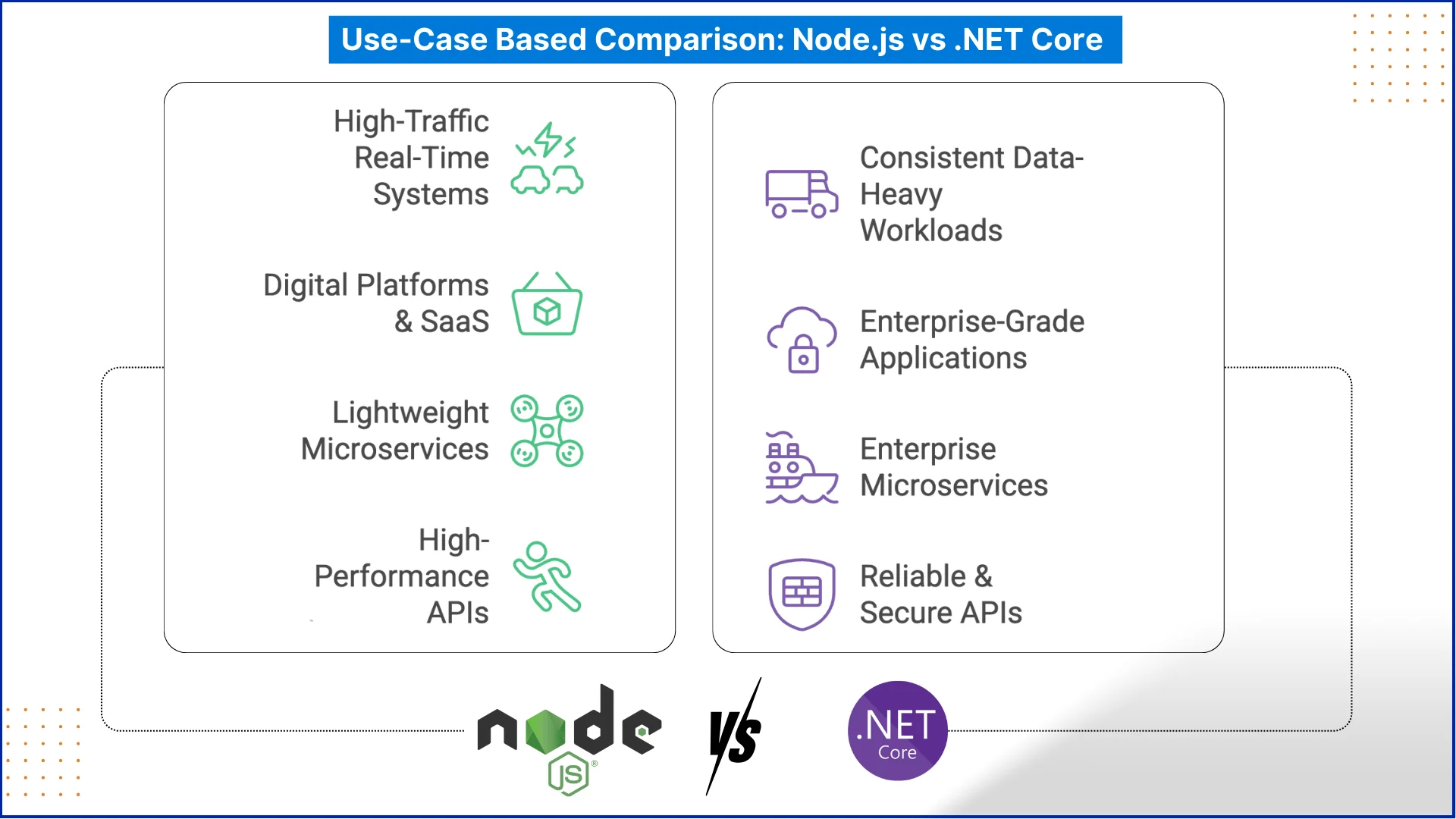
Use-Case Based Comparison: Node.js vs .NET Core
Both Node.js and .NET Core are capable of handling modern applications across different domains. However, their strengths vary depending on workload types, organizational needs, and operational priorities. Here’s how they compare across common enterprise and product scenarios:
 Node.js vs .NET Core for High-Traffic, Real-Time Systems
Node.js
Node.js is designed to handle massive real-time traffic efficiently, keeping response times low even under heavy user loads:
- Manages thousands of simultaneous connections without slowing down processes.
- Supports real-time chat, notifications, and live streaming features seamlessly.
- Used by Netflix and LinkedIn to deliver live updates at scale.
.NET Core
.NET Core excels when consistent performance and reliability are critical, even under complex, data-heavy workloads:
- Handles large-scale transactions predictably without unexpected slowdowns.
- Integrates with enterprise monitoring and scaling tools for reliability.
- Powers banking and insurance systems where uptime and data integrity matter.
.NET Core vs Node.js for Enterprise Apps
.NET Core
Enterprise-grade applications benefit from .NET Core’s focus on stability, compliance, and long-term maintainability:
- Ensures smooth updates and predictable patch cycles for critical systems.
- Meets regulatory standards in finance, healthcare, and government environments.
- Reduces operational risk for organizations running large, long-lived applications.
Node.js
Node.js is preferred for digital platforms and SaaS products where speed, flexibility, and iterative development are key:
- Enables rapid deployment of features and fixes without slowing teams.
- Adapts easily to evolving business needs and product changes.
- Popular with startups that need to scale quickly while iterating fast.
Node.js vs .NET Core for Microservices
Node.js
Lightweight microservices built with Node.js scale easily and handle distributed workloads efficiently:
- Fast startup and minimal memory footprint for containerized services.
- Simplifies asynchronous communication between multiple microservices.
- Ideal for cloud-native or serverless setups managing many small services.
.NET Core
.NET Core supports enterprise microservices that handle heavier data processing and complex workflows:
- Processes coordinated tasks reliably across services with high throughput.
- Works seamlessly with Azure and Windows-based infrastructure.
- Built-in monitoring and scaling tools make it suitable for large organizations.
Node.js vs .NET Core for APIs
Node.js
Node.js is optimized for high-performance APIs that need to handle multiple concurrent requests without delays:
- Serves RESTful and GraphQL endpoints efficiently, even under load.
- Supports real-time updates for SaaS and digital platforms.
- Offers an extensive ecosystem of open-source libraries for API functionality.
.NET Core
.NET Core ensures APIs remain reliable, secure, and scalable for enterprise workloads:
- Maintains predictable performance for high-volume, sensitive API calls.
- Includes built-in security, logging, and monitoring for compliance.
- Powers financial and healthcare systems where data integrity is critical.

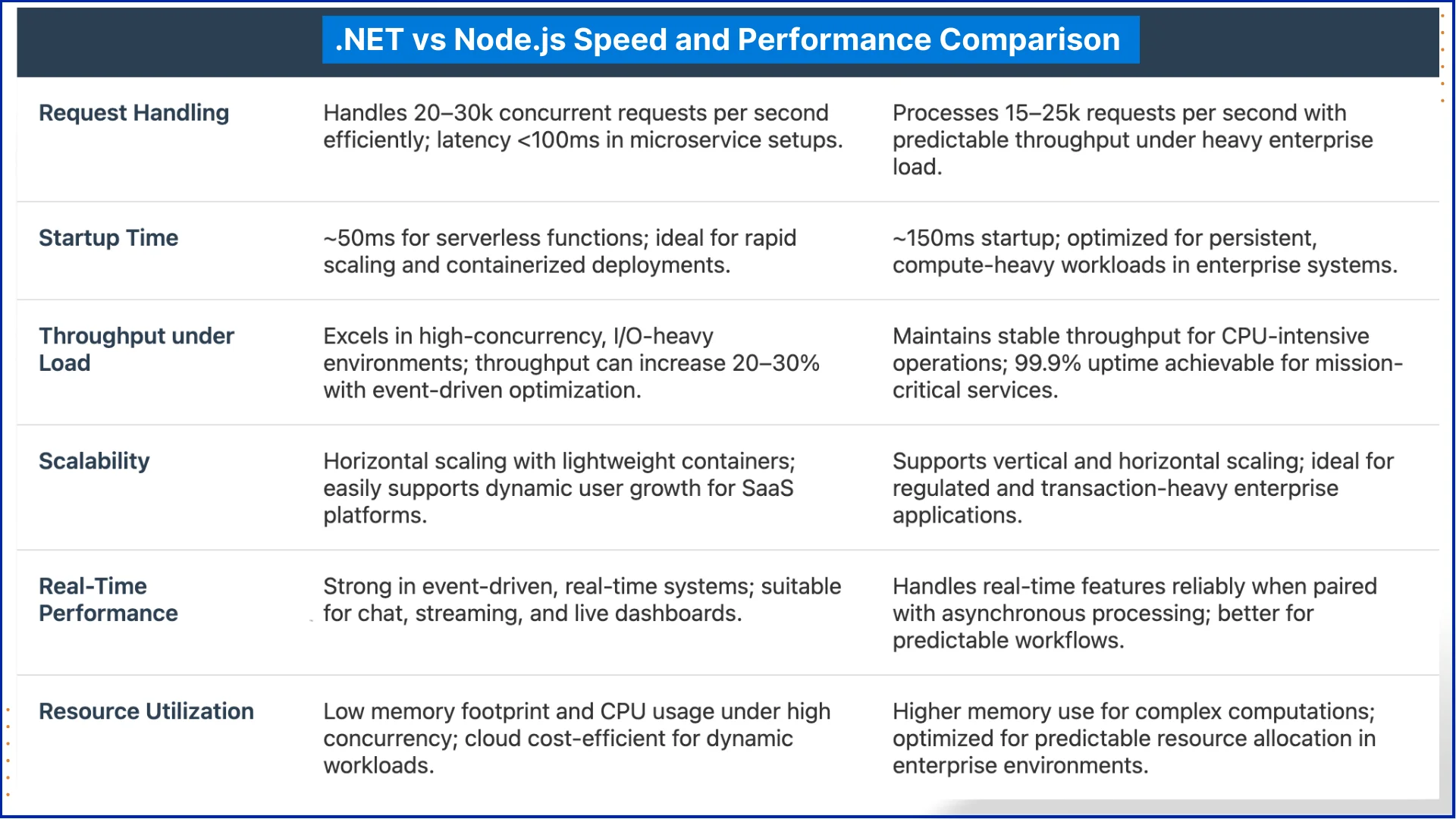
.NET vs Node.js Speed and Performance Comparison
Before making platform decisions in 2026, it’s essential to understand the performance differences between Node.js and .NET Core across key operational dimensions. The following table compares their capabilities side by side, highlighting how each platform performs:
When .NET Core is the Better Choice
.NET Core becomes the safer option when applications are tightly connected to business operations, compliance frameworks, and long-term infrastructure planning. It fits environments where system behaviour must remain predictable even as scale and regulatory pressure increase.
It is usually preferred when organizations face the following conditions:
- Regulated data and audit requirements- Industries such as banking, insurance, and healthcare rely on strict access controls, traceable logs, and controlled release processes, where .NET Core aligns naturally with enterprise compliance workflows.
- Large, interconnected business systems- When applications must integrate with identity providers, ERP platforms, internal databases, and reporting tools, .NET Core simplifies coordination across internal services and teams.
- Heavy transaction processing- Workloads involving financial calculations, billing engines, and operational analytics perform more consistently when managed by long-running, strongly typed backend services.
- Long-term platform stability- Organizations planning five- to ten-year system lifecycles often choose .NET Core to minimize dependency volatility and unplanned architectural rewrites.
- Existing Microsoft infrastructure investments- Companies already using Azure, Active Directory, SQL Server, and enterprise DevOps tooling reduce operational friction when backend services run on .NET Core.
When Node.js Makes More Business Sense
Node.js fits businesses that operate in fast-moving product markets where customer experience, rapid releases, and traffic variability drive technology decisions more than regulatory frameworks.
It is typically favoured under the following conditions:
- Product teams release features frequently- SaaS platforms and consumer-facing applications benefit from quick deployment cycles where backend services evolve weekly rather than quarterly.
- Traffic patterns are highly dynamic- Marketplaces, streaming platforms, and on-demand services handle sudden usage spikes more efficiently with lightweight, horizontally scalable Node.js services.
- APIs are the core of the business model- Companies built around mobile apps, partner integrations, or public APIs often select Node.js for fast request handling and flexible service composition.
- Smaller teams own full product workflows- When the same developers manage both frontend and backend, JavaScript-based stacks reduce coordination delays and onboarding time.
- Cloud-native cost optimization is a priority- Event-driven workloads and serverless architectures often run more cost-efficiently on Node.js when traffic volume fluctuates throughout the day.
How to Choose Between .NET Core and Node.js for Your Organization
Consider the following decision drivers before making a final choice: 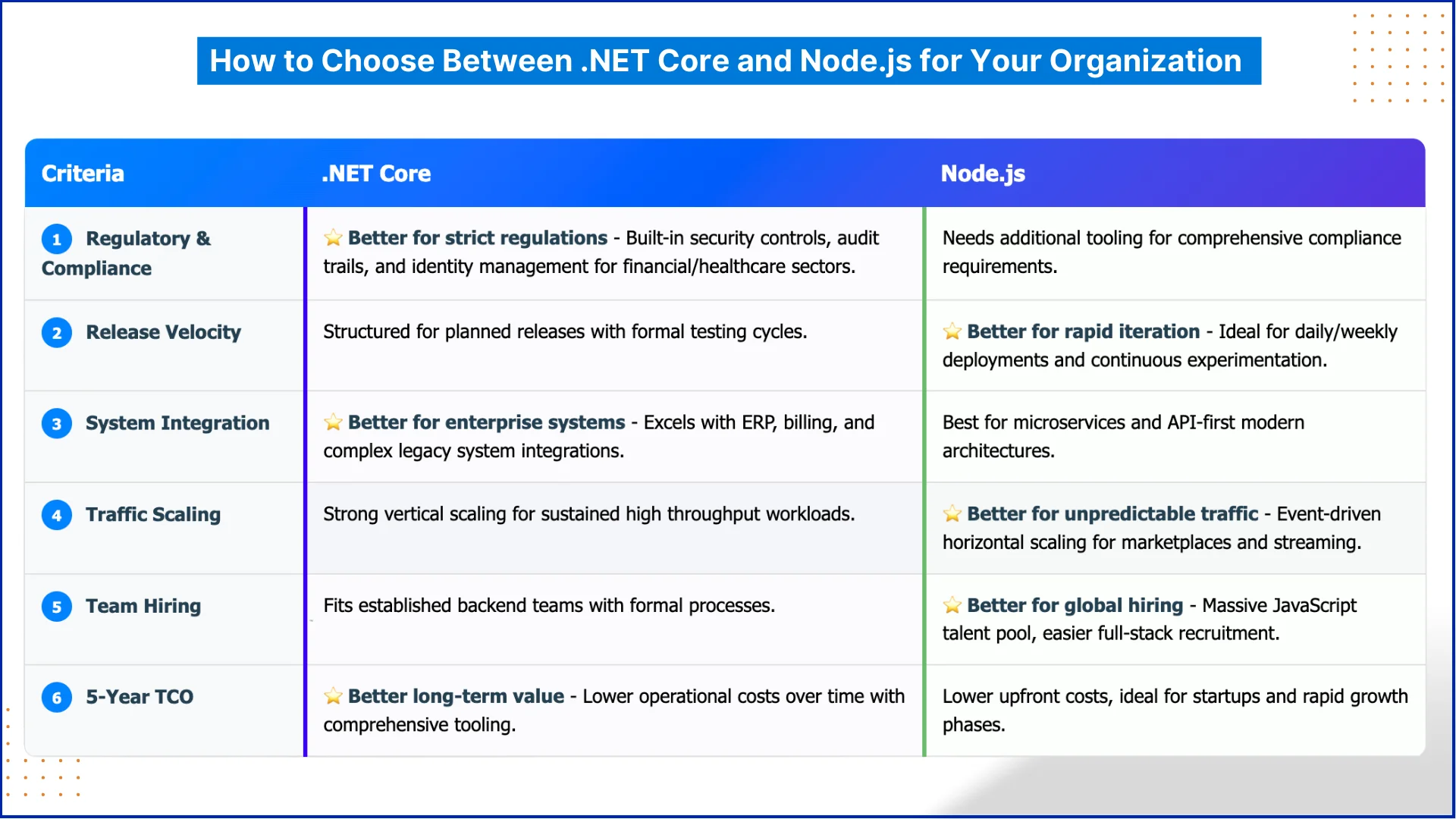 1. Regulatory and compliance pressure
If your applications must meet financial, healthcare, or data sovereignty regulations, predictable security controls, identity management, and audit trails become non-negotiable. Environments with frequent audits and strict reporting workflows often align better with .NET Core–based systems.
2. Product release frequency and change velocity
Teams that deploy updates weekly or even daily benefit from flexible architectures and lightweight services. Businesses running fast-moving digital products usually lean toward Node.js to support continuous experimentation and rapid customer feedback cycles.
3. System complexity and integration depth
When backend services connect deeply with ERP platforms, internal analytics, billing engines, and authentication systems, platform consistency and long-term compatibility matter more than short-term speed. These environments often favor .NET Core for managing complex dependencies.
4. Traffic patterns and scaling strategy
Applications with unpredictable spikes, such as marketplaces or streaming platforms, benefit from horizontally scalable, event-driven services. Node.js performs well when traffic fluctuates and services must scale up and down quickly without heavy infrastructure planning.
5. Hiring strategy and team structure
Organizations hiring globally for full-stack roles may find Node.js easier to scale due to widespread JavaScript expertise. Enterprises with established backend teams and formal development processes often align better with .NET Core skill sets and workflows.
6. Total cost of ownership over five years
Initial development costs rarely reflect long-term operational expenses. Maintenance, security updates, monitoring, and compliance tooling often favor .NET Core in stable enterprise systems, while Node.js can reduce early infrastructure costs for growing digital platforms.


Do you have more questions?
Have a one on one discussion with our Expert Panel
Reducing Azure cloud costs for SMBs is one of the most pressing challenges facing startup founders and small business CTOs right now. You signed up for flexible, pay-as-you-go cloud infrastructure, watched your team deploy a few services, and then received a monthly bill that was

Power Platform low-code solutions for SMBs have changed what's possible for founders and operations teams who don't have a developer on payroll. Microsoft's Power Platform gives small businesses a way to build custom apps, automate repetitive tasks, and surface business intelligence without hiring expensive engineering

Learning how to reduce cost in Azure cloud is one of the most pressing priorities for SMBs running production workloads in 2026. Cloud bills grow faster than revenue when teams spin up resources without a governance plan. The good news: a structured approach to Microsoft





Sahil Kataria
Founder and CEO

Amit Kumar
Chief Sales Officer



QServices Inc. undertakes every project with a high degree of professionalism. Their communication style is unmatched and they are always available to resolve issues or just discuss the project.
