Custom power apps development is one of the most common decision points IT leaders face when modernising business processes: use Power Platform's low-code tools to move fast, or invest in custom .NET applications that give you full architectural control? The honest answer depends on your use case, your governance maturity, and what you are actually trying to solve. This post breaks down when each approach wins, how to govern Power Platform at scale, and how to make the right call without committing to the wrong path for the next five years.
In This Article, You'll Learn
What Is the Core Difference Between Power Platform and Custom .NET?
When Custom Power Apps Development Makes Sense
When Custom .NET Development Is the Better Choice
How Power Platform Governance Prevents Shadow IT
What a Power Platform Center of Excellence Actually Does
Eager to discuss about your project?
Share your project idea with us. Together, we’ll transform your vision into an exceptional digital product!
What Is the Core Difference Between Power Platform and Custom .NET?
Both Power Platform and custom .NET development solve business problems, but they sit at opposite ends of the build-vs-configure spectrum. Understanding where each one lives is the foundation for every decision that follows.
Power Platform is Microsoft's suite of low-code tools: Power Apps (canvas and model-driven), Power Automate (workflow automation), Power BI (analytics and dashboards), Power Pages (external portals via power pages development), and Dataverse (the underlying relational database). It is designed so business analysts and citizen developers can build solutions with minimal traditional coding.
Custom .NET development means building applications from the ground up using C#, ASP.NET, Blazor, or similar technologies. You control the architecture, the data model, the performance profile, and the deployment target entirely.
Power Platform: Low-Code Tools for Business Users
Power Platform's real strength is speed. A business analyst who understands their workflow can build a canvas app, connect it to SharePoint or Dataverse, and automate approvals through Power Automate without waiting for IT. Power apps development services built on this foundation can move from idea to working prototype in days rather than months.
The platform also benefits from tight Microsoft ecosystem integration. Your Power Apps can read and write Dynamics 365 data natively, your Power BI dashboards surface D365 sales metrics, and your Power Automate flows trigger D365 actions without custom API work. Our post on Dynamics 365 integration services covers how these pieces connect for Microsoft-first organisations.
Custom .NET: Full-Stack Engineering for Complex Systems
Custom .NET is the right call when your requirements cannot be met by connectors and low-code logic. Complex business rules, high-throughput transaction processing, multi-tenant SaaS architecture, or deep integrations with legacy systems typically need a proper engineering approach. ASP.NET development services give you the control to model your domain precisely, optimise database queries, and build for the scale your business actually needs.
The key distinction: Power Platform apps run inside Microsoft's managed runtime. Custom .NET apps run wherever you deploy them, whether Azure, on-premises, or a hybrid configuration.
When Custom Power Apps Development Makes Sense
Custom power apps development delivers the most value in mid-market and enterprise scenarios where business users have strong domain knowledge but limited engineering resources. The sweet spot is internal tooling: approval workflows, data collection forms, operational dashboards, and process automation that bridges gaps between existing systems.
Power Apps Canvas vs Model-Driven: Choosing the Right App Type
Canvas apps give you pixel-perfect control over the user interface. You drag and drop components, connect to almost any data source, and design the experience to match your workflow exactly. They work well for mobile-first field tools, simple data entry forms, and one-off operational workflows.
Model-driven apps are built on top of Dataverse and follow a data-first approach. You define your data model (entities, relationships, forms, views) and the app renders itself based on that model. They are better for complex data management scenarios: CRM-style apps, case management systems, and inspection tracking where you have ten or more related entities. If you are deciding between these two, our guide on choosing between SharePoint, Power Apps, and Custom .NET for intranet portals covers the decision in detail.
Dataverse consulting matters most here. Getting the entity model right at the start prevents expensive data restructuring later, especially for model-driven apps where the schema drives the entire user experience.
Power Automate Workflow Examples That Fit Low-Code Well
Power automate consulting engagements consistently surface the same high-ROI use cases: new hire onboarding flows that create accounts across multiple systems automatically, invoice approval routing based on amount thresholds and department rules, and customer feedback routing based on category. These are exactly the power automate workflow examples where low-code automation outperforms custom development on both cost and delivery speed.
For a detailed look at what is possible in practice, our post on Power Automate workflow examples covers 10 real business setups with actual configuration steps, including multi-stage approvals and cross-system data sync patterns.
Power BI Dashboard Development as a Self-Service Analytics Layer
Power BI dashboard development is often the entry point for broader Power Platform adoption. Finance teams that previously waited weeks for IT to update reports can connect directly to Azure SQL, Dataverse, or SharePoint and build their own dashboards. The value of power bi consulting services is knowing when to build a governed shared semantic model versus when to let business users run their own reports. We cover the full process in our Power BI dashboard development guide.
When Custom .NET Development Is the Better Choice
Low-code has real limits. When you hit them, pushing Power Platform further rarely ends well.
Signs Your Project Has Outgrown Low-Code
The clearest signal is when your Power Apps solution requires more workarounds than logic. If you are using ten or more nested conditions in Power Fx, calling external APIs through custom connectors that keep breaking, or managing data in spreadsheets because Dataverse licensing costs too much for your user count, you have probably outgrown the platform for this particular use case.
Other clear signals:
Your app needs to handle hundreds of concurrent users under real load
You need fine-grained database control: custom indexes, stored procedures, or complex multi-table joins
Your security model goes beyond what Power Platform's role-based access can express cleanly
You are building a product you will sell or license to external customers
Healthcare, financial services, and regulated manufacturing often have requirements that low-code platforms cannot satisfy without significant workarounds. HIPAA-compliant data handling, PCI-DSS transaction processing, and FCA-regulated audit trails each have technical requirements that Power Platform can partially address but rarely meets fully in regulated scenarios without considerable workaround complexity.
Custom .NET applications running on your own Azure tenant give you direct control over encryption at rest, network isolation, audit logging granularity, and data residency. According to NIST's cybersecurity framework, systems handling regulated data need clearly defined control boundaries, which are easier to establish and audit in custom-built applications than in managed low-code platforms.
How Power Platform Governance Prevents Shadow IT
Power Platform governance is the set of policies, controls, and processes that prevent the platform from becoming a compliance liability. Without it, citizen developers build apps that store data in personal OneDrive folders, connect to unsanctioned external services, and bypass IT security controls entirely.
Shadow IT in Power Platform is a documented problem. When Microsoft included Power Apps in Microsoft 365 licences, millions of users suddenly had access to a development platform with no governance framework in place. The result at many organisations was exactly what you would expect: data silos, abandoned apps, and compliance gaps that only surfaced during audits.
Power Platform governance prevents shadow IT through DLP policies, environment strategies, and approval workflows that ensure no app reaches production without IT review. This is not theoretical. We have seen firsthand how quickly ungoverned Power Platform deployments create security and operational debt that costs far more to remediate than a governance programme would have cost upfront.
Shadow IT Power Platform: The Real Risk
The risk is not just security. Shadow IT creates operational debt that compounds. An app built by someone who has since left, connecting to a data source that has been decommissioned, running in the default environment with no backup strategy, is a support problem no one budgeted for. Our post on shadow IT in Power Platform covers the patterns we see most often and how to address them before they become incidents.
DLP Policies and Environment Strategies
A practical environment strategy for mid-market organisations uses three tiers: a default environment locked down to personal productivity use only, a shared development environment where approved makers can build, and production environments per business unit. This segmentation prevents most governance failures.
DLP policies sit on top of this. According to Microsoft's Power Platform admin documentation, you can apply DLP policies at the tenant or environment level, with environment-level policies taking precedence in specific contexts. Getting connector classification right (Business vs Non-Business vs Blocked) is the first thing a power automate consulting engagement should address when a client has an existing ungoverned deployment.
Power Platform Center of Excellence as the Control Layer
The Power Platform Center of Excellence is the governance body that owns environment strategy, DLP policies, maker onboarding, and app lifecycle management. It is a team and a process, supported by the Microsoft CoE Starter Kit, not just a technology configuration.
What a Power Platform Center of Excellence Actually Does
A Power Platform Center of Excellence (CoE) is a cross-functional team combining IT, security, and business unit representatives who own the platform's governance, adoption strategy, and technical standards.
QServices implements Power Platform Center of Excellence programs using Microsoft's CoE Starter Kit, which provides pre-built dashboards covering app inventory, maker activity, connector usage, and compliance status across your entire tenant. The CoE Starter Kit documentation is publicly available, but operationalising it requires deliberate setup and ongoing operational commitment that most IT teams underestimate.
Power Platform ALM and Release Management
Power platform ALM is the process of moving apps through development, test, and production environments in a controlled, repeatable way. Without ALM, every app becomes a snowflake: deployed manually, documented inconsistently, impossible to roll back when something breaks in production.
A proper power platform ALM setup uses Azure DevOps or GitHub Actions for deployment pipelines, solution packaging to export and import apps across environments, and environment variables to manage configuration differences between dev and prod. For automation that needs tight version control, comparing Power Automate vs Logic Apps is worth the time: Logic Apps and Azure Functions are often better choices when the workflow needs to live in source control as code rather than as a cloud flow.
Citizen Developer Governance Guardrails
Citizen developer programs need governance guardrails to prevent data silos and compliance gaps. Effective citizen developer governance means three things in practice: maker training (so people know what they are permitted to build), an approval process (so IT reviews anything touching sensitive or regulated data), and a support handover process (so apps do not become orphans when their creator moves on).
The Power Platform Governance Framework post outlines the six pillars in detail. Power platform governance is not a one-time project; it is an ongoing operational function that needs a named owner and a budget.
The Real Cost of Power Platform vs Custom .NET Development
Cost comparisons between low-code and custom development are difficult because the cost variables are different, not just the magnitudes.
Power Apps Development Services Pricing
For Power Platform, costs break into three areas: licensing (Power Apps per-user or per-app plans, Dataverse storage, premium connectors), consulting fees for initial build and governance setup, and ongoing support. In our client engagements, a typical mid-market single department solution runs in the tens of thousands of dollars all-in for design, build, governance setup, and user training. The Microsoft 365 licensing many organisations already hold covers basic Power Apps and Power Automate usage, which keeps the incremental cost low for simple scenarios.
The catch is Dataverse. Once you need a proper database backing your apps, Dataverse licensing adds meaningful cost. Microsoft includes 1GB of database storage per 20 licensed users; beyond that, storage costs $40 per GB per month (as of 2026, per Microsoft's Power Platform pricing). For data-intensive apps, this can exceed the cost of running Azure SQL inside a custom .NET solution. A power platform development company should be transparent about these licensing costs during initial discovery, not after the contract is signed.
Key Insight Microsoft includes 1GB of database storage per 20 licensed users; beyond that, storage costs $40 per GB per month (as of 2026, per Microsoft's Power Platform pricing).
Hidden Costs in Low-Code Platforms
The costs most organisations miss:
Technical debt from poorly architected apps: apps built without proper data models cost real money to fix or rebuild
Governance setup: a proper CoE, environment strategy, and ALM pipeline requires upfront consulting investment that is easy to skip and expensive to retrofit
Premium connectors: many enterprise integrations require premium connectors that add per-user licensing costs that scale with adoption
Platform ceiling costs: when requirements exceed low-code capabilities, the cost to work around them or rebuild in custom code is significant, often more than a custom build would have cost initially
For complex, long-lived applications, total cost of ownership often favours custom .NET after three to five years. Power BI dashboard development is a counter-example where Power Platform almost always wins on cost at any scale.
How to Choose: A Decision Framework
The decision is not Power Platform versus custom .NET. Most mature Microsoft organisations use both. The question is which tool fits which problem.
Questions to Ask Before Committing to a Platform
Choose custom power apps development (Power Platform) when:
Primary users are business analysts or domain experts, not software engineers
Core data already lives in Microsoft 365, Dataverse, or Dynamics 365
You need something working in weeks, not months
The workflow follows standard patterns: approvals, notifications, data collection, reporting
You have or are actively building a Power Platform center of excellence to govern what gets built
Choose custom .NET development when:
You need full control over performance, data model, or deployment target
The application will serve external customers or requires custom authentication and authorisation logic
Compliance requirements exceed what Power Platform can meet cleanly
The application lifecycle spans five or more years with frequent, complex feature evolution
You need microservices, event streaming, or business logic that low-code simply cannot express
A practical heuristic: if you can describe the entire application on a single page of requirements with no edge cases, Power Platform will likely serve you well. If the requirements document has footnotes, exceptions, and integration diagrams, budget for custom development.
For teams considering migration from legacy systems, migrating from legacy .NET Framework to .NET 8 or .NET 9 is often a better path than replatforming to Power Platform for applications with established codebases and complex business logic.
According to Gartner's research on low-code application platforms, low-code development tools will account for 70% of application development activity by 2025. That is not a case for using low-code for everything; it is a case for having a clear decision framework so you use it for the right things and govern it properly when you do.
Key Insight According to Gartner's research on low-code application platforms, low-code development tools will account for 70% of application development activity by 2025.
Key Takeaways
Both Power Platform and custom .NET development solve business problems, but they sit at opposite ends of the build-vs-configure spectrum.
Custom power apps development delivers the most value in mid-market and enterprise scenarios where business users have strong domain knowledge but limited engineering resources.
Power Platform governance is the set of policies, controls, and processes that prevent the platform from becoming a compliance liability.
A Power Platform Center of Excellence (CoE) is a cross-functional team combining IT, security, and business unit representatives who own the platform's governance, adoption strategy, and technical standards.
Cost comparisons between low-code and custom development are difficult because the cost variables are different, not just the magnitudes.
Conclusion
Custom power apps development and custom .NET development are complementary tools that serve different problem types. Power Platform wins on speed, accessibility, and Microsoft ecosystem integration. Custom .NET wins on complexity, compliance depth, and long-term architectural control. Organisations that get the most value use both: Power Platform for citizen-built tools governed by proper power platform governance, and custom .NET for systems of record and complex integrations that need proper engineering discipline.
The single most important success factor for Power Platform is governance. Without it, citizen developer programs become shadow IT programs, and the speed advantage disappears under compliance remediation costs. Build your CoE, set your DLP policies, and run your ALM process from day one.
If you are at the decision point between these approaches, or if you have deployed Power Platform and need governance put in place, QServices works with mid-market and enterprise teams across healthcare, logistics, and financial services on both platforms. Reach out to talk through your specific situation.
Co-Founder and CTO, QServices IT Solutions Pvt Ltd
Rohit Dabra is the Co-Founder and Chief Technology Officer at QServices, a software development company focused on building practical digital solutions for businesses. At QServices, Rohit works closely with startups and growing businesses to design and develop web platforms, mobile applications, and scalable cloud systems. He is particularly interested in automation and artificial intelligence, building systems that automate routine tasks for teams and organizations.
Use Power Platform when your primary users are business analysts rather than engineers, your data already lives in Microsoft 365 or Dataverse, and you need a solution in weeks rather than months. Custom .NET is the better choice when you need fine-grained database control, complex compliance requirements, high-concurrency performance, or an application that will be sold to external customers.
Power Platform governance is the set of policies, controls, and processes that prevent the platform from becoming a compliance liability. It covers DLP connector policies, environment strategy (dev/test/prod separation), maker approval workflows, and app lifecycle management. Without it, citizen developers can build apps that store data in unsanctioned locations, connect to blocked external services, and create shadow IT that surfaces during audits.
Preventing shadow IT in Power Platform requires three things: a segmented environment strategy that locks down the default environment, DLP policies that classify connectors as Business, Non-Business, or Blocked, and a maker approval process that requires IT review before any app accessing sensitive data reaches production. A Power Platform Center of Excellence provides the ongoing governance structure to maintain these controls.
A Power Platform Center of Excellence (CoE) is a cross-functional team of IT, security, and business representatives who own the platform’s governance, adoption strategy, and technical standards. Microsoft provides a free CoE Starter Kit with dashboards for app inventory, maker activity, and connector usage. Any organisation with more than 20 active makers or apps accessing regulated data needs one.
Canvas apps give you full control over the UI and work best for mobile-first tools, simple forms, and workflows connecting to multiple data sources. Model-driven apps are built on Dataverse and work best for complex data management with many related entities, such as CRM-style apps, case management, or inspection tracking. If your app has more than 10 entities with relationships, start with a model-driven approach.
A typical mid-market Power Platform engagement for a single department runs $25,000 to $75,000 all-in, including build, governance setup, and training. Custom .NET applications start higher due to engineering costs but often have lower total cost of ownership after three to five years, especially when Dataverse storage costs and premium connector licensing are factored in for data-intensive scenarios.
Power Platform ALM (application lifecycle management) is the process of moving apps through development, test, and production environments using solution packaging, environment variables, and deployment pipelines in Azure DevOps or GitHub Actions. You need it as soon as an app is used by more than one team or accesses production data. Without ALM, apps are deployed manually with no rollback capability and become impossible to maintain consistently.
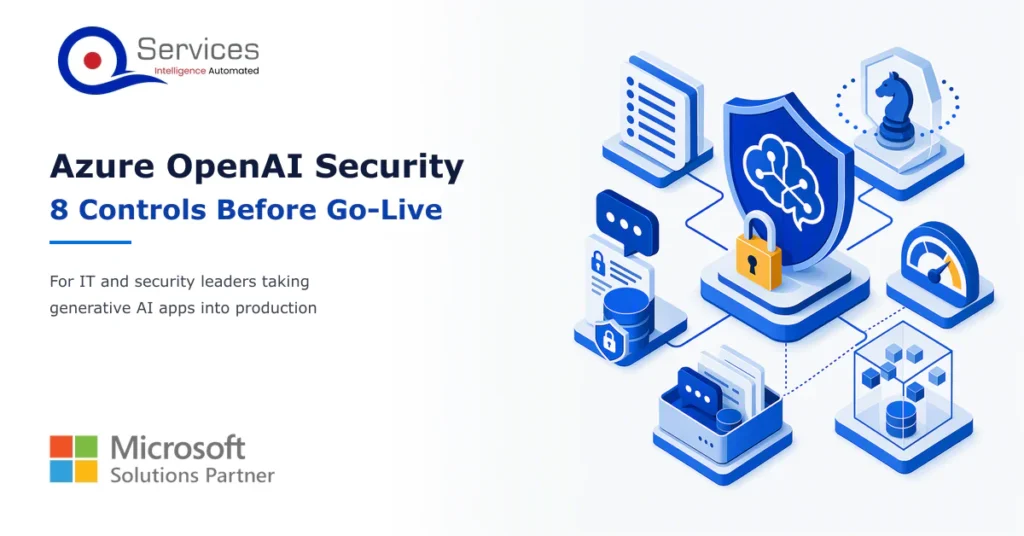
Azure OpenAI security for production apps: identity, private networking, content filters, prompt injection defenses and monitoring to set before go-live.
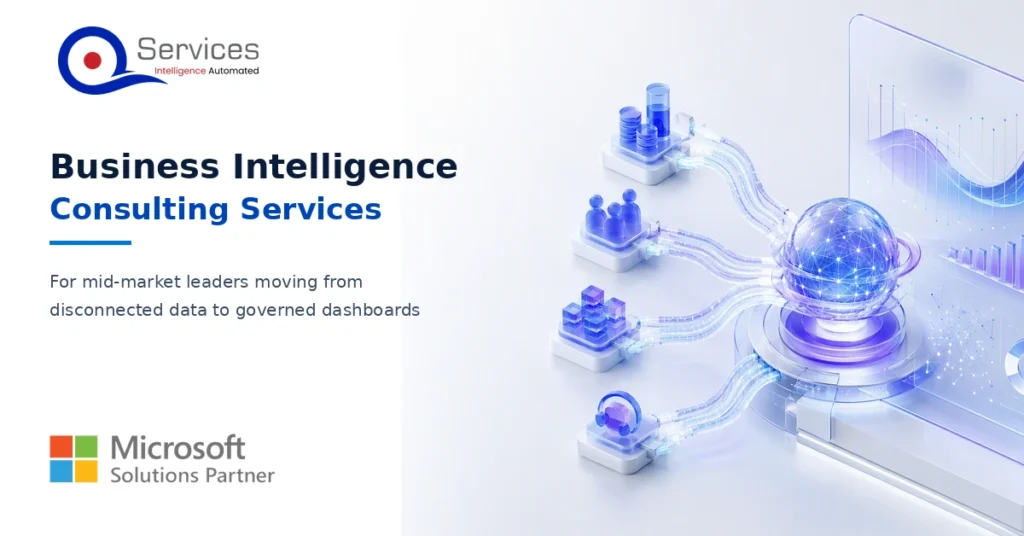
Business intelligence consulting services should give a mid-market company a governed way to make decisions. Attractive dashboards are only the visible part. The useful outcome is a system in which source data, metric definitions, access, releases, ownership, and support still work after the consultants leave.
In a Microsoft Solutions Partner vs Microsoft Partner comparison, the difference is validation. A company can participate in the Microsoft AI Cloud Partner Program without holding a customer-facing Solutions Partner designation. A designated Solutions Partner has met Microsoft’s current threshold in a specific solution pathway: at least 70 out of 100 partner capability points, with more than zero points in every required metric, based on performance, skilling, and customer success data recorded in Partner Center.
Eager to discuss about your project?
Share your project idea with us. Together, we’ll transform your vision into an exceptional digital product!
Azure OpenAI security for production apps: identity, private networking, content filters, prompt injection defenses and monitoring to set before go-live.
Business intelligence consulting services should give a mid-market company a governed way to make decisions. Attractive dashboards are only the visible part. The useful outcome is a system in which source data, metric definitions, access, releases, ownership, and support still work after the consultants leave.
In a Microsoft Solutions Partner vs Microsoft Partner comparison, the difference is validation. A company can participate in the Microsoft AI Cloud Partner Program without holding a customer-facing Solutions Partner designation. A designated Solutions Partner has met Microsoft’s current threshold in a specific solution pathway: at least 70 out of 100 partner capability points, with more than zero points in every required metric, based on performance, skilling, and customer success data recorded in Partner Center.
QServices Inc. undertakes every project with a high degree of professionalism. Their communication style is unmatched and they are always available to resolve issues or just discuss the project.
Turn the Microsoft Licenses
You Already Own Into an AI Workplace
Join our live webinar on Sept 24 and see five ways to automate meetings, approvals, and