Custom power apps development is how Microsoft-stack organizations finally close the gap between what IT can build and what the business actually needs. If your team still routes approvals through email chains, tracks inventory in spreadsheets, or waits six months for developer time on a form that should take a week, Power Apps was designed for exactly this problem.
This guide covers what you can build, real deployment costs, common pitfalls, and what separates a solid delivery from a project that creates more tech debt than it solves.
In This Article, You'll Learn
What Can You Actually Build with Custom Power Apps?
Six Proven Use Cases for Custom Power Apps Development
What Can You Actually Build with Custom Power Apps?
The short answer: anything your team does repeatedly on a screen. Power Apps is not a workaround. It's a licensed Microsoft product with enterprise-grade connectors, security, and data modeling through Dataverse. The real question is not whether it can handle your use case. The question is whether you're building it in a way that scales.
Internal Process Apps That Replace Paper and Email
Most organizations start here. Inspection checklists, incident reports, purchase requisitions, quality sign-offs. These are forms that someone fills out, submits, and waits for someone else to act on. Custom power apps development turns those into mobile-capable, auditable workflows within days.
A warehouse team processing 200 inbound shipments per day doesn't need a full ERP module. They need a mobile form that auto-populates from a barcode scan, flags discrepancies, and routes exceptions to a supervisor. That's a canvas app with three screens and two Power Automate flows.
Customer-Facing Solutions with Power Pages Development
Power pages development extends the platform beyond internal users. You can build external portals where vendors submit invoices, customers track orders, or partners request support, all authenticated and connected to your internal data.
The licensing model for Power Pages is separate from Power Apps, so factor it into your cost estimate early. For organizations already paying for Power Platform per-user licenses, it often makes more sense than building a separate web app from scratch.
Apps That Talk to Dataverse, SharePoint, and SQL
One of the strongest points of the platform is the connector library. Power Apps connects natively to SharePoint, SQL Server, Dynamics 365, Azure services, SAP, and hundreds of third-party APIs. Dataverse consulting work often involves setting up the right data model first, so the apps built on top don't become fragile workarounds.
If your apps are pulling from five different systems and running slow or unreliable, that's usually a data architecture issue, not a Power Apps limitation. Building a unified data layer with Microsoft Dataverse addresses this cleanly before the first app is written.
Six Proven Use Cases for Custom Power Apps Development
Power apps development services work best when there's a clear process to automate, a defined set of users, and data that already lives somewhere in your Microsoft environment. Here's where we see the most consistent ROI across project types.
Field Service Inspection and Reporting
Field technicians need apps that work offline, capture photos, record GPS coordinates, and sync when connectivity returns. Model-driven apps backed by Dataverse handle this well. Canvas apps can work for field use too, but offline capability requires deliberate design decisions from the start.
We've deployed inspection apps for utilities, construction sites, and healthcare facilities where paper clipboards were the previous standard. ROI typically becomes visible within 30 days once you account for reduced transcription time and faster exception handling.
HR Workflows, Leave Management, and Onboarding
Leave requests, onboarding checklists, performance reviews, and equipment requests are high-volume, low-complexity workflows that suit Power Apps well. We built a full leave management application in three days, including integration with Microsoft Teams and SharePoint for notifications. The full story is in how we built a leave management app in Power Apps in 3 days.
Finance teams, procurement departments, and compliance offices tend to follow the same pattern: gather input, route for approval, archive the record. Once you build one of these well, the structure repeats across the organization with minimal additional effort.
Power Apps Canvas vs Model-Driven Apps Explained
The power apps canvas vs model driven decision comes up in almost every project scoping conversation. Getting this wrong early means rework later, often expensive rework.
Canvas App Strengths and Limitations
Canvas apps give you pixel-level control over the UI. You drag elements onto a screen, write formulas in a language similar to Excel, and connect to data sources through a point-and-click interface. They're fast to prototype and easy for business users to understand and adjust after delivery.
The tradeoff is scalability. Canvas apps built without a proper data architecture become slow and hard to maintain as data volumes grow. They work best for focused use cases, typically fewer than 500 concurrent users and fewer than 100,000 rows in any connected table. Push beyond that without proper Dataverse design and performance degrades fast.
When Model-Driven Apps Win
Model-driven apps are built on Dataverse tables. The UI is generated from your data model rather than designed from scratch. This makes them less visually flexible but far more consistent, easier to govern, and better suited to complex business logic.
If you need role-based access, complex record relationships, server-side business rules, and full audit history, start with a model-driven app. It's more work upfront but the result is maintainable for years rather than months. Think complaints management systems, contract lifecycle trackers, or multi-stage regulatory approval workflows.
How Power Automate Consulting Multiplies App Value
Custom power apps development rarely stops at the app itself. The real value comes from connecting those apps into broader automated workflows. That's where power automate consulting work makes the difference between a form and an actual process improvement.
Power Automate Workflow Examples That Save Real Hours
Power automate workflow examples that generate measurable savings share a common pattern: they eliminate a handoff that was previously done by email. An approval request that used to sit in someone's inbox for three days gets routed automatically, escalated if unanswered within 24 hours, and archived when complete.
Examples that work consistently across industries:
Invoice approval: Vendor submits through a Power Pages portal, Power Automate routes to the finance approver, triggers payment in ERP on approval
Incident escalation: Field app flags an anomaly, automatically creates a Dynamics 365 support ticket, notifies the on-call engineer via Teams
Document renewal: Automated SharePoint scan, 30-day notification to the document owner, escalation to the compliance manager if not renewed
Choosing between Power Automate and Azure-native integration services is a real architectural decision for organizations with complex workflow needs. Our breakdown of Power Automate vs Logic Apps: 7 key differences for 2026 covers exactly when each approach fits.
Power Platform Governance Before Shadow IT Takes Hold
This is the section most vendors skip in their sales pitch. Power Platform lowers the barrier to building apps, which is its primary value. But that same accessibility creates a governance problem if you don't set the rules before adoption grows across the organization.
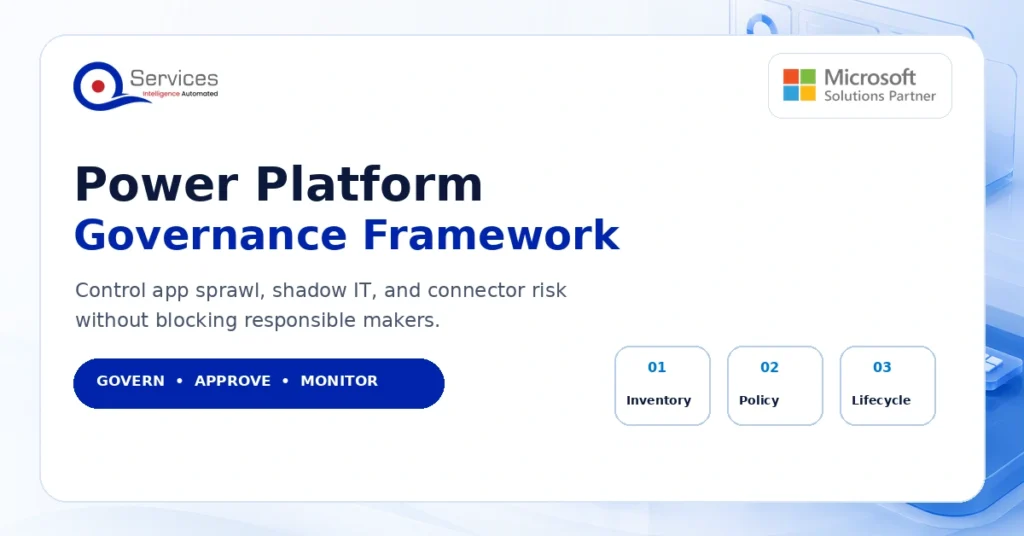
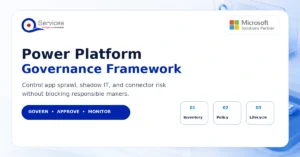
Power Platform governance prevents shadow IT through DLP policies, environment strategies, and approval workflows. Without these controls, business users build apps that connect sensitive HR data to personal storage accounts, or finance teams create flows that pull from production SQL without IT's knowledge.
How DLP Policies Protect Sensitive Data
Data Loss Prevention (DLP) policies in Power Platform control which connectors can be used together in a single app or flow. You classify connectors as "business" or "non-business" and block mixing them. A properly configured DLP policy stops a user from building a flow that exports Dynamics 365 customer records to a personal Gmail account.
Setting up DLP is not technically complex, but the decisions about what to lock down and what to leave open require judgment. Lock everything down and adoption dies. Leave everything open and compliance exposure grows quietly. DLP policies in Power Platform: what to lock down and what to leave open covers the practical framework for getting this balance right.
Citizen Developer Governance That Actually Works
Citizen developer governance is not about restricting what people can build. It's about creating the right environment strategy, naming conventions, review processes, and training so that self-built apps don't become technical debt or compliance liabilities six months later.
A working citizen developer governance program includes:
A dedicated development environment, separate from production
A defined review process before promoting apps to production
Clear ownership records for every active app in the tenant
Scheduled audits to identify apps that are unused or no longer maintained
Citizen developer programs need governance guardrails to prevent data silos and compliance gaps. In regulated industries like finance and healthcare, a misconfigured flow can trigger a regulatory violation. The broader picture of uncontrolled citizen development is detailed in shadow IT is eating your Power Platform.
What Custom Power Apps Development Costs in 2026
The honest answer is that costs vary significantly based on complexity, integration requirements, and whether you're building one app or a coordinated suite. Here's a practical breakdown based on what we see across mid-market and enterprise projects.
Typical Project Ranges by App Type
App Type
Typical Range
Timeline
Simple canvas app (single data source, 3-5 screens)
These ranges assume a mid-size organization, standard Microsoft 365 licensing already in place, and reasonable access to subject matter experts during the build. If your data is scattered or locked in legacy systems, expect the dataverse consulting work alone to add 20-40% to your estimate.
Key Insight If your data is scattered or locked in legacy systems, expect the dataverse consulting work alone to add 20-40% to your estimate.
Power bi consulting services are often scoped alongside apps because the same Dataverse data model that powers your apps also feeds your reporting. Power bi dashboard development done in parallel with app development is typically cheaper than scoping them as separate engagements.
Power Platform ALM and Ongoing Maintenance Costs
Power platform ALM (Application Lifecycle Management) is what keeps your apps running safely after go-live. This includes environment promotion pipelines moving builds from dev to test to production, solution-based deployment, version control, and structured change management processes.
Most organizations underestimate this budget line. An app built by a consultant and handed off without ALM processes will break when Microsoft releases a connector update, when the original developer leaves, or when someone makes a direct edit to the production environment. Budget 15-20% of initial development cost annually for maintenance and ALM support.
Key Insight Budget 15-20% of initial development cost annually for maintenance and ALM support.
Power Platform Center of Excellence Setup
A Power Platform Center of Excellence is a governance structure, not a dedicated physical team. It's the combination of policies, tools, training, and oversight that allows an organization to scale Power Platform adoption without losing control of what's being built across the tenant.
QServices implements Power Platform Center of Excellence using Microsoft's CoE toolkit as a foundation. The toolkit provides pre-built apps and dashboards for tracking app inventory, usage analytics, compliance status, and maker activity across the entire tenant.
The Microsoft CoE Starter Kit Explained
The Microsoft CoE Starter Kit is a free set of apps, flows, and dashboards that gives IT full visibility into Power Platform activity. It includes four main components:
Admin app: Shows all apps, flows, and connectors across environments in a single consolidated view
Compliance process: Automated email workflow that prompts makers to justify their apps periodically
Nurture components: Training materials and maker community tools to grow responsible adoption
Governance components: DLP impact analysis and connector usage audit reports
For a mid-size organization with 50+ active makers, setting up the CoE toolkit takes two to four weeks. The harder part is the organizational work: deciding who owns governance decisions, how the app approval process works, and what the escalation path looks like for policy violations.
Power bi dashboard development is where CoE value becomes visible to leadership. When you can show the CTO a live dashboard that reads "312 active apps in this tenant, 78 unused, 14 connecting to external services without DLP coverage," the governance conversation becomes concrete and actionable rather than theoretical.
Building those dashboards on top of CoE telemetry data is standard power bi consulting services work. It's one of the highest-ROI activities for organizations that have already invested in Power Platform infrastructure.
According to Gartner's research on low-code application platforms, organizations with formal governance frameworks report significantly higher adoption rates and fewer security incidents than those running low-code platforms without structured oversight.
What to Expect from a Power Platform Development Company
Working with a power platform development company is different from working with a general software agency. The engagement should start with a discovery phase covering your existing Microsoft 365 setup, your data model, your licensing posture, and whether governance is already in place.
If a vendor skips straight to wireframes without asking about your environment strategy or DLP configuration, that's a sign they're selling a project rather than solving a problem. Apps built without that context create issues six months post-launch that often cost more to fix than the original build.
A solid delivery process for power apps development services looks like this:
Discovery (3-5 days): Map the current process, identify data sources, assess the existing Power Platform setup and licensing
Blueprint: Define the data model, app architecture, integration points, and any licensing gaps
Iterative build: Two-week sprints with working demos at each checkpoint
Governance handoff: Document the app, configure the ALM pipeline, train internal admins
Hypercare period: 30-60 days of dedicated post-launch support before full handoff
One honest limitation worth knowing before you start: Power Platform is a licensed Microsoft product, and license costs are entirely separate from development fees. A Power Apps Premium per-user license runs approximately $20/user/month, as of 2026. For organizations with 500+ users, that math needs to be part of your business case before committing to a platform-wide rollout.
Key Insight A Power Apps Premium per-user license runs approximately $20/user/month, as of 2026.
Key Takeaways
The short answer: anything your team does repeatedly on a screen.
Power apps development services work best when there's a clear process to automate, a defined set of users, and data that already lives somewhere in your Microsoft environment.
The power apps canvas vs model driven decision comes up in almost every project scoping conversation.
Custom power apps development rarely stops at the app itself.
This is the section most vendors skip in their sales pitch.
Conclusion
Custom power apps development works when it's planned properly: the right app type for the use case, a data model that scales, power platform governance in place before adoption grows, and power platform ALM processes that keep things running after handoff. Without those pieces, even well-built apps become maintenance problems within 12-18 months.
The organizations that get the most from the platform treat custom power apps development as a strategic investment, not a one-off request. That means standing up a Center of Excellence, running citizen developer governance with clear guardrails, and building an ALM discipline that outlasts any single vendor engagement.
If you're evaluating power apps development services for your organization, the fastest path to a real cost and timeline is a scoping session focused on your specific process, your data, and your Microsoft licensing situation. QServices has delivered Power Platform projects across healthcare, logistics, finance, and technology sectors with results you can verify before signing anything.
Co-Founder and CTO, QServices IT Solutions Pvt Ltd
Rohit Dabra is the Co-Founder and Chief Technology Officer at QServices, a software development company focused on building practical digital solutions for businesses. At QServices, Rohit works closely with startups and growing businesses to design and develop web platforms, mobile applications, and scalable cloud systems. He is particularly interested in automation and artificial intelligence, building systems that automate routine tasks for teams and organizations.
Power Platform governance is the set of policies, processes, and tools that control how apps, flows, and automations are built and managed across a Microsoft 365 tenant. It typically includes DLP (Data Loss Prevention) policies that restrict which connectors can be combined, environment strategies that separate development from production, an approval process for promoting apps to production, and usage monitoring dashboards. Without governance, organizations face security risks from shadow IT, data leakage through uncontrolled connectors, and growing technical debt from abandoned or misconfigured apps.
Preventing shadow IT in Power Platform requires three layers of control. First, configure DLP policies that block high-risk connector combinations, particularly anything that can move data outside your Microsoft tenant. Second, implement an environment strategy with dedicated development, test, and production environments so unauthorized changes cannot reach production directly. Third, run a citizen developer governance program with app registration requirements, regular usage audits, and clear ownership accountability. Power Platform governance prevents shadow IT through DLP policies, environment strategies, and approval workflows that make unauthorized development visible and controllable before it creates compliance exposure.
Power Apps supports two main app types. Canvas apps let you design custom mobile and web interfaces connected to SharePoint, SQL Server, Dataverse, and hundreds of APIs. Model-driven apps generate interfaces from your Dataverse data model and are better suited to complex business systems requiring role-based access and audit history. Common builds include field inspection tools, HR workflow apps, procurement approval systems, customer-facing portals via Power Pages, compliance tracking systems, and inventory management apps. Most organizations start with one focused process and expand from there once the data model is established.
A simple canvas app typically runs $5,000 to $15,000 and takes 2-4 weeks. Mid-complexity apps with multiple data sources and approval flows cost $15,000 to $40,000 over 4-8 weeks. A full model-driven app with Dataverse setup ranges from $25,000 to $75,000 over 6-12 weeks. Enterprise suites combining apps, Power Automate flows, Power Pages portals, and Power BI dashboards run $75,000 to $200,000 or more. Microsoft license costs, approximately $20 per user per month for Power Apps Premium, are separate from development fees and must be factored into the total investment before scoping begins.
A Power Platform Center of Excellence (CoE) is a governance structure that gives IT visibility and control over all apps, flows, and automations being built across the organization. It typically uses Microsoft’s free CoE Starter Kit, which includes apps and dashboards that track app inventory, maker activity, compliance status, and connector usage across the tenant. The CoE also includes a review and approval process for apps before they reach production. Organizations with a functioning CoE see higher adoption rates, fewer security incidents, and significantly less technical debt from abandoned or misconfigured apps over time.
Choose a canvas app when you need a custom interface for a specific, focused task with limited data complexity, typically under 500 concurrent users and straightforward data relationships. Choose a model-driven app when you are building a system of record with complex business rules, role-based access, full audit history, and data relationships across multiple Dataverse tables. The practical test: if you are replacing a form or a simple approval workflow, canvas works well. If you are replacing a database application that multiple departments will share over several years, model-driven is the right foundation.
DLP policies in Power Platform are configured in the Power Platform admin center under Data policies. You create a policy at the tenant or environment level, then classify connectors into one of three groups: Business (trusted connectors that can connect to each other), Non-Business (personal or external connectors kept isolated), and Blocked (connectors that cannot be used at all). The key decision is which connectors belong in each group. A practical starting point is blocking personal storage connectors such as Gmail and personal OneDrive from mixing with business data connectors like Dynamics 365, SharePoint, and SQL Server, then expanding the policy based on your organization’s specific compliance requirements.
Business intelligence consulting services should give a mid-market company a governed way to make decisions. Attractive dashboards are only the visible part. The useful outcome is a system in which source data, metric definitions, access, releases, ownership, and support still work after the consultants leave.
In a Microsoft Solutions Partner vs Microsoft Partner comparison, the difference is validation. A company can participate in the Microsoft AI Cloud Partner Program without holding a customer-facing Solutions Partner designation. A designated Solutions Partner has met Microsoft’s current threshold in a specific solution pathway: at least 70 out of 100 partner capability points, with more than zero points in every required metric, based on performance, skilling, and customer success data recorded in Partner Center.
Business intelligence consulting services should give a mid-market company a governed way to make decisions. Attractive dashboards are only the visible part. The useful outcome is a system in which source data, metric definitions, access, releases, ownership, and support still work after the consultants leave.
In a Microsoft Solutions Partner vs Microsoft Partner comparison, the difference is validation. A company can participate in the Microsoft AI Cloud Partner Program without holding a customer-facing Solutions Partner designation. A designated Solutions Partner has met Microsoft’s current threshold in a specific solution pathway: at least 70 out of 100 partner capability points, with more than zero points in every required metric, based on performance, skilling, and customer success data recorded in Partner Center.