Power BI consulting services sit at the center of a much bigger decision than most companies realize. The first conversation usually starts with dashboards: "We need better reporting." But within weeks, the scope expands to Power Apps for field teams, Power Automate flows to replace manual approvals, and suddenly someone asks whether the whole organization needs a power platform governance framework. If your vendor only knows one part of this stack, you end up with gaps that cost more to fix than the original project.
This guide breaks down what you should expect from a power platform development company, how to evaluate partners before you sign a contract, and where most organizations go wrong when they skip governance.
In This Article, You'll Learn
What Power BI Consulting Services Actually Cover
Beyond Power BI Consulting: The Full Microsoft Power Platform Stack
How to Choose the Right Power BI Consulting Services Partner
Power Platform Governance: Why It Makes or Breaks Your Investment
What to Expect from Custom Power Apps Development
Eager to discuss about your project?
Share your project idea with us. Together, we’ll transform your vision into an exceptional digital product!
Power BI consulting services go well beyond connecting a spreadsheet to a dashboard template. A capable partner handles data modeling, DAX calculations, row-level security, incremental refresh, and deployment pipelines. The difference between a vendor who knows the tool and one who knows the craft shows up in report load times, dataset governance, and whether your leadership team actually opens the dashboards six months after go-live.
Power BI Dashboard Development: Beyond the Bar Chart
Power BI dashboard development that sticks requires three things before a single visual gets built: a clean data model, agreed-upon business definitions, and a publishing strategy. We consistently see organizations skip the second item. When Finance defines "revenue" differently from Sales, the same Power BI report generates arguments instead of decisions.
A good consulting engagement starts with a data dictionary session, maps source systems (Azure SQL, Dataverse, SharePoint, Dynamics 365), and designs the semantic model before writing a line of DAX. Skipping this step adds two to four weeks of rework later.
Connecting Power BI to Your Data Sources
Most mid-size companies have data spread across at least four systems. Direct query works for real-time needs but punishes performance if the underlying database lacks proper indexing. Import mode is faster but requires scheduled refresh and storage planning. Composite models split the difference and suit organizations with a mix of historical and live data.
Beyond Power BI Consulting: The Full Microsoft Power Platform Stack
Most engagements that start with power bi consulting services end up touching the rest of the Power Platform. The real productivity gains come from connecting the pieces rather than using them in isolation.
Power Apps Canvas vs Model-Driven: Which Should You Use?
The power apps canvas vs model driven decision is one of the first technical choices in any custom power apps development project, and it trips up a lot of buyers.
Canvas apps give you pixel-level design control and connect to almost any data source. They work well for field tools, inspection forms, and purpose-built workflows. Model-driven apps are built on Dataverse and inherit the data model automatically. They suit CRM-style applications, case management, and anything with complex relationships between records. Most organizations end up needing both: a canvas app for driver delivery confirmation and a model-driven app for operations managers tracking route performance.
Power Pages Development and Dataverse Consulting
Power pages development is the underused part of the stack. Power Pages lets you publish external-facing portals backed by Dataverse without custom web development, cutting delivery time significantly for partner portals, job applicant tracking, or customer self-service.
Dataverse consulting is what makes Power Pages and model-driven apps reliable at scale. Dataverse is not just a database; it is a governed, role-secured data platform with built-in audit logging. Getting the data model right in Dataverse pays dividends across every app and report built on top of it.
How to Choose the Right Power BI Consulting Services Partner
Shopping for power bi consulting services is harder than it looks because everyone claims Microsoft expertise. Here is how to separate vendors who have done this at scale from those who have completed a few proof-of-concept builds.
Questions That Reveal Whether a Vendor Really Knows Power Platform
Ask for two things: a sample data model from a past project (anonymized) and a walk-through of how they handle power platform ALM. A proper ALM setup uses separate environments for development, test, and production, managed through Azure DevOps or GitHub Actions, with solution packaging and version control. If the vendor describes manually promoting changes between environments, they are not ready for enterprise deployment.
Three patterns signal a vendor who will cost you more in the long run:
No fixed price on the scoping phase. A vendor who cannot estimate a discovery sprint has never done one properly.
No mention of governance. Any power apps development services engagement that skips power platform governance will create shadow IT problems within six months.
Demo-only experience. Ask how many production environments they manage actively. Production support reveals whether a vendor understands operational reality.
Power Platform Governance: Why It Makes or Breaks Your Investment
Power platform governance is the set of policies, environment structures, and approval workflows that determine who can build what, where data can flow, and how apps get promoted to production. Without it, the Power Platform becomes a source of shadow IT rather than a solution to it.
Power Platform governance prevents shadow IT through DLP policies, environment strategies, and approval workflows. Organizations that allow unrestricted app creation in the default environment regularly discover apps connecting to unsanctioned external services and storing sensitive data outside approved systems. We have written in detail about shadow IT in the Power Platform and how quickly it compounds.
DLP Policies and Environment Strategy
Data loss prevention (DLP) policies determine which connectors can be used in which environments. A well-designed policy allows SharePoint and Teams connectors in the default environment, restricts Salesforce and external HTTP connectors to approved development environments, and blocks high-risk connectors entirely unless explicitly approved. Our DLP policy guide covers the decision framework for common connector categories.
Most mature organizations run at least four environments: default, development, test, and production. No app touches production data until it has passed through an approval gate.
Citizen Developer Governance: Enabling Teams Without Creating Chaos
Citizen developer governance is the balance between enabling non-IT staff to build solutions and ensuring those solutions meet security and compliance standards. Done right, citizen developer programs reduce IT backlog by 30-40%. Done wrong, they create data silos, compliance gaps, and apps that collapse when the person who built them leaves.
Key Insight Done right, citizen developer programs reduce IT backlog by 30-40%.
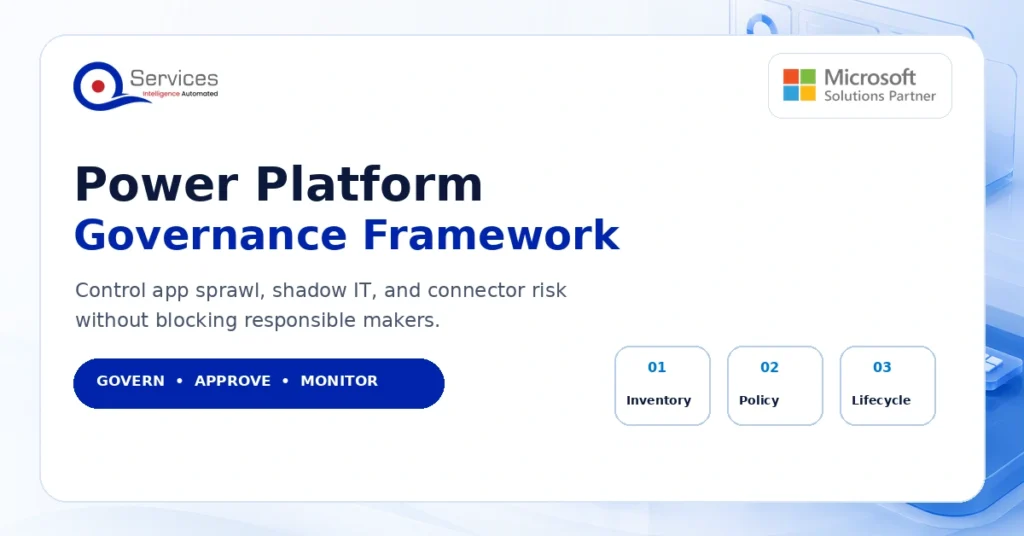
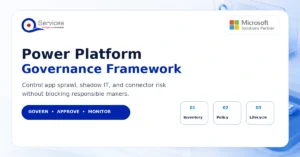
Citizen developer programs need governance guardrails to prevent data silos and compliance gaps. The guardrails include mandatory training before environment access is granted, a review board for apps touching sensitive data, and a deprecation process for abandoned apps. Our Power Platform Governance Framework covers all six pillars.
What to Expect from Custom Power Apps Development
Custom power apps development follows a predictable arc when the vendor is experienced. The first two weeks cover requirements and design. Weeks three through six are build and internal testing. Week seven is user acceptance testing. Week eight is production deployment and hypercare.
This gets tricky when scope is not locked before development starts. We have seen organizations add "one small thing" three times in week five and end up with a twelve-week project. Our three-day Power Apps build for leave management shows what happens when scope stays tight from day one.
Power Apps Development Services: What a Good Brief Looks Like
The best briefs for power apps development services answer five questions before the first technical call:
Who are the users, and what devices do they use?
Where does the data live today, and where should it live after?
What is the volume of records and transactions?
What integrations are required (SAP, Dynamics, SharePoint, external APIs)?
What does success look like in six months?
A vendor who does not ask all five is either assuming answers or planning to discover them at your expense.
How Long Does Custom Power Apps Development Take?
A single-purpose canvas app with two or three screens and a SharePoint or Dataverse backend typically takes three to four weeks for an experienced team. A model-driven app with custom business logic, approval workflows, and external integrations runs eight to twelve weeks. Multi-app solutions with shared Dataverse schemas require solution architecture planning before the first sprint and take longer accordingly.
Power Automate Consulting: Automating the Workflows That Slow You Down
Power automate consulting is where organizations see the fastest ROI from the Power Platform. Manual approval workflows, data transfer between systems, and notification routing are exactly the kind of repetitive, rule-based work Power Automate handles well without requiring developer resources.
Power Automate Workflow Examples That Deliver Real ROI
The most impactful power automate workflow examples in production are not the flashy AI-powered ones. They are the unglamorous ones:
Invoice approval routing: A document is uploaded to SharePoint, Power Automate extracts key fields using AI Builder, routes to the correct approver by amount and department, and updates the ERP on approval. This eliminates two to three manual handoffs per invoice.
Employee onboarding: A new hire record in Dynamics 365 triggers IT provisioning requests, a welcome email sequence, and Planner tasks for the manager. What used to take three departments a week now runs in four hours.
Logistics exception handling: When a shipment status changes to "delayed," Power Automate notifies the customer, updates the order management system, and creates a task for operations. No one monitors a screen to catch it.
Power automate consulting makes sense when workflows cross system boundaries, when approval logic is complex, or when you need connectors to systems your IT team does not manage directly. It makes less sense for high-volume transaction processing or sub-second latency requirements, where Azure Logic Apps or Azure Functions are better choices.
How Much Does Power Platform Development Cost?
Cost is the question everyone asks and no vendor wants to answer directly. The honest answer: it depends on scope, but there are real ranges.
In our client engagements, a single Power BI dashboard with three to five report pages typically runs $8,000 to $15,000. A multi-report power bi dashboard development project with a semantic model, row-level security, and scheduled refresh runs $20,000 to $40,000. Custom Power Apps engagements we scope start around $15,000 for simple canvas apps and reach $80,000 to $150,000 for complex model-driven solutions with integrations.
Key Insight In our client engagements, a single Power BI dashboard with three to five report pages typically runs $8,000 to $15,000.
Typical Engagement Models for Power Platform Work
Most power platform development company engagements follow one of three models:
Dataverse storage: The default allocation fills faster than expected for transactional systems with document attachments.
Training: Citizen developer enablement costs $500 to $2,000 per cohort and is almost always skipped, increasing IT support load by 20-30%.
ALM tooling: Azure DevOps setup and licensing add to the project budget if you are not already on the platform.
What Is a Power Platform Center of Excellence?
A Power Platform Center of Excellence (CoE) is the internal governance body responsible for standards, training, environment management, and strategic direction of the Power Platform across an organization. It is not a committee that meets once a quarter. A functioning CoE has defined owners, tooling, and measurable outcomes tracked month to month.
QServices implements Power Platform Center of Excellence programs using Microsoft's CoE toolkit, which provides out-of-the-box inventory of apps, flows, and makers across all environments, plus governance automation to flag unused or non-compliant resources. The Microsoft CoE Starter Kit is the standard starting point, and setup typically takes four to eight weeks. Our Power Platform CoE guide walks through the first 90 days in detail.
What a Mature CoE Looks Like
A mature power platform center of excellence manages three things actively:
Maker management: Who is licensed, what training they have completed, and which environments they can access.
App lifecycle: Automated discovery of new apps, review workflows for apps accessing sensitive connectors, and quarterly audits of active versus abandoned solutions.
Metrics and reporting: Monthly reports to IT leadership on adoption, support volume, and cost per active maker.
For organizations with mature CoE ambitions, Dynamics 365 implementation often runs alongside a CoE program because both require the same governance infrastructure to succeed.
Key Takeaways
Power BI consulting services go well beyond connecting a spreadsheet to a dashboard template.
Most engagements that start with power bi consulting services end up touching the rest of the Power Platform.
Shopping for power bi consulting services is harder than it looks because everyone claims Microsoft expertise.
Power platform governance is the set of policies, environment structures, and approval workflows that determine who can build what, where data can flow, and how apps get promoted to production.
Custom power apps development follows a predictable arc when the vendor is experienced.
Conclusion
Power BI consulting services are a starting point, not a destination. The organizations that extract lasting value from the Microsoft Power Platform treat it as a governed, connected platform rather than a collection of individual tools. That means investing in proper data modeling before building dashboards, choosing the right app architecture before writing code, establishing DLP policies before enabling citizen developers, and building a power platform center of excellence before unmanaged apps become a support burden.
The right partner for power bi consulting services talks about governance on the first call, shows you a real ALM setup, and gives you a realistic cost estimate before you sign anything. If you are evaluating partners, our published delivery metrics and project governance model are a transparent starting point for that conversation.
Co-Founder and CTO, QServices IT Solutions Pvt Ltd
Rohit Dabra is the Co-Founder and Chief Technology Officer at QServices, a software development company focused on building practical digital solutions for businesses. At QServices, Rohit works closely with startups and growing businesses to design and develop web platforms, mobile applications, and scalable cloud systems. He is particularly interested in automation and artificial intelligence, building systems that automate routine tasks for teams and organizations.
Power Platform governance is the set of policies, environment structures, DLP rules, and approval workflows that control who can build apps and flows, which connectors they can use, and how solutions move from development to production. Without it, organizations face shadow IT, compliance gaps, and unmanaged apps that grow into support problems. A governance framework includes a defined environment strategy (default, dev, test, prod), DLP policies per tier, maker registration requirements, and a Center of Excellence to manage app lifecycle and adoption metrics.
Shadow IT in Power Platform happens when employees build apps and flows in the default environment without IT oversight, often connecting to unsanctioned external services. Prevention requires three controls working together: environment strategy (restricting production data to governed environments), DLP policies (blocking high-risk connectors in default environments), and maker registration (requiring training and approval before users can build outside a sandbox). Organizations that implement all three typically see a significant reduction in unmanaged apps within 90 days.
For organizations on Microsoft technology stacks, Power BI is the stronger choice in most cases. It integrates natively with Azure SQL, Dataverse, Dynamics 365, Microsoft 365, and Azure Data Factory without additional middleware. Licensing is included in many Microsoft 365 plans, significantly reducing per-user cost compared to Tableau. Tableau is preferred in organizations with mixed cloud environments or heavy Salesforce dependency and offers stronger visual customization options for those willing to pay the premium.
Power Apps supports three application types: canvas apps (custom UI, connects to 900+ data sources), model-driven apps (built on Dataverse with relationship-driven data and built-in forms), and Power Pages (external web portals). Common use cases include field service mobile apps, inventory management, employee onboarding workflows, customer portals, compliance inspection forms, approval routing, and ERP integrations. Most mid-size organizations can replace 60-80% of their low-to-medium complexity custom development needs with Power Apps, reducing both build time and ongoing maintenance cost.
Costs vary by scope. A single Power BI dashboard with three to five report pages typically runs $8,000 to $15,000. A full Power BI semantic model with row-level security and scheduled refresh runs $20,000 to $40,000. Simple canvas apps cost $15,000 to $35,000. Model-driven apps with integrations run $50,000 to $150,000. Power Automate workflow projects typically cost $5,000 to $20,000 per workflow group. Budget separately for Power Apps Premium licensing (approximately $20 per user per month for premium connectors), Dataverse storage for high-volume data, and citizen developer training.
A Power Platform Center of Excellence (CoE) is the internal team and governance structure responsible for managing the Power Platform across an organization. It sets development standards, manages maker access and training, owns the environment strategy, and tracks adoption metrics. Microsoft provides the free CoE Starter Kit, a set of apps and flows that automate app inventory, compliance alerts, and maker management. A well-run CoE prevents shadow IT, reduces support tickets, and gives citizen developers a governed path to production. Setup using Microsoft’s toolkit typically takes four to eight weeks.
Canvas apps are right when you need precise UI control, multi-source data connections, or a mobile-first experience for a specific workflow such as field inspections or delivery confirmation. Model-driven apps are right when your data has complex relationships, you need built-in case management, or you are building something that will grow into a larger operations system on Dataverse. If you are connecting to SharePoint, SQL, or external APIs with a custom interface, canvas is typically the better fit. If you are starting with Dataverse as your data store and need role-based forms, model-driven is usually faster to build and easier to maintain.
Business intelligence consulting services should give a mid-market company a governed way to make decisions. Attractive dashboards are only the visible part. The useful outcome is a system in which source data, metric definitions, access, releases, ownership, and support still work after the consultants leave.
In a Microsoft Solutions Partner vs Microsoft Partner comparison, the difference is validation. A company can participate in the Microsoft AI Cloud Partner Program without holding a customer-facing Solutions Partner designation. A designated Solutions Partner has met Microsoft’s current threshold in a specific solution pathway: at least 70 out of 100 partner capability points, with more than zero points in every required metric, based on performance, skilling, and customer success data recorded in Partner Center.
Business intelligence consulting services should give a mid-market company a governed way to make decisions. Attractive dashboards are only the visible part. The useful outcome is a system in which source data, metric definitions, access, releases, ownership, and support still work after the consultants leave.
In a Microsoft Solutions Partner vs Microsoft Partner comparison, the difference is validation. A company can participate in the Microsoft AI Cloud Partner Program without holding a customer-facing Solutions Partner designation. A designated Solutions Partner has met Microsoft’s current threshold in a specific solution pathway: at least 70 out of 100 partner capability points, with more than zero points in every required metric, based on performance, skilling, and customer success data recorded in Partner Center.