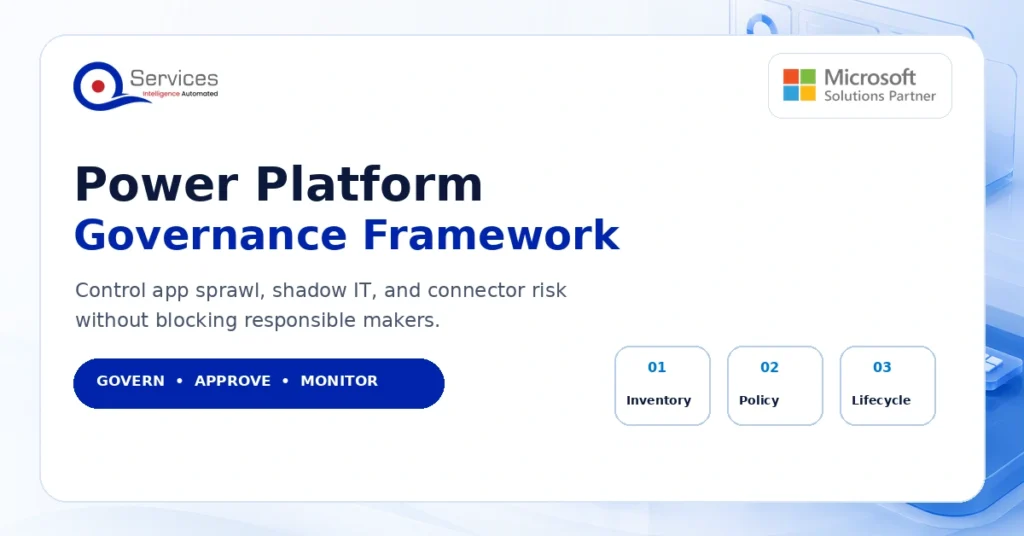
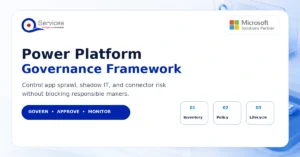
Power platform dlp policies are the first line of defense between your citizen developers and a compliance incident. When Microsoft opened Power Platform to the enterprise market, it handed non-technical staff the ability to connect hundreds of external services to your corporate data in minutes. Whether that is empowering or alarming depends entirely on whether you have a DLP strategy in place.
Most organizations hit one of two failure modes: they lock everything down so tightly that nobody can build anything useful, or they leave connectors wide open and discover six months later that someone automated a process sending customer records to a personal Dropbox. This guide breaks down exactly where the real risks sit, which connectors are safe to leave open, and how to structure policies that protect data without blocking the productivity gains that make Power Platform worth adopting.
In This Article, You'll Learn
What Are Power Platform DLP Policies and Why Do They Matter?
What to Lock Down: High-Risk Connectors in Your DLP Configuration
What to Leave Open: Connectors That Drive Real Productivity
How to Configure Power Platform DLP Policies Without Breaking Workflows
Power Platform Governance: The Bigger Picture
Eager to discuss about your project?
Share your project idea with us. Together, we’ll transform your vision into an exceptional digital product!
What Are Power Platform DLP Policies and Why Do They Matter?
Power Platform DLP (Data Loss Prevention) policies are rules that control which connectors can share data with each other inside Power Apps, Power Automate, and Power Pages. Think of them as firewall rules for data flows, not network traffic. A DLP policy classifies every connector into one of three buckets: Business, Non-Business, or Blocked. Connectors in different buckets cannot exchange data in the same app or flow.
This matters because Power Automate can connect SharePoint to Gmail in about four clicks. Without DLP policies, a well-meaning employee can build a flow that copies every new SharePoint document to a personal Gmail account as an attachment. That is a GDPR violation, a potential HIPAA breach, and a security incident waiting to happen, all created by someone who just wanted to move faster.
According to Microsoft's Power Platform admin documentation, DLP policies apply at the environment level or the tenant level, and tenant-level policies always take precedence. This hierarchy is critical when designing a multi-environment governance strategy, from initial power pages development projects to enterprise-wide automation programs.
Key Insight According to Microsoft's Power Platform admin documentation, DLP policies apply at the environment level or the tenant level, and tenant-level policies always take precedence.
The Two Connector Categories You Need to Understand
Before configuring anything, understand the distinction between premium connectors and standard connectors. Standard connectors come with most Microsoft 365 licenses. Premium connectors (Salesforce, SAP, custom HTTP connectors) require Power Apps per-user or per-app licensing.
This matters for DLP because premium connectors often connect to external business-critical systems where data sensitivity is highest. Your DLP policy needs to explicitly classify both tiers rather than letting premium connectors fall into a default bucket. A missed classification here is often where data incidents start.
Why DLP Policies Are Non-Negotiable in Regulated Industries
For organizations in healthcare, banking, or logistics, power platform governance is not optional. A hospital using Power Apps for patient intake without DLP controls risks exposing PHI through an unblocked external connector. A bank using Power Automate for document processing without DLP guardrails risks data flowing to non-compliant storage. The regulatory cost of getting this wrong far exceeds the cost of configuring policies correctly from day one.
What to Lock Down: High-Risk Connectors in Your DLP Configuration
Not every connector is risky, but some categories need immediate attention when building your initial baseline policy.
External SaaS Connectors: Where Data Leaks Start
The highest-risk connectors are those that move data outside your Microsoft tenant boundary. These include:
Gmail and Google Drive (personal or business Google accounts outside your org)
Dropbox, Box, and generic FTP connectors
Slack (unless it is your approved enterprise workspace)
Twitter/X and LinkedIn social connectors
SendGrid and Mailchimp email marketing services
These should go in the Blocked category for most environments. The business case for connecting SharePoint directly to Mailchimp through an automated flow rarely justifies the data exposure risk. If marketing needs that integration, it should run through a proper API layer with audit logging, not a citizen-built Power Automate flow.
Social Media and Consumer App Connectors
Power Automate has connectors for Instagram, Facebook Pages, Twitter/X, and YouTube. For most enterprise environments, these belong in the Blocked bucket unless you are running a dedicated social media management environment with a documented approval process.
If your organization has a legitimate use case, create a separate environment with its own DLP policy that permits only those specific connectors, with nothing sensitive available alongside them.
Custom Connectors and HTTP Request Actions
The HTTP with Azure AD and plain HTTP connectors deserve special attention. The HTTP connector lets a flow call any URL, which means a user can build a flow that posts SharePoint list data to any external endpoint. Classify the HTTP connector as Blocked in production environments.
Developers who need HTTP for custom integrations should work within a governed development environment, following the Power Platform governance framework your IT team will actually use. This is not about stopping development, it is about keeping integration work inside accountable boundaries.
What to Leave Open: Connectors That Drive Real Productivity
Locking down everything is not governance. It is obstruction. Any connector that keeps data inside your organization's Microsoft tenancy is almost always a safe Business classification. The risk rises the moment data crosses the tenancy boundary.
Key Insight Any connector that keeps data inside your organization's Microsoft tenancy is almost always a safe Business classification.
Microsoft 365 Services You Should Keep Open
These connectors are safe to classify as Business in almost every organization:
SharePoint Online
Microsoft Teams
Outlook (Office 365)
OneDrive for Business (not personal OneDrive)
Microsoft Forms
Azure DevOps
Excel Online (Business)
Planner and To Do
All of these operate within your Microsoft tenant boundary. For teams doing power pages development, portal connectors that read from SharePoint or internal Dataverse tables also belong in the Business group. External data source connectors used for portal forms need the same scrutiny as any other external connector.
Dataverse and Azure Connectors
Dataverse is Microsoft's native data platform for Power Platform and should be classified as Business without exception. The same applies to Azure SQL, Azure Blob Storage within your subscription, Azure Key Vault, and Azure Service Bus.
If your organization is working with a dataverse consulting partner to build a unified data layer, confirm that all Dataverse connectors are explicitly in the Business bucket. Blocking them by accident is one of the most common issues we see during initial DLP rollouts, and it breaks model-driven apps entirely. Good dataverse consulting work always includes a DLP review before any app goes live.
How to Configure Power Platform DLP Policies Without Breaking Workflows
The biggest reason DLP rollouts go badly is that admins apply a tenant-wide restrictive policy without first auditing what is already running. You inherit broken automations and frustrated business users within hours.
The Three-Environment Strategy for Power Platform ALM
A solid power platform ALM strategy uses three environments with different DLP strictness levels:
Development (exploratory policy): Citizen developers and professionals can experiment. Most Microsoft connectors are available. Audit logging is enabled throughout.
Test/UAT (production-matching policy): DLP mirrors the production environment exactly. Any app or flow that works here will work in production.
Production (strict policy): Only Business-classified connectors are available. Environment-level policies add restrictions on top of the tenant baseline.
This model is standard practice for any power platform development company doing enterprise work. It prevents the scenario where an app works in dev and breaks in production because connector classifications differ between environments. A mature power platform ALM setup provisions these environments from a template with consistent DLP settings, not configured by hand each time.
Power Automate Workflow Examples That Need Special DLP Rules
Invoice approval flows pulling from SAP or Dynamics 365: both connectors must be in the same Business group
HR onboarding flows connecting Workday to SharePoint and Teams: Workday is a premium connector requiring explicit Business classification
Customer notification flows from Dataverse to an SMS provider: if the SMS provider is external, it needs to be blocked in production or routed through approved middleware
The honest answer is that DLP configuration for flows spanning multiple systems often needs environment-specific policies rather than a single tenant-wide rule. Working with a power automate consulting partner helps here. When building a tiered access model that holds up under audit, the NIST SP 800-53 data classification controls offer a useful reference framework for how to categorize data sensitivity levels formally.
Key Insight When building a tiered access model that holds up under audit, the NIST SP 800-53 data classification controls offer a useful reference framework for how to categorize data sensitivity levels formally.
Power Platform Governance: The Bigger Picture
Power platform dlp policies are one piece of a broader governance framework. On their own, they are necessary but not sufficient. DLP tells connectors what they cannot share. Governance tells people what they cannot build, and gives you visibility into both.
Power Platform Center of Excellence: The Foundation
The power platform center of excellence is the governance structure that makes DLP sustainable at scale. Microsoft provides a CoE Starter Kit that includes admin dashboards, policy enforcement flows, and inventory templates out of the box. QServices implements Power Platform Center of Excellence using Microsoft's CoE toolkit, customized to each client's compliance and licensing requirements.
The CoE gives you visibility into every app and flow running in your tenant. Without it, you cannot audit DLP compliance because you do not know what exists. See our detailed guide on setting up a Power Platform Center of Excellence from scratch for the full implementation walkthrough.
Power Apps Canvas vs Model Driven: DLP Considerations
Power apps canvas vs model driven is a choice with governance implications beyond UI design. Canvas apps can connect to any available connector, making DLP classification directly relevant to every build decision. Model-driven apps run exclusively on Dataverse, which means their data access is governed by Dataverse security roles rather than connector-level DLP policies.
For regulated industries, model-driven apps often present a cleaner governance story: all data stays in Dataverse, access is role-based, and there is no connector-level exposure. Canvas apps offer more design flexibility but require more careful DLP configuration for every connector they use. The choice depends on your data model, compliance requirements, and whether users need the layout freedom that canvas provides.
Shadow IT and Citizen Developer Governance
Power Platform governance prevents shadow IT through DLP policies, environment strategies, and approval workflows. But that only works if someone is actively monitoring what is running. The platform's accessibility is its biggest strength and its most persistent governance challenge.
How Shadow IT Grows in Power Platform
Shadow IT in Power Platform follows a predictable pattern. A motivated employee builds a flow that solves a real problem. It works, so they share it with colleagues. Six months later, there are twenty undocumented flows running business-critical processes, several connecting to external services that your DLP policy was supposed to block.
This happens because the default environment is available to every user in your tenant and often starts with a permissive DLP policy. The fix is to restrict the default environment aggressively and provide a managed sandbox for legitimate experimentation. Our post on shadow IT in Power Platform covers the detection and remediation process in detail, including how to identify flows that have already bypassed your DLP rules.
Citizen Developer Programs Need Guardrails
Citizen developer governance is not about stopping people from building. It is about channeling that energy through guardrails that prevent compliance failures and data quality problems. A well-run program includes:
An approved connector list published internally
A lightweight submission process for promoting apps to production
DLP policies that allow experimentation in sandbox but enforce restrictions in production
Quarterly training on connector classifications and data sensitivity
Citizen developer programs need governance guardrails to prevent data silos and compliance gaps. Organizations that get this right typically see three to five times higher automation adoption than those that either lock everything down or ignore governance entirely. The gap between what citizen developers build and what IT knows about is where most Power Platform risk actually lives.
Building Your DLP Strategy with a Power Platform Development Company
Most mid-market organizations lack the in-house Power Platform admin depth to configure DLP policies correctly across complex environments. A power platform development company that has done this before can save weeks of trial and error and prevent the mistake of breaking existing workflows during a rollout.
Power Apps Development Services and DLP Planning
When we engage as power apps development services provider, DLP planning is part of the initial discovery phase, not an afterthought. Before writing a single line of Power Fx, we audit the existing environment, catalog all connectors in use, and draft a DLP policy that accommodates the requested app without creating new risk exposure.
For custom power apps development projects, the DLP configuration is designed alongside the app architecture. Apps built this way move through the dev/test/production pipeline cleanly because connector classification was part of the design from day one. This matters especially when building apps that touch regulated data, where a last-minute DLP adjustment can delay go-live by weeks.
Power BI Dashboard Development and Data Classification
Power BI dashboard development sits at an interesting intersection with DLP. Power BI reports and datasets in the Power BI service are not directly governed by Power Platform DLP connector policies the way Power Automate flows are. However, the data feeding Power BI often flows through Power Automate or Dataverse, both of which are subject to DLP.
If you are using power bi consulting services to build executive dashboards on sensitive data, the right conversation combines Microsoft Information Protection sensitivity labels on the underlying datasets with Power Platform DLP on the data pipelines feeding those datasets. For a comparison of how Power BI handles data governance versus Tableau, our Power BI vs Tableau comparison for Microsoft companies covers the enterprise governance angle in detail.
Key Takeaways
Power Platform DLP (Data Loss Prevention) policies are rules that control which connectors can share data with each other inside Power Apps, Power Automate, and Power Pages.
Not every connector is risky, but some categories need immediate attention when building your initial baseline policy.
Locking down everything is not governance.
The biggest reason DLP rollouts go badly is that admins apply a tenant-wide restrictive policy without first auditing what is already running.
Power platform dlp policies are one piece of a broader governance framework.
Conclusion
Getting power platform dlp policies right is an ongoing governance discipline, not a one-time configuration task. It requires clear connector classification, a three-environment power platform ALM strategy, and visibility through a power platform center of excellence. Organizations that invest in this foundation report fewer data incidents, faster audit readiness, and significantly higher automation adoption across the business.
Start with a default-deny approach at the tenant level, build environment-specific exceptions for legitimate business connectors, and document every decision with a named data owner. If your organization is scaling power platform governance across multiple teams and needs expertise to structure this correctly, that is the work we do at QServices. Talk to our team about your current environment and where the real risks are hiding.
Co-Founder and CTO, QServices IT Solutions Pvt Ltd
Rohit Dabra is the Co-Founder and Chief Technology Officer at QServices, a software development company focused on building practical digital solutions for businesses. At QServices, Rohit works closely with startups and growing businesses to design and develop web platforms, mobile applications, and scalable cloud systems. He is particularly interested in automation and artificial intelligence, building systems that automate routine tasks for teams and organizations.
Power Platform governance is a framework of policies, processes, and tools that controls how apps, flows, and data connections are built and managed across your Microsoft Power Platform environment. It includes DLP policies that classify which connectors can share data, environment strategies that separate development from production, and a Center of Excellence that provides visibility into all activity in your tenant. Effective Power Platform governance prevents shadow IT, reduces compliance risk, and gives IT administrators oversight of every app and flow across the organization.
Power Platform governance prevents shadow IT through DLP policies, environment strategies, and approval workflows. The most effective approach restricts the default environment to approved Microsoft connectors only, provides a managed sandbox for citizen developer experimentation, and requires a review process before any app reaches production. Monitoring through the Power Platform Center of Excellence gives admins visibility into every app and flow, including ones built without IT involvement.
To set up DLP policies in Power Platform, go to the Power Platform Admin Center and navigate to Data Policies. Create a new policy, assign it to specific environments or apply it tenant-wide, and classify each connector as Business, Non-Business, or Blocked. Start with a restrictive baseline that blocks external consumer connectors like Gmail and Dropbox, keep Microsoft 365 services in the Business group, and create environment-specific exceptions for legitimate business needs. Always audit existing flows before applying a new policy to avoid breaking running automations.
Power Apps lets you build custom business applications without traditional software development. Common builds include employee onboarding portals, field inspection and audit apps, inventory management tools, customer service interfaces, approval workflows, and compliance tracking dashboards. Canvas apps give designers full control over layout and can connect to hundreds of data sources. Model-driven apps are built on Dataverse and suit structured business processes where data integrity and role-based access control are priorities.
A Power Platform Center of Excellence (CoE) is a governance team and toolset that manages how Power Platform is adopted and used across your organization. Microsoft provides a free CoE Starter Kit that includes admin dashboards showing every app, flow, and connector in your tenant, along with automated policies for managing unused resources and enforcing compliance. The CoE acts as the operational hub for DLP policy management, citizen developer training, and environment lifecycle management.
Use a canvas app when you need full design control, a custom UI, or connections to multiple external data sources. Use a model-driven app when your data lives entirely in Dataverse, your process is structured and form-based, and you need strong role-based access control without custom UI work. For regulated industries, model-driven apps are often easier to govern because all data stays in Dataverse under your security role configuration, while canvas apps require more careful DLP planning for each connector they use.
Power Platform development costs vary widely based on scope and complexity. A simple canvas app from a power apps development services provider typically costs between $5,000 and $25,000 for design, build, and deployment. Enterprise solutions involving Dataverse, complex Power Automate workflows, and multi-environment ALM governance can range from $25,000 to $150,000 or more. Microsoft’s own licensing adds per-user or per-app costs on top of project fees. The total depends on your existing Microsoft licensing, the number of environments needed, connector requirements, and whether DLP policy setup and governance are included in the engagement scope.
Business intelligence consulting services should give a mid-market company a governed way to make decisions. Attractive dashboards are only the visible part. The useful outcome is a system in which source data, metric definitions, access, releases, ownership, and support still work after the consultants leave.
In a Microsoft Solutions Partner vs Microsoft Partner comparison, the difference is validation. A company can participate in the Microsoft AI Cloud Partner Program without holding a customer-facing Solutions Partner designation. A designated Solutions Partner has met Microsoft’s current threshold in a specific solution pathway: at least 70 out of 100 partner capability points, with more than zero points in every required metric, based on performance, skilling, and customer success data recorded in Partner Center.
Business intelligence consulting services should give a mid-market company a governed way to make decisions. Attractive dashboards are only the visible part. The useful outcome is a system in which source data, metric definitions, access, releases, ownership, and support still work after the consultants leave.
In a Microsoft Solutions Partner vs Microsoft Partner comparison, the difference is validation. A company can participate in the Microsoft AI Cloud Partner Program without holding a customer-facing Solutions Partner designation. A designated Solutions Partner has met Microsoft’s current threshold in a specific solution pathway: at least 70 out of 100 partner capability points, with more than zero points in every required metric, based on performance, skilling, and customer success data recorded in Partner Center.