HL7 to FHIR migration is now one of the most urgent compliance projects facing US hospitals. The Centers for Medicare & Medicaid Services has set a firm 2027 deadline requiring Prior Authorization APIs, Patient Access APIs, and three related FHIR endpoints to be live, and the hospitals treating this as a future problem are already running short on time.
The challenge is not understanding FHIR. The hard part is that your existing HL7 v2 infrastructure, built over 15-20 years with undocumented local customizations, needs to feed a modern REST API without disrupting the clinical workflows that staff and patients depend on. Most project plans underestimate this work by 40-60%.
Key Insight Most project plans underestimate this work by 40-60%.
This guide covers the technical realities of FHIR migration, how .NET modernization connects to the work, and what a realistic timeline looks like before the 2027 deadline arrives.
In This Article, You'll Learn
What Is HL7 to FHIR Migration (and Why 2027 Changes Everything)
The Real Technical Challenges of HL7 to FHIR Migration
How .NET Application Modernization Fits FHIR Migration
What the FHIR Migration Process Actually Looks Like
Choosing the Right Technology Stack for Your FHIR Build
Eager to discuss about your project?
Share your project idea with us. Together, we’ll transform your vision into an exceptional digital product!
What Is HL7 to FHIR Migration (and Why 2027 Changes Everything)
HL7 to FHIR migration means transitioning your healthcare data exchange from HL7 v2 or v3 messaging standards to FHIR R4, a modern REST-based specification built on JSON, HTTP, and OAuth 2.0.
The two standards reflect completely different architectural assumptions. HL7 v2 was designed in the 1980s around pipe-delimited flat file messages sent over a proprietary TCP protocol called MLLP. FHIR treats every clinical concept as a structured API resource, queryable and returnable via standard web conventions that any developer with REST experience can work with immediately.
The Difference Between HL7 v2, v3, and FHIR
HL7 v2: Pipe-delimited messages over MLLP. Found in roughly 95% of US hospital integrations for ADT events, lab results, and clinical orders. Highly flexible but inconsistently implemented across vendors and sites.
HL7 v3: XML-based and more formally specified than v2. Largely considered a failed standard outside of CDA clinical documents because implementation complexity outweighed the benefits.
FHIR R4: Resource-based REST API. Each clinical concept (Patient, Observation, MedicationRequest, Encounter) is a defined JSON structure accessible via standard HTTP GET, POST, and PUT operations.
What the 2027 CMS Deadline Actually Requires
The CMS Interoperability and Prior Authorization Final Rule requires payers and providers participating in CMS programs to implement four FHIR R4-based APIs by January 2027:
Patient Access API: Patients can download their claims history, clinical records, and formulary data
Provider Access API: Treating providers can access patient records across payers
Payer-to-Payer Data Exchange API: Transfers complete patient history when coverage changes
Prior Authorization API: Real-time electronic prior authorization with decision support integrated into provider workflows
Hospitals and health plans that fail to build or source compliant FHIR endpoints face interruptions to CMS reimbursement workflows and potential enforcement action. The deadline does not move based on project complexity.
The Real Technical Challenges of HL7 to FHIR Migration
The honest picture: this migration is harder than most project timelines account for. Switching data formats is the straightforward part. The difficult part is that your HL7 v2 messages contain 20 years of local customizations that no automated mapping tool handles reliably.
Mapping Legacy HL7 Data to FHIR Resources
Standard HL7 v2 segments like PID, PV1, OBX, and OBR map to FHIR resources like Patient, Encounter, Observation, and DiagnosticReport. Published mapping guides exist for these standard segments. The problem is the Z-segments, local codes, non-standard field placements, and vendor-specific extensions that every hospital accumulates over years of integration work.
A typical mid-size hospital has 40-60 distinct HL7 v2 message variants across its EHR, lab, radiology, and pharmacy systems. Each variant needs individual mapping logic and validation testing. Budget 3-6 months of mapping effort for a medium-complexity environment. Organizations with heavily customized systems or older EHR platforms should budget closer to 12 months for the mapping work alone.
API Security and Access Control in FHIR
FHIR requires OAuth 2.0 with SMART on FHIR authorization scopes, which is a meaningful shift from the VPN-based, network-layer security most HL7 v2 environments rely on. Building the security layer correctly means deploying an OAuth 2.0 authorization server, defining SMART scope hierarchies for patient, clinical, and administrative access levels, and implementing audit logging for every FHIR resource request to satisfy HIPAA requirements.
The security architecture alone typically takes 4-8 weeks to design, implement, and test. Getting it wrong has compliance consequences that extend well beyond 2027. Our post on HIPAA-Compliant Cloud Architecture on Azure covers the Azure-specific patterns for HIPAA-compliant FHIR deployments in detail.
How .NET Application Modernization Fits FHIR Migration
Most hospital integration engines and clinical systems in the US run on .NET Framework. ASP.NET WebForms applications from 2006-2012, WCF services processing HL7 messages, Windows Services polling lab system queues. When FHIR migration work starts, teams almost always discover that the system feeding the new FHIR API is a 15-year-old .NET Framework 4.6 application with no current technical owner.
This is where .NET application modernization and FHIR migration intersect more than project plans usually account for.
Building FHIR APIs with ASP.NET Core
Modern .NET FHIR servers are built on ASP.NET Core alongside libraries like the HL7 FHIR .NET SDK or Firely Server. These provide FHIR R4 resource serialization and deserialization, built-in validation against FHIR profiles, and RESTful endpoint scaffolding for standard FHIR operations.
A team offering asp.net development services with healthcare experience can build a FHIR facade layer that sits in front of your existing HL7 v2 systems. The facade translates incoming FHIR REST requests into HL7 v2 queries and returns properly structured FHIR responses. This is not a permanent solution, but it gets you to a compliant, testable FHIR endpoint quickly while deeper data migration work proceeds in parallel. Many hospitals use exactly this approach to hit interim compliance checkpoints.
Why Legacy App Modernization Often Precedes FHIR Adoption
The strangler fig pattern is the standard approach for legacy app modernization in healthcare IT. Rather than replacing everything at once, you build new FHIR-compliant services alongside existing HL7 systems and incrementally shift traffic to the new layer as it proves reliable.
Legacy .NET Framework modernization uses the strangler fig pattern to incrementally replace components without a full rewrite, which matters when the system being replaced processes thousands of lab results per day and clinical downtime carries real patient risk.
The practical migration sequence:
Identify which HL7 message types generate the highest FHIR query volume
Build FHIR resource endpoints for those message types first, backed by HL7 v2 sources
Route FHIR API traffic to the new endpoints
Keep the existing HL7 pipeline running in parallel until stability is confirmed
Decommission legacy HL7 components individually as replacement services prove reliable
Partnering with an enterprise application development team that understands both HL7 data structures and modern .NET modernization paths makes this incremental approach significantly less risky. For Azure-specific FHIR infrastructure decisions, Patient Data Exchange with Azure Health Data Services is worth reading before you choose a FHIR server platform.
What the FHIR Migration Process Actually Looks Like
No two hospital FHIR migrations are identical, but the phases are consistent enough to plan around with reasonable confidence.
Phase 1: Assessment and Gap Analysis (4-8 Weeks)
Before any code is written, you need an accurate inventory of what exists. This means cataloging every HL7 v2 message type currently in production, mapping existing data flows to their target FHIR resources, identifying which source systems will need API changes, and assessing security architecture gaps for OAuth 2.0 compliance.
Most organizations find three to five times more HL7 integrations than they believed going into this phase. One hospital we worked with expected roughly 20 distinct HL7 message variants and discovered 74 across 12 different systems. The gap analysis phase is where project scope gets set properly, and rushing it creates delays in every phase that follows.
Phase 2: Building the FHIR Layer (3-9 Months)
This phase covers FHIR server selection or build, data mapping development for each HL7 message type, SMART on FHIR authorization server setup, and integration testing against source systems. Options for the FHIR server include Azure Health Data Services (managed), HAPI FHIR (open-source), Firely Server (commercial), or a custom ASP.NET Core implementation for teams with specific requirements.
The length of this phase varies most based on HL7 integration count and whether source systems also need modernization. Teams that need to update underlying .NET Framework applications alongside the FHIR build should expect the higher end of this range and plan both workstreams explicitly.
Phase 3: Testing, Validation, and Go-Live (2-4 Months)
CMS FHIR program certification requires passing the Inferno Testing Suite, the official conformance testing tool maintained by ONC. Inferno tests each FHIR endpoint against CMS-defined implementation guides and the US Core FHIR profile, and a 100% pass rate is required for certification. Most teams need two to three test cycles before achieving a clean pass, and each cycle involves real debugging work on mapping logic, response formatting, and scope enforcement.
Key Insight Inferno tests each FHIR endpoint against CMS-defined implementation guides and the US Core FHIR profile, and a 100% pass rate is required for certification.
This phase also includes performance testing. Prior Authorization API responses need to be fast enough for live clinical workflows, which means load testing under realistic conditions is required before go-live, not after.
Choosing the Right Technology Stack for Your FHIR Build
The technology decisions you make during this migration will run for the next 10-15 years. Getting them right matters more than getting them done quickly, especially in a regulated environment where changing the stack mid-operation carries significant compliance retesting costs.
Blazor for Patient-Facing Portals
If your FHIR migration includes a new patient portal (required under the Patient Access API rule), Blazor development services deserve serious consideration for teams with existing .NET expertise. Blazor Server renders UI on the server with SignalR; Blazor WebAssembly runs C# directly in the browser via WebAssembly, giving you two deployment models from a single .NET codebase.
For healthcare teams already working in C#, Blazor means developers can share FHIR data models directly between the API layer and the patient portal, eliminating the JSON serialization mismatches that consistently introduce bugs in mixed-stack implementations. This is not a minor benefit when your FHIR Patient resource schema needs to match exactly what patients see on screen. We compared both frameworks in depth in Blazor vs React for Enterprise Apps: When Each One Wins.
.NET Microservices for FHIR API Orchestration
Larger FHIR implementations benefit from .net microservices consulting when the scope justifies the operational overhead. A typical FHIR microservices decomposition separates a FHIR Gateway for routing and authorization, a Patient Service handling Patient and Coverage resources, a Clinical Service managing Observation and MedicationRequest, and a Prior Authorization Service running the PA workflow independently.
.NET 9 migration is worth evaluating for API-heavy FHIR services. Published benchmarks show 20-30% throughput improvements on REST API endpoints compared to .NET 6 in CPU-bound scenarios, which matters for high-volume Prior Authorization processing where response time directly affects clinical staff productivity.
Key Insight Published benchmarks show 20-30% throughput improvements on REST API endpoints compared to .NET 6 in CPU-bound scenarios, which matters for high-volume Prior Authorization processing where response time directly affects clinical staff productivity.
The tradeoff is operational complexity. For most hospitals implementing only the four baseline CMS-required APIs, a monolithic ASP.NET Core application is faster to build, easier to test, and simpler to operate than a microservices setup. Reserve the microservices architecture for organizations whose DevOps capabilities already match the overhead. Our post on Why Healthcare IT Projects Fail at Compliance, Not Code explores how architecture complexity compounds compliance delivery risk in practical terms.
How to Select a Partner for Your FHIR Migration
Most hospitals cannot staff a complete FHIR migration from internal resources while maintaining normal IT operations. Choosing the right enterprise application development partner often matters more than any single technology decision made during the project.
What to Look for in a Healthcare IT Partner
A qualified partner should demonstrate hands-on FHIR R4 delivery experience, including passing Inferno conformance testing on a real CMS program submission, not just familiarity with the FHIR specification. They need enough HL7 v2 knowledge to handle Z-segment mapping edge cases without escalating every non-standard segment to your team. And they should have documented HIPAA compliance delivery on similar-scale projects.
QServices specializes in .NET modernization with Human-in-the-Loop governance for enterprise applications, meaning clinical data mappings receive structured human review before reaching production. For systems where a mapping error could affect a patient's medication history or prior authorization decision, that review layer has real clinical significance beyond process compliance.
A qualified dotnet development company focused on healthcare will also understand how to sequence .NET Framework modernization work alongside the FHIR build so that both programs reinforce each other rather than competing for the same development resources at the same time.
Questions to Ask Any Custom Software Development Company
Before contracting with any custom software development company for FHIR migration work, get direct answers to these questions:
Have you completed Inferno conformance testing on a CMS-program submission?
How do you handle HL7 Z-segment customizations during FHIR resource mapping?
What is your process for validating FHIR resource accuracy against source system data?
Who owns the mapping documentation and technical specifications at project completion?
Do you involve a HIPAA compliance specialist in architecture and data model reviews?
Partners who answer with specifics and examples are worth continuing conversations with. Those who respond with generalities about following best practices should raise concerns about their actual delivery depth.
Our HITL Governance Manifesto describes the delivery principles we apply to sensitive systems like FHIR integrations, where a data error in production carries direct clinical consequences.
Key Takeaways
HL7 to FHIR migration means transitioning your healthcare data exchange from HL7 v2 or v3 messaging standards to FHIR R4, a modern REST-based specification built on JSON, HTTP, and OAuth 2.0.
The honest picture: this migration is harder than most project timelines account for.
Most hospital integration engines and clinical systems in the US run on .NET Framework.
No two hospital FHIR migrations are identical, but the phases are consistent enough to plan around with reasonable confidence.
The technology decisions you make during this migration will run for the next 10-15 years.
Conclusion
HL7 to FHIR migration is a multi-year effort that most hospital IT teams have underestimated. The 2027 deadline is firm, the Inferno test suite is unforgiving, and the HL7 v2 complexity buried in your integration infrastructure will surprise you when mapping work begins in earnest.
The practical path forward: start your gap analysis immediately, adopt the strangler fig pattern to phase the migration without big-bang risk, and build on .NET technologies your team already knows. Use asp.net development services expertise for the FHIR server, Azure Health Data Services for managed infrastructure, and Blazor where you need modern patient-facing interfaces maintained by the same team as your API layer.
If your organization needs a partner for this work, look for a team combining deep HL7 to FHIR migration delivery experience, proven .NET application modernization capability, and a governance model that keeps human review in the loop for clinical data decisions. The 2027 deadline is close enough that delaying this conversation is no longer a reasonable option.
Co-Founder and CTO, QServices IT Solutions Pvt Ltd
Rohit Dabra is the Co-Founder and Chief Technology Officer at QServices, a software development company focused on building practical digital solutions for businesses. At QServices, Rohit works closely with startups and growing businesses to design and develop web platforms, mobile applications, and scalable cloud systems. He is particularly interested in automation and artificial intelligence, building systems that automate routine tasks for teams and organizations.
In most cases, incremental modernization is safer and faster than a full rewrite. The strangler fig pattern lets you replace .NET Framework components one at a time, routing traffic to new ASP.NET Core services while the legacy system continues running. Full rewrites typically cost 3-5x more, take longer than estimated, and fail at higher rates because scope is systematically underestimated. Rewrite only when the existing code is genuinely unmaintainable or the technology is structurally incompatible with your FHIR requirements, such as WCF services that cannot expose REST endpoints without significant rework.
The strangler fig pattern is an approach to legacy app modernization where new services are built alongside existing systems rather than replacing them all at once. A routing layer, often an API gateway or reverse proxy, gradually sends traffic to new services as they are completed, until the old system can be safely decommissioned. For HL7 to FHIR migration specifically, this means building FHIR endpoints backed by the old HL7 system initially, then replacing the HL7 data source with native FHIR storage over time. This avoids the clinical risk of a big-bang cutover and allows phased compliance delivery.
Migration from .NET Framework to .NET 8 or .NET 9 typically follows four steps: run the .NET Upgrade Assistant to surface breaking changes and incompatible packages, convert projects to SDK-style .csproj format, replace removed APIs (WCF server, ASP.NET WebForms, System.Web) with .NET equivalents or third-party ports, and run your test suite against the migrated codebase. Most web API projects complete migration in 2-6 weeks. WCF services require more effort: either port to CoreWCF or replace with ASP.NET Core minimal APIs. .NET 9 migration delivers 20-30% throughput improvements on REST API workloads compared to .NET 6, making it worth the extra step over .NET 8 for API-heavy FHIR services.
Blazor is Microsoft’s framework for building interactive web UIs using C# instead of JavaScript. Blazor Server renders UI on the server with SignalR for real-time communication; Blazor WebAssembly runs C# directly in the browser via WebAssembly. For healthcare teams with existing .NET expertise building a FHIR patient portal, Blazor is a strong choice because developers can share FHIR data models between the frontend and API layer without JSON serialization issues. It is less suited for teams without .NET background or for applications requiring very rich client-side interactivity where JavaScript frameworks like React have a larger ecosystem of components.
A complete HL7 to FHIR migration for a mid-size hospital typically takes 12-24 months depending on HL7 integration complexity and available team capacity. The gap analysis phase takes 4-8 weeks. Building the FHIR layer takes 3-9 months based on scope. Testing and CMS Inferno conformance certification takes 2-4 months, often requiring 2-3 test cycles. Organizations using the strangler fig pattern can reach partial compliance faster, often delivering the four baseline CMS-required APIs within 12 months while continuing broader modernization work in parallel.
FHIR migration costs vary significantly based on HL7 integration complexity. A hospital with 20-30 HL7 message types and a focused scope of the four CMS-required APIs typically spends $300,000-$600,000 working with a qualified custom software development company. Organizations with 60+ message variants, legacy .NET Framework systems requiring modernization alongside the FHIR build, or complex security requirements should expect $800,000-$1.5M or more. Using Azure Health Data Services as the managed FHIR server reduces infrastructure costs compared to building a custom FHIR server, and the strangler fig pattern reduces risk but can extend the total engagement duration.
For most hospitals implementing the four baseline CMS FHIR APIs, a well-structured monolithic ASP.NET Core application is faster to build, easier to test, and simpler to operate than a microservices architecture. Start with a monolith unless your team already runs microservices in production or your FHIR scope extends well beyond the required four APIs. If you do pursue microservices, invest in .NET microservices consulting early to define service boundaries correctly, as poor boundaries between services create integration complexity that exceeds what the monolith would have cost. Microservices add value when independent scaling, separate deployment cycles, or team autonomy across large engineering organizations justifies the overhead.
Azure migration cost breaks down by workload strategy, not a single number. See real per-workload ranges, what FastTrack and Azure Migrate and Modernize actually cover, and how a fixed-price Blueprint Sprint replaces a vague estimate with a firm quote.
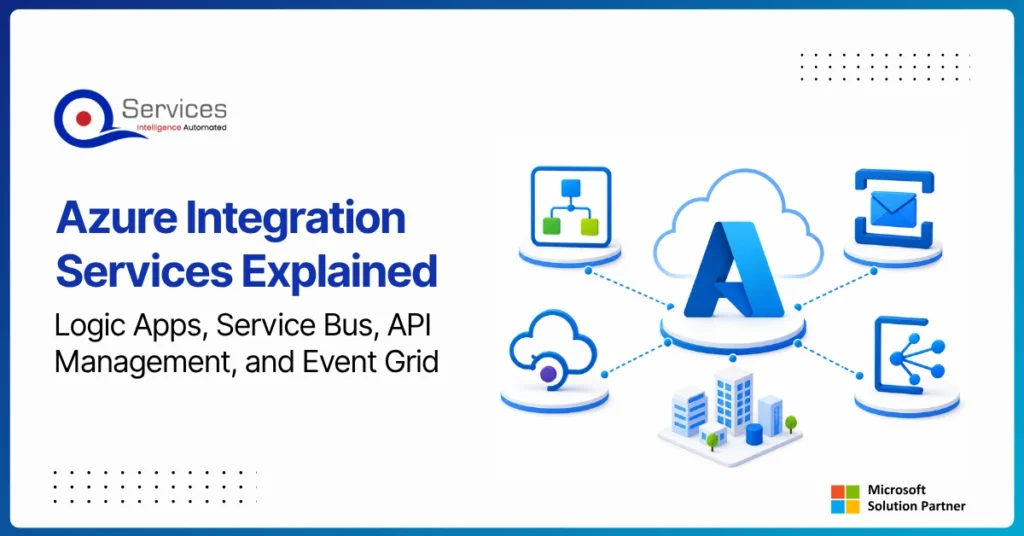
Azure Integration Services is Microsoft’s suite of cloud-native tools for connecting applications, data, and processes across your enterprise. When your organization runs a mix of on-premise systems, SaaS platforms, and custom APIs, getting them to communicate reliably is one of the hardest operational problems you will face. Azure integration services address that directly with four purpose-built components: Logic Apps for workflow automation, Service Bus for reliable messaging, API Management for governing APIs at scale, and Event Grid for event-driven architecture.
Key Insight Azure Integration Services is Microsoft’s suite of cloud-native tools for connecting applications, data, and processes across your enterprise.
This guide breaks down each component, explains how they work together, and covers when azure cloud migration services can bring your entire integration layer into the cloud. Teams evaluating azure consulting services for the first time will find the service breakdowns most useful. Teams already planning a lift and shift to azure should jump straight to the migration section.
Power BI Embedded is Microsoft’s developer-focused API for embedding interactive analytics directly inside third-party apps, customer portals, and SaaS products. If you are building software and want customers to see live dashboards without logging into the Power BI service, this is where that journey starts. The question is not whether you can embed Power BI reports, you almost certainly can. The real question is whether it makes financial and architectural sense for your specific situation. This guide covers the when, the how, and the cost math that most tutorials skip.
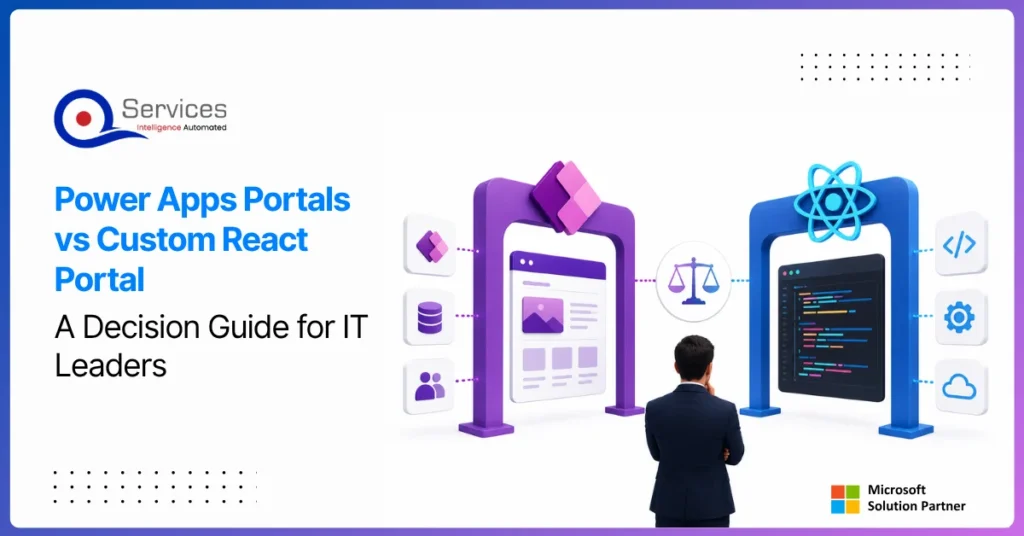
Power apps portals sit at an interesting crossroads for IT leaders: they’re fast, deeply integrated with the Microsoft stack, and manageable without a dedicated development team. But they’re also constrained in ways that matter when your business needs a portal that handles complex UI logic, third-party integrations outside the Microsoft ecosystem, or pixel-perfect UX design.
This guide gives you a straight comparison so you can make the right call without spending three months in discovery. We’ll cover what each option actually delivers, where each breaks down, and the governance questions that need answers before you commit either way.
If you’re evaluating your Microsoft stack more broadly, our breakdown of Power Platform vs Custom .NET Development provides useful parallel context.
Azure migration cost breaks down by workload strategy, not a single number. See real per-workload ranges, what FastTrack and Azure Migrate and Modernize actually cover, and how a fixed-price Blueprint Sprint replaces a vague estimate with a firm quote.
Azure Integration Services is Microsoft’s suite of cloud-native tools for connecting applications, data, and processes across your enterprise. When your organization runs a mix of on-premise systems, SaaS platforms, and custom APIs, getting them to communicate reliably is one of the hardest operational problems you will face. Azure integration services address that directly with four purpose-built components: Logic Apps for workflow automation, Service Bus for reliable messaging, API Management for governing APIs at scale, and Event Grid for event-driven architecture.
Key Insight Azure Integration Services is Microsoft’s suite of cloud-native tools for connecting applications, data, and processes across your enterprise.
This guide breaks down each component, explains how they work together, and covers when azure cloud migration services can bring your entire integration layer into the cloud. Teams evaluating azure consulting services for the first time will find the service breakdowns most useful. Teams already planning a lift and shift to azure should jump straight to the migration section.
Power BI Embedded is Microsoft’s developer-focused API for embedding interactive analytics directly inside third-party apps, customer portals, and SaaS products. If you are building software and want customers to see live dashboards without logging into the Power BI service, this is where that journey starts. The question is not whether you can embed Power BI reports, you almost certainly can. The real question is whether it makes financial and architectural sense for your specific situation. This guide covers the when, the how, and the cost math that most tutorials skip.
Power apps portals sit at an interesting crossroads for IT leaders: they’re fast, deeply integrated with the Microsoft stack, and manageable without a dedicated development team. But they’re also constrained in ways that matter when your business needs a portal that handles complex UI logic, third-party integrations outside the Microsoft ecosystem, or pixel-perfect UX design.
This guide gives you a straight comparison so you can make the right call without spending three months in discovery. We’ll cover what each option actually delivers, where each breaks down, and the governance questions that need answers before you commit either way.
If you’re evaluating your Microsoft stack more broadly, our breakdown of Power Platform vs Custom .NET Development provides useful parallel context.