Power platform governance is the difference between Microsoft 365 becoming a productivity multiplier and becoming a compliance liability. If your IT team has watched Power Apps spread across departments with no visibility into which data is being accessed, which connectors are active, or who approved what, you already know the problem. Most governance frameworks fail not because they're technically wrong but because they're too restrictive to survive contact with actual business users. This guide walks through a framework that mid-market IT teams in regulated industries can realistically implement, one that channels the energy of citizen developers without letting it spiral into a compliance incident. We'll cover environment strategy, DLP policies, center of excellence setup, and when to bring in a power platform development company to accelerate the build.
Key Insight Power platform governance is the difference between Microsoft 365 becoming a productivity multiplier and becoming a compliance liability.
In This Article, You'll Learn
What Is Power Platform Governance and Why Most Frameworks Fail
How to Build a Power Platform Governance Framework That Sticks
Power Platform Center of Excellence: Your Governance Command Center
Power Platform ALM: Keeping Apps Out of Personal Workspaces
What Is Power Platform Governance and Why Most Frameworks Fail
Power Platform governance is the set of policies, processes, and technical controls that regulate how Power Apps, Power Automate, Power BI, and Power Pages are built, deployed, and used across an organization. A well-designed framework defines who can build what, where data can flow, and how apps move from development to production.
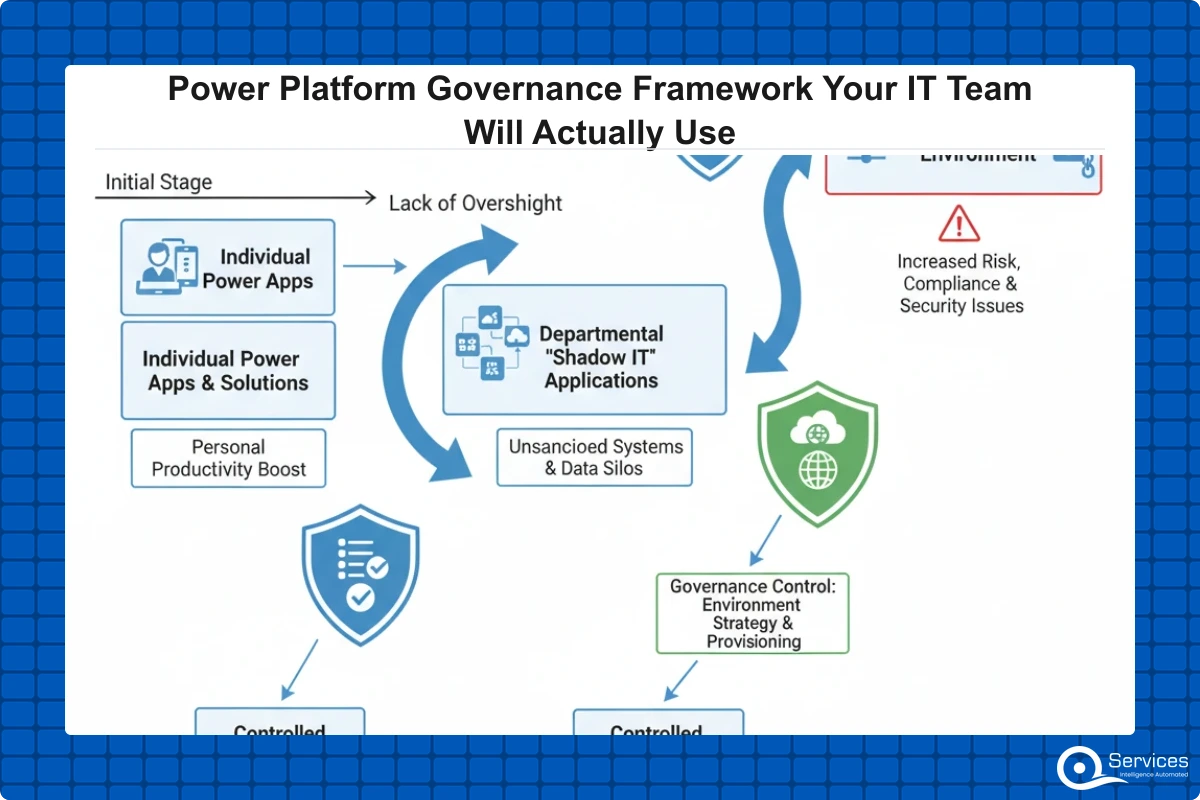
The problem with most governance frameworks is that they confuse restriction with control. Locking down every connector and requiring IT approval for every flow does stop shadow IT, but it also stops legitimate business automation. The end result is that users route around IT and build in Excel or Google Sheets, which is harder to govern than a poorly structured Power App.
The Hidden Cost of Ungoverned Citizen Development
When citizen developer governance is absent, the costs are rarely visible until something goes wrong. A sales team builds a Power Automate flow that pulls customer records into a personal OneDrive folder. A logistics coordinator connects a canvas app to an external API without anyone vetting the data security terms. A finance analyst builds a Power BI report that caches sensitive payroll data in a shared workspace.
None of these actions are malicious. They're the natural result of giving people powerful tools without guardrails. The regulatory exposure in healthcare or banking is significant: HIPAA, SOX, and PCI-DSS all care about where data goes, and "a citizen developer built it" is not a compliance defense. Citizen developer programs need governance guardrails to prevent data silos and compliance gaps before they become audit findings.
Shadow IT Power Platform: What IT Teams Are Actually Dealing With
Shadow IT Power Platform is a specific flavor of a broader problem. Microsoft's default tenant settings allow any licensed user to create environments, build apps, and configure flows against production data. By the time IT discovers these apps exist, they may have hundreds of users, active integrations, and no documentation.
The average mid-market organization discovers 40-60 unmanaged Power Platform environments when they first run a governance audit. Most were created by well-intentioned people solving real business problems, which is exactly why heavy-handed deletion isn't the answer. Power Platform governance prevents shadow IT through DLP policies, environment strategies, and approval workflows that make the right path easier than the wrong one.
How to Build a Power Platform Governance Framework That Sticks
Building power platform governance that your IT team will actually maintain requires three things working together: a sensible environment strategy, DLP policies calibrated to risk rather than fear, and an approval process that doesn't add two weeks to every request. Getting all three right is where most organizations struggle, and where the framework either becomes operational policy or a document nobody reads.
Environment Strategy: Dev, Test, and Production
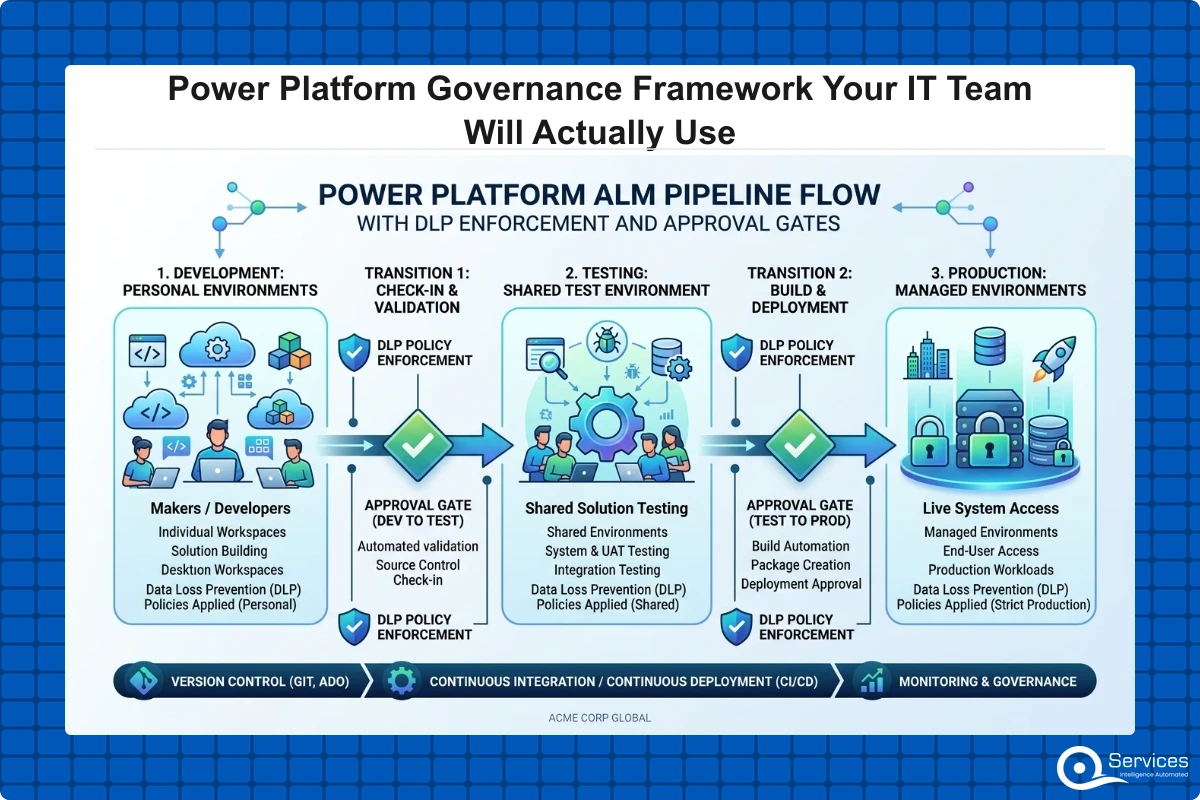
The foundation of power platform ALM is a clear environment structure. For most mid-market organizations, three tiers work well. Personal developer environments give each maker a sandboxed workspace with limited connectors and no production data access. A shared development and test environment is where validated apps get tested against representative data before promotion. Production environments are IT-managed with full DLP enforcement and change management requirements.
The dataverse consulting work we do with clients almost always starts with environment rationalization. One manufacturing client came to us with 87 environments across their tenant, 11 of which were actively serving business processes with no IT visibility. Getting that to a managed six-environment structure took about three weeks and didn't require deleting a single app. The approach was migrating solutions systematically rather than forcing users to rebuild from scratch.
Data Loss Prevention Policies That Don't Block Productivity
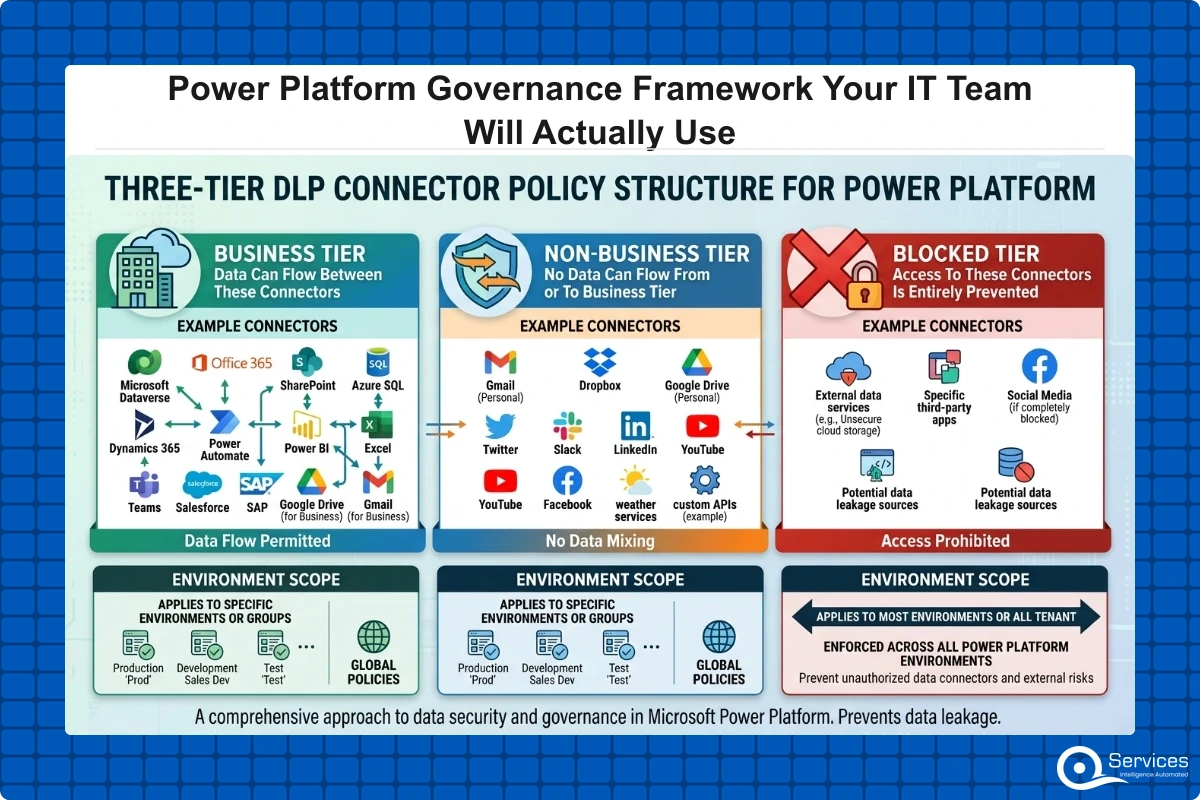
DLP policies are where most power platform governance frameworks overcorrect. The instinct to block everything not on an approved list makes sense from a security standpoint but ignores that Power Platform's value is its connector ecosystem. A tiered approach works better than a blanket restriction.
Group connectors into three buckets. Business connectors (SharePoint, Dataverse, Teams, Outlook, SQL Server) are allowed by default in business environments. Non-business connectors such as social media platforms and personal storage services are blocked in business environments and allowed only in personal sandboxes. Blocked connectors are specific high-risk services your organization has determined pose unacceptable data transfer risk. According to Microsoft's Power Platform admin documentation, DLP policies apply at the environment level, which means you can maintain different policies for different risk profiles without one blanket policy that frustrates everyone.
Power Platform Center of Excellence: Your Governance Command Center
A Power Platform Center of Excellence (CoE) is a cross-functional team of IT, security, compliance, and business representatives responsible for enabling, governing, and scaling Power Platform adoption across an organization. It maintains standards, provides maker support, and monitors platform health. The power platform center of excellence is not an IT gatekeeper function. Done well, it makes it faster for business users to build good solutions because the guardrails are already in place. Good citizen developer governance programs are built around a CoE, not around a list of restrictions.
What the Microsoft CoE Toolkit Actually Includes
QServices implements Power Platform Center of Excellence using Microsoft's CoE Starter Kit, a collection of apps, flows, and dashboards deployed into a dedicated CoE environment. The toolkit provides an inventory of every app, flow, and connector in your tenant updated daily, automated maker onboarding that provisions personal environments and sends governance guidance to new builders, compliance tracking that triggers cleanup workflows for apps not accessed in 60 or more days, and power bi dashboard development built into the toolkit showing adoption by department, connector usage, and flow run volumes.
Key Insight QServices implements Power Platform Center of Excellence using Microsoft's CoE Starter Kit, a collection of apps, flows, and dashboards deployed into a dedicated CoE environment.
The CoE toolkit is free from Microsoft. The work is in configuring it correctly and building the operating model around it. Most organizations that try to self-implement underestimate the configuration effort by a factor of three. A power platform development company with CoE experience can compress three months of setup into three to four weeks. You can review the full scope of toolkit components in Microsoft's CoE Starter Kit documentation.
Roles and Responsibilities in a Functioning CoE
A CoE without clear ownership becomes another abandoned SharePoint site. Three roles matter most:
Role
Responsibility
Platform Owner
Final authority on environment strategy and DLP policy changes
Connects platform policy to broader IT security and compliance requirements
Each role is typically a partial allocation for existing staff, not a new hire. The Maker Community Lead is often someone in a business unit who already informally helps colleagues with Power Platform. That person is usually the right choice to run the program, not an IT architect who doesn't use the tools daily.
Power Platform ALM: Keeping Apps Out of Personal Workspaces
Power platform ALM (Application Lifecycle Management) ensures apps move through environments systematically rather than being built and deployed in the same personal workspace. Without it, you get production apps running in developer environments with no change history, no rollback capability, and no one who knows what changed last month.
Power Apps Canvas vs Model Driven: Choosing the Right Foundation
The power apps canvas vs model driven decision shapes everything downstream in your governance model. Canvas apps are the right choice when you need custom UI, mobile-first experiences, or integration with systems outside Dataverse. They're faster to build and easier for citizen developers to create independently. The trade-off is that they're harder to govern at scale because layout and data access are intertwined in the app definition.
Model-driven apps are built on top of Dataverse and inherit its data model, security roles, and business rules automatically. Role-based access, audit logging, and field-level security come from the Dataverse layer, not from custom app logic. For regulated industries, model-driven apps with dataverse consulting support are usually the right foundation for anything touching customer data, financial records, or clinical information. Canvas apps work well for operational tools where the data stays in SharePoint or simple SQL tables.
Source Control and Deployment Pipelines for Power Platform
Microsoft's deployment pipelines for Power Platform let you define a source-to-target environment path and promote solutions with approval gates at each stage. Power platform ALM done correctly means makers work in personal environments, solutions get reviewed and tested in a shared environment, and only approved changes reach production. This is the same principle behind AI-augmented software delivery: automated tools build the thing, humans approve every deployment.
For teams already using Azure DevOps, the Power Platform Build Tools extension gives you the same pull request model and deployment history you use for traditional code, applied directly to Power Platform solutions.
What Can You Build With Power Apps and Power Automate?
What can you build with Power Apps? Power Apps can build field service mobile apps, inspection checklists, approval portals, inventory management tools, employee onboarding trackers, and customer intake forms. Custom power apps development can also connect to external APIs, Azure services, and on-premises data sources via the on-premises data gateway.
The real constraint isn't capability. It's knowing when Power Platform is the right tool versus when a project has outgrown the platform. Power Platform works best when the complexity is in the data and process, not in the user interface or integration architecture. Once you need complex offline sync or deeply customized connector logic exceeding a few hundred lines, you're typically past the platform's practical range.
Power Automate Workflow Examples That Actually Scale
Power automate workflow examples that consistently deliver value in regulated industries include:
Invoice approval routing: Trigger on invoice receipt, apply business rules for approval tier, route to the appropriate approver, and write the decision to a Dataverse audit log.
Employee offboarding: Triggered by an HR system update, the flow revokes app access, archives personal environments, and notifies IT of any flows needing reassignment.
Compliance document collection: Sends periodic reminders, tracks acknowledgment in Dataverse, escalates to manager after a defined number of days, and generates a compliance report for audit review.
Contract review workflow: Extracts key terms using AI Builder, routes to legal, sends to DocuSign for signature, and updates the CRM record automatically.
7 Power Automate workflows every SMB should set up first covers the foundational patterns in detail. Power automate consulting engagements we run typically start with one of these high-ROI patterns before expanding to more complex orchestrations. Our power automate consulting practice also includes connector architecture review to ensure flows don't inadvertently violate DLP policy as they scale.
Power BI Dashboard Development Tied to Your Data Layer
Power bi consulting services conversations almost always surface the same gap: dashboards built against live transactional databases create performance problems and give analysts query load that impacts production systems. Power BI dashboard development should connect to a dedicated analytics layer, not directly to operational databases.
For organizations already using Dataverse, the Dataverse connector in Power BI is the right path. For broader enterprise data, building an ETL pipeline into Azure Synapse or a Fabric lakehouse gives Power BI a performant query target without operational impact. For Microsoft-aligned companies weighing analytics platform choices, Power BI vs Tableau lays out where each tool wins. If your organization is already paying for Microsoft 365 E3 or above, the economics almost always favor Power BI for standard reporting and dashboard needs.
How to Set Up DLP Policies in Power Platform
Setting up DLP policies in Power Platform starts in the Power Platform admin center. The process has four steps:
Navigate to admin.powerplatform.microsoft.com and select Policies, then Data policies.
Create a new policy and define its scope: specific environments or all environments except selected ones.
Classify connectors into Business, Non-Business, or Blocked categories.
Apply the policy and test against a non-production environment before rolling to production.
NIST's Cybersecurity Framework provides a useful structure for deciding which connectors belong in which category. Anything capable of routing data to a consumer service or external storage provider should be non-business or blocked by default in regulated environments.
Key Insight NIST's Cybersecurity Framework provides a useful structure for deciding which connectors belong in which category.
Tiered Connector Policies for Different User Groups
One DLP policy for an entire tenant is almost never the right answer. A healthcare organization might allow its clinical operations team to use a certified EHR connector while keeping that connector blocked for general staff. A financial services firm might allow power pages development teams to use external payment gateway connectors in test environments only, keeping those connectors blocked in production until a formal security review is complete.
The mechanism is environment-level DLP policy layering. Organization-wide policies set a compliance floor. Environment-specific policies can be more restrictive but not more permissive than the baseline. Power pages development for external-facing portals often needs connectors that internal apps don't require, and the layered approach handles that without compromising the baseline security posture.
Monitoring and Alerting for Policy Violations
DLP policies prevent certain connections from being made, but they don't tell you when someone attempts to build something that violates policy. The CoE toolkit's compliance monitoring flows send alerts when a new app references blocked connectors, when flow run volume spikes unexpectedly (a potential automated data exfiltration pattern), or when a maker creates a new environment outside the managed environment list.
These alerts route to the Maker Community Lead for triage rather than directly to security, which keeps the response proportional and educational. This matters for citizen developer governance because the goal is to redirect energy toward compliant solutions, not to shut down automation efforts entirely.
When Your Power Platform Governance Needs a Development Partner
The DIY approach to power platform governance works until it doesn't. Most mid-market organizations can configure initial DLP policies and install the CoE toolkit internally. The point where power apps development services from an external partner add clear value is when your tenant has more than 50 active makers and governance has already fallen behind, or when you're operating in a regulated industry where compliance documentation for every platform decision is required.
Custom Power Apps Development vs Internal Build
The honest trade-off between custom power apps development through a partner and building internally is time versus knowledge transfer. A power platform development company can deliver a fully governed, production-ready application in 4-8 weeks that would take an internal team 6-9 months to build and govern properly, because they've solved the same architecture and security problems across multiple client environments.
The risk of full outsourcing is dependency. The best engagements pair a partner team with internal makers so your organization builds competency while the partner provides architecture, governance framework, and complex integration work. You should leave the engagement more capable, not more reliant on the vendor for ongoing changes.
What Power Apps Development Services Should Include
When evaluating power apps development services from any partner, ask for specifics on four things: environment strategy and DLP policy documentation delivered as part of the project, source control setup with version history from day one, CoE toolkit configuration integrated with existing monitoring, and handover sessions for internal makers before the engagement closes.
QServices includes all four in standard project delivery because governance that only the vendor understands is not governance. For organizations in healthcare or banking, also ask how platform decisions align with your broader HIPAA-compliant cloud architecture on Azure, since Power Platform environments inherit your tenant's security posture.
Key Takeaways
Power Platform governance is the set of policies, processes, and technical controls that regulate how Power Apps, Power Automate, Power BI, and Power Pages are built, deployed, and used across an organization.
Building power platform governance that your IT team will actually maintain requires three things working together: a sensible environment strategy, DLP policies calibrated to risk rather than fear, and an approval process that doesn't add two weeks to every request.
A Power Platform Center of Excellence (CoE) is a cross-functional team of IT, security, compliance, and business representatives responsible for enabling, governing, and scaling Power Platform adoption across an organization.
Power platform ALM (Application Lifecycle Management) ensures apps move through environments systematically rather than being built and deployed in the same personal workspace.
What can you build with Power Apps?
Conclusion
Power platform governance is not a one-time configuration project. It's an operating model that needs ownership, regular review, and a maker community around it. The organizations that get this right treat their citizen developers as partners rather than security risks, build DLP policies that reflect actual risk rather than reflexive restriction, and invest in a CoE that makes it easier to build correctly than to build badly.
If your IT team is spending more time chasing ungoverned apps than enabling new ones, that's a signal the framework needs rebuilding, not just tightening. A power platform governance assessment with an experienced partner can identify the gaps faster than an internal audit, and the cost of getting it right is far less than the cost of a data breach or compliance failure in a regulated industry. Ready to build a framework your team will actually use? Contact QServices to start with a governance assessment tailored to your industry and tenant configuration.
Co-Founder and CTO, QServices IT Solutions Pvt Ltd
Rohit Dabra is the Co-Founder and Chief Technology Officer at QServices, a software development company focused on building practical digital solutions for businesses. At QServices, Rohit works closely with startups and growing businesses to design and develop web platforms, mobile applications, and scalable cloud systems. He is particularly interested in automation and artificial intelligence, building systems that automate routine tasks for teams and organizations.
Power Platform governance is the set of policies, processes, and technical controls that regulate how Power Apps, Power Automate, Power BI, and Power Pages are built, deployed, and used across an organization. A well-designed framework defines who can build what, where data can flow, and how applications move from development environments to production. Without it, licensed users can create unmanaged environments and connect sensitive data to unsanctioned services by default.
Power Platform governance prevents shadow IT through three primary controls: DLP policies that restrict which connectors can be used in each environment, an environment strategy that gives makers a sandboxed personal space to build without touching production data, and approval workflows that route new app and flow requests through IT before deployment. Pairing these technical controls with a Maker Community Lead who provides maker support keeps the response educational rather than purely restrictive.
Power Apps can build field service mobile apps, inspection checklists, approval portals, inventory management tools, employee onboarding trackers, and customer intake forms. Custom power apps development can also connect to external APIs, Azure services, and on-premises data via the on-premises data gateway. Power Apps works best when the complexity is in the data and process rather than in a highly customized user interface or complex offline architecture.
A Power Platform Center of Excellence (CoE) is a cross-functional team of IT, security, compliance, and business representatives responsible for enabling, governing, and scaling Power Platform adoption. It typically uses Microsoft’s free CoE Starter Kit to maintain a daily inventory of all apps and flows, automate maker onboarding, monitor for compliance violations, and provide power bi dashboard development visibility into tenant-wide adoption and connector usage.
Choose canvas apps for custom UI, mobile-first experiences, or integrations with systems outside Dataverse. Choose model-driven apps when you need robust governance, role-based security, and audit logging built into the data layer rather than the app. For regulated industries handling customer data, financial records, or clinical information, model-driven apps on Dataverse are typically the safer and more governable choice.
Set up DLP policies in the Power Platform admin center under Policies, then Data policies. Create a new policy, define its scope (specific environments or all environments), classify connectors into Business, Non-Business, or Blocked categories, then test in a non-production environment before rolling to production. Use layered policies for different user groups rather than one blanket organization-wide policy, since clinical teams, developers, and general staff often have different legitimate connector needs.
Power Platform development costs vary significantly based on complexity. Simple canvas apps built by citizen developers cost relatively little beyond Microsoft 365 licensing. Custom power apps development with a professional partner typically runs from $15,000 to $80,000 depending on Dataverse modeling requirements and integration depth. A governance assessment and CoE setup from a power platform development company typically runs $10,000 to $25,000, depending on tenant size and the number of existing unmanaged environments requiring remediation.
Azure migration cost breaks down by workload strategy, not a single number. See real per-workload ranges, what FastTrack and Azure Migrate and Modernize actually cover, and how a fixed-price Blueprint Sprint replaces a vague estimate with a firm quote.
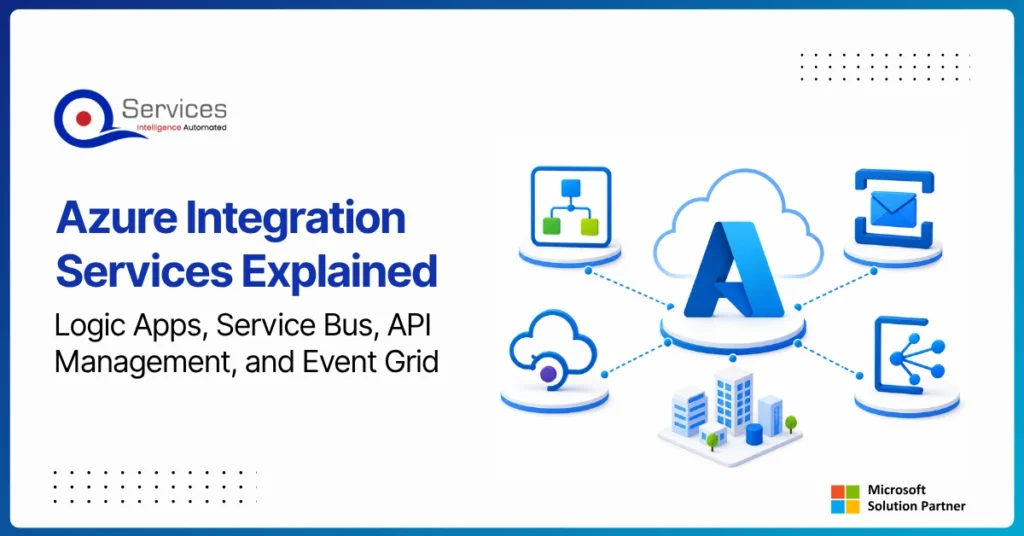
Azure Integration Services is Microsoft’s suite of cloud-native tools for connecting applications, data, and processes across your enterprise. When your organization runs a mix of on-premise systems, SaaS platforms, and custom APIs, getting them to communicate reliably is one of the hardest operational problems you will face. Azure integration services address that directly with four purpose-built components: Logic Apps for workflow automation, Service Bus for reliable messaging, API Management for governing APIs at scale, and Event Grid for event-driven architecture.
Key Insight Azure Integration Services is Microsoft’s suite of cloud-native tools for connecting applications, data, and processes across your enterprise.
This guide breaks down each component, explains how they work together, and covers when azure cloud migration services can bring your entire integration layer into the cloud. Teams evaluating azure consulting services for the first time will find the service breakdowns most useful. Teams already planning a lift and shift to azure should jump straight to the migration section.
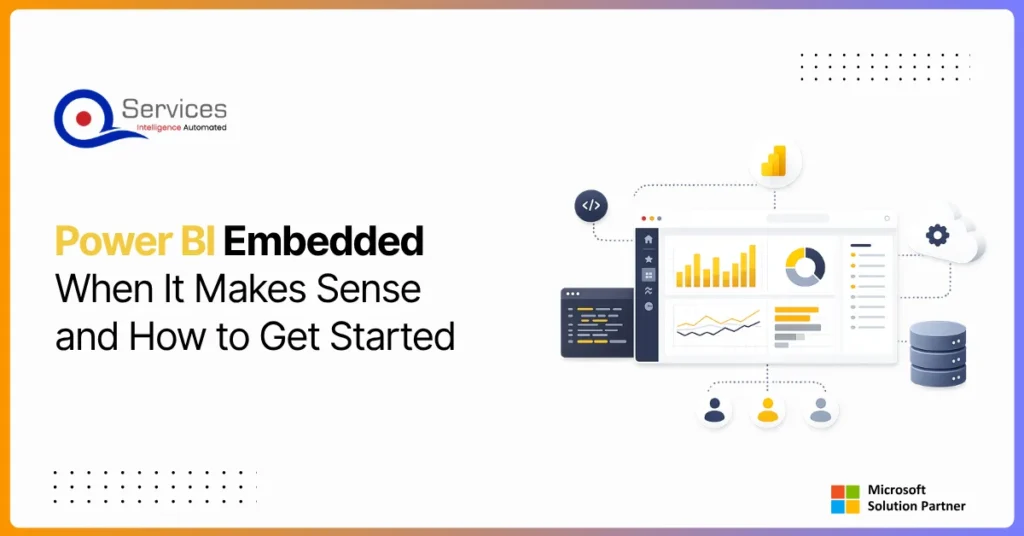
Power BI Embedded is Microsoft’s developer-focused API for embedding interactive analytics directly inside third-party apps, customer portals, and SaaS products. If you are building software and want customers to see live dashboards without logging into the Power BI service, this is where that journey starts. The question is not whether you can embed Power BI reports, you almost certainly can. The real question is whether it makes financial and architectural sense for your specific situation. This guide covers the when, the how, and the cost math that most tutorials skip.
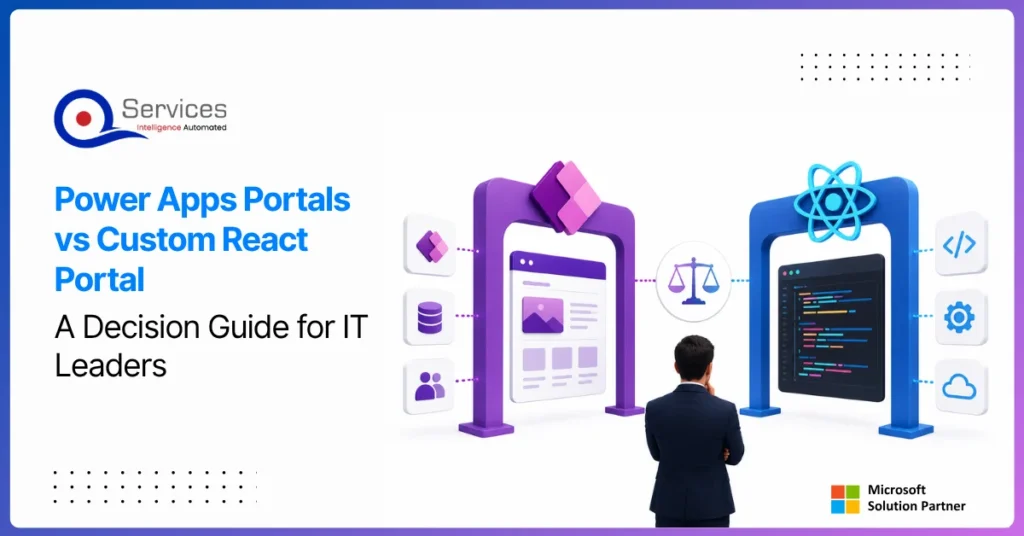
Power apps portals sit at an interesting crossroads for IT leaders: they’re fast, deeply integrated with the Microsoft stack, and manageable without a dedicated development team. But they’re also constrained in ways that matter when your business needs a portal that handles complex UI logic, third-party integrations outside the Microsoft ecosystem, or pixel-perfect UX design.
This guide gives you a straight comparison so you can make the right call without spending three months in discovery. We’ll cover what each option actually delivers, where each breaks down, and the governance questions that need answers before you commit either way.
If you’re evaluating your Microsoft stack more broadly, our breakdown of Power Platform vs Custom .NET Development provides useful parallel context.
Azure migration cost breaks down by workload strategy, not a single number. See real per-workload ranges, what FastTrack and Azure Migrate and Modernize actually cover, and how a fixed-price Blueprint Sprint replaces a vague estimate with a firm quote.
Azure Integration Services is Microsoft’s suite of cloud-native tools for connecting applications, data, and processes across your enterprise. When your organization runs a mix of on-premise systems, SaaS platforms, and custom APIs, getting them to communicate reliably is one of the hardest operational problems you will face. Azure integration services address that directly with four purpose-built components: Logic Apps for workflow automation, Service Bus for reliable messaging, API Management for governing APIs at scale, and Event Grid for event-driven architecture.
Key Insight Azure Integration Services is Microsoft’s suite of cloud-native tools for connecting applications, data, and processes across your enterprise.
This guide breaks down each component, explains how they work together, and covers when azure cloud migration services can bring your entire integration layer into the cloud. Teams evaluating azure consulting services for the first time will find the service breakdowns most useful. Teams already planning a lift and shift to azure should jump straight to the migration section.
Power BI Embedded is Microsoft’s developer-focused API for embedding interactive analytics directly inside third-party apps, customer portals, and SaaS products. If you are building software and want customers to see live dashboards without logging into the Power BI service, this is where that journey starts. The question is not whether you can embed Power BI reports, you almost certainly can. The real question is whether it makes financial and architectural sense for your specific situation. This guide covers the when, the how, and the cost math that most tutorials skip.
Power apps portals sit at an interesting crossroads for IT leaders: they’re fast, deeply integrated with the Microsoft stack, and manageable without a dedicated development team. But they’re also constrained in ways that matter when your business needs a portal that handles complex UI logic, third-party integrations outside the Microsoft ecosystem, or pixel-perfect UX design.
This guide gives you a straight comparison so you can make the right call without spending three months in discovery. We’ll cover what each option actually delivers, where each breaks down, and the governance questions that need answers before you commit either way.
If you’re evaluating your Microsoft stack more broadly, our breakdown of Power Platform vs Custom .NET Development provides useful parallel context.