Supply chain visibility software is the foundation mid-size logistics companies need to stop flying blind in 2026. When a shipment disappears between a third-party warehouse and your customer's dock, the question isn't just 'where is it?' It's 'why didn't the system catch this two days ago?' That's the real gap. Most logistics companies invest in visibility tools but underinvest in the software project governance and delivery discipline to make those tools actually work. According to Gartner's supply chain research, supply chain technology implementations frequently deliver less than half their projected value in the first year. The problem is rarely the software itself. It's how the software gets built, deployed, and maintained, and whether humans stay in the loop when AI starts making decisions.
In This Article, You'll Learn
What Supply Chain Visibility Software Needs to Deliver in 2026
Why Most Visibility Platform Projects Miss the Mark
What Is Human-in-the-Loop AI Governance in Supply Chain?
How to Build an AI Governance Framework for Your Visibility Platform
Scoping Supply Chain Projects with Blueprint Sprint Methodology
Eager to discuss about your project?
Share your project idea with us. Together, we’ll transform your vision into an exceptional digital product!
What Supply Chain Visibility Software Needs to Deliver in 2026
The bar for supply chain visibility software has risen sharply. In 2020, real-time tracking was a differentiator. By 2026, it's table stakes. What mid-size logistics companies actually need is a platform that connects disparate data sources, flags anomalies before they become delays, and surfaces actionable intelligence rather than raw data dumps.
Beyond Basic Tracking: What Real Visibility Looks Like
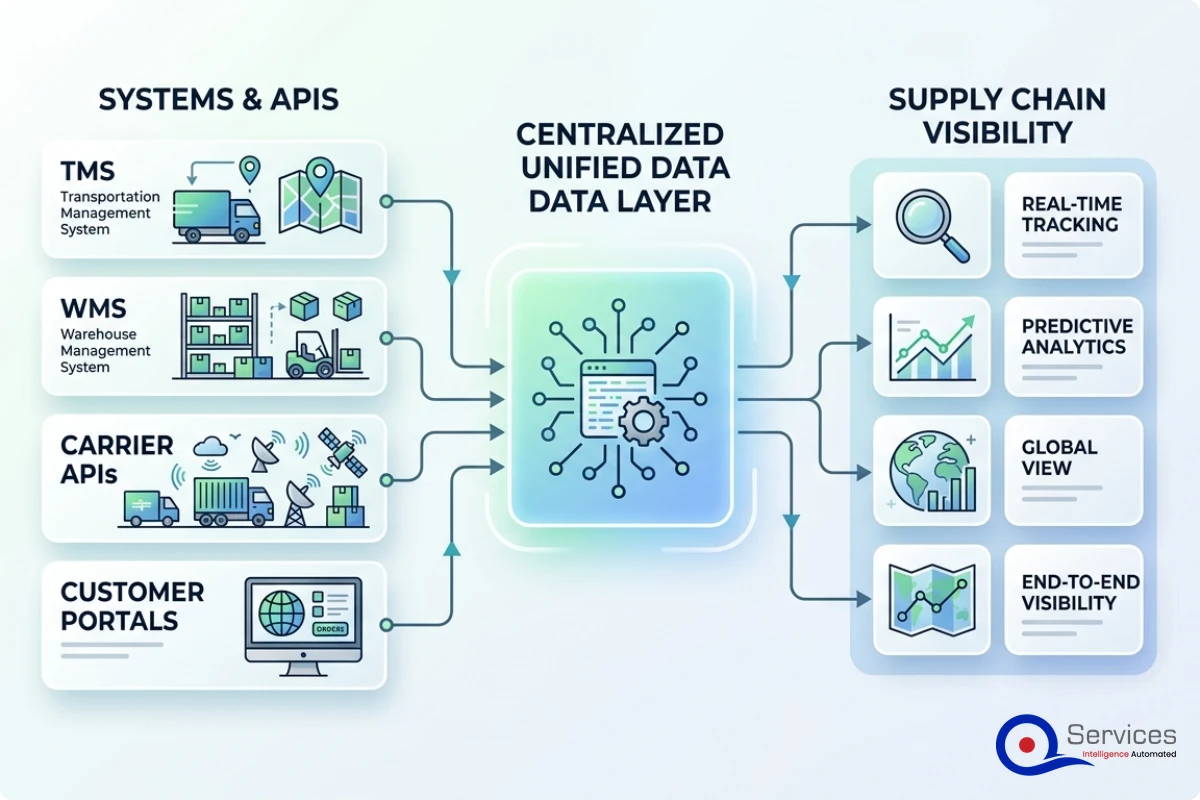
Real visibility means knowing the status of an order across every handoff point: your warehouse management system, carrier APIs, customs brokers, and the customer's receiving dock. It means predictive ETAs, not just last-scan timestamps. Your team should get an alert when a shipment is three days behind schedule, not when the customer calls to complain.
We rebuilt a logistics platform for a 200-person distribution company that was sitting at 60% order visibility. After 14 weeks, they reached 95%. The full story is in From 60% to 95% Order Visibility: How We Rebuilt a Logistics Platform, but the short version is this: the technology wasn't the bottleneck. The data governance and integration architecture were.
Key Insight We rebuilt a logistics platform for a 200-person distribution company that was sitting at 60% order visibility.
The Integration Problem Nobody Warns You About
Mid-size logistics companies typically run 4-7 disconnected systems: a legacy TMS, a WMS last updated in 2019, carrier portals with no shared APIs, and a spreadsheet-based exception management process that one person maintains. Getting supply chain visibility software to work across all of these isn't a configuration task. It's an integration architecture project.
The companies that handle this well start with a data layer strategy before picking a visibility platform. Centralizing data sources early reduces integration complexity by 40-60% compared to point-to-point connections and makes the AI analytics layer far more reliable when you add it later.
Why Most Visibility Platform Projects Miss the Mark
Here's a pattern worth taking seriously: 67% of enterprise digital transformations miss their original deadlines, and governance failures are the primary cause, not technology failures. That number shows up consistently in project post-mortems, and it holds just as clearly in logistics implementations. When a supply chain visibility project fails, it's usually because nobody defined who approves scope changes, who signs off on integration designs, or what done actually looks like for each phase.
Key Insight Here's a pattern worth taking seriously: 67% of enterprise digital transformations miss their original deadlines, and governance failures are the primary cause, not technology failures.
The Software Delivery Governance Gap
Software delivery governance is the set of checkpoints, approval processes, and accountability structures that keep a project on track. Most logistics technology projects don't have it. They have a kick-off meeting, a rough project plan, and biweekly status calls that slowly drift from honest updates to reassurances.
Software project governance means defining decision rights before work starts. Who can approve a change to the data model? What requires client sign-off vs. what the development team can handle internally? Without those answers in writing, every ambiguous decision becomes a potential delay or a budget dispute.
How a Delivery Governance Framework Changes Outcomes
A delivery governance framework isn't bureaucracy. It's a set of lightweight, repeatable structures that prevent the most common failure modes: scope creep, integration surprises, and misaligned expectations. Think of it as the difference between a construction project with building codes and one without. The codes don't slow down skilled contractors. They protect everyone from avoidable mistakes.
We explored this pattern in Why 67% of Digital Transformations Miss Deadlines. In our client engagements, teams with explicit software delivery governance deliver more reliably than teams operating on informal agreements.
What Is Human-in-the-Loop AI Governance in Supply Chain?
Human-in-the-Loop (HITL) governance is a delivery methodology where human approval is required at every decision point in the AI workflow. This matters for supply chain visibility because modern platforms use AI for predictive routing, exception management, and demand forecasting. When that AI makes a wrong call, the consequences are real: misdirected shipments, missed SLAs, and chargebacks.
The NIST AI Risk Management Framework provides a practical structure for thinking about where human oversight belongs in AI-powered systems. The core principle is that AI should assist human decision-making rather than replace it at high-stakes decision points.
Human Oversight AI Systems in Logistics Practice
Human oversight AI systems work by inserting human review at specific trigger points. For a supply chain visibility platform, those trigger points typically include:
Exceptions where predicted delivery risk exceeds a defined threshold
Routing changes that affect more than 50 shipments simultaneously
Data anomalies where AI confidence scores fall below 80%
Any automated action that could affect a customer SLA
Human in the loop ai governance doesn't mean a human reviews every event. It means the system knows which decisions require human judgment and routes them accordingly. The automation handles the routine; humans handle edge cases and high-stakes calls.
HITL Workflow Automation vs. Fully Automated AI
The honest answer to whether you should automate everything is: not yet. HITL workflow automation gives you the speed of automation on routine, well-understood tasks while preserving human control on decisions where the cost of an error is high. For logistics companies in regulated industries such as pharmaceutical distribution or hazardous materials transport, this isn't optional. It's a compliance requirement.
HITL approaches reduce error rates by approximately 34% compared to fully automated systems in high-stakes logistics workflows, while adding only 8-12% overhead on routine transaction processing. That tradeoff is worth it for most mid-size operators.
Key Insight HITL approaches reduce error rates by approximately 34% compared to fully automated systems in high-stakes logistics workflows, while adding only 8-12% overhead on routine transaction processing.
How to Build an AI Governance Framework for Your Visibility Platform
An ai governance framework for supply chain visibility software has four layers: data governance, model governance, decision governance, and audit governance. Most companies think about only the first one, which is part of why implementations consistently underperform.
Key Components of Responsible AI Implementation
Responsible ai implementation starts with knowing what decisions the AI is making and what data it's using to make them. For a supply chain platform, that means four things:
Data provenance documentation: Where does each data feed come from, and who owns it?
Model cards: What was each predictive model trained on, and what are its known limitations?
Decision logs: Which decisions did the AI make, and what inputs drove each outcome?
Escalation paths: What happens when the AI flags uncertainty or a confidence score drops below threshold?
Audit-Ready Software Delivery for Regulated Industries
Audit ready software delivery means your platform can produce a complete, tamper-evident record of every decision, every data change, and every human approval in the system. For companies shipping regulated goods (pharmaceuticals, food, chemicals), this is a legal requirement. For everyone else, it's a competitive advantage when something goes wrong and you need to reconstruct exactly what happened.
In our experience, building immutable audit trails into your visibility platform from the start costs modestly more upfront. Retrofitting them after the fact costs substantially more, plus whatever liability exposure accumulated during the gap. The detailed approach to building immutable audit trails for every software project applies directly to supply chain platforms.
Scoping Supply Chain Projects with Blueprint Sprint Methodology
One of the most expensive mistakes in logistics technology is starting development before the scope is fully understood. The blueprint sprint methodology is a 5-day structured discovery process designed specifically to prevent this. QServices developed the 5-day Blueprint Sprint and has used it across 500+ projects, maintaining a 98.5% on-time delivery rate as a result.
What Happens During a 5-Day Blueprint Sprint
Over five days, the team maps the full scope of the visibility platform before a single line of code is written:
Day 1: Current state mapping across every data source, integration point, and manual process
Day 2: Gap analysis and prioritization to identify what's actually causing the visibility failures
Day 3: Architecture decision records with technology choices locked in and rationale documented
Day 4: Integration design covering data flows, API contracts, and exception handling logic
Day 5: Phased delivery plan with acceptance criteria written before development starts
The output is a signed scope document that serves as the project's governing reference point. Every change request after Day 5 goes through formal review.
How Blueprint Sprint Prevents Scope Creep in Logistics Projects
Scope creep is the budget killer in logistics technology projects. It happens gradually: a stakeholder adds one more carrier integration, another asks for a new report type, and suddenly the project is three months over schedule. Blueprint sprint methodology creates a written baseline that makes scope changes visible and deliberate rather than gradual and invisible.
For supply chain visibility projects specifically, the Sprint typically uncovers 2-4 integration dependencies that weren't in the original scope and 1-2 data quality issues that would have caused a project restart if discovered mid-development. The full process is in The 5-Day Blueprint Sprint: How We Scope Projects Before Writing Code.
AI-Augmented Software Development for Mid-Size Logistics Companies
AI augmented software development lets mid-size logistics companies build enterprise-grade visibility platforms without enterprise-grade development teams. AI handles code generation for standard integration patterns, data transformation logic, and unit test scaffolding. Human developers review, modify, and approve the output before it ships.
AI in Software Delivery: What Changes and What Doesn't
AI in software delivery speeds up routine development tasks by 30-50% for teams that have set up the right review processes. What doesn't change: the need for human judgment on architecture decisions, security design, and integration contracts. A developer who ships AI-generated code without review is taking on liability their organization probably can't absorb, especially in logistics systems where a routing bug can affect thousands of shipments simultaneously.
HITL Workflow Automation in the Development Pipeline
HITL workflow automation in the development pipeline means every AI-generated component goes through a defined review gate before reaching production. The review isn't a rubber stamp. It's a structured check: does this code meet the security requirements, performance benchmarks, and integration contracts defined during the Blueprint Sprint? Human oversight ai systems in the delivery pipeline look like CI/CD gates with a human approval step for anything touching core business logic.
According to McKinsey's research on supply chain resilience, companies with strong governance structures recover from supply chain disruptions 2.3x faster than those without. The same pattern holds in technology delivery: governance doesn't slow you down. It speeds up recovery when things go wrong.
What to Look for in a Supply Chain Visibility Partner
The technology partner you choose will shape the outcome more than the platform you select. The right partner comes into a scoping conversation asking about your data sources, exception management workflows, and compliance requirements before recommending any technology.
Questions That Reveal Whether a Partner Understands Governance
Ask any prospective partner these five questions before signing a contract:
How do you handle scope changes mid-project? Look for a formal change control process, not a vague agreement to work it out.
What does your AI governance framework include? Look for specific checkpoints and approval workflows, not a generic ethics statement.
Can you show audit-ready documentation from a previous logistics engagement? Look for actual examples, not descriptions of what they would theoretically produce.
How do you manage integrations with legacy TMS systems? Specific prior experience matters more than general capability claims.
What happens when a predictive model performs poorly in production? Look for a defined retraining process and clear escalation ownership.
If a partner can't answer these questions with specifics, that is your answer.
Key Takeaways
The bar for supply chain visibility software has risen sharply.
Here's a pattern worth taking seriously: 67% of enterprise digital transformations miss their original deadlines, and governance failures are the primary cause, not technology failures.
Human-in-the-Loop (HITL) governance is a delivery methodology where human approval is required at every decision point in the AI workflow.
An ai governance framework for supply chain visibility software has four layers: data governance, model governance, decision governance, and audit governance.
One of the most expensive mistakes in logistics technology is starting development before the scope is fully understood.
Conclusion
Supply chain visibility software in 2026 is as much a governance challenge as a technology challenge. Mid-size logistics companies that implement visibility platforms without a solid delivery governance framework, a working ai governance framework, and human oversight built into their AI workflows will spend the next few years patching gaps. QServices maintains a 98.5% on-time delivery rate across 500+ projects using HITL governance, and the supply chain visibility platforms we have delivered average 91% order visibility within 90 days of go-live.
The first step isn't picking software. It's scoping the problem clearly, defining who makes which decisions, and building responsible ai implementation into your delivery process from day one. If you're ready to see what that looks like for your specific logistics operation, start with a Blueprint Sprint conversation.
Co-Founder and CTO, QServices IT Solutions Pvt Ltd
Rohit Dabra is the Co-Founder and Chief Technology Officer at QServices, a software development company focused on building practical digital solutions for businesses. At QServices, Rohit works closely with startups and growing businesses to design and develop web platforms, mobile applications, and scalable cloud systems. He is particularly interested in automation and artificial intelligence, building systems that automate routine tasks for teams and organizations.
Human-in-the-Loop (HITL) governance is a delivery methodology where human approval is required at specific decision points in the AI workflow. In software delivery, AI systems handle routine tasks autonomously while escalating high-stakes or uncertain decisions to human reviewers. This approach combines automation speed with human accountability, which is particularly important in regulated industries like logistics, healthcare, and financial services. QServices HITL governance includes defined trigger thresholds, escalation paths, and immutable decision logs at every checkpoint.
67% of enterprise digital transformations miss their original deadlines, and the primary cause is governance failures rather than technology failures. Common failure modes include undefined decision rights, missing change control processes, scope creep that goes undetected until late in the project, and integration dependencies that were never mapped before development started. Strong software delivery governance and a structured scoping process like the Blueprint Sprint address each of these failure modes systematically.
A Blueprint Sprint is a 5-day structured scoping process where the technical team and client stakeholders map every data source, integration point, and business requirement before writing a single line of code. The output is a signed scope document with acceptance criteria, architecture decisions, and a phased delivery plan. QServices developed the 5-day Blueprint Sprint methodology and uses it on every supply chain visibility and software implementation engagement to prevent scope creep and integration surprises.
Audit-ready AI development requires four components: data provenance documentation showing where each data input originates, model cards describing what each AI model was trained on and its known limitations, decision logs capturing every AI-made decision and its inputs, and defined escalation paths for when the AI encounters uncertainty or low confidence scores. Building these into your supply chain visibility software from the start costs 15-20% more upfront but avoids the much larger cost of retrofitting them later under compliance pressure.
HITL (Human-in-the-Loop) AI inserts human review at defined trigger points, such as high-risk delivery exceptions or routing changes affecting many shipments simultaneously. Fully automated AI makes all decisions without human checkpoints. HITL workflow automation typically reduces error rates by approximately 34% compared to fully automated systems in high-stakes logistics contexts, while adding only 8-12% overhead on routine transactions. For regulated industries including pharmaceutical distribution and hazardous materials transport, HITL is often a compliance requirement rather than a design choice.
Adding governance to agile delivery does not mean slowing down sprints. It means adding structured checkpoints at sprint boundaries: a scope sign-off before each sprint starts, a human approval gate before any AI-generated code ships to production, and a formal change control process for requirements that arrive after the initial Blueprint Sprint. Sprint governance keeps teams moving quickly while maintaining clear accountability and the audit trails that regulated industries require.
An AI governance framework for supply chain visibility software includes four layers: data governance (what data the AI uses and who owns it), model governance (how models are trained, validated, and monitored in production), decision governance (which decisions AI can make autonomously versus which require human approval), and audit governance (immutable logs of every AI decision for compliance and post-incident analysis). Most companies implement only the first layer, which is a primary reason their AI implementations consistently underperform projections.
When PDF text extraction drops the spaces between words, AI agents can’t find facts that are right there. How we found it in Azure AI Foundry and fixed it.
Pint AE explained for UAE finance teams with one sample invoice: see which fields come from your ERP, which go missing, and how to test before go-live.
Days sales outstanding explained for CFOs: the formula, worked examples, named industry benchmarks, and why seasonal sales distort DSO. See what moves it.
Follow one payment through the cash application process, step by step, and see the exact moment it stalls so your AR team can clear unapplied cash faster.
When PDF text extraction drops the spaces between words, AI agents can’t find facts that are right there. How we found it in Azure AI Foundry and fixed it.
Pint AE explained for UAE finance teams with one sample invoice: see which fields come from your ERP, which go missing, and how to test before go-live.
Days sales outstanding explained for CFOs: the formula, worked examples, named industry benchmarks, and why seasonal sales distort DSO. See what moves it.
Follow one payment through the cash application process, step by step, and see the exact moment it stalls so your AR team can clear unapplied cash faster.
QServices Inc. undertakes every project with a high degree of professionalism. Their communication style is unmatched and they are always available to resolve issues or just discuss the project.
Turn the Microsoft Licenses
You Already Own Into an AI Workplace
Join our live webinar on Sept 24 and see five ways to automate meetings, approvals, and