Supply chain visibility software is supposed to tell you where every order is, right now, without a phone call. For one mid-size logistics company we worked with, the honest answer was: 60% of the time. The other 40%? Stale data, disconnected carrier feeds, and manual status updates sometimes hours old. That gap cost them roughly $2.1 million annually in expediting fees, customer credits, and lost contracts. This post walks through the full rebuild: what broke, what the blueprint sprint uncovered, how human-in-the-loop governance kept the project on track, and why the platform now delivers 95% real-time order visibility.
Key Insight For one mid-size logistics company we worked with, the honest answer was: 60% of the time.
In This Article, You'll Learn
The Problem: When Supply Chain Visibility Software Shows 60%
Why Digital Transformations Fail in Logistics
What Is Human-in-the-Loop AI Governance for Supply Chain Software?
How We Scoped the Rebuild: Blueprint Sprint Methodology in 5 Days
Building the Platform: AI Augmented Software Development With Governance
Eager to discuss about your project?
Share your project idea with us. Together, we’ll transform your vision into an exceptional digital product!
The Problem: When Supply Chain Visibility Software Shows 60%
The company ran 14 carrier integrations across domestic and cross-border routes. Each had its own data format, update frequency, and error handling quirks. The result was a visibility dashboard that looked complete but wasn't. Orders disappeared from tracking for hours, status updates arrived out of sequence, and exception alerts fired too late to prevent customer impact.
According to McKinsey's supply chain operations research, companies with fragmented tracking systems report 23% higher operating costs compared to those with unified supply chain visibility software. The cost is not just in fees. It's in the decision-making gap: when your operations team cannot see 40% of active orders, they default to phone calls, email threads, and gut instinct.
Why Logistics Teams Lose Track of Orders
The root cause was architectural, not operational. The original platform polled each carrier API every 15 minutes. Carriers that throttled requests failed silently, and those failures were logged but never surfaced. The dashboard showed "last updated 14 minutes ago" even when the underlying update was empty.
Event-driven architecture changes this. When a carrier fires a webhook, you process it immediately. When a carrier goes silent for more than 20 minutes, you raise an alert. The difference between those two approaches accounts for roughly 35 percentage points of visibility coverage.
What 40% Blind Spots Actually Cost
The operations team had built informal workarounds: a shared spreadsheet for high-priority shipments, a Slack channel for exception alerts, and a weekly carrier review meeting that mostly existed to surface gaps the software missed. Three people spent an estimated 12 hours per week managing information the platform should have provided automatically. At $85 per hour fully loaded, that's approximately $53,000 per year in manual effort alone, before factoring in expediting costs and customer credits.
How Supply Chain Visibility Software Failures Cascade
Visibility gaps compound. A missed exception at hour 2 leads to a delayed response at hour 6, a customer call at hour 8, and a credit at hour 24. This client had a 4.2% exception rate, but because detection was slow, 61% of exceptions required some form of customer credit or expediting. Faster detection changes that ratio significantly.
Why Digital Transformations Fail in Logistics
Before writing a single line of code, we needed to understand why the previous rebuild had failed. That project ran 7 months, consumed roughly $340,000, and was abandoned with no production release.
Key Insight That project ran 7 months, consumed roughly $340,000, and was abandoned with no production release.
67% of enterprise digital transformations miss deadlines due to governance failures, not technology failures. That pattern holds across our 500+ project history, and this engagement matched it exactly. The previous vendor had technically solid engineers. The problem was software delivery governance: no formal checkpoints, scope that grew by approximately 40% mid-project, and stakeholder reviews that happened monthly instead of weekly.
The Governance Gap Most Vendors Don't Mention
Software delivery governance is the unglamorous part of any project proposal. Vendors lead with architecture diagrams and case studies. They bury the governance section because governance feels like overhead rather than value. The honest answer is that governance is where projects survive or die. AI in software delivery makes this worse, not better, because AI-assisted development moves faster and scope ambiguity compounds with velocity. This is the delivery governance framework failure mode: individual contributors optimize locally while the project drifts globally.
Why Good Technology Alone Doesn't Deliver Results
The first rebuild had chosen solid technology: modern microservices, real-time event processing, a well-designed API layer. None of that saved it. By month 4, the platform was technically impressive and operationally incomplete because the team had optimized for technical elegance rather than stakeholder-defined outcomes. If scope creep is a recurring pattern on your projects, our analysis of how governance prevents scope creep covers the specific controls that break the cycle.
What Is Human-in-the-Loop AI Governance for Supply Chain Software?
Human-in-the-Loop (HITL) governance is a delivery methodology where human approval is required at every major decision point in a software project, not just at the end. For a supply chain visibility software rebuild, stakeholders review and approve the data model before it's built, the integration architecture before it's wired up, and the exception detection logic before it's deployed. Nothing significant moves forward without a documented sign-off.
Reviewing a completed module for approval is rubber-stamping. Reviewing a design before implementation is governance. For a full definition and practical examples, see our guide to human-in-the-loop governance for software teams.
Human Oversight of AI Systems vs. Fully Automated Pipelines
The rebuilt platform included several AI-assisted components: predictive exception detection, automated carrier scoring, and anomaly alerts. We landed on a tiered model for human oversight in AI systems. High-confidence exceptions (above 92% model confidence) trigger automated alerts immediately. Medium-confidence exceptions (65-92%) route to a human review queue. Low-confidence signals are logged for model retraining. This is responsible AI implementation in practice: deploy automation where reliability is high, keep human judgment where it matters most.
Human in the loop ai governance also means the model's decision logic is visible. Every exception flag shows the top three contributing factors so the reviewer can evaluate whether the AI's reasoning makes sense. Black-box alerts erode trust. Transparent ones build it.
HITL Workflow Automation in Practice
HITL workflow automation doesn't mean slowing everything down with approvals. It means building approval workflows into the system so they happen fast and with full context. In this platform, the carrier integration validation workflow runs automatically, catches configuration errors, and routes them to the integration owner for a focused 15-minute review. That's faster than the previous process, which involved a 24-hour wait for a batch job to surface the error.
How We Scoped the Rebuild: Blueprint Sprint Methodology in 5 Days
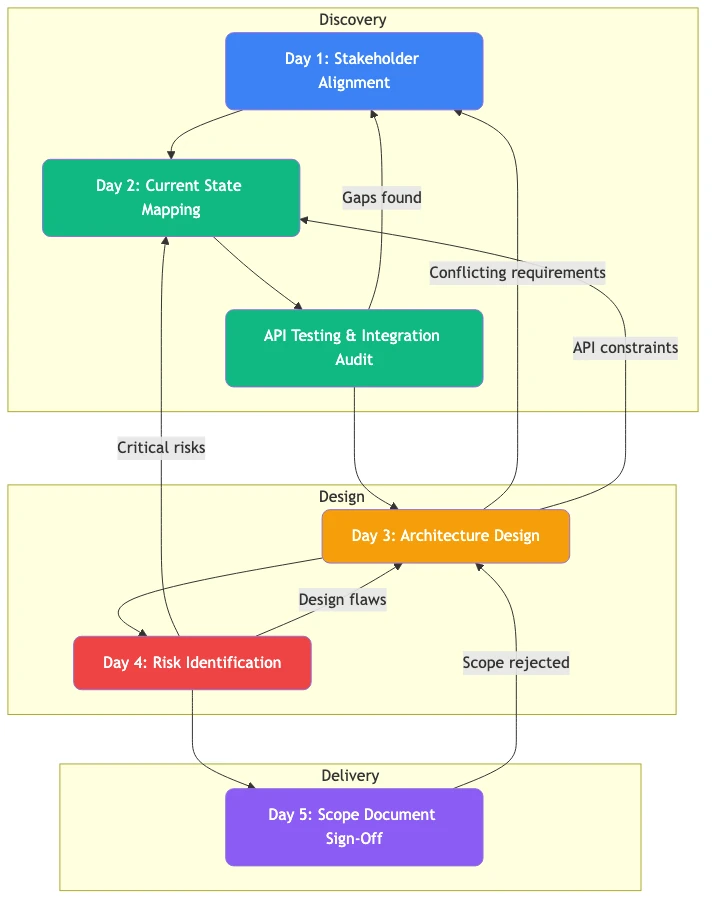
QServices developed the 5-day Blueprint Sprint as a structured scoping process for any significant software rebuild. Day 1 covers stakeholder alignment and success metric definition. Day 2 maps the current state and identifies integration gaps. Day 3 covers architecture decisions. Day 4 identifies risks and mitigation strategies. Day 5 produces a formal scope document with timeline, cost estimate, and sign-off.
For this logistics platform, the blueprint sprint methodology surfaced three unresolved issues: carrier APIs varied far more than internal documentation suggested, the existing data model had a flaw that would have broken real-time updates, and two stakeholder teams had conflicting definitions of "visibility." One meant location data; the other meant ETA accuracy. Finding that in week 1 rather than month 4 is the difference between a successful project and another abandoned one. The full blueprint sprint process is documented here.
Five Days Before Writing a Line of Code
The blueprint sprint methodology resists the temptation to start coding immediately by establishing that a signed scope document is more valuable than the first five development sprints. This project's sprint produced a 34-page technical scope document, a carrier integration compatibility matrix, and a formal definition of "95% visibility" that all stakeholders agreed to measure the same way. Projects fail when success is defined differently by different stakeholders at delivery time.
What the Blueprint Sprint Surfaces That Kickoffs Miss
Traditional kickoffs collect requirements. Blueprint sprints validate them. The client assumed their largest carrier partner supported webhook-based updates. A 20-minute API test on day 2 of the sprint revealed they only supported polling at 30-minute intervals. That architectural change was caught in week 1 rather than week 12.
Building the Platform: AI Augmented Software Development With Governance
AI augmented software development means using AI tools actively throughout the build cycle, with documented human review at each stage. AI-assisted generation handled roughly 40% of the boilerplate: data transformation layers, API client wrappers, logging scaffolding, and test fixtures. Human engineers wrote the carrier integration logic, exception detection rules, and the real-time event processing core.
The ai governance framework for this project defined those boundaries explicitly before development started, so engineers knew when to use AI assistance and when to write and review everything manually. That boundary definition is a core part of responsible AI implementation, not an afterthought.
The Architecture Decisions That Drove Visibility to 95%
The rebuild moved from polling to an event-driven architecture using Azure Service Bus as the message backbone. Each carrier integration became a dedicated Azure Function consuming carrier webhooks and normalizing them into a common event schema. The main platform subscribed to that event stream and updated order state typically within 8 seconds of a carrier event.
For the four carriers that didn't support webhooks, a smart polling layer adjusted frequency based on order priority. High-priority orders get polled every 2 minutes during key milestone windows; standard orders every 10 minutes. This cut unnecessary API calls by 62% while improving coverage. The Azure-specific real-time tracking patterns are covered in our post on building real-time delivery tracking with Azure Maps and SignalR.
Key Insight This cut unnecessary API calls by 62% while improving coverage.
Responsible AI Implementation at Every Layer
The predictive exception detection model trained on 18 months of historical order data. Responsible AI implementation here meant transparent model inputs, a bias audit across carrier types, and a documented retraining schedule. The ai governance framework also specified how often the model would be reviewed and what triggers a retraining cycle.
The NIST AI Risk Management Framework provided the structure for our AI governance documentation. That documentation matters practically: logistics clients face audits from enterprise customers who want to verify that AI-assisted decisions in their supply chain are governed, not arbitrary.
Delivery Governance Framework That Kept the Project on Track
The delivery governance framework for this project had four active components: weekly stakeholder demos showing working software, a scope change log reviewed each sprint, a RAID board updated daily, and a formal go/no-go process for each deployment.
Weekly demos are not status meetings. A status meeting reports on what happened. A weekly demo shows working software and forces a real conversation about whether it meets expectations. This project ran 16 consecutive weekly demos without a missed slot, and two of those demos surfaced requirement gaps corrected before they became expensive errors. Software project governance that includes working demos is materially different from governance that relies on written reports alone.
Software Project Governance Checkpoints
At the end of each two-week sprint, the stakeholder group reviewed completed work against the scope document. Any work outside scope required a written change request with a documented impact assessment. Three change requests came in during the five-month project. All three were approved and estimated before the work started. The project finished within 2% of the original budget. Software project governance isn't bureaucracy. It's the mechanism that lets you say yes to real changes while preventing uncontrolled drift.
Audit-Ready Software Delivery in Logistics
Audit-ready software delivery means every decision is documented: why the architecture was chosen, who approved it, when, and what alternatives were considered. We used an immutable audit trail structure throughout: design decisions recorded in Confluence with sign-off timestamps, code review records in Azure DevOps, and deployment approval records tied to specific stakeholder names. Our post on building immutable audit trails for every software project covers the mechanics.
Results: Supply Chain Visibility Software at 95% in 90 Days
The platform went live after five months. Order visibility coverage moved from 60% to 95%. Exception detection response time dropped from 8.4 hours to 1.2 hours. The operations team's manual tracking workload dropped from 12 hours per week to under 2 hours. Customer credits related to visibility failures dropped by 78%.
Total project cost was $287,000, including the 5-day blueprint sprint and all delivery governance overhead. Annualized savings exceeded $380,000 in year one, producing a positive ROI before the project's first anniversary.
What Changed in the First 90 Days
The first change stakeholders noticed wasn't the dashboard. It was the exception alerts. Within the first week of launch, the operations team received automated alerts for three shipments that would have gone undetected until a customer called. In each case, they contacted the customer proactively before the delivery window was missed. By month 3, the operations team had abandoned the manual tracking spreadsheet entirely. That spreadsheet had existed for four years.
The Metrics That Actually Mattered
Gartner's supply chain management research shows that companies with high supply chain visibility outperform peers by 20% in on-time delivery rates. The client's on-time delivery rate improved from 83% to 91% in the post-launch period. QServices maintains a 98.5% on-time delivery rate across 500+ projects using HITL governance. The ai governance framework and the blueprint sprint methodology are not process taxes. They're what makes that delivery number possible.
Key Takeaways
The company ran 14 carrier integrations across domestic and cross-border routes.
Before writing a single line of code, we needed to understand why the previous rebuild had failed.
Human-in-the-Loop (HITL) governance is a delivery methodology where human approval is required at every major decision point in a software project, not just at the end.
QServices developed the 5-day Blueprint Sprint as a structured scoping process for any significant software rebuild.
AI augmented software development means using AI tools actively throughout the build cycle, with documented human review at each stage.
Conclusion
Supply chain visibility software fails when the technology is treated as the solution rather than the tool. The real solution combines the right architecture, responsible AI implementation, and a delivery governance framework that keeps the project honest from day one through go-live.
This logistics rebuild worked because the blueprint sprint methodology caught structural problems before they became expensive changes, the HITL workflow automation kept human judgment in the right places, and the weekly demo cadence kept all stakeholders aligned without slowing delivery. The 35-percentage-point improvement in order visibility was the outcome. The software delivery governance and structured scoping process were the method.
If your logistics platform is running below 80% order visibility, the problem is almost certainly not the technology. It's how that technology was selected, scoped, and governed. Start with five days of structured scoping before committing to months of development. You'll know the full picture before writing a single line of code.
Co-Founder and CTO, QServices IT Solutions Pvt Ltd
Rohit Dabra is the Co-Founder and Chief Technology Officer at QServices, a software development company focused on building practical digital solutions for businesses. At QServices, Rohit works closely with startups and growing businesses to design and develop web platforms, mobile applications, and scalable cloud systems. He is particularly interested in automation and artificial intelligence, building systems that automate routine tasks for teams and organizations.
Human-in-the-Loop (HITL) governance is a delivery methodology where human approval is required at every major decision point in a software project, not just at the end. Unlike milestone reviews that happen after phases complete, HITL governance embeds human checkpoints throughout development: before the data model is built, before integrations are wired, and before anything is deployed. This prevents the scope drift and undetected errors that cause most digital transformation failures. QServices HITL governance includes formal sign-off workflows, weekly working demos, and immutable audit trails at every stage.
67% of enterprise digital transformations miss deadlines due to governance failures, not technology failures. The most common causes are scope that expands without formal change management, stakeholder reviews that happen too infrequently to catch misalignment early, and delivery teams that optimize for technical quality rather than stakeholder-defined outcomes. The technology in failed projects is usually sound. The governance process is usually absent or under-resourced.
A blueprint sprint is a structured 5-day scoping process used before development begins. QServices developed the 5-day Blueprint Sprint to replace traditional requirements gathering, which often produces unvalidated assumptions. The sprint covers stakeholder alignment, current-state mapping, architecture decisions, risk identification, and a formal scope document with sign-off. For supply chain visibility software rebuilds, a blueprint sprint typically surfaces carrier API compatibility gaps and conflicting stakeholder definitions of success before a single line of code is written.
Audit-ready software delivery with AI components requires three things: transparent model inputs with no unexplainable black-box decisions, documented approval workflows that attribute every significant decision to a named human reviewer, and a bias audit across the relevant data categories before deployment. For logistics platforms, this means documenting why exception detection thresholds were set, who approved them, and how the model performs across different carrier types and route categories. The NIST AI Risk Management Framework provides a practical structure for this documentation.
Fully automated AI systems make decisions and take actions without human review at any point. Human-in-the-Loop AI systems require human approval at defined decision points, typically where model confidence is below a threshold or where the consequences of error are significant. In practice, a tiered model works best: high-confidence AI decisions proceed automatically, medium-confidence decisions route to human review, and low-confidence signals are logged for model improvement. This hybrid approach outperforms fully automated systems in accuracy and stakeholder trust for enterprise logistics applications.
Adding software delivery governance to agile doesn’t mean replacing sprints with bureaucratic gates. It means adding structured checkpoints at the right moments: a signed scope document before development begins, a weekly demo cadence showing working software rather than status reports, a scope change log reviewed each sprint, and a formal go/no-go process for deployments. These additions typically add less than 5% overhead to a sprint cycle while significantly reducing scope drift and rework costs.
An AI governance framework for software delivery includes: defined boundaries specifying where AI-generated code is acceptable and where human authorship is required, an approval workflow for AI outputs before they reach production, transparent model documentation covering inputs, outputs, and confidence thresholds, a bias audit process for models that affect real-world decisions, and a retraining schedule tied to production performance data. QServices HITL governance includes all of these components as standard elements of every AI-augmented software project.
When PDF text extraction drops the spaces between words, AI agents can’t find facts that are right there. How we found it in Azure AI Foundry and fixed it.
Pint AE explained for UAE finance teams with one sample invoice: see which fields come from your ERP, which go missing, and how to test before go-live.
Days sales outstanding explained for CFOs: the formula, worked examples, named industry benchmarks, and why seasonal sales distort DSO. See what moves it.
Follow one payment through the cash application process, step by step, and see the exact moment it stalls so your AR team can clear unapplied cash faster.
When PDF text extraction drops the spaces between words, AI agents can’t find facts that are right there. How we found it in Azure AI Foundry and fixed it.
Pint AE explained for UAE finance teams with one sample invoice: see which fields come from your ERP, which go missing, and how to test before go-live.
Days sales outstanding explained for CFOs: the formula, worked examples, named industry benchmarks, and why seasonal sales distort DSO. See what moves it.
Follow one payment through the cash application process, step by step, and see the exact moment it stalls so your AR team can clear unapplied cash faster.
QServices Inc. undertakes every project with a high degree of professionalism. Their communication style is unmatched and they are always available to resolve issues or just discuss the project.
Turn the Microsoft Licenses
You Already Own Into an AI Workplace
Join our live webinar on Sept 24 and see five ways to automate meetings, approvals, and