If you've ever tried to hire a banking software development company without first understanding what that really means, you've probably discovered the hard way that most software vendors aren't built for regulated industries. The gap between a team that can build a payment feature and one that can build it to PCI-DSS standards, pass an OCC audit, and still ship on time is significant. This guide is for IT decision-makers who need to close that gap before signing a contract, because the decisions you make upfront directly determine whether your project ends in production or in a compliance review board.
Banking isn't just a vertical. It's a constraint system. Every architectural decision carries regulatory weight, and that changes how good software development companies think, scope, and deliver.
In This Article, You'll Learn
What Makes Banking Software Development Different from Standard Enterprise Projects
How to Evaluate a Banking Software Development Company Before You Sign
How KYC/AML Automation Fits Into Your Banking Software Development Roadmap
Azure for Banking: Cloud Migration That Passes Regulatory Scrutiny
Core Banking Modernization: What to Tackle First
Eager to discuss about your project?
Share your project idea with us. Together, we’ll transform your vision into an exceptional digital product!
What Makes Banking Software Development Different from Standard Enterprise Projects
Most software projects fail on execution. Banking software projects fail on compliance, and usually long before the first line of production code ships. This isn't a new observation, but it's one that continues to cost financial institutions time and money at scale.
The distinction matters. Fintech software development has to satisfy both engineering standards and regulatory frameworks at once, and those two things often pull in opposite directions. Speed, for example, is almost always in conflict with auditability.
The Compliance Burden That Generic Developers Miss
A general-purpose software team thinks about compliance as a checkbox. They deliver the feature, then they tag on a security review. Banking projects don't work this way. PCI-DSS, OCC/FDIC guidance, and BSA requirements have to be part of the design, not appended to it.
The honest reality is that a large share of banking digital transformation projects run over budget, and compliance gaps are among the most common causes. Not bad code, not scope creep. Compliance scope that wasn't correctly defined from the start.
Financial services cloud migration introduces a second constraint layer on top of regulatory compliance. You're not just moving workloads. You're moving workloads in a way that satisfies your regulator's examination criteria, preserves data residency requirements, and passes penetration testing before go-live.
We covered the infrastructure side of this in our post on Azure Landing Zones Explained for Mid-Size Companies, but the banking-specific version adds audit trails, key management requirements, and network segmentation rules that go well beyond standard enterprise cloud practice.
The Hidden Cost of Getting Fintech Software Development Wrong
The cost of a compliance failure in banking isn't just the remediation expense. It's the regulatory relationship, the potential enforcement action, and the reputational damage. A regional bank that receives a Matter Requiring Attention from the OCC after a failed system audit can face 12-18 months of heightened supervision. That's a real cost that doesn't show up in any vendor proposal.
How to Evaluate a Banking Software Development Company Before You Sign
This is where most IT leaders either spend too little time or ask the wrong questions. There are four things a credible banking software development company must be able to demonstrate, not just claim.
What a Real Regulatory Track Record Looks Like
Ask for specific examples. Not "we've worked with banks" but "here is a project where we built KYC/AML automation for a mid-size credit union and here's how we handled the examination cycle." If they can't give you specifics, they're not the right partner.
The team should understand HITL governance frameworks for banking, including how OCC and FDIC guidance applies to AI-assisted decisioning in loan origination or fraud detection workflows. This isn't fringe knowledge for a banking software firm. It's table stakes.
Questions to Ask About Technical Depth
Does their team hold Azure certifications relevant to financial services? Have they implemented banking compliance software that's been examined by a federal regulator? Can they walk you through how they handle secrets management in a multi-tenant architecture?
These questions separate vendors who understand the domain from those who are learning it on your dime.
How KYC/AML Automation Capabilities Translate to Delivery
KYC/AML automation is one of the fastest-moving areas in banking technology. Ask potential vendors what their standard approach to identity verification is, which data providers they integrate with, and how they handle sanctions screening updates. If the answer is vague, that's a problem. The FFIEC BSA/AML Examination Manual is publicly available and a credible vendor should be able to reference it fluently.
How KYC/AML Automation Fits Into Your Banking Software Development Roadmap
KYC/AML automation isn't a single feature. It's a set of interconnected systems that handle identity verification, risk scoring, transaction monitoring, and regulatory reporting. Getting any one of them wrong creates systemic risk across the others.
According to the NIST Cybersecurity Framework, financial institutions that integrate security controls into their software development lifecycle report measurably lower rates of compliance incidents. The same logic applies when you embed KYC/AML logic early in your architecture rather than treating it as a bolt-on after the core functionality is built.
Building KYC Verification Into Onboarding Flows
The best time to solve identity verification is before a customer ever touches your platform. That means API-level integrations with identity providers at the point of account creation, document verification that matches your risk tier requirements, and audit logs that capture every step in the onboarding flow.
A mid-size bank we worked with reduced its manual KYC review time by 74% by moving from a batch verification model to real-time API-driven checks at account opening. The key was building the verification logic into the core onboarding service from day one, not as a post-process.
Key Insight A mid-size bank we worked with reduced its manual KYC review time by 74% by moving from a batch verification model to real-time API-driven checks at account opening.
AML Transaction Monitoring That Reduces False Positives
The honest answer about AML transaction monitoring is that false positives are expensive. Each one requires a human analyst to review, document, and clear. Industry estimates suggest compliance teams at mid-size institutions spend 30-40% of their hours clearing alerts that turn out to be legitimate transactions.
Key Insight Industry estimates suggest compliance teams at mid-size institutions spend 30-40% of their hours clearing alerts that turn out to be legitimate transactions.
Regtech solutions that use machine learning to calibrate thresholds reduce that figure significantly. But only if the underlying transaction data model is built correctly. We've seen AML systems that generate fewer alerts but catch more actual issues, simply because the data pipeline was designed to surface behavioral patterns rather than just transaction amounts.
Integrating KYC/AML Systems With Legacy Core Banking
This is where core banking modernization gets complicated. Your new KYC/AML layer has to talk to a core banking system that may be 20 years old. That integration work is where projects often stall. See our breakdown of 5 proven patterns for Power Platform legacy banking integration for practical approaches to this challenge.
Azure for Banking: Cloud Migration That Passes Regulatory Scrutiny
Azure for banking has become the preferred cloud strategy at mid-size financial institutions for a specific reason: Microsoft's compliance documentation is built for regulators. Azure's compliance portfolio covers SOC 1, SOC 2, PCI-DSS, FedRAMP, and financial services regulations including the OCC's interagency guidance on cloud computing.
But having access to a compliant cloud platform is not the same as building compliantly on it. The platform provides the foundation. Your development team, and the banking software development company you partner with, determines whether the applications built on that foundation actually meet examination standards.
Azure Services Approved for Financial Workloads
Not every Azure service is appropriate for regulated banking workloads. Institutions typically rely on Azure SQL Managed Instance for core transactional data, Azure Key Vault for secrets management, Azure Active Directory for identity, Azure Monitor with Log Analytics for audit logging, and Azure Kubernetes Service for containerized workloads with network policy enforcement.
The configuration of these services matters as much as the choice of services. Azure Landing Zones provide the governance scaffolding, but banking workloads typically require additional policy controls around data classification, egress filtering, and privileged access management.
What PCI-DSS Compliant Development Actually Requires
PCI-DSS compliant development is not just about where your data lives. It's about how your development team writes code, manages secrets, handles access, and documents change control. The 12 requirements in PCI-DSS v4.0 touch everything from network segmentation to software testing practices.
Per the PCI Security Standards Council, organizations that implement secure software development lifecycle practices see significantly lower rates of cardholder data exposure. That means code reviews for injection flaws, dependency scanning for known vulnerabilities, and penetration testing before any cardholder data environment goes live.
One trap we see regularly: teams that build on Azure, assume the cloud provider handles PCI-DSS, and skip application-layer controls. The shared responsibility model doesn't work that way. Azure secures the infrastructure. You're responsible for securing the application.
How Financial Services Cloud Migration Planning Should Work
A realistic financial services cloud migration for a regulated institution takes 6-18 months depending on the complexity of the core banking system. The first 90 days are almost entirely architecture and compliance planning. That's not inefficiency. That's the correct order of operations.
If a vendor quotes you a 60-day cloud migration for a core banking workload, ask detailed questions. Either they're scoping something much smaller than you think, or they're not accounting for examination readiness work. This mismatch is one of the patterns we flag regularly in our Azure cost audits, where rushed planning phases create expensive rework later.
Core Banking Modernization: What to Tackle First
Core banking modernization is one of those projects that sounds like it needs to happen all at once. It doesn't. The "big rewrite" approach is almost always the wrong one. In our client engagements, banks that attempt full core replacements in a single program consistently spend far more than their original budget and end up with a system that, while improved, didn't justify the disruption cost.
The Strangler Fig Approach to Legacy Banking Systems
The pattern that works is incremental. You build new capabilities outside the legacy core, route traffic to the new system gradually, and retire old components when the new ones have proven stable in production. This approach limits the blast radius if something goes wrong and keeps the business running throughout the migration.
Open banking API development is often the right entry point for this strategy. You expose your core capabilities through an API layer, which creates a clean boundary between the legacy system and any new services. That boundary gives you room to modernize incrementally without shutting down production systems.
When Fraud Detection Software Becomes a Modernization Entry Point
Fraud detection software is usually one of the first components to migrate in a banking modernization project, for a straightforward reason: it doesn't need to live inside the core. You can pull transaction data via API, score it in real time, and feed decisions back to the core without modifying the core system directly.
This is the architecture pattern we describe in detail in How to build fraud detection automation for fintech SMBs on Azure. The key insight: real-time scoring engines work best as independent services that consume a data stream, not as features embedded in the transaction processing layer.
Open Banking API Development, PCI-DSS Compliance, and What Connects Them
Open banking API development sits at the intersection of two competing pressures: the push toward data portability driven by frameworks like PSD2 in Europe and emerging U.S. equivalents under CFPB Section 1033 rulemaking, and the need to maintain strict controls over cardholder data. Navigating both requires deliberate API design decisions from the start.
PCI-DSS Compliant Development at the API Layer
The API layer is where most PCI-DSS failures in modern banking platforms occur. Common issues include tokenization gaps where raw card data passes through an API not designed to handle it, insufficient rate limiting on authentication endpoints, and inadequate logging of access to cardholder data environments.
Banking compliance software should include API gateway policies that enforce field-level encryption, mask sensitive data in logs, and alert on anomalous access patterns. These controls need to be part of the initial API design, not added after the API is already in production.
Consent Management in Open Banking Architecture
Open banking requires explicit, auditable consent from customers for data sharing. Your consent management layer needs to be as robust as your transaction processing layer. Records need to be immutable, timestamped, and retrievable on demand for regulatory examination.
For teams building on Azure, the combination of Azure API Management, Azure Event Hubs, and immutable blob storage provides a solid technical foundation for consent tracking. But the data model and consent state machine have to be designed correctly from day one.
Fraud Detection Software and Regtech Solutions That Scale
Fraud detection software in banking is a moving target. Fraud patterns change faster than most machine learning models retrain, which means static rule sets age quickly. The systems that perform best long-term combine real-time rule engines with continuously trained models and human review for high-value or ambiguous transactions.
Regtech solutions are broader than fraud detection alone. They cover sanctions screening, transaction reporting, capital adequacy calculations, and model risk management documentation for AI-assisted decisions. A credible banking software development company should be able to connect their technical delivery to the specific regulatory use cases these tools address.
The compliance failures that attract OCC examination attention are rarely dramatic breaches. They're usually gaps in documentation, monitoring, or alert response protocols that compound over time. Treating fraud detection software and regtech as afterthoughts is how those gaps form.
Key Takeaways
Most software projects fail on execution.
This is where most IT leaders either spend too little time or ask the wrong questions.
KYC/AML automation isn't a single feature.
Azure for banking has become the preferred cloud strategy at mid-size financial institutions for a specific reason: Microsoft's compliance documentation is built for regulators.
Core banking modernization is one of those projects that sounds like it needs to happen all at once.
Conclusion
Choosing the right banking software development company is one of the highest-stakes vendor decisions a financial institution's IT leadership makes. The cost of getting it right is often invisible. The cost of getting it wrong shows up in failed audits, deferred launches, and compliance remediation cycles that consume engineering capacity for quarters at a time.
The criteria that matter most: regulatory experience backed by specifics, proven capabilities in KYC/AML automation and banking compliance software, a credible approach to financial services cloud migration, and engineering practices that treat PCI-DSS compliant development as a design requirement rather than a post-launch checklist.
If you're early in the vendor evaluation process, start with a structured scoping engagement before any development begins. A focused discovery sprint is the fastest way to surface the compliance and integration assumptions that will determine whether your project ships on time and holds up under examination.
Co-Founder and CTO, QServices IT Solutions Pvt Ltd
Rohit Dabra is the Co-Founder and Chief Technology Officer at QServices, a software development company focused on building practical digital solutions for businesses. At QServices, Rohit works closely with startups and growing businesses to design and develop web platforms, mobile applications, and scalable cloud systems. He is particularly interested in automation and artificial intelligence, building systems that automate routine tasks for teams and organizations.
KYC/AML automation involves integrating identity verification APIs at onboarding, building real-time transaction monitoring with ML-calibrated thresholds, and connecting to a regulatory reporting layer. The core steps are: (1) select a regulated identity data provider, (2) build verification logic into the account creation flow rather than as a post-process, (3) configure transaction monitoring rules based on your institution’s risk profile, and (4) establish automated SAR/CTR filing workflows. The FFIEC BSA/AML Examination Manual provides the compliance baseline all systems must satisfy.
PCI-DSS compliant development means building applications that meet all 12 PCI-DSS v4.0 requirements throughout the development lifecycle, not just in production. This includes network segmentation to isolate cardholder data environments, application-layer controls like field-level encryption and injection flaw prevention, change control documentation, and annual penetration testing. On Azure, PCI-DSS compliance is a shared responsibility: Microsoft secures the infrastructure, and your development team is responsible for the application-layer controls.
Migrating banking systems to Azure typically takes 6-18 months for regulated workloads and follows a phased approach: (1) compliance and architecture planning in the first 60-90 days, (2) landing zone setup with banking-specific policy controls, (3) non-production workload migration with regulatory review, and (4) production cutover with rollback procedures. Key Azure services include Azure SQL Managed Instance, Azure Key Vault, Azure Active Directory, and Azure Monitor. Each phase should produce documentation suitable for regulator examination.
An open banking API is a standardized interface that lets authorized third parties access customer banking data or initiate transactions with the customer’s explicit consent. In the U.S., open banking is driven by CFPB rulemaking under Section 1033 of the Dodd-Frank Act. Technically, open banking APIs use OAuth 2.0 for authorization and RESTful design patterns, and must comply with PCI-DSS requirements when cardholder data is involved. They also require robust consent management with immutable audit trails.
Banking software development costs vary significantly based on scope and compliance requirements. A custom core banking module with KYC/AML integration typically ranges from $200,000 to $800,000 for a mid-size institution. A full cloud migration for a regulated banking workload on Azure adds $150,000 to $500,000 in architecture, migration, and examination readiness work. Fraud detection software integration runs $50,000 to $250,000 depending on ML model complexity. These are rough ranges; a proper scoping engagement produces a more accurate figure for your specific context.
Azure services most commonly used in banking workloads include Azure SQL Managed Instance for transactional data, Azure Key Vault for secrets and key management, Azure Active Directory for identity and access, Azure Monitor with Log Analytics for audit logging, Azure Kubernetes Service for containerized workloads, Azure API Management for open banking API gateways, and Azure Sentinel for security event management. All are covered under Azure’s PCI-DSS, SOC 1/2, and FedRAMP certifications, though your application-layer controls still require separate validation.
Building AI-powered fraud detection for banking involves three components: a real-time transaction scoring engine that evaluates each transaction against behavioral models, a rule engine that applies static thresholds for known fraud patterns, and a human review workflow for edge cases and high-value transactions. On Azure, this architecture typically uses Azure Stream Analytics for real-time data ingestion, Azure Machine Learning for model training and scoring, and Azure Logic Apps for analyst notification workflows. Models should be retrained at least quarterly as fraud patterns evolve, with model risk management documentation maintained for regulatory review.
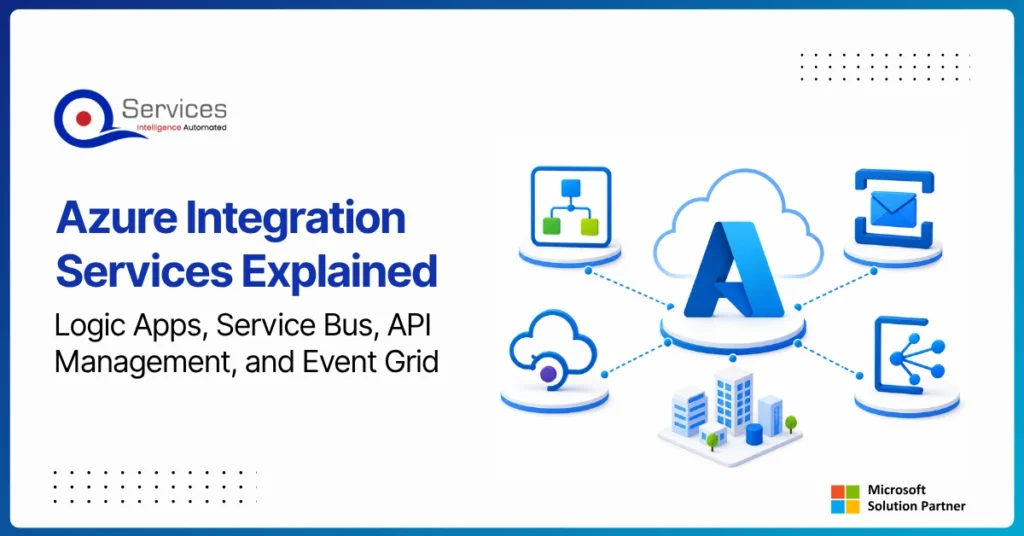
Azure Integration Services is Microsoft’s suite of cloud-native tools for connecting applications, data, and processes across your enterprise. When your organization runs a mix of on-premise systems, SaaS platforms, and custom APIs, getting them to communicate reliably is one of the hardest operational problems you will face. Azure integration services address that directly with four purpose-built components: Logic Apps for workflow automation, Service Bus for reliable messaging, API Management for governing APIs at scale, and Event Grid for event-driven architecture.
Key Insight Azure Integration Services is Microsoft’s suite of cloud-native tools for connecting applications, data, and processes across your enterprise.
This guide breaks down each component, explains how they work together, and covers when azure cloud migration services can bring your entire integration layer into the cloud. Teams evaluating azure consulting services for the first time will find the service breakdowns most useful. Teams already planning a lift and shift to azure should jump straight to the migration section.
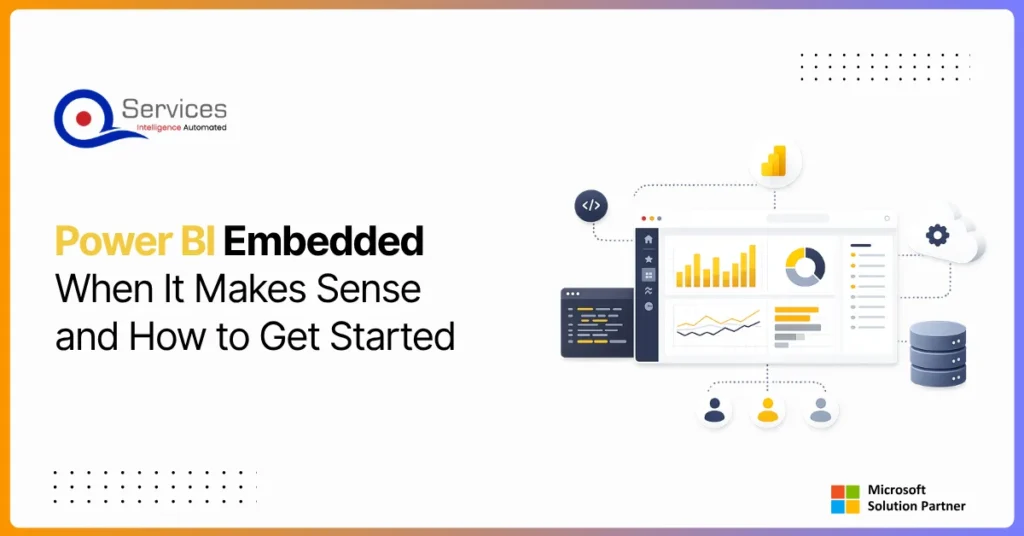
Power BI Embedded is Microsoft’s developer-focused API for embedding interactive analytics directly inside third-party apps, customer portals, and SaaS products. If you are building software and want customers to see live dashboards without logging into the Power BI service, this is where that journey starts. The question is not whether you can embed Power BI reports, you almost certainly can. The real question is whether it makes financial and architectural sense for your specific situation. This guide covers the when, the how, and the cost math that most tutorials skip.
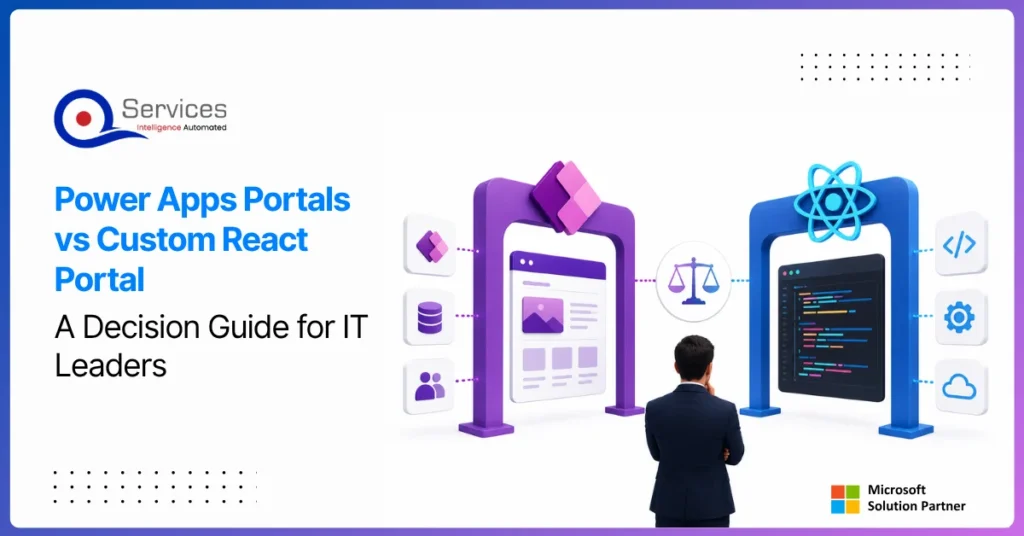
Power apps portals sit at an interesting crossroads for IT leaders: they’re fast, deeply integrated with the Microsoft stack, and manageable without a dedicated development team. But they’re also constrained in ways that matter when your business needs a portal that handles complex UI logic, third-party integrations outside the Microsoft ecosystem, or pixel-perfect UX design.
This guide gives you a straight comparison so you can make the right call without spending three months in discovery. We’ll cover what each option actually delivers, where each breaks down, and the governance questions that need answers before you commit either way.
If you’re evaluating your Microsoft stack more broadly, our breakdown of Power Platform vs Custom .NET Development provides useful parallel context.
Azure Integration Services is Microsoft’s suite of cloud-native tools for connecting applications, data, and processes across your enterprise. When your organization runs a mix of on-premise systems, SaaS platforms, and custom APIs, getting them to communicate reliably is one of the hardest operational problems you will face. Azure integration services address that directly with four purpose-built components: Logic Apps for workflow automation, Service Bus for reliable messaging, API Management for governing APIs at scale, and Event Grid for event-driven architecture.
Key Insight Azure Integration Services is Microsoft’s suite of cloud-native tools for connecting applications, data, and processes across your enterprise.
This guide breaks down each component, explains how they work together, and covers when azure cloud migration services can bring your entire integration layer into the cloud. Teams evaluating azure consulting services for the first time will find the service breakdowns most useful. Teams already planning a lift and shift to azure should jump straight to the migration section.
Power BI Embedded is Microsoft’s developer-focused API for embedding interactive analytics directly inside third-party apps, customer portals, and SaaS products. If you are building software and want customers to see live dashboards without logging into the Power BI service, this is where that journey starts. The question is not whether you can embed Power BI reports, you almost certainly can. The real question is whether it makes financial and architectural sense for your specific situation. This guide covers the when, the how, and the cost math that most tutorials skip.
Power apps portals sit at an interesting crossroads for IT leaders: they’re fast, deeply integrated with the Microsoft stack, and manageable without a dedicated development team. But they’re also constrained in ways that matter when your business needs a portal that handles complex UI logic, third-party integrations outside the Microsoft ecosystem, or pixel-perfect UX design.
This guide gives you a straight comparison so you can make the right call without spending three months in discovery. We’ll cover what each option actually delivers, where each breaks down, and the governance questions that need answers before you commit either way.
If you’re evaluating your Microsoft stack more broadly, our breakdown of Power Platform vs Custom .NET Development provides useful parallel context.