AI augmented software delivery is no longer an experiment reserved for Silicon Valley startups with unlimited budgets. Mid-market companies in healthcare, banking, logistics, and SaaS are now shipping AI-assisted code, automating review cycles, and using generative tools to compress delivery timelines by 30-40%. But there's a problem most vendors won't tell you about: the AI handles the speed, not the accountability.
Key Insight Mid-market companies in healthcare, banking, logistics, and SaaS are now shipping AI-assisted code, automating review cycles, and using generative tools to compress delivery timelines by 30-40%.
When something goes wrong in an AI-assisted project, and eventually something does, the question isn't whether the model made a good prediction. The question is who signed off. That's the gap at the center of every failed digital transformation we've seen: not broken technology, but broken governance. This post breaks down what ai augmented software delivery actually looks like when it works, why human oversight matters more than the tools you choose, and the specific framework QServices uses to keep both speed and control on the same team.
In This Article, You'll Learn
Why AI Augmented Software Delivery Is More Than a Speed Play
What Is Human-in-the-Loop AI Governance?
Why Do Most Digital Transformations Still Fail?
The Blueprint Sprint Methodology: Scope Before You Code
How to Build an AI Governance Framework for Software Teams
Eager to discuss about your project?
Share your project idea with us. Together, we’ll transform your vision into an exceptional digital product!
Why AI Augmented Software Delivery Is More Than a Speed Play
The productivity numbers are real. GitHub Copilot studies show developers complete tasks up to 55% faster when AI assists with code generation. Internal QA automation reduces bug-detection cycles from days to hours. Documentation that used to take a junior developer half a sprint now takes an AI tool 20 minutes.
But those numbers describe outputs, not outcomes. Shipping code faster means nothing if that code ships with compliance gaps, undocumented decisions, or architectural choices nobody reviewed. The teams that succeed with ai augmented software development are the ones that treated governance as a design decision before the first line of code, not an audit step added at the end.
The Speed Advantage Is Real, but Incomplete
AI tools accelerate three things well: boilerplate generation, pattern-based testing, and documentation drafts. That covers roughly 40-60% of the work in a typical software sprint. The remaining 40-60% is judgment: architecture decisions, security tradeoffs, UX calls, and stakeholder alignment. No AI tool makes those calls well without a human in the loop.
Key Insight That covers roughly 40-60% of the work in a typical software sprint.
The teams that don't understand this distinction tend to over-automate early and hit a wall around week six. Delivery looks fast on the surface, then one compliance review or one stakeholder demo reveals that several critical decisions were made by the model, not the team.
What "AI in Software Delivery" Actually Changes
AI in software delivery changes the ratio of creation to review, not the need for review. When a developer writes 200 lines of code manually, they understand every line. When an AI generates 2,000 lines in the same time, the developer needs a structured review process to reach the same level of understanding. Without that process, velocity becomes a liability.
This is why responsible ai implementation requires governance architecture, not just prompt engineering. The tools are only as trustworthy as the process wrapped around them. For a closer look at what happens when that process is absent, What Happens When AI Writes Code and Nobody Reviews It walks through specific failure scenarios that play out repeatedly across unstructured AI-assisted projects.
What Is Human-in-the-Loop AI Governance?
Human-in-the-Loop (HITL) governance is a delivery methodology where human approval is required at every decision point in the software delivery lifecycle. It's not about slowing AI down. It's about making AI output accountable.
In practice, hitl workflow automation means the AI generates, proposes, or drafts. A qualified human reviews, approves, or rejects. The decision and the reasoning are logged. That audit trail is what makes the difference between a project that feels fast and a project that can survive a compliance review.
A typical HITL-governed sprint looks like this: the AI proposes code for a feature. The developer reviews it for correctness, security, and architecture fit. An approval is logged with the reviewer's ID, timestamp, and any modifications made. The approved code goes into the pipeline. A separate AI tool runs tests. A human QA lead reviews the results. The QA sign-off is logged. Deployment requires a human trigger.
None of those steps add more than 15-20 minutes per feature to the cycle. But every step creates an artifact that answers the compliance question: who decided this, and when?
HITL vs Fully Automated AI: The Key Differences
The distinction is simpler than most vendors make it sound. Fully automated AI makes decisions and executes them without human review. Human oversight ai systems hold those decisions for human approval before execution.
For low-stakes, repeatable tasks like code formatting or test data generation, full automation is fine. For anything that touches production systems, user data, financial transactions, or regulated workflows, HITL is not optional. It's the architecture that keeps your organization defensible. The post HITL vs Fully Automated AI: Why the Hybrid Approach Wins for Enterprise digs into the specific tradeoffs across different use cases.
Why Do Most Digital Transformations Still Fail?
67% of enterprise digital transformations miss deadlines due to governance failures, not technology failures. That's not a vendor stat. It's the pattern across post-mortems conducted across hundreds of projects, and it aligns with what McKinsey's research on transformation success rates consistently shows: the technology works. The governance doesn't.
The reasons are predictable once you've seen enough projects:
Scope changes mid-sprint with no formal review process
AI-generated code merged without documented approval
Compliance requirements discovered after architecture decisions are locked in
No audit trail for decisions made in Slack threads and forgotten
These aren't technology problems. They're software delivery governance problems. We've covered the full breakdown in Why 67% of Digital Transformations Miss Deadlines, which is worth reading before you start scoping any major initiative.
Key Insight We've covered the full breakdown in Why 67% of Digital Transformations Miss Deadlines, which is worth reading before you start scoping any major initiative.
The Governance Gap in AI-Assisted Projects
AI-assisted projects introduce a specific governance gap that traditional agile frameworks weren't designed to handle. When a developer writes code manually, there's an implicit paper trail: the commit, the PR, the review comments. When an AI generates code and a developer pastes it in without a structured review workflow, that implicit trail disappears.
The governance gap is the space between what the AI produced and what the organization can defend. As AI tooling accelerates, that gap widens unless you design around it explicitly. This is the problem that software project governance is built to solve, and it's why bolting governance on at the end of a project never works as well as designing it in from sprint one.
How Software Delivery Governance Closes the Gap
Software delivery governance doesn't mean adding bureaucracy. It means designing decision points into the workflow so that accountability is automatic, not retrospective.
Concretely, that means every AI-generated artifact has an assigned reviewer. Every merge requires a documented sign-off. Every sprint closes with a governance review that logs what was decided and by whom. Those artifacts are immutable. You can't edit a decision log after the fact. Building Immutable Audit Trails for Every Software Project explains how that architecture works in a real delivery environment.
The Blueprint Sprint Methodology: Scope Before You Code
QServices developed the 5-day Blueprint Sprint to solve a specific problem: teams that start coding before they've resolved the decisions that will blow up their timeline. The blueprint sprint methodology runs before a single line of production code is written. It produces a scoped, agreed-upon delivery plan with clear boundaries, a risk log, and a governance structure.
The cost of a week of structured scoping is almost always lower than the cost of three weeks of re-scoping mid-project. If that ratio sounds conservative, consider that scope rework in the back half of a project is exponentially more expensive than scope rework in week one, because integration complexity has compounded by then.
What Happens in Those 5 Days
Day one: stakeholder interviews and business objective mapping. Day two: technical architecture review and integration point identification. Day three: risk and compliance assessment (this is where HIPAA, PCI-DSS, or banking regulations get surfaced, not discovered at week eight). Day four: sprint plan design with defined review checkpoints. Day five: sign-off and delivery contract.
The output is a document stack that governs the entire project. Every decision made during the blueprint sprint is logged. Every agreed constraint is documented. When scope change requests come in at week four, and they always do, the blueprint becomes the reference point for an honest conversation about tradeoffs rather than a conflict about expectations.
How Blueprint Sprint Prevents Scope Creep
Scope creep is almost never about bad stakeholders. It's about undefined boundaries at project start. When the original scope is vague, every new feature request is technically within scope because there was no scope to protect. The blueprint sprint creates that boundary explicitly, in writing, with stakeholder sign-off before a single developer writes a line of code.
Scope Creep Kills Projects: How Governance Prevents It walks through real examples of how blueprint-governed projects handle scope change requests differently than projects that started without one. The difference in how those conversations go is significant.
How to Build an AI Governance Framework for Software Teams
An ai governance framework for software delivery has four layers: policy, process, tooling, and audit. Most organizations build the tooling layer first and wonder why the policy and process layers don't follow automatically. They don't. They require deliberate design choices that the tooling alone can't make.
Here's what each layer requires:
Policy layer: What decisions require human approval? What AI tools are approved for use? What data can AI tools access? Who is accountable for AI-generated outputs?
Process layer: How does approval happen? What's the review checklist? How are decisions logged? How are disputes resolved between reviewers?
Tooling layer: What CI/CD gates enforce review requirements? What logging infrastructure captures decisions? What dashboards surface governance metrics to project leads?
Audit layer: What artifacts prove that governance happened? Who can access them? How long are they retained? What triggers a formal governance review?
Core Components of a Delivery Governance Framework
A delivery governance framework for AI-augmented teams includes these five non-negotiable components:
Approval workflow design (documented in sprint setup, not improvised during review)
AI output classification (which outputs require senior review, which are auto-approvable)
Audit-ready software delivery means the answer to a regulator's question about how a decision was made takes minutes to produce, not weeks. Most teams can't answer that question because they didn't design their delivery process to generate that answer automatically.
The three artifacts that make a project audit-ready are: a decision log, a change log, and a test evidence record. All three should be generated automatically as a byproduct of the delivery process, not assembled manually when an audit notice arrives.
For regulated industries, this is non-negotiable. Healthcare teams deal with HIPAA requirements. Banking teams deal with OCC and FDIC expectations. The post HITL Governance for Banking: OCC/FDIC Compliance Built into Delivery covers what audit-ready ai in software delivery looks like in a regulated financial context.
Responsible AI Implementation Across Regulated Industries
Responsible ai implementation looks different depending on the regulatory context. The governance principles are consistent. The specific requirements are not, and the teams that try to apply a generic framework to a regulated industry usually discover the gaps during an audit, not before it.
Healthcare: HIPAA and Clinical Data Boundaries
In healthcare IT, the governance question starts with data boundaries. What PHI can the AI tool access? What decisions require a clinician's review? What happens when AI-generated code processes patient data incorrectly?
The governance framework in a healthcare context needs to map every AI tool's data access against HIPAA's minimum necessary standard. Any tool that accesses PHI needs to be documented in your BAA stack. Any AI-generated code that processes PHI needs a clinical reviewer in the approval chain, not just a developer. Why Healthcare IT Projects Fail at Compliance, Not Code covers the specific failure patterns that repeat across healthcare software projects.
Banking: Explainability and Regulatory Defensibility
In banking, the software delivery governance question adds a layer: explainability. Regulators don't just want to know who approved a decision. They want to understand the reasoning behind it. When AI drives a credit scoring model, a fraud detection rule, or a transaction monitoring threshold, the governance framework needs to capture not just the approval, but the documented logic.
This is why human in the loop ai governance is structurally different from rubber-stamping. A reviewer who can't explain why they approved an AI output hasn't really governed it. The NIST AI Risk Management Framework provides the baseline expectations for what documented explainability looks like in high-stakes contexts.
Logistics: Speed Without Sacrificing Traceability
In logistics software, the core tension is speed vs. traceability. AI-augmented route optimization, inventory prediction, and carrier selection can run at machine speed. But when a shipment goes wrong, the post-mortem needs a traceable chain of decisions. Who authorized the route change? What data did the AI use? Was the threshold adjustment reviewed before it went live?
How to Measure Software Delivery Quality in AI-Augmented Teams
Most teams measure delivery quality by output metrics: story points completed, bugs found in QA, deployment frequency. Those metrics don't capture governance quality. A team can complete 40 story points in a sprint and still have zero documented AI approval records, zero audit artifacts, and zero compliance checkpoint completions.
QServices maintains a 98.5% on-time delivery rate across 500+ projects using HITL governance. That number is a byproduct of measuring the right things: governance compliance per sprint, approval cycle times, audit artifact completeness, and post-sprint decision log coverage alongside traditional delivery metrics.
Key Metrics for Software Delivery Quality
The governance metrics that actually predict delivery success:
Approval cycle time: How long does it take for AI-generated artifacts to get reviewed? Cycles longer than 4 hours signal process friction, not careful review.
Governance coverage rate: What percentage of AI-generated outputs have a documented human review? Below 95% is a risk indicator in regulated industries.
Compliance checkpoint hit rate: Did every sprint close with its required compliance reviews completed and logged?
Scope change request response time: How quickly does the team assess scope change requests against the original blueprint and produce a written impact assessment?
The single most underrated governance tool in agile delivery is the weekly client demo. Not because it shows progress. Because it forces a human to stand in front of a stakeholder and explain every decision made that week.
You can't demo a decision you didn't make deliberately. You can't explain an AI-generated architecture choice you didn't review. The weekly demo is a governance forcing function that costs one hour a week and prevents weeks of rework. Weekly Client Demos: The Most Underrated Governance Tool makes this case with specific examples from projects where the demo caught governance gaps before they became compliance incidents.
Key Takeaways
The productivity numbers are real.
Human-in-the-Loop (HITL) governance is a delivery methodology where human approval is required at every decision point in the software delivery lifecycle.
67% of enterprise digital transformations miss deadlines due to governance failures, not technology failures.
QServices developed the 5-day Blueprint Sprint to solve a specific problem: teams that start coding before they've resolved the decisions that will blow up their timeline.
An ai governance framework for software delivery has four layers: policy, process, tooling, and audit.
Conclusion
AI augmented software delivery is the direction the industry is moving, and the teams that do it well will ship faster, stay compliant, and build systems that hold up under scrutiny. The ones that don't will keep chasing speed while wondering why their projects drift off-track and their audit responses take weeks to prepare.
The framework isn't complicated: human in the loop ai governance built into sprint design from day one, immutable audit trails generated automatically as a delivery byproduct, a blueprint sprint before coding starts, and consistent measurement of governance quality alongside delivery speed. Those four elements are what responsible ai implementation looks like at scale, not just on paper.
If your team is working through how to add software delivery governance to your AI-assisted projects, we're happy to walk through what a blueprint sprint engagement looks like for your specific context. The first conversation is a scoping call, not a sales pitch.
Co-Founder and CTO, QServices IT Solutions Pvt Ltd
Rohit Dabra is the Co-Founder and Chief Technology Officer at QServices, a software development company focused on building practical digital solutions for businesses. At QServices, Rohit works closely with startups and growing businesses to design and develop web platforms, mobile applications, and scalable cloud systems. He is particularly interested in automation and artificial intelligence, building systems that automate routine tasks for teams and organizations.
Human-in-the-Loop (HITL) governance is a delivery methodology where human approval is required at every decision point in the software lifecycle. The AI generates or proposes an output, a qualified human reviews and approves or rejects it, and the decision is logged with a timestamp and reviewer attribution. This creates an audit trail that proves accountability at every stage of delivery, which is critical for regulated industries like healthcare, banking, and logistics.
67% of enterprise digital transformations miss deadlines due to governance failures, not technology failures. The most common causes are: scope changes with no formal review process, AI-generated code merged without documented approval, compliance requirements discovered after architecture is locked in, and no audit trail for decisions made informally. The technology almost always works. The process and accountability structure around it frequently does not.
QServices developed the 5-day Blueprint Sprint as a structured pre-coding scoping process. Over five days, the team conducts stakeholder interviews, maps technical architecture and integration points, assesses compliance and regulatory risks, designs sprint checkpoints, and produces a signed delivery contract. The blueprint governs the entire project and gives both the development team and the client a clear reference point when scope change requests arise later in the project.
Audit-ready software delivery requires three automatically generated artifacts: a decision log (recording what was decided, by whom, and when), a change log (tracking every modification to requirements or architecture), and a test evidence record (documenting QA results and approval sign-offs). These should be generated as a byproduct of your delivery process, not assembled manually when an audit notice arrives. Regulated industries such as healthcare and banking typically require these artifacts to meet HIPAA, OCC, or FDIC expectations.
Fully automated AI makes decisions and executes them without human review. Human-in-the-Loop (HITL) automation generates a decision and holds it for human approval before execution. For low-stakes tasks like code formatting or test data generation, full automation is appropriate. For anything that touches production systems, user data, financial transactions, or regulated workflows, HITL governance is required to maintain accountability, explainability, and regulatory defensibility.
Add governance to agile delivery by designing human approval checkpoints directly into your sprint structure rather than treating governance as a separate audit step. Specifically: assign a named reviewer to every AI-generated artifact, require documented sign-off before merging, close each sprint with a governance review that logs all decisions made, and run a weekly client demo that forces the team to explain and defend every decision from that sprint. These steps add minimal time but create the audit trail that makes delivery defensible.
An AI governance framework for software delivery has four layers. The policy layer defines which decisions require human approval and who is accountable for AI-generated outputs. The process layer defines how approvals happen and how decisions are logged. The tooling layer implements CI/CD gates, logging infrastructure, and governance dashboards. The audit layer defines what artifacts prove governance occurred, who can access them, and how long they are retained. All four layers must be designed deliberately; the tooling layer alone does not produce the other three.
Azure migration cost breaks down by workload strategy, not a single number. See real per-workload ranges, what FastTrack and Azure Migrate and Modernize actually cover, and how a fixed-price Blueprint Sprint replaces a vague estimate with a firm quote.
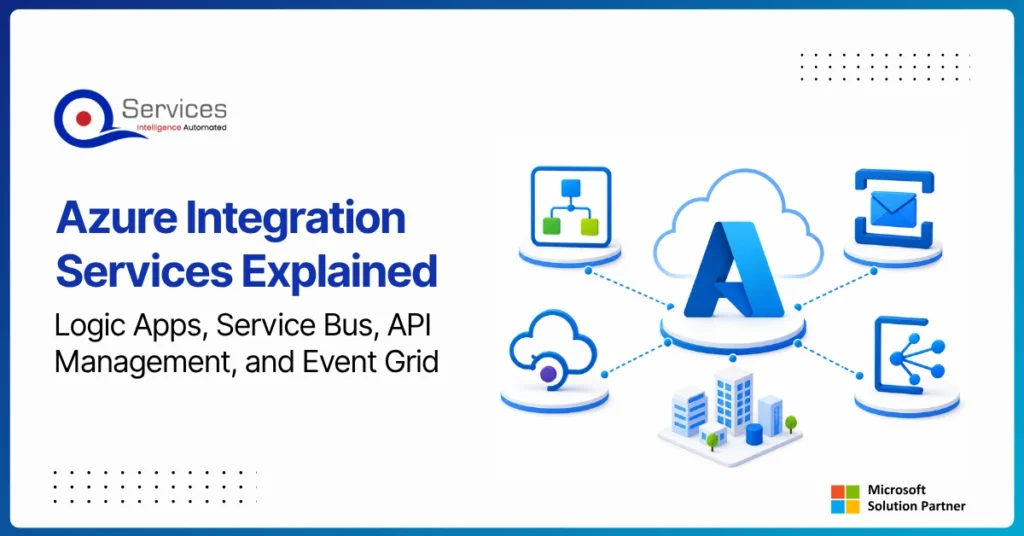
Azure Integration Services is Microsoft’s suite of cloud-native tools for connecting applications, data, and processes across your enterprise. When your organization runs a mix of on-premise systems, SaaS platforms, and custom APIs, getting them to communicate reliably is one of the hardest operational problems you will face. Azure integration services address that directly with four purpose-built components: Logic Apps for workflow automation, Service Bus for reliable messaging, API Management for governing APIs at scale, and Event Grid for event-driven architecture.
Key Insight Azure Integration Services is Microsoft’s suite of cloud-native tools for connecting applications, data, and processes across your enterprise.
This guide breaks down each component, explains how they work together, and covers when azure cloud migration services can bring your entire integration layer into the cloud. Teams evaluating azure consulting services for the first time will find the service breakdowns most useful. Teams already planning a lift and shift to azure should jump straight to the migration section.
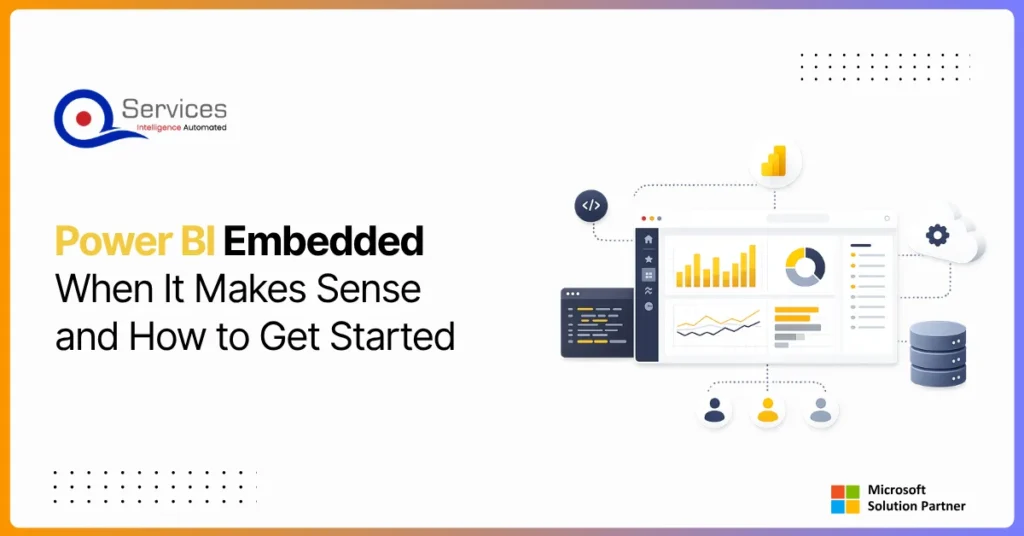
Power BI Embedded is Microsoft’s developer-focused API for embedding interactive analytics directly inside third-party apps, customer portals, and SaaS products. If you are building software and want customers to see live dashboards without logging into the Power BI service, this is where that journey starts. The question is not whether you can embed Power BI reports, you almost certainly can. The real question is whether it makes financial and architectural sense for your specific situation. This guide covers the when, the how, and the cost math that most tutorials skip.
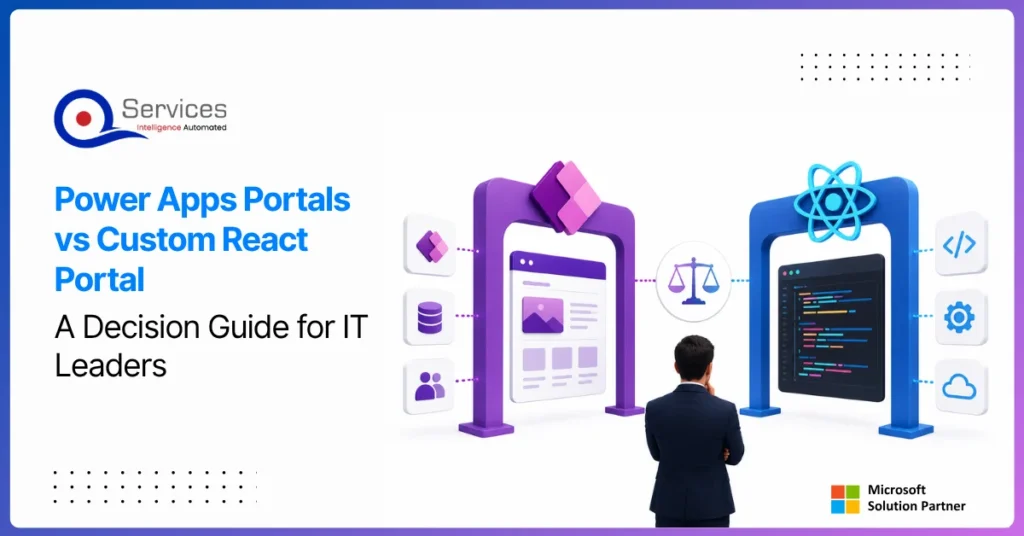
Power apps portals sit at an interesting crossroads for IT leaders: they’re fast, deeply integrated with the Microsoft stack, and manageable without a dedicated development team. But they’re also constrained in ways that matter when your business needs a portal that handles complex UI logic, third-party integrations outside the Microsoft ecosystem, or pixel-perfect UX design.
This guide gives you a straight comparison so you can make the right call without spending three months in discovery. We’ll cover what each option actually delivers, where each breaks down, and the governance questions that need answers before you commit either way.
If you’re evaluating your Microsoft stack more broadly, our breakdown of Power Platform vs Custom .NET Development provides useful parallel context.
Azure migration cost breaks down by workload strategy, not a single number. See real per-workload ranges, what FastTrack and Azure Migrate and Modernize actually cover, and how a fixed-price Blueprint Sprint replaces a vague estimate with a firm quote.
Azure Integration Services is Microsoft’s suite of cloud-native tools for connecting applications, data, and processes across your enterprise. When your organization runs a mix of on-premise systems, SaaS platforms, and custom APIs, getting them to communicate reliably is one of the hardest operational problems you will face. Azure integration services address that directly with four purpose-built components: Logic Apps for workflow automation, Service Bus for reliable messaging, API Management for governing APIs at scale, and Event Grid for event-driven architecture.
Key Insight Azure Integration Services is Microsoft’s suite of cloud-native tools for connecting applications, data, and processes across your enterprise.
This guide breaks down each component, explains how they work together, and covers when azure cloud migration services can bring your entire integration layer into the cloud. Teams evaluating azure consulting services for the first time will find the service breakdowns most useful. Teams already planning a lift and shift to azure should jump straight to the migration section.
Power BI Embedded is Microsoft’s developer-focused API for embedding interactive analytics directly inside third-party apps, customer portals, and SaaS products. If you are building software and want customers to see live dashboards without logging into the Power BI service, this is where that journey starts. The question is not whether you can embed Power BI reports, you almost certainly can. The real question is whether it makes financial and architectural sense for your specific situation. This guide covers the when, the how, and the cost math that most tutorials skip.
Power apps portals sit at an interesting crossroads for IT leaders: they’re fast, deeply integrated with the Microsoft stack, and manageable without a dedicated development team. But they’re also constrained in ways that matter when your business needs a portal that handles complex UI logic, third-party integrations outside the Microsoft ecosystem, or pixel-perfect UX design.
This guide gives you a straight comparison so you can make the right call without spending three months in discovery. We’ll cover what each option actually delivers, where each breaks down, and the governance questions that need answers before you commit either way.
If you’re evaluating your Microsoft stack more broadly, our breakdown of Power Platform vs Custom .NET Development provides useful parallel context.