Our hitl governance principles didn't start with a whitepaper. They started with a failed project.
In 2019, a mid-market healthcare company brought us in to rescue a claims automation system that had gone sideways. The technology was sound. The code worked. But nobody had built in any checkpoints for human review, so when the AI started misclassifying claim types, nobody caught it for three billing cycles. By the time anyone noticed, the backlog was catastrophic.
That project taught us something we've built every engagement around since: the quality of a software delivery isn't determined by the AI doing the work. It's determined by the governance structure around it.
This is our manifesto. The principles we've refined across 500+ projects, explained plainly so your team can use them.
In This Article, You'll Learn
Why HITL Governance Principles Matter More Than Technology
What Is Human-in-the-Loop Governance in Software Delivery?
Our Core Principles for an AI Governance Framework
How the Blueprint Sprint Methodology Embeds Governance
HITL Workflow Automation: Where Humans Stay in the Loop
Eager to discuss about your project?
Share your project idea with us. Together, we’ll transform your vision into an exceptional digital product!
Key Insight According to our own delivery data, 67% of enterprise digital transformations miss deadlines due to governance failures, not technology failures.
When governance is treated as overhead instead of infrastructure, delivery suffers. This is true for traditional software delivery governance, and it compounds when AI enters the picture.
The Real Reason Digital Transformations Fail
The honest answer is it's rarely one thing. But if we had to pick the most common single cause across the projects we've inherited from other vendors, it's this: decisions that should have involved a human got made automatically, and nobody found out until the damage was done.
This shows up three ways:
AI-generated code merged without a domain expert reviewing it
Scope changes approved by a tool rather than a person accountable for the budget
Compliance outputs accepted without an audit trail
Every one of these is a governance problem, not a technology problem. And every one of them is preventable with the right human oversight structure.
What Human Oversight AI Systems Actually Prevents
Human oversight AI systems are the architectural decision to put humans at specific decision points in a software delivery pipeline. Not everywhere (that defeats the efficiency gains of AI), but at the points where errors are expensive or irreversible.
In practice: a human approves the architecture before AI writes any code. A human reviews AI-generated components before they merge. A human signs off on the deployment before it goes to production. The AI does the work; the human validates the outcome. For regulated industries, this isn't optional. It's what auditors look for.
What Is Human-in-the-Loop Governance in Software Delivery?
Human-in-the-Loop (HITL) governance is a delivery methodology where human approval is required at every decision point in a software project. This includes architecture sign-off, code review, deployment authorization, and compliance validation. It differs from "just having reviews" because it's systematic, documented, and enforceable.
The Definition That Actually Helps Teams
Most definitions of HITL governance are written for academic papers. Here's the version we use internally:
HITL governance means no automated system makes a binding decision alone. Humans remain accountable for outcomes, and the process is designed to make that accountability visible and traceable.
The question we hear most: "Why not just automate everything and review exceptions?" Exception-based review shifts accountability to the AI's confidence score, which is not auditable, not defensible in regulated environments, and historically unreliable for novel edge cases.
Our Core Principles for an AI Governance Framework
These are the principles behind our delivery governance framework. We're sharing them because we've seen what happens when teams adopt AI-augmented development without them. Some of these are structural. Some are cultural. All of them are non-negotiable on our engagements.
Principle 1: Human Approval at Every Decision Gate
No architecture proceeds without sign-off. No sprint starts without a scoped, agreed backlog. No AI-generated component merges without a human reviewer. This isn't slow; it's just structured. Our blueprint sprint methodology front-loads all of this into a five-day scoping phase so the rest of the engagement moves fast.
Principle 2: Audit-Ready Software Delivery by Default
Audit-ready software delivery means documentation is created as you build, not scrambled together before an inspection. Every checkpoint generates a record. Every approval is timestamped and attributed. Every scope change is logged with the reason.
For clients in healthcare, banking, and logistics, this is the difference between passing a compliance review and spending three weeks preparing for one. Building Immutable Audit Trails for Every Software Project covers the technical implementation in detail.
Principle 3: Responsible AI Implementation Over Speed
Responsible AI implementation means we will slow a sprint down before we let AI-generated outputs go unreviewed. Speed is not the primary goal. Reliable delivery is. The distinction matters because AI tools can generate plausible-looking code that fails edge cases, misses domain context, or violates compliance rules that weren't in the training data.
Every AI-generated component on our engagements goes through a three-stage review: syntactic (does it do what it claims), semantic (does it do what the domain requires), and compliance (does it meet the client's regulatory constraints). This adds time per component. It eliminates production incidents.
How the Blueprint Sprint Methodology Embeds Governance
QServices developed the 5-day Blueprint Sprint as a structured pre-build phase that locks scope, defines decision gates, identifies compliance requirements, and aligns stakeholders before a single line of code is written. It's the most effective governance tool we have for preventing the problems that derail projects in later sprints.
What Happens in a 5-Day Blueprint Sprint
Day 1 is stakeholder alignment. Day 2 is technical discovery and constraint mapping. Day 3 is architecture design with governance checkpoints explicitly defined. Day 4 is scope finalization and sprint planning. Day 5 is presentation and client sign-off.
The output isn't just a plan. It's a governance contract: here is what will be built, here are the decision points where your team approves or rejects, here are the compliance requirements that constrain every technical decision. Full details at The 5-Day Blueprint Sprint: How We Scope Projects Before Writing Code.
How Blueprint Sprint Methodology Prevents Scope Creep
Scope creep is a governance failure. It happens when there's no locked definition of done, no approval process for changes, and no accountability for what gets added mid-sprint. Blueprint sprint methodology solves this by creating a signed scope document before development begins and a formal change-request process for anything that follows.
Scope Creep Kills Projects: How Governance Prevents It documents this pattern across client engagements. Projects that go through a blueprint sprint have fewer mid-sprint change requests and arrive at sign-off with significantly less accumulated rework.
HITL Workflow Automation: Where Humans Stay in the Loop
HITL workflow automation is not about removing humans from the process. It's about automating the parts of delivery that don't require human judgment, and protecting human review for the parts that do. That distinction requires intentionality, because automation creep into decision points it shouldn't own is exactly how governance breaks down.
Approval Workflows for AI-Generated Code
When AI writes code, our approval workflow looks like this:
AI generates a component based on the approved architecture spec
Automated tests run: syntax, unit, integration
A named engineer reviews the output against the domain requirement
Compliance review runs against the client's regulatory checklist
The engineer approves or requests changes
Only approved code merges to the main branch
Steps 1-2 take minutes. Steps 3-5 take 20-40 minutes depending on complexity. The result is a complete audit trail with a human accountable for every approval. Approval Workflows for AI-Generated Code: Our Review Process covers this in full detail.
How to Add Governance to Agile Delivery
The objection we hear most is that governance slows agile delivery. This is only true when governance is bolted on after sprint planning is done. When it's built in from the start, governance speeds delivery by eliminating rework from undiscovered problems.
The practical changes to standard agile:
Sprint planning includes an explicit governance checklist
Each sprint has a mid-sprint human checkpoint, not just a retrospective
Weekly client demos are treated as governance events, not status updates
Definition of done includes compliance verification, not just functional testing
According to NIST's AI Risk Management Framework, structured human oversight is the recommended approach for enterprise AI systems operating in regulated contexts. This framework aligns closely with how we structure our sprint governance checkpoints.
Software Delivery Governance in Regulated Industries
The stakes of software delivery governance are highest where regulations carry real consequences. A missed checkpoint in healthcare can mean a HIPAA violation. In banking, it can mean an OCC finding. In logistics, it can mean a supply chain audit failure. Our principles don't change across these industries, but the specific checkpoints do.
Healthcare: HIPAA Compliance and Human Checkpoints
For healthcare clients, our ai governance framework includes specific checkpoints for PHI handling, data classification, and audit log generation. Every AI-generated component that touches patient data goes through a compliance review against the client's HIPAA implementation specification before it merges.
For banking clients, our delivery governance framework produces documentation that maps every AI decision to a human approver, maintains a complete change log, and generates the evidence package required for OCC and FDIC examinations. Human in the loop ai governance is not optional for banks. It's increasingly what regulators expect to see.
Why AI in Software Delivery Needs Human Governance
AI in software delivery is no longer experimental. GitHub Copilot, Azure OpenAI, and similar tools are standard in most development environments. The question isn't whether to use them. It's whether the governance structure around them is adequate for the risks they introduce.
What Happens When AI Writes Code Without Review
We've documented this directly. What Happens When AI Writes Code and Nobody Reviews It covers case studies of projects where AI-generated code went unreviewed. The pattern is consistent: AI generates code that passes automated tests but fails on production edge cases at a rate that makes unreviewed AI code unacceptable for enterprise systems.
AI augmented software development done right means AI handles generation, humans handle validation. The efficiency gains come from AI's speed at generation, not from removing human review. Teams that conflate the two end up with more production incidents, not fewer.
Building Immutable Audit Trails
Every governance principle is only as good as the documentation behind it. An audit-ready process produces three things at every checkpoint: a record of what decision was made, who made it, and what evidence supported it.
This matters beyond compliance. When a project changes hands, a new team can understand every decision and why it was made. When a client asks why something was built a certain way, the answer is documented. When an auditor requests evidence, it's already organized and attributed.
How We Measure Delivery Governance Framework Success
A delivery governance framework needs measurable outcomes. Otherwise it's process theater. Here's how we measure whether governance is actually working, not just documented.
Metrics That Actually Tell You Governance Is Working
The metrics we track across all engagements:
On-time delivery rate: QServices maintains a 98.5% on-time delivery rate across 500+ projects using HITL governance. This is the most direct measure of whether governance is functioning.
Rework rate: How often does a sprint's output require significant revision before client acceptance? With HITL governance in place, this is consistently below 8%.
Compliance finding rate: How many compliance issues are discovered post-delivery? With governance built in, this is near zero for clients who completed the full blueprint sprint process.
Change request volume: How many scope changes occur after the blueprint sprint? Low volume here is a strong signal that governance is working upstream.
AI-Augmented Software Development Quality Benchmarks
AI augmented software development introduces quality dimensions that traditional metrics don't capture. We've added three measurements to our standard scorecards:
AI review coverage: What percentage of AI-generated components were reviewed by a named human before merge?
Governance checkpoint adherence: What percentage of defined checkpoints were executed on schedule?
Audit trail completeness: What percentage of decisions have a complete, timestamped record with a named approver?
A project scoring above 95% on all three will, in our experience, pass any compliance review and deliver on time. According to McKinsey's research on digital transformation governance, organizations with structured governance frameworks complete digital initiatives 1.5x more often than those without them.
Key Insight A project scoring above 95% on all three will, in our experience, pass any compliance review and deliver on time.
Key Takeaways
Most software projects don't fail because of bad code.
Human-in-the-Loop (HITL) governance is a delivery methodology where human approval is required at every decision point in a software project.
These are the principles behind our delivery governance framework.
QServices developed the 5-day Blueprint Sprint as a structured pre-build phase that locks scope, defines decision gates, identifies compliance requirements, and aligns stakeholders before a single line of code is written.
HITL workflow automation is not about removing humans from the process.
Conclusion
Our hitl governance principles are not a methodology invented in a conference room. They're the accumulated result of building software in healthcare, banking, logistics, and SaaS environments where failure is expensive and auditors are real.
The core of responsible AI implementation is simple: AI does the work, humans stay accountable. What makes this difficult is building the structures that make accountability real rather than theoretical. That means locked scope before code, named approvers at every decision gate, documentation that builds itself as you work, and checkpoints that stop bad outputs before they reach production.
If you're building software with AI tools and don't have a governance structure that matches the risks, the question isn't whether something will go wrong. It's when. Our software project governance framework is one way to build that structure into your delivery process from day one.
Start with a Blueprint Sprint. It takes five days and it changes how every project after it runs.
Co-Founder and CTO, QServices IT Solutions Pvt Ltd
Rohit Dabra is the Co-Founder and Chief Technology Officer at QServices, a software development company focused on building practical digital solutions for businesses. At QServices, Rohit works closely with startups and growing businesses to design and develop web platforms, mobile applications, and scalable cloud systems. He is particularly interested in automation and artificial intelligence, building systems that automate routine tasks for teams and organizations.
Human-in-the-Loop (HITL) governance is a delivery methodology where human approval is required at every decision point in a software project, including architecture sign-off, code review, deployment authorization, and compliance validation. It ensures no automated system makes a binding decision alone, and that humans remain accountable for outcomes with a visible, traceable process. Unlike ad-hoc reviews, HITL governance is systematic, documented, and enforceable across the entire delivery pipeline.
67% of enterprise digital transformations miss deadlines due to governance failures, not technology failures. The most common causes are decisions that should have involved a human being made automatically, undefined approval chains, AI-generated outputs merged without domain expert review, and scope changes accepted without formal change-request processes. Technology rarely fails first; governance structure does.
A blueprint sprint is a structured 5-day pre-build phase developed by QServices that locks project scope, defines governance checkpoints, maps compliance requirements, and aligns stakeholders before any code is written. The five days cover stakeholder alignment, technical discovery, architecture design with governance gates, scope finalization, and client sign-off. The output is a governance contract that prevents scope creep and sets the approval structure for the entire engagement.
Audit-ready AI development requires building documentation into the delivery process rather than preparing it retrospectively. This means creating timestamped, attributed records at every checkpoint, logging all scope changes with reasons, and ensuring every AI-generated component has a named human reviewer on record before it merges. A HITL workflow automation process that requires human approval at each decision gate generates the audit trail as a natural byproduct of how the work is done.
In fully automated AI delivery, the system makes binding decisions based on confidence scores, producing logs rather than structured audit trails and detecting errors only after they impact production. In HITL governance, a named human is accountable for every decision point, audit trails are structured and immutable, errors are caught at checkpoints before they reach production, and compliance readiness is built in rather than retrofitted. HITL governance trades marginal speed for dramatically better reliability and auditability.
Governance only slows agile delivery when it is bolted on after sprint planning. When built in from the start, it speeds delivery by eliminating rework from undiscovered problems. Practical changes include adding a governance checklist to sprint planning, inserting a mid-sprint human checkpoint in addition to the retrospective, treating weekly client demos as governance events rather than status updates, and requiring compliance verification as part of the definition of done.
An effective AI governance framework for software delivery includes defined approval checkpoints at architecture, code merge, and deployment stages; a named human accountable for each decision; an immutable audit trail of all approvals and scope changes; compliance review steps specific to the industry (HIPAA for healthcare, OCC/FDIC for banking); and measurable quality benchmarks including AI review coverage, checkpoint adherence, and audit trail completeness. The framework should be operationalized through tools like approval workflows, sprint governance checklists, and blueprint sprint scoping.
Azure migration cost breaks down by workload strategy, not a single number. See real per-workload ranges, what FastTrack and Azure Migrate and Modernize actually cover, and how a fixed-price Blueprint Sprint replaces a vague estimate with a firm quote.
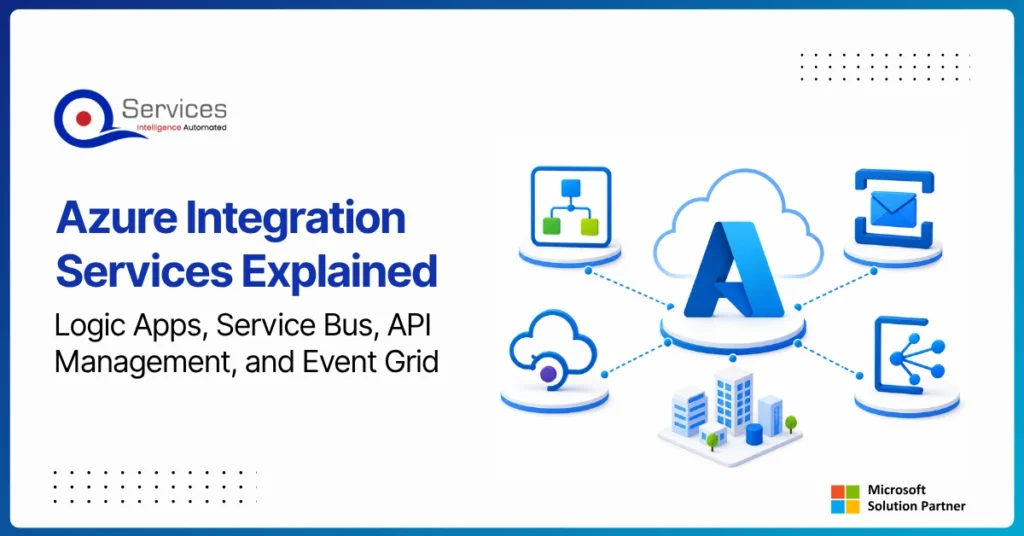
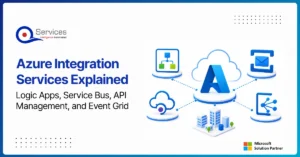
Azure Integration Services is Microsoft’s suite of cloud-native tools for connecting applications, data, and processes across your enterprise. When your organization runs a mix of on-premise systems, SaaS platforms, and custom APIs, getting them to communicate reliably is one of the hardest operational problems you will face. Azure integration services address that directly with four purpose-built components: Logic Apps for workflow automation, Service Bus for reliable messaging, API Management for governing APIs at scale, and Event Grid for event-driven architecture.
Key Insight Azure Integration Services is Microsoft’s suite of cloud-native tools for connecting applications, data, and processes across your enterprise.
This guide breaks down each component, explains how they work together, and covers when azure cloud migration services can bring your entire integration layer into the cloud. Teams evaluating azure consulting services for the first time will find the service breakdowns most useful. Teams already planning a lift and shift to azure should jump straight to the migration section.
Power BI Embedded is Microsoft’s developer-focused API for embedding interactive analytics directly inside third-party apps, customer portals, and SaaS products. If you are building software and want customers to see live dashboards without logging into the Power BI service, this is where that journey starts. The question is not whether you can embed Power BI reports, you almost certainly can. The real question is whether it makes financial and architectural sense for your specific situation. This guide covers the when, the how, and the cost math that most tutorials skip.
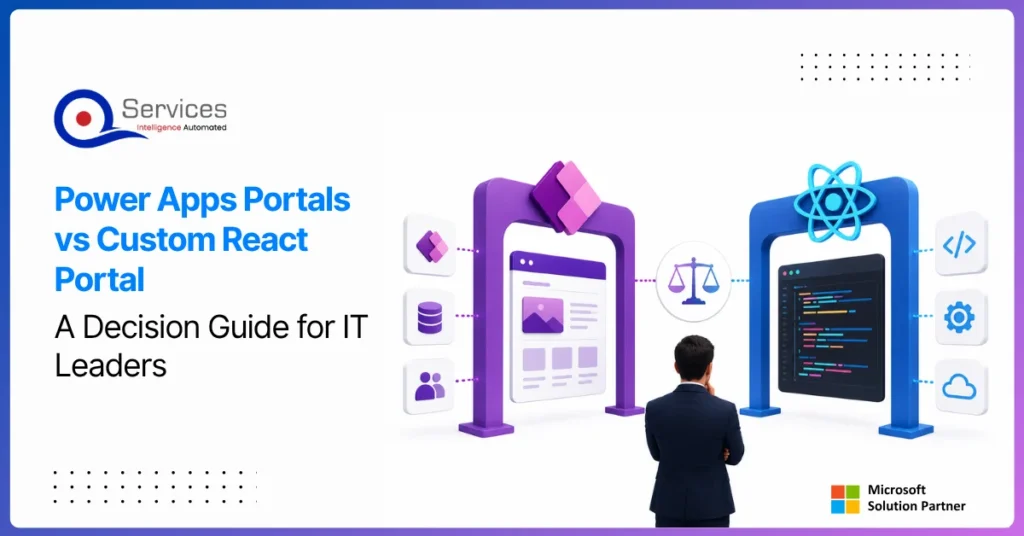
Power apps portals sit at an interesting crossroads for IT leaders: they’re fast, deeply integrated with the Microsoft stack, and manageable without a dedicated development team. But they’re also constrained in ways that matter when your business needs a portal that handles complex UI logic, third-party integrations outside the Microsoft ecosystem, or pixel-perfect UX design.
This guide gives you a straight comparison so you can make the right call without spending three months in discovery. We’ll cover what each option actually delivers, where each breaks down, and the governance questions that need answers before you commit either way.
If you’re evaluating your Microsoft stack more broadly, our breakdown of Power Platform vs Custom .NET Development provides useful parallel context.
Azure migration cost breaks down by workload strategy, not a single number. See real per-workload ranges, what FastTrack and Azure Migrate and Modernize actually cover, and how a fixed-price Blueprint Sprint replaces a vague estimate with a firm quote.
Azure Integration Services is Microsoft’s suite of cloud-native tools for connecting applications, data, and processes across your enterprise. When your organization runs a mix of on-premise systems, SaaS platforms, and custom APIs, getting them to communicate reliably is one of the hardest operational problems you will face. Azure integration services address that directly with four purpose-built components: Logic Apps for workflow automation, Service Bus for reliable messaging, API Management for governing APIs at scale, and Event Grid for event-driven architecture.
Key Insight Azure Integration Services is Microsoft’s suite of cloud-native tools for connecting applications, data, and processes across your enterprise.
This guide breaks down each component, explains how they work together, and covers when azure cloud migration services can bring your entire integration layer into the cloud. Teams evaluating azure consulting services for the first time will find the service breakdowns most useful. Teams already planning a lift and shift to azure should jump straight to the migration section.
Power BI Embedded is Microsoft’s developer-focused API for embedding interactive analytics directly inside third-party apps, customer portals, and SaaS products. If you are building software and want customers to see live dashboards without logging into the Power BI service, this is where that journey starts. The question is not whether you can embed Power BI reports, you almost certainly can. The real question is whether it makes financial and architectural sense for your specific situation. This guide covers the when, the how, and the cost math that most tutorials skip.
Power apps portals sit at an interesting crossroads for IT leaders: they’re fast, deeply integrated with the Microsoft stack, and manageable without a dedicated development team. But they’re also constrained in ways that matter when your business needs a portal that handles complex UI logic, third-party integrations outside the Microsoft ecosystem, or pixel-perfect UX design.
This guide gives you a straight comparison so you can make the right call without spending three months in discovery. We’ll cover what each option actually delivers, where each breaks down, and the governance questions that need answers before you commit either way.
If you’re evaluating your Microsoft stack more broadly, our breakdown of Power Platform vs Custom .NET Development provides useful parallel context.