KYC/AML automation is the difference between a compliance team that scales and one that drowns in paperwork. Manual identity verification takes an average of 15-30 minutes per customer application, and transaction monitoring alert queues pile up faster than analysts can clear them. For mid-market banks and fintechs already using Microsoft technology, Azure offers a complete stack for building production-grade compliance automation. The architecture decisions you make upfront determine whether you build something auditor-ready or something that creates new problems downstream. This post covers the practical architecture: which Azure services handle which compliance functions, how they connect, and the governance layer you cannot skip.
In This Article, You'll Learn
Why KYC/AML Automation Has Become Non-Negotiable
The Azure Services That Power KYC/AML Banking Compliance Software
How to Automate KYC/AML Compliance: A Practical Architecture
What Financial Services Cloud Migration Actually Requires
Fraud Detection Software: Adding AI Intelligence to the Pipeline
Eager to discuss about your project?
Share your project idea with us. Together, we’ll transform your vision into an exceptional digital product!
Manual KYC review doesn't just slow onboarding. It introduces inconsistency. Two analysts reviewing the same document package often reach different risk ratings, which creates defensibility problems when regulators ask why you approved a particular customer. In our client engagements, banks processing more than 10,000 new accounts per month consistently see manual review costs climb once you factor in analyst time, error correction, and re-review cycles.
The regulatory pressure is straightforward: FinCEN and the Financial Action Task Force both expect financial institutions to have controls proportionate to their risk exposure. "We reviewed everything manually" is not a convincing answer when your transaction volume reaches millions per month.
Why Regtech Solutions Are Growing Faster Than Banks Expected
Regtech solutions sit between your raw banking data and your compliance obligations. They translate transaction records, customer profiles, and document scans into structured risk signals that analysts and regulators can act on. The global regtech market has grown substantially over the past several years, driven largely by the cost economics of automating BSA/AML compliance.
Core banking modernization is a parallel driver. Legacy systems built on batch overnight processing cannot support the real-time transaction screening that modern AML rules require. The 2023 amendments to the Bank Secrecy Act emphasized beneficial ownership transparency and faster Suspicious Activity Report filing, pressures that manual processes cannot absorb at scale. This is why financial services cloud migration has accelerated across the industry, with Azure positioned as the primary destination for regulated workloads in Microsoft-aligned organizations.
The Azure Services That Power KYC/AML Banking Compliance Software
Azure for banking compliance workloads is a well-documented use case. Microsoft holds FedRAMP High authorization and maintains compliance certifications relevant to financial services, including SOC 1, SOC 2, PCI DSS, and ISO 27001. That matters because your auditors will ask about your cloud provider's compliance posture, not just your application's configuration.
Azure AI Services for Identity Verification
Azure AI Document Intelligence handles the document extraction layer in KYC workflows. It extracts structured data from passports, driver's licenses, utility bills, and corporate registration documents with accuracy above 95% for supported document types. You pair this with Azure Face API for liveness detection and identity photo matching, though you need to review Microsoft's Responsible AI terms carefully before deploying facial recognition in any customer-facing context.
Key Insight It extracts structured data from passports, driver's licenses, utility bills, and corporate registration documents with accuracy above 95% for supported document types.
Azure Cognitive Search handles name screening against sanctions lists and PEP (Politically Exposed Person) databases. Combined with fuzzy matching logic, it identifies high-risk individuals even when names are transliterated differently across document sources. A starting threshold of Jaro-Winkler 0.85 works reasonably well for name matching, but expect to tune this over the first three to six months of live data.
Azure Data Platform for AML Transaction Monitoring
The transaction monitoring backbone typically runs on Azure Synapse Analytics for batch processing and Azure Event Hubs for real-time streaming. Synapse runs complex pattern queries across years of transaction history. Event Hubs provides the sub-second latency needed for card payment screening. Azure Machine Learning handles the scoring models: peer group analysis, velocity checks, and geographic anomaly detection.
These models require retraining on a defined schedule, and Azure ML Pipelines automate that process with version control and rollback capabilities. One practical note: AML datasets are heavily imbalanced because genuine financial crime is rare by design. Optimize model evaluation for recall and precision-recall AUC, not overall accuracy.
Security and PCI-DSS Compliant Development on Azure
PCI-DSS compliant development on Azure is not automatic just because you're using Azure services. You need to configure Azure Key Vault for encryption key management, set up Azure Private Link to keep payment data off the public internet, and implement network segmentation with Azure Virtual Network and Network Security Groups. The full configuration checklist is covered in Building PCI-DSS Compliant Apps on Azure, which is worth reviewing before you finalize your network topology design.
How to Automate KYC/AML Compliance: A Practical Architecture
How to automate KYC/AML compliance comes down to four distinct stages: identity verification, risk scoring, ongoing monitoring, and case management. Each stage has different latency requirements and different data sensitivity levels, which drives your Azure service selection.
Document Verification and Identity Matching
The document verification stage runs synchronously during customer onboarding. A customer submits ID documents, and within 30-90 seconds, the system returns a verification result. The processing sequence works like this:
Document image uploaded to Azure Blob Storage with customer-scoped SAS tokens (not public access)
Extracted data compared against customer-provided information using fuzzy matching
Face match performed between document photo and liveness-captured selfie
Result written to case management database with a confidence score
When confidence falls below a defined threshold, the application routes to a human reviewer queue rather than auto-approving or auto-rejecting. That human checkpoint is not optional from a regulatory standpoint. It's where HITL governance for banking becomes a technical requirement, not just a philosophy.
Transaction Screening and Sanctions Checks
Sanctions screening runs on every outbound payment, typically completing within 200-500ms. Azure Cognitive Search with a pre-loaded OFAC, EU, and UN sanctions list handles the matching. The key configuration decision is your fuzzy match threshold: too strict creates false negatives, too loose generates alert volumes that overwhelm your analysts. This is where banking compliance software requires domain expertise, not just engineering skill.
Risk Scoring with Azure Machine Learning
Risk scoring is where the system moves from rule-following to genuine intelligence. Azure ML supports several approaches that work for AML use cases:
Gradient boosting models for structured transaction features (amount, frequency, counterparty geography)
Graph neural networks for detecting network-level anomalies across customer relationships
Isolation Forest for unsupervised anomaly detection on new customer segments
The honest answer: start simple. A well-tuned gradient boosting model on 15-20 features usually outperforms a more complex neural network on AML datasets, because financial crime data is sparse and imbalanced by nature. Complexity costs interpretability, and interpretability matters when you need to explain a model decision to a regulator.
What Financial Services Cloud Migration Actually Requires
Financial services cloud migration to Azure for KYC/AML workloads is not a lift-and-shift exercise. The architecture must satisfy both technical requirements and regulatory expectations. OCC Bulletin 2023-17 and parallel FDIC guidance expect banks to demonstrate ongoing oversight of cloud-hosted critical functions, not just point-in-time compliance at deployment.
Mapping Your Compliance Workloads Before Migration
Before you migrate anything, categorize your compliance workloads by data sensitivity and regulatory classification. Core KYC data (government IDs, biometric data) sits under the strictest controls: encryption at rest with customer-managed keys in Azure Key Vault, data residency constraints, and access logging at the individual record level. AML transaction data has different retention requirements under BSA regulations, typically five years minimum.
Azure Policy and Azure Blueprints let you encode these requirements as guardrails that enforce themselves. If a developer creates a storage account without encryption or a database without private endpoint connectivity, the deployment fails at provisioning time. This is far more reliable than documentation and training alone. For the infrastructure baseline, Azure Landing Zones Explained for Mid-Size Companies covers what a compliant landing zone actually includes for regulated workloads.
Open Banking API Development During Migration
Open banking API development introduces additional complexity during migration. You're not just moving internal workloads. You're creating new external-facing interfaces that must meet PSD2 standards in the EU, FCA open banking rules in the UK, or equivalent frameworks in other jurisdictions. Azure API Management handles the gateway layer: rate limiting, OAuth 2.0 authentication, mutual TLS, and API versioning for third-party developers integrating with your banking platform.
Every API endpoint that exposes customer financial data needs its own security review cycle, not just a shared review of the API gateway configuration. PCI-DSS compliant development principles apply to the API layer as much as to the storage layer.
Fraud Detection Software: Adding AI Intelligence to the Pipeline
Fraud detection software in a KYC/AML context targets specific financial crime typologies: structuring, layering, account takeover, and synthetic identity fraud. Each typology has different behavioral signatures and different data requirements, which is why generic anomaly detection tools rarely work without significant customization.
How Real-Time Transaction Monitoring Works on Azure
Real-time transaction monitoring uses Azure Event Hubs as the ingestion layer, with a stream processing application such as Azure Stream Analytics applying rules and ML scoring to each transaction as it arrives. Suspicious transactions generate alerts within seconds, not hours.
The architecture that works in practice: a rules engine runs first (fast, deterministic, catches obvious violations), followed by ML scoring for borderline cases. This two-tier approach keeps latency low while giving you the nuance that pure rules-based systems miss. Rules are easier to explain to examiners. ML catches the patterns rules miss.
Reducing False Positives with Machine Learning
The operational reality of AML implementation is that most banks spend more analyst time on false positives than on genuine suspicious activity. A well-configured ML scoring layer typically reduces false positive rates by 30-60% compared to pure rules-based systems.
Key Insight A well-configured ML scoring layer typically reduces false positive rates by 30-60% compared to pure rules-based systems.
This matters operationally. If your fraud detection software generates 2,000 alerts per day and 85% are false positives, your analysts spend most of their time clearing noise rather than investigating real risk. Getting that rate below 60% changes the economics of your compliance team entirely. For fintech software development teams building this kind of system, false positive reduction is consistently the metric that determines whether stakeholders see the investment as worthwhile.
Key Insight If your fraud detection software generates 2,000 alerts per day and 85% are false positives, your analysts spend most of their time clearing noise rather than investigating real risk.
Governance and Human Oversight in Automated Compliance
Automating KYC/AML processes does not mean removing human judgment. It means applying human judgment where it matters most: at escalation points, model validation checkpoints, and high-risk case reviews. The compliance teams that get this right spend their human capacity on decisions that actually require human reasoning, rather than on document checks that a machine handles with higher consistency.
Why Automated KYC/AML Still Needs Human Review
No regulator accepts "the algorithm decided" as a complete compliance explanation. OCC examiners and FDIC auditors expect banks to show that humans understand, supervise, and can override automated decisions. This requires specific technical implementation: human review queues with SLA tracking, override logging with reason codes, and escalation paths that activate when model confidence drops below threshold.
Our HITL governance principles translate directly into these system requirements. Every automated compliance decision should have a corresponding human review path for edge cases, with audit trails that demonstrate the governance structure was actually used, not just documented on paper.
Building Audit Trails That Satisfy Examiners
Every compliance decision, automated or not, needs a complete record: what data was evaluated, what model version ran, what score was produced, and what action followed. Azure Cosmos DB with append-only write patterns works well for this, or you can write to immutable Azure Blob Storage with legal hold policies for long-term retention.
Audit trails for KYC/AML systems require tamper-evident records retained for the regulatory minimum period without gaps. This also means versioning your ML models and linking each decision record to the exact model version that produced the score. When an examiner asks why the system flagged or cleared a transaction three years ago, you need to reconstruct the complete decision context, not just the outcome.
What to Look for in a Banking Software Development Company
Selecting a banking software development company to build or extend your KYC/AML automation system is a decision where compliance context matters more than raw technical capability. Most competent development firms can write the code. Fewer understand what questions to ask before writing any.
Fintech Software Development Capabilities to Demand
Fintech software development for compliance systems requires specific experience: familiarity with BSA/AML regulatory frameworks, hands-on experience configuring azure for banking workloads under compliance constraints, and the ability to produce documentation that satisfies regulatory examination, not just technical code review.
Ask your prospective partner whether they have worked with OCC or FDIC examiners on a cloud-hosted compliance system, whether they can produce a data flow diagram mapping each data element to its regulatory classification, and what their approach to model governance and model risk management looks like. If that last question produces confusion, they don't have the compliance depth you need. For context on what the full banking software development process involves before signing a statement of work, Banking Software Development: What You Need to Know Before Starting covers the scoping decisions that most teams underestimate.
Choosing a Partner for Core Banking Modernization
Core banking modernization projects fail more often at the compliance integration layer than at the technical one. A team that understands how your general ledger connects to your AML transaction monitoring database, and what that connection means for regulatory reporting, is worth significantly more than a team that can build clean microservices without that context.
Pricing for banking compliance software development varies widely. In our client engagements, a mid-market KYC/AML automation project's cost depends heavily on scope, integration complexity, and whether you're building greenfield or modernizing existing systems, with infrastructure typically representing a meaningful but smaller share of total spend compared to development, integration testing, and compliance documentation.
Key Takeaways
Manual KYC review doesn't just slow onboarding.
Azure for banking compliance workloads is a well-documented use case.
How to automate KYC/AML compliance comes down to four distinct stages: identity verification, risk scoring, ongoing monitoring, and case management.
Financial services cloud migration to Azure for KYC/AML workloads is not a lift-and-shift exercise.
Fraud detection software in a KYC/AML context targets specific financial crime typologies: structuring, layering, account takeover, and synthetic identity fraud.
Conclusion
KYC/AML automation on Azure is achievable for mid-market financial institutions without building a proprietary AI research team. The Azure service stack, from Document Intelligence to Azure ML to Event Hubs, covers the core compliance use cases. What separates successful builds from expensive ones is architectural discipline: mapping regulatory requirements to technical controls before writing code, building human oversight into the system from the start rather than adding it afterward, and choosing a banking software development company that understands both the engineering and the regulatory context.
If you're planning a KYC/AML automation build or a financial services cloud migration to Azure, the architecture decisions made in the first few weeks shape every constraint that follows. That's where experienced fintech software development partners and a clear understanding of regtech solutions available on Azure make the most difference.
Co-Founder and CTO, QServices IT Solutions Pvt Ltd
Rohit Dabra is the Co-Founder and Chief Technology Officer at QServices, a software development company focused on building practical digital solutions for businesses. At QServices, Rohit works closely with startups and growing businesses to design and develop web platforms, mobile applications, and scalable cloud systems. He is particularly interested in automation and artificial intelligence, building systems that automate routine tasks for teams and organizations.
To automate KYC/AML compliance, organizations implement a multi-stage pipeline using AI-powered document verification, automated sanctions screening, and machine learning-based risk scoring. On Azure, this combines Azure AI Document Intelligence for identity extraction, Azure Cognitive Search for sanctions list matching, and Azure Machine Learning for behavioral risk scoring. The process covers onboarding through ongoing transaction monitoring, with human review queues handling cases where automated confidence scores fall below defined thresholds. Every automated decision must produce an audit trail that satisfies regulatory examination requirements.
PCI-DSS compliant cloud development means architecting and configuring cloud systems to meet the Payment Card Industry Data Security Standard. On Azure, this requires encrypting cardholder data using Azure Key Vault for key management, restricting network paths with Azure Private Link and Virtual Networks so payment data never traverses the public internet, implementing detailed access logging, and maintaining tamper-evident audit trails. PCI DSS compliance is not automatic on any cloud platform — it requires deliberate configuration of every service that touches payment data, plus documentation demonstrating those controls to a Qualified Security Assessor.
Migrating banking systems to Azure requires categorizing each workload by regulatory classification before moving anything. Start by mapping compliance data (KYC records, transaction logs, audit trails) to its sensitivity level and retention requirements under BSA and applicable state regulations. Deploy Azure Landing Zones as your compliant infrastructure baseline, encode compliance controls as Azure Policy guardrails that prevent misconfiguration at provisioning time, and migrate in phases starting with non-critical workloads. OCC Bulletin 2023-17 and FDIC cloud guidance should shape your oversight model. Core transaction processing systems typically migrate last, after the compliance infrastructure is validated.
An open banking API is an interface that allows authorized third-party financial service providers to access customer banking data and initiate payments with customer consent. Open banking APIs must comply with regulatory standards such as PSD2 in the EU or FCA regulations in the UK. On Azure, open banking API development uses Azure API Management for gateway functions including authentication, rate limiting, and API versioning, and Azure Active Directory B2C for customer consent management. Every endpoint that exposes customer financial data requires its own security review independent of the gateway configuration.
A mid-market KYC/AML automation project typically costs between $400,000 and $1.2 million, depending on scope, number of integrations, and whether you are building on new infrastructure or modernizing legacy systems. Simpler implementations covering document verification only, without ongoing transaction monitoring, can run $150,000 to $350,000. Enterprise-scale AML platforms with real-time streaming, graph analytics, and full regulatory reporting typically exceed $1.5 million. Infrastructure costs represent approximately 20-30% of total project spend, with the remainder covering development, integration testing, compliance documentation, and model validation.
Microsoft Azure holds FedRAMP High authorization and compliance certifications including SOC 1, SOC 2, PCI DSS, and ISO 27001, making it suitable for regulated banking workloads. Key Azure services used in banking compliance include Azure AI Document Intelligence for KYC document extraction, Azure Cognitive Search for sanctions screening, Azure Synapse Analytics for batch transaction analytics, Azure Event Hubs for real-time monitoring ingestion, Azure Machine Learning for risk scoring models, Azure Key Vault for encryption key management, and Azure API Management for open banking API gateway functions.
Building AI-powered fraud detection for banking requires a two-tier architecture: a fast rules engine for deterministic checks such as velocity limits and geographic restrictions, combined with a machine learning scoring layer for behavioral anomalies that rules miss. On Azure, Azure Stream Analytics handles real-time transaction processing while Azure Machine Learning hosts gradient boosting or graph neural network models for scoring. The critical design decision is calibrating your precision-recall tradeoff — models tuned for high recall find more fraud but generate more false positives requiring analyst review. Most production deployments start with gradient boosting models on 15-20 structured features before adding more complex approaches.
Azure migration cost breaks down by workload strategy, not a single number. See real per-workload ranges, what FastTrack and Azure Migrate and Modernize actually cover, and how a fixed-price Blueprint Sprint replaces a vague estimate with a firm quote.
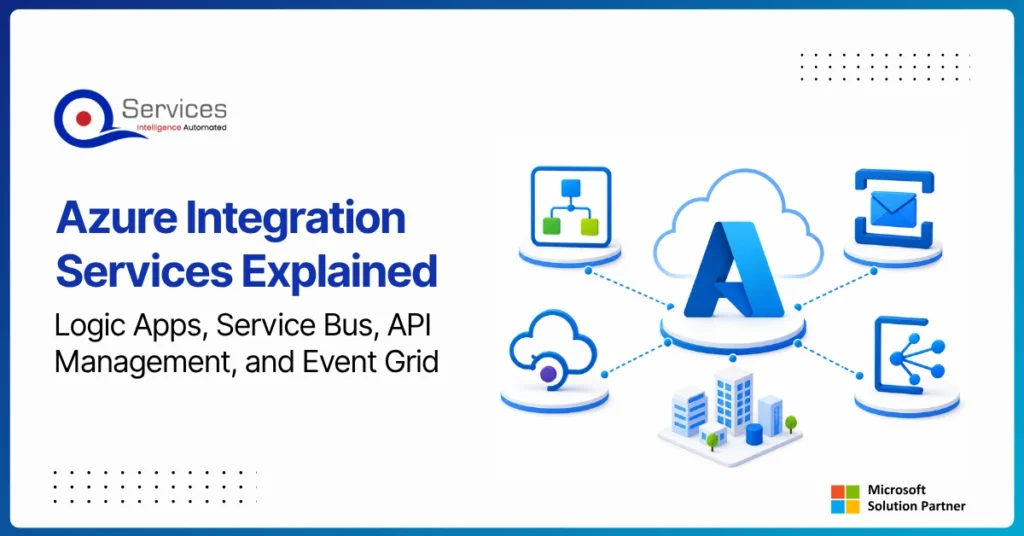
Azure Integration Services is Microsoft’s suite of cloud-native tools for connecting applications, data, and processes across your enterprise. When your organization runs a mix of on-premise systems, SaaS platforms, and custom APIs, getting them to communicate reliably is one of the hardest operational problems you will face. Azure integration services address that directly with four purpose-built components: Logic Apps for workflow automation, Service Bus for reliable messaging, API Management for governing APIs at scale, and Event Grid for event-driven architecture.
Key Insight Azure Integration Services is Microsoft’s suite of cloud-native tools for connecting applications, data, and processes across your enterprise.
This guide breaks down each component, explains how they work together, and covers when azure cloud migration services can bring your entire integration layer into the cloud. Teams evaluating azure consulting services for the first time will find the service breakdowns most useful. Teams already planning a lift and shift to azure should jump straight to the migration section.
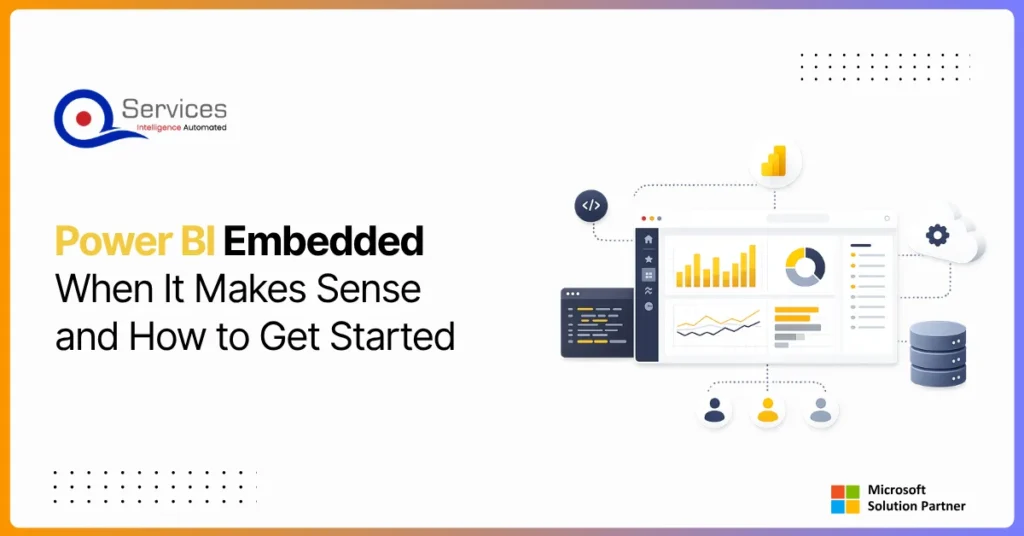
Power BI Embedded is Microsoft’s developer-focused API for embedding interactive analytics directly inside third-party apps, customer portals, and SaaS products. If you are building software and want customers to see live dashboards without logging into the Power BI service, this is where that journey starts. The question is not whether you can embed Power BI reports, you almost certainly can. The real question is whether it makes financial and architectural sense for your specific situation. This guide covers the when, the how, and the cost math that most tutorials skip.
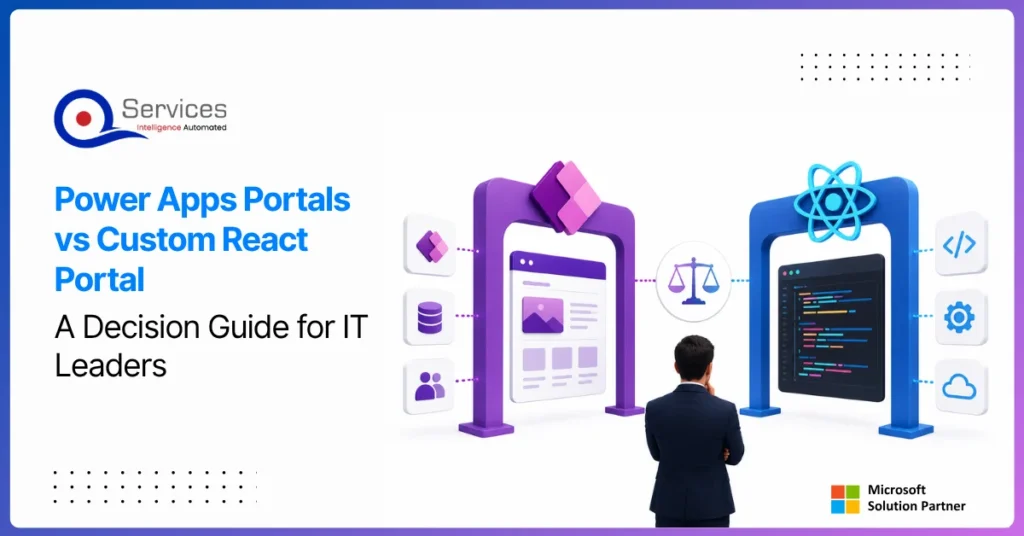
Power apps portals sit at an interesting crossroads for IT leaders: they’re fast, deeply integrated with the Microsoft stack, and manageable without a dedicated development team. But they’re also constrained in ways that matter when your business needs a portal that handles complex UI logic, third-party integrations outside the Microsoft ecosystem, or pixel-perfect UX design.
This guide gives you a straight comparison so you can make the right call without spending three months in discovery. We’ll cover what each option actually delivers, where each breaks down, and the governance questions that need answers before you commit either way.
If you’re evaluating your Microsoft stack more broadly, our breakdown of Power Platform vs Custom .NET Development provides useful parallel context.
Azure migration cost breaks down by workload strategy, not a single number. See real per-workload ranges, what FastTrack and Azure Migrate and Modernize actually cover, and how a fixed-price Blueprint Sprint replaces a vague estimate with a firm quote.
Azure Integration Services is Microsoft’s suite of cloud-native tools for connecting applications, data, and processes across your enterprise. When your organization runs a mix of on-premise systems, SaaS platforms, and custom APIs, getting them to communicate reliably is one of the hardest operational problems you will face. Azure integration services address that directly with four purpose-built components: Logic Apps for workflow automation, Service Bus for reliable messaging, API Management for governing APIs at scale, and Event Grid for event-driven architecture.
Key Insight Azure Integration Services is Microsoft’s suite of cloud-native tools for connecting applications, data, and processes across your enterprise.
This guide breaks down each component, explains how they work together, and covers when azure cloud migration services can bring your entire integration layer into the cloud. Teams evaluating azure consulting services for the first time will find the service breakdowns most useful. Teams already planning a lift and shift to azure should jump straight to the migration section.
Power BI Embedded is Microsoft’s developer-focused API for embedding interactive analytics directly inside third-party apps, customer portals, and SaaS products. If you are building software and want customers to see live dashboards without logging into the Power BI service, this is where that journey starts. The question is not whether you can embed Power BI reports, you almost certainly can. The real question is whether it makes financial and architectural sense for your specific situation. This guide covers the when, the how, and the cost math that most tutorials skip.
Power apps portals sit at an interesting crossroads for IT leaders: they’re fast, deeply integrated with the Microsoft stack, and manageable without a dedicated development team. But they’re also constrained in ways that matter when your business needs a portal that handles complex UI logic, third-party integrations outside the Microsoft ecosystem, or pixel-perfect UX design.
This guide gives you a straight comparison so you can make the right call without spending three months in discovery. We’ll cover what each option actually delivers, where each breaks down, and the governance questions that need answers before you commit either way.
If you’re evaluating your Microsoft stack more broadly, our breakdown of Power Platform vs Custom .NET Development provides useful parallel context.