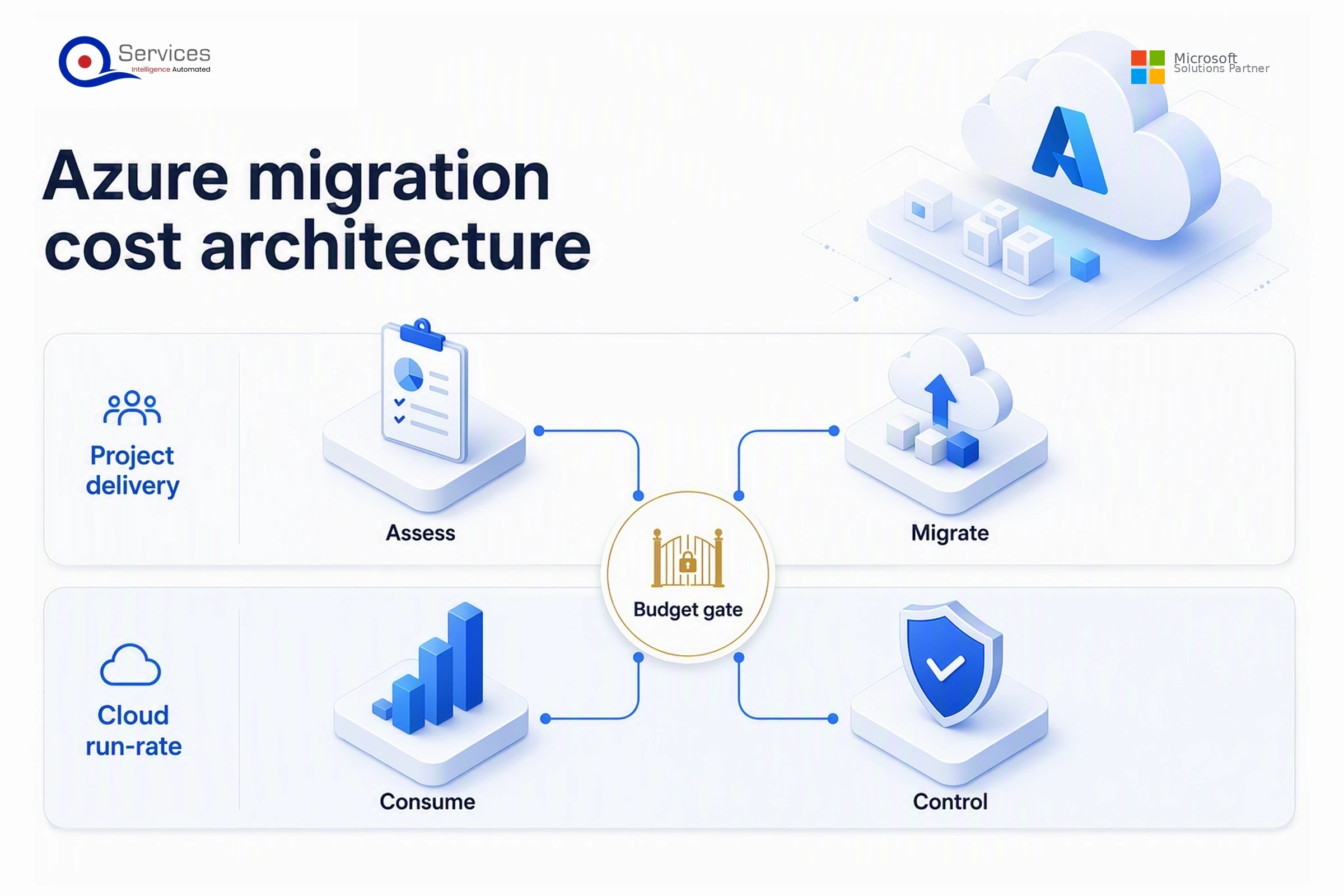
An Azure migration cost has two separate parts: the one-time cost to assess, prepare, move, test, and cut over workloads, and the ongoing cost to run those workloads in Azure. There is no defensible universal price per server or application. A useful budget starts with discovered utilization and dependencies, assigns a migration strategy to each workload, prices the target Azure resources, then adds landing-zone, security, testing, dual-running, and decommissioning work.
Direct Answer
Azure migration cost planning works best when each workload is estimated by scope, migration path, dependencies, licensing, security, testing, and post-migration optimization. The goal is not only to forecast one-time project cost, but to create a governed cost model finance, IT, and security teams can review before production migration begins.
Microsoft’s calculators estimate Azure consumption rather than the complete professional-services project. Azure Migrate can discover and assess an estate at no service charge, yet the business still pays for internal effort, partner delivery, remediation, test environments, some data movement, and production services after cutover. A usable budget turns those assumptions into workload-level scope that finance, security, application owners, and the delivery partner can challenge before work begins.
In this article, you'll learn
How to separate one-time migration expense from the recurring Azure run rate.
Which workload, dependency, licensing, security, and compliance choices change the budget.
How rehost, replatform, refactor, repurchase, retain, and retire decisions affect cost.
How to build low, base, and high estimates without pretending a calculator result is a quote.
How Azure Hybrid Benefit, reservations, savings plans, and Microsoft assistance may change the economics.
What a migration quote should include before a CIO approves it.
How should executives review Azure migration cost?
A defensible Azure migration budget separates one-time project work from the recurring Azure run rate. Mixing the two is how estimates become impossible to defend.
One total may suit a board-level business case, but it is a poor working model. Keep separate ledgers for migration work, the platform foundation, temporary transition costs, and steady-state Azure consumption. Migration work ends. A landing zone can support later workloads. Dual running should be temporary, while cloud consumption continues and changes with demand.
Azure Migrate assessment and Azure Pricing Calculator
Using list price without utilization or license eligibility
For an early funding request, present a range rather than false precision. The low case should assume known, stable dependencies and minimal remediation. The base case should include the work the team reasonably expects. The high case should model identified uncertainties such as unsupported operating systems, an untested disaster-recovery design, weak dependency data, or a compliance review that can add remediation. Record what changes between cases. A range without assumptions is only a larger guess.
Public dollar bands provide orientation, not a rate card. Workload mix, labor rates, Microsoft agreement pricing, region, uptime, recovery objectives, and internal staffing all change the result. The scenarios later in this guide show how scope changes. Procurement still needs discovered quantities, negotiated prices, and an approved work breakdown.
Why should your Azure migration estimate start with a cost baseline?
A workload is the business capability being moved, including its application components, data stores, integrations, identities, operational procedures, and owners. One workload might run on a single virtual machine. Another could span web servers, a database cluster, file shares, scheduled jobs, message queues, a third-party payment gateway, and an identity provider. Counting both as “one application” hides the work that controls migration cost.
Microsoft’s Azure Migrate assessment documentation reflects this need for evidence. Assessments can cover servers, SQL Server estates, and web applications, and they evaluate readiness before calculating sizing and estimated resource cost. An appliance-based discovery provides continuing configuration and performance information; a CSV import can support a quicker initial estimate. The output is a point-in-time assessment, so a configuration change or a longer observation window can change the recommendation.
Performance coverage deserves attention. CPU and memory utilization alone are not enough for many workloads. Disk IOPS, throughput, and network traffic influence the target size and therefore the run rate. Microsoft’s assessment confidence guidance scores the availability of performance data. If coverage is weak, extend profiling or disclose that the estimate uses as-is sizing. Otherwise an apparently precise monthly figure may be based on missing telemetry.
Minimum inventory fields for a cost model
Business owner, technical owner, criticality, user population, and permitted downtime.
Inbound and outbound dependencies, authentication flows, certificates, batch schedules, and integrations.
Current license entitlements, Software Assurance or subscription status, support contracts, and renewal dates.
Recovery time objective, recovery point objective, backup retention, availability requirements, and test frequency.
Regulatory scope, data classification, residency constraints, audit evidence, and separation-of-duties requirements.
Current fully loaded infrastructure and operating cost, including people and facilities where relevant.
The inventory should also identify workloads that should not move. Retirement eliminates migration and future hosting cost. Retention can be rational when a system is near end of life, tied to specialized hardware, or blocked by contract. A migration program that measures success by the number of machines moved can spend money preserving technical debt.
How do you identify the real drivers of Azure cloud migration cost?
Azure cloud migration cost moves with scope, target architecture, assurance requirements, and delivery constraints. Put each driver in the estimate instead of burying it in a contingency line.
Workload readiness and technical debt
Supported operating systems, modern authentication, current database versions, automated deployment, and documented dependencies lower uncertainty. Unsupported software, hard-coded IP addresses, local file dependencies, obsolete drivers, and manual release steps create remediation work. A rehost label does not remove that work; it only describes the intended target pattern.
Migration strategy
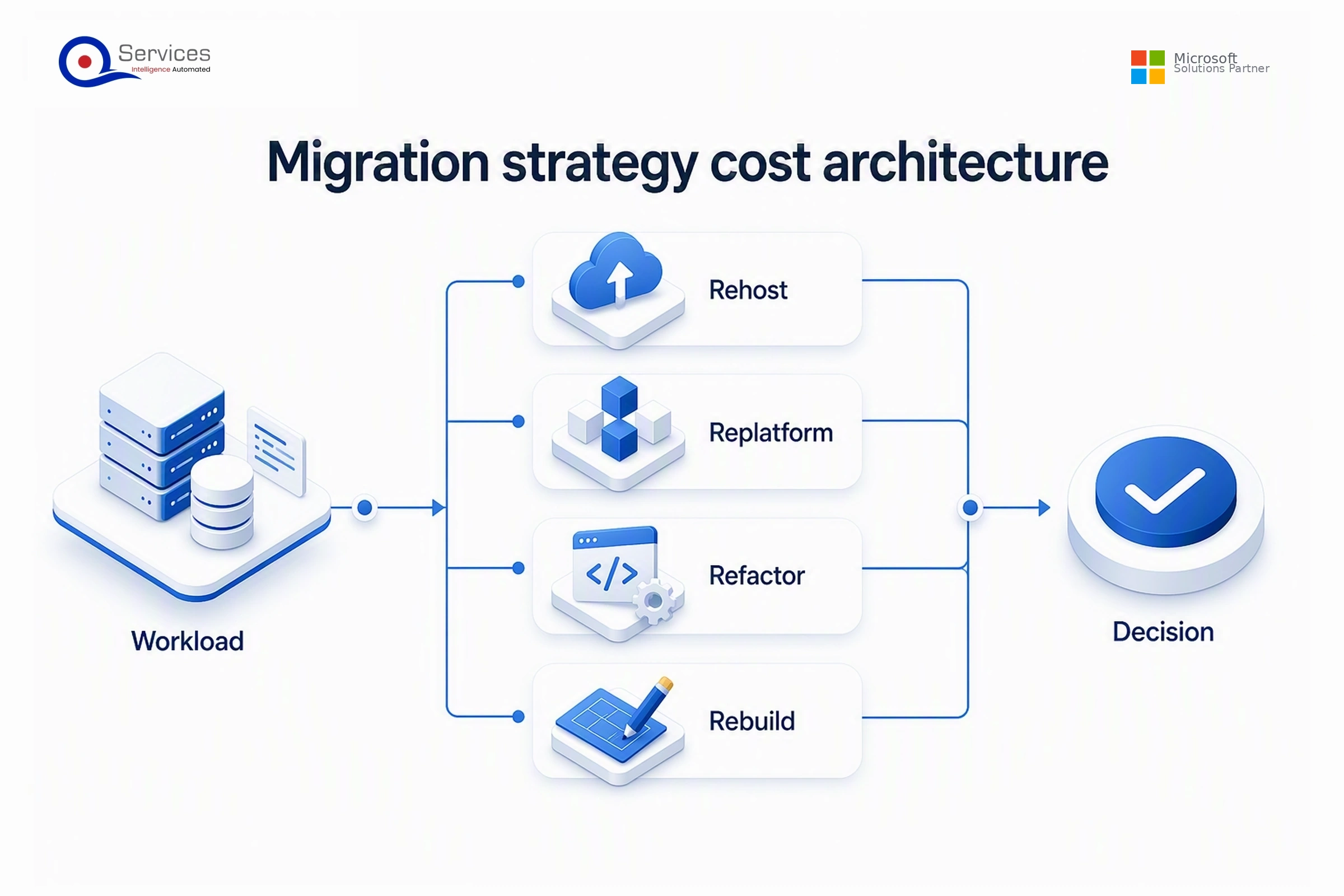
Replication-led rehosting usually has less application engineering than refactoring, but it may carry a higher run rate if the source was overprovisioned. Replatforming can add database conversion, regression testing, and operational retraining while reducing maintenance. Refactoring can improve scalability and resilience, yet it introduces development scope and product risk. Compare implementation expense and steady-state economics together.
Dependency and data complexity
Large data volume is not the only concern. Change rate, cutover window, consistency requirements, encryption, validation, and rollback determine the method. An eight-terabyte archive that can move over a weekend may be simpler than a one-terabyte transaction database with near-zero downtime and many consumers. For very large or constrained transfers, Azure Data Box may be an option; device, shipping, storage, and relevant export costs still need their own lines.
Availability and recovery
A nonproduction tool and a revenue system should not share an architecture assumption. Availability zones, paired-region recovery, database replicas, immutable backups, failover orchestration, and recovery exercises add resources and engineering. Cost the required service level, not the most elaborate diagram and not the cheapest single-instance target.
Identity, network, and security
Hybrid DNS, private connectivity, firewalls, route inspection, privileged access, key management, endpoint controls, and security monitoring often span multiple teams. They are platform work, not free by-products of copying a VM. Their designs must be ready before the first production wave, which makes late discovery especially expensive.
Compliance and evidence
HIPAA, PCI DSS, SOC 2, financial-services controls, and internal policies do not have a universal “compliance surcharge.” They add specific obligations: control mapping, policy configuration, log retention, private access, encryption, evidence collection, validation, documented approvals, and sometimes independent testing. Microsoft warns that using built-in control mappings does not itself guarantee compliance. Cost the customer’s responsibilities and the evidence the auditor expects.
People, timing, and change
A compressed schedule may require parallel teams, after-hours cutovers, or another rehearsal. Business-user testing consumes internal capacity even when a partner handles the technical move. Budget for service-desk preparation, runbooks, training, communications, and hypercare as delivery work.
How do migration strategies change cost, work, risk, and run rate?
The migration strategy changes both cost and risk. A cheap lift-and-shift can become expensive later if the application still carries old licensing, security, or performance problems.
Strategy
Main implementation work
Relative one-time effort
Run-rate implication
Good fit
Retire
Usage validation, records handling, dependency removal, shutdown
Low, but not zero
Eliminates hosting
Unused or replaced systems
Retain
Document exception, integration boundary, review date
Low now
Source cost remains
Blocked, near-retirement, or hardware-bound workloads
Rehost
Replicate, configure target, test, cut over
Usually lower
Can preserve inefficient sizing
Time-sensitive moves with compatible workloads
Relocate
Move a supported platform with minimal architecture change
Varies by platform
Often preserves operating model
Eligible virtualized estates
Replatform
Change managed service or runtime, convert and test
Medium
May reduce operations or improve elasticity
Databases and web applications ready for managed services
Subscription replaces part of infrastructure/maintenance
Commodity capabilities with acceptable SaaS fit
“Relative effort” is not a price promise. A small refactor can cost less than a difficult rehost of a brittle clustered system. Use the strategy as the start of a work breakdown. For each workload, estimate discovery, preparation, target build, migration execution, testing, cutover, rollback readiness, documentation, and hypercare.
Classify the portfolio, assess representative workloads, and calibrate later estimates from evidence. If the first five rehosts each require identity remediation omitted from the model, update it before committing later waves.
How do costs change across 3 Azure migration scopes?
These scenarios compare scope rather than quote a price. Use them to spot the assumptions that belong in discovery, then price those assumptions with estate data and contract rates.
Scenario 1: 15 virtual machines for a professional services firm
Assume twelve straightforward rehosts, two retirements, and one replatformed SQL workload. The firm has standard business-hours systems, a documented identity environment, 4 TB of data, a weekend cutover window, and no regulated-data requirement beyond normal corporate controls. Its network design and Azure tenant already exist.
This example is cheap only if the assumptions survive discovery. If the SQL workload needs application changes, if the tenant lacks guardrails, or if the business requires near-zero downtime, it no longer belongs in the same band. The recurring Azure estimate should be exported separately from Azure Migrate or rebuilt in the Pricing Calculator using the actual region, uptime, disk, backup, and licensing selections.
Scenario 2: 50 mixed workloads with a new landing zone
Assume thirty rehosts, ten replatforms, five retirements, and five retained systems. The estate has several business integrations, 25 TB of data, a new hub-and-spoke network, centralized logging, backup policies, two migration rehearsals for critical workloads, and eight weeks of wave execution.
The spread is driven less by the number fifty than by what “mixed” means. Ten database or application replatforms can dominate the effort. The high case assumes weak dependency evidence, more remediation, and a 25% contingency; the low case assumes clean discovery and rapid owner acceptance. Do not choose the low case because it is affordable. Choose it only if the evidence supports it.
Key Insight The high case assumes weak dependency evidence, more remediation, and a 25% contingency; the low case assumes clean discovery and rapid owner acceptance.
Scenario 3: a regulated 180-workload program
Assume a financial or healthcare organization with multiple environments, private connectivity, a platform landing zone, centralized security operations, immutable backup requirements, formal control mapping, 80 TB of data, regional recovery for selected systems, and auditable approvals. Workloads use a mixture of rehost, replatform, refactor, retire, and retain decisions.
A responsible early estimate would separate platform, application, data, assurance, and program-governance work. Rather than publishing a single invented total, build a range per wave after representative assessments. The first funding gate can cover portfolio discovery, landing-zone decisions, two or three representative workload designs, and a migration factory plan. The next gate can authorize a pilot wave. Later funding follows observed throughput, defect rates, test effort, and accepted target costs.
Funding by gate keeps a server count from turning into an unsupported program commitment. It also keeps unknown application remediation out of an early fixed-price promise. A fixed price is credible once a wave has named workloads, assumptions, exclusions, and acceptance criteria.
Need an Azure migration number your CFO can challenge?
Map workloads, assumptions, risks, and target consumption in a five-day Blueprint before committing to delivery.
How do you build an Azure migration cost calculator finance can audit?
A useful calculator has traceable inputs. A server-count form that returns a sales number does not. Build one-time and recurring costs independently, then combine them for finance’s chosen investment period.
One-time migration budget = assessment and design + platform foundation + workload preparation and migration + data and network work + security and compliance implementation + testing and cutover + transition/dual running + contingency − confirmed funding or credits.
Recurring Azure run rate = compute + database + storage + backup + network + security + monitoring + support + operations − validated license and commitment discounts.
Three-year decision view = one-time migration budget + 36 months of modeled Azure and cloud operations + retained source costs during transition − avoidable source costs and approved incentives.
Step 1: choose an evidence date and observation window
Record when inventory was captured and how long performance data was collected. Seasonal businesses may need more than a typical month. Note workloads with incomplete metrics, because their target sizes need a different confidence label.
Step 2: assign strategy and complexity
For every workload, record the selected strategy and a complexity basis. Complexity should be explained through dependencies, data, downtime, remediation, service level, and assurance rather than a subjective “small/medium/large” field. A high-complexity rehost and a low-complexity replatform are both possible.
Step 3: estimate the Azure target
Use the assessment recommendation or configure the target in the Azure Pricing Calculator. Enter region, service tier, operating system, uptime, storage type and quantity, data transfer, backup, monitoring, and support. Microsoft’s calculator states that results are estimates, not quotes, and actual prices can vary with agreement, purchase date, and currency. Export the assumptions with the result.
Step 4: estimate project work
Break delivery into activities with owners and acceptance criteria. Include application-owner testing and security review even if the labor is internal and does not appear on the partner invoice. Procurement needs the cash cost; the business case needs the full effort and opportunity cost.
Step 5: add transition duration
Model how long source and target will overlap. A one-month overlap and a six-month migration factory have different economics. Include test subscriptions, replicated storage, network circuits, temporary tooling, and support-contract overlap. Also model when source costs can actually be removed; a server shutdown does not automatically end a data-center lease.
Step 6: apply discounts only when eligible
Check license evidence, scope, term, utilization stability, and purchasing authority. Do not subtract an advertised maximum saving from the business case. Model pay-as-you-go first, then a validated discounted case. Keep unapproved Microsoft assistance as upside, not as money already received.
Step 7: run sensitivity tests
Change the inputs that can overturn the decision: utilization, migration duration, required redundancy, database target, outbound traffic, retained licenses, and number of refactors. The output should show which assumptions matter most. That tells leadership where another week of discovery is worth more than another round of spreadsheet formatting.
One-time project cost versus ongoing Azure TCO
The migration project and the Azure bill answer different questions. Project cost asks what it takes to move safely. Total cost of ownership asks what the organization will spend to operate the capability over a defined period compared with the alternative.
Azure Migrate’s business-case capability can compare on-premises and Azure TCO and evaluate strategies that prefer platform services or use infrastructure targets. That analysis becomes more useful when the source-cost baseline is complete. Hardware depreciation alone is not the on-premises cost. Facilities, power, warranties, virtualization, storage, backup, network, licenses, security tools, and operations can all matter. Conversely, not every current cost disappears after migration.
For Azure, include services that protect and operate the workload. A calculator configuration with one VM and one disk may omit backup retention, logging ingestion, Defender plans, private endpoints, firewall processing, disaster recovery, nonproduction environments, and support. The right comparison is required outcome against required outcome.
Do not force modernization savings into the migration case if they depend on later engineering. A rehost can be phase one and rightsizing phase two, but the financial model should state when the optimization happens and who owns it. QServices IT’s article on common Azure cost mistakes is a useful follow-on for the operating phase.
Licensing, reservations, and savings plans
Azure Hybrid Benefit
Eligible Windows Server customers can use qualifying licenses with active Software Assurance or qualifying subscriptions to reduce the Windows component of Azure VM cost. Microsoft’s Windows Server Azure Hybrid Benefit guidance says the customer then pays the base compute rate equivalent to the Linux rate. Standard and Datacenter editions have different dual-use rights during migration, so license evidence and assignment need review rather than a checkbox assumption.
For Azure SQL Database and SQL Managed Instance, Microsoft states that eligible Software Assurance-enabled SQL Server licenses can save “up to 30 percent or more,” depending on the configuration. The benefit applies to qualifying vCore-based provisioned compute, not every purchasing model. Promotional pages cite larger maximum combined savings in selected scenarios, but actual savings vary by region, instance, and use. Quote the modeled configuration, not the headline.
Reservations
Azure Reservations use a one- or three-year commitment and may reduce eligible resource cost by up to 72% from pay-as-you-go rates. The percentage is a maximum, not a default. Reservation scope, resource eligibility, utilization, and exchange or cancellation rules affect value. For Windows VMs and Azure SQL Database, the reservation addresses eligible resource consumption; software licensing may remain separate unless Azure Hybrid Benefit applies.
Key Insight Azure Reservations use a one- or three-year commitment and may reduce eligible resource cost by up to 72% from pay-as-you-go rates.
Savings plans
Azure savings plans commit the customer to a fixed hourly compute spend for one or three years and may reduce eligible compute charges by up to 65% from pay-as-you-go pricing. Eligible usage receives the discount until the hourly commitment is consumed; additional usage is billed at pay-as-you-go rates. Unused hourly commitment does not roll forward. Savings plans can suit changing compute footprints, while reservations can fit stable, specific usage.
A sensible sequence is to migrate, observe, rightsize, and then commit, unless the estate is already well understood and the organization accepts the commitment risk. Buying a three-year commitment to preserve an oversized source configuration can lock in the wrong baseline.
How does Microsoft migration assistance affect scope in 2026
Microsoft’s current program language centers on Frontier Accelerate for Azure. The program page describes AI-enhanced assessments, zero-cost deployment assistance through Cloud Accelerate Factory for eligible services, delivery funding through specialized partners, Azure credits, training, and certification-exam discounts. It does not promise a universal funding amount or automatic entitlement.
Treat assistance as a scoped input. Confirm eligibility, covered services, required consumption or milestones, who performs each activity, deadlines, and whether credits offset consumption or delivery. A funded activity can still leave customer work for application remediation, security approval, user testing, data validation, operating-model change, and services outside the eligible list.
Azure Migrate itself is available without a service charge for discovery, assessment, planning, and supported migration tooling. Microsoft notes that third-party integrated tools may charge. For server migration, the tooling has no usage charge during the first 180 days from the start of replication for a VM, while storage, networking, and compute used for replication or tests can still create charges. “The tool is free” should never be translated into “the project is free.”
Landing zones and compliance change the scope
An Azure landing zone is the governed environment in which workloads operate. Microsoft’s Cloud Adoption Framework distinguishes a platform landing zone for shared identity, connectivity, management, security, and governance from application landing zones used by workload teams. The design can include management groups, subscription vending, network topology, policy, logging, security monitoring, and automation.
A mid-market company with a mature platform may reuse most of this foundation. A first migration may need to build it. Estimate the platform once and allocate it transparently; do not hide the full cost in the first workload or pretend each later workload rebuilds it.
For regulated workloads, map required controls to customer, Microsoft, and shared responsibilities. Determine which controls are inherited from the platform, which are implemented in the application landing zone, and what evidence is produced. Built-in Azure Policy mappings can help assess controls, but Microsoft explicitly says use of mapped features does not guarantee compliance. Security, legal, privacy, risk, and audit stakeholders still need to validate the design.
A cheap-looking rehost can become an expensive program here. The workload may move quickly, while private connectivity, key custody, log retention, privileged-access workflows, recovery tests, evidence, and approvals take longer. Those costs pay for a controlled production environment.
Hidden costs that common estimates miss
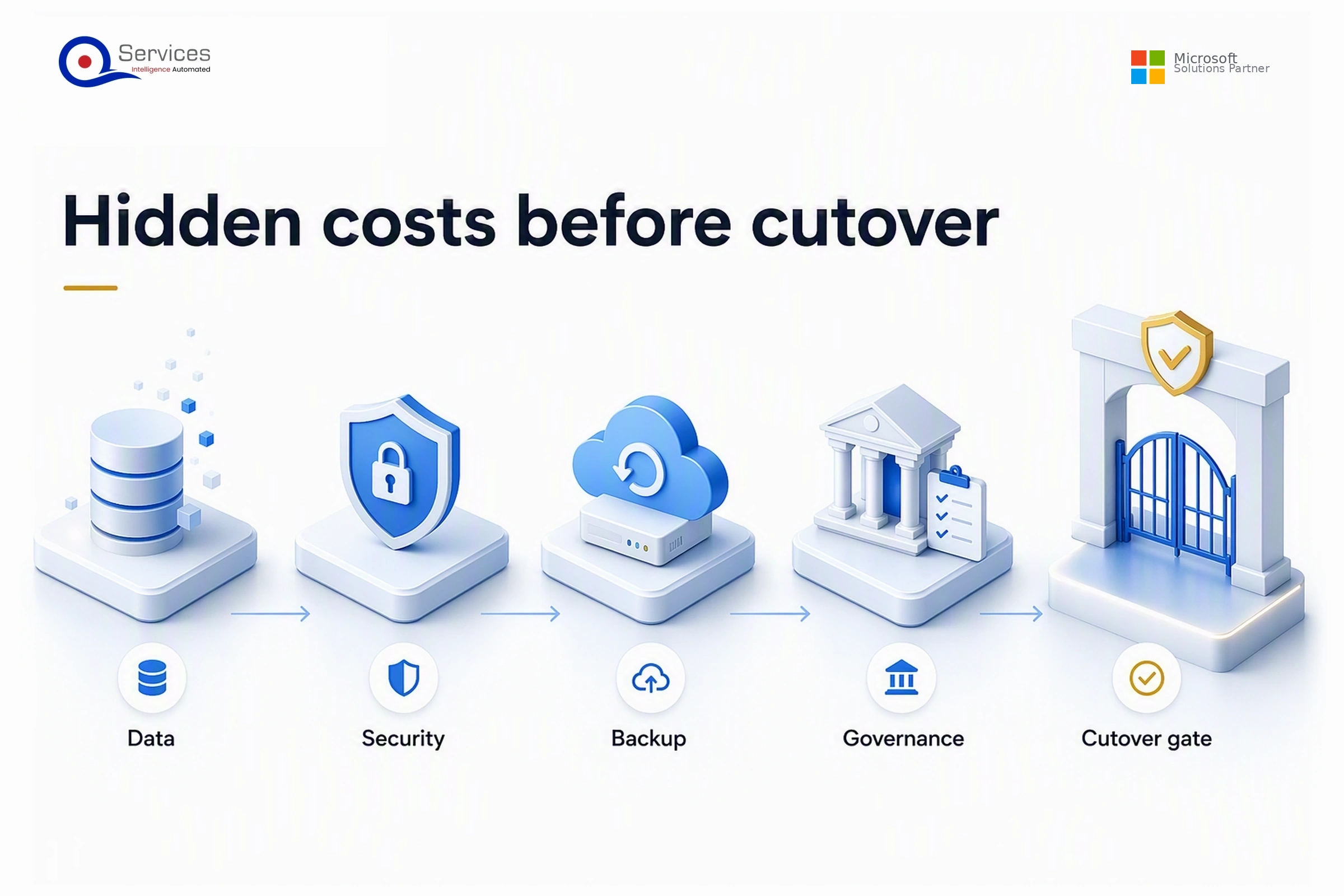
Hidden costs usually come from work nobody owned during planning: data egress, identity cleanup, monitoring, backup, compliance evidence, and decommissioning old infrastructure.
Dual running: Source and Azure environments overlap during replication, testing, rollback protection, and phased cutover.
Nonproduction parity: Development, test, staging, performance, training, and disaster-recovery environments can exceed the simple production footprint.
Data transfer and connectivity: Data into Azure is generally free, but outbound and inter-region traffic can be charged. Microsoft’s September 2026 bandwidth page lists North America inter-region transfer at $0.02 per GB and premium-network internet egress after the first 100 GB per month beginning at $0.087 per GB for the next tier; verify current rates and agreement pricing at quote time.
Database and application remediation: Unsupported features, collation issues, latency assumptions, authentication changes, and local dependencies can turn a nominal replatform into engineering work.
Security tooling: Logging, SIEM ingestion, Defender plans, key management, vulnerability management, and privileged access have service and operating costs.
Recovery assurance: Replication is not proof of recovery. Runbooks, failover tests, application validation, and return-to-primary procedures take time and may require duplicate capacity.
Decommissioning: Data retention, certificate and DNS cleanup, dependency confirmation, contract termination, asset disposal, and records evidence happen after cutover.
Internal labor: Application owners, finance, procurement, security, service desk, and business testers spend time even when the vendor quote excludes them.
Delayed decisions: Unavailable owners and slow approvals extend dual running and consume delivery capacity.
Post-migration optimization: Rightsizing, schedules, commitment purchases, storage lifecycle, tagging, and allocation rules require active ownership.
Azure budgets are useful controls, but they send notifications rather than stop resources. Microsoft says cost data commonly arrives after a delay and budget evaluation occurs periodically. Combine budgets with policy, access controls, tagging, anomaly review, and an operating cadence. A stopped VM that is not deallocated can continue to incur compute cost; deallocated machines can still incur disk and some networking charges.
For practical operating ideas, see QServices IT’s Azure cost optimization strategies. The migration team should define ownership for these actions before handover, not leave them as a post-launch wish list.
Timeline, migration waves, and governance
A cost model should be attached to a delivery model. Begin with discovery and decision records, then establish the landing zone and migrate a representative pilot. Use the pilot to measure actual preparation effort, replication behavior, defect rates, test duration, approval time, and support demand. Recalibrate later waves from evidence.
Gate
Decision
Evidence
Portfolio gate
Which workloads move, modernize, retire, or remain?
Inventory, owners, dependencies, business criticality
Architecture gate
Is the target secure, supportable, and costed?
Design, policy, threat and control review, calculator export
Wave-ready gate
Can this workload enter migration?
Remediation complete, test plan, rollback plan, approvals
Business validation, monitoring, cost checks, runbook handover
Human-in-the-loop governance is especially useful where automation performs discovery, infrastructure deployment, or replication. Automation can accelerate a repeatable task; named people still approve strategy, architecture, cutover, and acceptance. Preserve architecture decision records and assumptions so a later cost dispute can be traced to the decision that created it.
Turn the estimate into a fixed, reviewable scope
QServices IT offers a five-day Blueprint Sprint for $5,000. For an Azure migration, use that time to test broad sales assumptions before making a larger delivery commitment. The scope discussion should name workloads, migration strategies, target assumptions, exclusions, dependencies, risks, decision owners, and acceptance criteria. Confirm the contractual deliverables in the proposal before signing.
Key Insight QServices IT offers a five-day Blueprint Sprint for $5,000.
A Project Sprint starts at $15,000 and runs for 15 to 45 days, but it is not a universal migration package. The workload or wave still has to fit the agreed scope. Larger programs can use bounded waves, with each wave informed by evidence from the last. Weekly demonstrations let the buyer inspect working results instead of relying on a monthly status report.
Azure migration quote checklist
Before comparing supplier totals, normalize the scope. A lower figure often excludes work rather than performing the same work efficiently.
Named workload inventory, environments, data quantities, dependencies, and selected migration strategy.
Source and target regions, subscriptions, service tiers, uptime, availability, backup, and recovery assumptions.
Landing-zone, identity, connectivity, policy, logging, and security responsibilities.
Licenses, reservations, savings plans, agreement discounts, and incentives included in the model.
Discovery, remediation, testing, rehearsals, cutover, rollback, hypercare, documentation, and handover.
Customer responsibilities, required decision turnaround, blackout periods, and access prerequisites.
Azure consumption, third-party licenses, circuits, appliances, tax, travel, and after-hours work included or excluded.
Change-control method, acceptance criteria, warranty or hypercare window, and rate for out-of-scope work.
Who owns scripts, infrastructure-as-code, diagrams, runbooks, and architecture decision records.
When source systems and contracts can be retired and who validates decommissioning.
Key Takeaways
Separate one-time migration work, transition costs, and recurring Azure run-rate before approving a budget.
Build estimates from discovered utilization, dependencies, migration strategy, landing-zone needs, testing, and compliance work.
Use Azure calculators for consumption modelling, not as a complete project quote.
Apply Azure Hybrid Benefit, reservations, savings plans, and Microsoft assistance only after eligibility is confirmed.
Ask for assumptions, exclusions, acceptance criteria, ownership, and decommissioning scope before signing a migration quote.
Conclusion
A credible Azure migration cost is not a single calculator screenshot or a generic per-server range. It is a record of the decisions behind the number: what is moving, how each workload will move, what has to be remediated, which Azure services will run afterward, and who is responsible for testing, governance, and decommissioning.
Before approving a migration budget, separate one-time delivery work from the steady-state Azure run rate, document the assumptions behind each scenario, and keep contingency tied to known uncertainty. That gives finance, security, application owners, and delivery teams a budget they can challenge instead of a number they have to trust blindly.
If you need a workload-level Azure migration budget instead of another generic range, Book a Blueprint Call. QServices IT will help turn assumptions into a reviewable migration scope before you commit to delivery.
Eager to discuss about your project?
Share your project idea with us. Together, we’ll transform your vision into an exceptional digital product!
Co-Founder and CTO, QServices IT Solutions Pvt Ltd
Rohit Dabra is the Co-Founder and Chief Technology Officer at QServices, a software development company focused on building practical digital solutions for businesses. At QServices, Rohit works closely with startups and growing businesses to design and develop web platforms, mobile applications, and scalable cloud systems. He is particularly interested in automation and artificial intelligence, building systems that automate routine tasks for teams and organizations.
There is no universal cost per server or application. Separate assessment, platform, remediation, migration, testing, transition, compliance, and decommissioning work from the recurring Azure run rate, then build low, base, and high cases from discovered data.
Azure Migrate is available at no service charge for discovery, assessment, planning, and supported migration tooling. Third-party tools, replicated storage, networking, test compute, partner labor, and production Azure services can still cost money.
No. It estimates the Azure services and usage configured in the calculator. It does not include remediation, landing-zone implementation, testing, change management, migration labor, or decommissioning.
Only when the target footprint is stable enough to justify a one- or three-year commitment. Many teams first observe and rightsize migrated workloads, then select reservations or a savings plan.
There is no universal percentage. Base the reserve on identified uncertainty such as missing dependency data, unsupported software, strict downtime, untested recovery, or unresolved compliance controls.
Compliance adds control mapping, policy, identity and network restrictions, logging, evidence, testing, and approval work. Separate reusable platform controls from workload-specific obligations.
When PDF text extraction drops the spaces between words, AI agents can’t find facts that are right there. How we found it in Azure AI Foundry and fixed it.
Pint AE explained for UAE finance teams with one sample invoice: see which fields come from your ERP, which go missing, and how to test before go-live.
Days sales outstanding explained for CFOs: the formula, worked examples, named industry benchmarks, and why seasonal sales distort DSO. See what moves it.
When PDF text extraction drops the spaces between words, AI agents can’t find facts that are right there. How we found it in Azure AI Foundry and fixed it.
Pint AE explained for UAE finance teams with one sample invoice: see which fields come from your ERP, which go missing, and how to test before go-live.
Days sales outstanding explained for CFOs: the formula, worked examples, named industry benchmarks, and why seasonal sales distort DSO. See what moves it.
QServices Inc. undertakes every project with a high degree of professionalism. Their communication style is unmatched and they are always available to resolve issues or just discuss the project.
Turn the Microsoft Licenses
You Already Own Into an AI Workplace
Join our live webinar on Sept 24 and see five ways to automate meetings, approvals, and