Microsoft solutions partner certification is one of those credentials that shows up in every vendor deck but rarely gets explained in plain terms. The designation is not a one-time award. Microsoft reviews it every 12 months, checking whether a partner has current certifications, relevant project history, and real customer satisfaction scores on file. If you are evaluating azure consulting services for a cloud migration, a Power Platform rollout, or a Copilot deployment, knowing what sits behind that badge changes how you shortlist vendors.
This post breaks down what the certification involves, the six specialization areas, and what holding it should mean in practice when your project kicks off.
In This Article, You'll Learn
What Is a Microsoft Solutions Partner?
The Six Specialization Designations Explained
Why Microsoft Solutions Partner Certification Matters for Azure Consulting Services
How QServices Earned Its Microsoft Solutions Partner Certification
What a Certified Azure Migration Partner Does on Your Project
Eager to discuss about your project?
Share your project idea with us. Together, we’ll transform your vision into an exceptional digital product!
A Microsoft Solutions Partner is a company that has met Microsoft's formal requirements across three dimensions: partner capability score, customer success metrics, and the number of certified professionals on staff. The designation replaced the old "Gold" and "Silver" competency system in October 2022, when Microsoft overhauled its partner program to make the credential harder to hold and more meaningful to buyers.
To earn and keep the badge, a partner must score at least 70 points out of 100 on a capability score that combines:
Performance: net new customers added to a solution area over the past year
Skilling: the number of employees holding relevant Microsoft certifications
Customer success: deployment and usage growth across the partner's customer base
Microsoft re-checks scores monthly and formally renews partners annually. If a partner drops below 70, the designation lapses. That continuous review is the key difference from the old Gold/Silver system, which many partners held for years without active project delivery.
How Does Microsoft Award the Designation?
Microsoft tracks partner activity through its Partner Center platform. Project data, certification counts, and customer usage metrics feed into the capability score automatically. Partners cannot self-report in the traditional sense; the data comes from Microsoft's own telemetry and verified customer submissions.
What Are the Microsoft Solutions Partner Requirements?
The requirements differ by specialization, but the core threshold is consistent: a partner needs 70 points or more on the capability score plus the required employee certifications for that solution area. A partner can hold multiple designations simultaneously if they meet the criteria across areas.
The Six Specialization Designations Explained
The microsoft solutions partner certification program covers six solution areas. Each maps to a set of Microsoft products and a specific group of required certifications.
Designation
Focus Area
Typical Projects
Infrastructure (Azure)
Azure IaaS, hybrid cloud, migration
Lift and shift to azure, azure landing zone implementation
Power automate consulting, power apps development services
Modern Work
Microsoft 365, Teams, SharePoint
Collaboration, hybrid workforce tools
Security
Microsoft Sentinel, Defender, Purview
Azure security assessment, compliance
For buyers, this table matters because a partner holding the Infrastructure designation has proven azure cloud migration services depth, while a partner holding only Business Applications may not have the Azure architecture skills you need for a hybrid cloud azure setup.
Why Microsoft Solutions Partner Certification Matters for Azure Consulting Services
The honest answer is that it narrows the risk. When you hire an azure consulting services firm, you are betting on their team's actual skills and their delivery process. The certification gives you a data-backed starting point instead of relying entirely on references and sales presentations.
Azure Infrastructure Assessment and Architecture Review
A certified azure migration partner has demonstrated that their team can do more than stand up virtual machines. The skilling requirement means at least several engineers hold certifications like Azure Solutions Architect Expert or Azure Administrator, which cover azure architecture review concepts, networking, identity, and governance. That matters when you are commissioning an azure infrastructure assessment before a major workload move.
Azure Security Assessment Standards
The Security designation specifically requires certifications in Microsoft Sentinel and Defender products. If you are planning an azure security assessment, a partner holding this designation has engineers who have passed formal Microsoft exams covering exactly that toolset. That is a different level of confidence from a partner who simply claims cloud security experience.
How QServices Earned Its Microsoft Solutions Partner Certification
QServices is a certified Microsoft Solutions Partner with designations covering Azure infrastructure, Digital & App Innovation, Business Applications, and Modern Work. The team has completed 500+ Azure and Microsoft platform projects since 2014, across healthcare, logistics, SaaS, banking, and financial services sectors.
Holding the certification means Microsoft's own platform data confirms that QServices has been actively deploying Azure workloads, adding net new Azure customers, and growing usage metrics year on year. It is not a badge the company purchased or inherited from a merger.
Human-in-the-Loop AI Governance
One area where QServices goes beyond standard certification requirements is governance. As organisations move toward Copilot Studio and Azure AI deployments, the risk of automated decisions without human review grows. QServices applies Human-in-the-Loop governance as a delivery standard, meaning human approval gates are built into every deployment stage rather than treated as optional. Our post on AI agent governance covers the practical framework for enterprise teams. For teams evaluating Azure AI platforms, the Azure AI Foundry vs Azure OpenAI Service comparison is a useful next read.
What a Certified Azure Migration Partner Does on Your Project
Talk to a Microsoft-Certified Expert before you sign a statement of work. Certification status tells you a partner meets baseline standards, but project outcomes depend on how they apply that knowledge in your specific environment.
Azure Landing Zone Implementation
An Azure landing zone is the pre-configured environment that defines governance, networking, identity, and security before any workloads move. A certified azure migration partner implements a landing zone from a documented baseline (Microsoft's Cloud Adoption Framework) rather than building one ad-hoc per engagement. Azure landing zone implementation is where many migrations run into trouble: incorrect subscription structure, missing policy assignments, and no monitoring baseline are common causes of post-migration incidents.
Migrate On-Premise to Azure: The Five Phases
The standard approach to migrate on premise to azure follows five phases: Discovery, Assessment, Planning, Migration, and Optimisation. Each phase has distinct tooling. Discovery uses Azure Migrate or third-party inventory tools. Assessment maps dependencies and identifies compatibility issues. Planning sets the migration wave structure. Migration executes the workload moves. Optimisation runs azure cost optimization consulting checks after workloads are live to right-size resources and eliminate waste.
Azure Cost Optimization Consulting
Cost control is where many migrations stall post-go-live. Azure managed services provider engagements typically include right-sizing reviews, reserved instance purchasing recommendations, and auto-scaling configuration. Without these, Azure bills commonly run 20-40% above initial budget in the first six months after migration, a pattern Gartner's cloud migration research consistently documents.
Key Insight Without these, Azure bills commonly run 20-40% above initial budget in the first six months after migration, a pattern Gartner's cloud migration research consistently documents.
Power Platform and Microsoft Certified Work
The Business Applications and Modern Work designations cover the Power Platform side of Microsoft's stack. A microsoft azure consulting company that also holds these designations can handle the full Microsoft ecosystem, not just the infrastructure layer.
Power Automate Consulting and Process Automation
Power automate consulting typically starts with mapping existing manual approval processes, identifying which steps can run automatically without losing accountability, and building flows that connect Microsoft 365 data with line-of-business systems. Multi-stage Power Automate approval workflows are one of the most common starting points for organisations new to the platform. Power platform governance matters here: without proper environment policies and data loss prevention configuration, automated flows can expose sensitive data across the organisation.
Power Apps and Power BI Consulting Services
Power apps development services range from simple form-based tools that replace spreadsheets to fully custom business applications integrating with Dynamics 365 or Azure data sources. Power bi consulting services add the reporting layer, connecting Azure Synapse, Dataverse, or SQL databases to dashboards that business users can maintain without IT involvement. Both capabilities sit within the power platform development company scope that the Business Applications designation validates.
How to Choose the Right Azure Consulting Partner
Certification is a starting point, not the complete picture. When you evaluate a microsoft azure consulting company for a real engagement, ask these specific questions:
How many of your engineers hold current Azure certifications? Not just the company's total headcount, but active certifications renewed within the last two years.
Can you show me a recent azure architecture review from a project with a similar workload profile?
What does your azure managed services provider model look like post-migration? Who handles alerts at 2am?
How do you approach azure devops consulting services and CI/CD pipeline setup? A migration without a proper deployment pipeline just creates a different set of operational problems.
Do you have experience with hybrid cloud azure setup in regulated industries like healthcare or financial services?
According to Microsoft's Partner Center documentation, you can verify any partner's current certification status directly through Microsoft's official portal before signing a contract. This takes under two minutes and removes any ambiguity about whether a badge is current or lapsed.
Key Takeaways
A Microsoft Solutions Partner is a company that has met Microsoft's formal requirements across three dimensions: partner capability score, customer success metrics, and the number of certified professionals on staff.
The microsoft solutions partner certification program covers six solution areas.
The honest answer is that it narrows the risk.
QServices is a certified Microsoft Solutions Partner with designations covering Azure infrastructure, Digital & App Innovation, Business Applications, and Modern Work.
Talk to a Microsoft-Certified Expert before you sign a statement of work.
Conclusion
Microsoft solutions partner certification is a verifiable, actively maintained credential. It tells you that a partner's engineers are certified, that Microsoft's own data confirms active project delivery, and that the partner meets the capability threshold Microsoft sets for each solution area. For any azure cloud migration services engagement, Power Platform rollout, or Azure AI project, it is the most objective starting point for shortlisting vendors.
QServices holds microsoft solutions partner certification across Azure infrastructure, Digital & App Innovation, Business Applications, and Modern Work, with over 500 completed projects backing those designations. If you are scoping an azure migration partner engagement, an azure app modernization initiative, or a power platform governance review, the right next step is a direct conversation.
Talk to a Microsoft-Certified Expert at QServices to get a clear scope and honest timeline before you commit to a statement of work.
Co-Founder and CTO, QServices IT Solutions Pvt Ltd
Rohit Dabra is the Co-Founder and Chief Technology Officer at QServices, a software development company focused on building practical digital solutions for businesses. At QServices, Rohit works closely with startups and growing businesses to design and develop web platforms, mobile applications, and scalable cloud systems. He is particularly interested in automation and artificial intelligence, building systems that automate routine tasks for teams and organizations.
A Microsoft Solutions Partner is a company that has passed Microsoft’s formal capability assessment across one or more of six solution areas: Infrastructure (Azure), Digital & App Innovation, Data & AI, Business Applications, Modern Work, and Security. To hold the designation, a partner must score at least 70 out of 100 on a capability score measuring net new customers added, employee certifications held, and customer deployment growth. Microsoft reviews scores monthly and renews the designation annually, so the badge reflects current, active delivery rather than historical performance.
A certified Microsoft Partner is a company that has met Microsoft’s requirements under the Microsoft Cloud Partner Program. The current certification is the Microsoft Solutions Partner designation, which replaced the older Gold and Silver competency tiers in October 2022. A certified partner has verified project history, a team of Microsoft-certified engineers, and measurable customer success metrics that Microsoft tracks directly through its Partner Center platform.
To become a Microsoft Solutions Partner, a company must enroll in the Microsoft Cloud Partner Program, build a team with the required Microsoft certifications for their target solution area, deliver projects that add net new customers or grow usage for existing ones, and reach a capability score of 70 or more out of 100. Microsoft reviews partner scores monthly, so the designation requires ongoing active delivery rather than a one-time application process.
Individual Microsoft Partner certificates are earned by passing Microsoft certification exams through the official Microsoft Learn platform. Engineers pursue role-based certifications such as Azure Solutions Architect Expert, Azure Administrator, or Microsoft Security Operations Analyst. These individual certifications, combined with verified project delivery data, contribute to a company’s overall Microsoft Solutions Partner capability score that determines whether the organisation qualifies for the designation.
Azure migration timelines depend on workload complexity and the number of applications being moved. A straightforward lift and shift of 10 to 20 servers with a certified azure migration partner typically takes 6 to 12 weeks, including discovery, assessment, and migration phases. Complex migrations involving legacy applications, regulated data, or multi-region setups can take 4 to 12 months. The azure landing zone implementation and assessment phases alone typically require 2 to 4 weeks before any workload moves.
An Azure managed services provider handles ongoing operations of an organisation’s Azure environment after initial deployment. This typically includes monitoring and alerting, security patch management, cost optimisation reviews, backup and disaster recovery testing, and identity management. A certified azure managed services provider uses Microsoft’s native tooling, meaning Azure Monitor, Defender for Cloud, and Azure Policy, rather than third-party replacements that add unnecessary licensing cost and complexity.
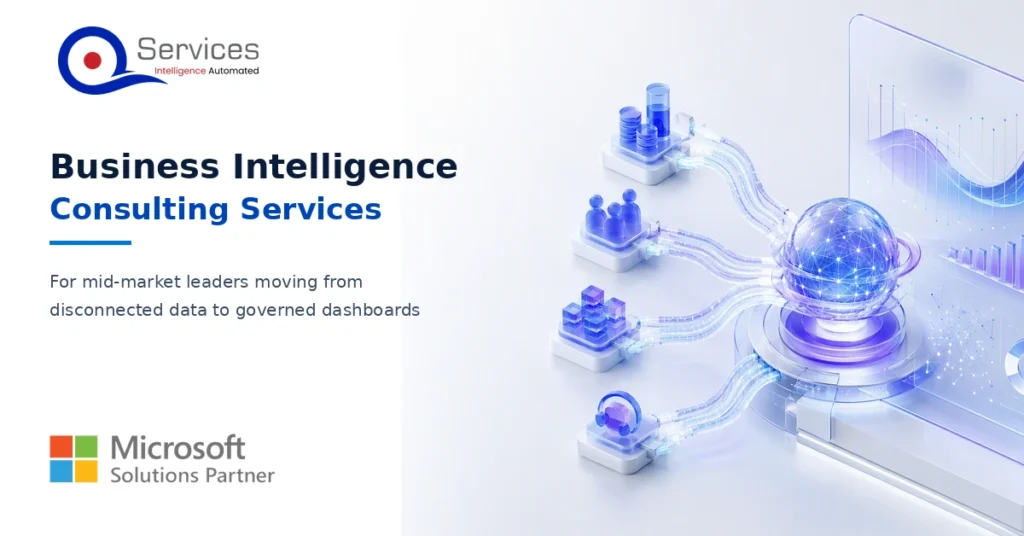
Business intelligence consulting services should give a mid-market company a governed way to make decisions. Attractive dashboards are only the visible part. The useful outcome is a system in which source data, metric definitions, access, releases, ownership, and support still work after the consultants leave.
In a Microsoft Solutions Partner vs Microsoft Partner comparison, the difference is validation. A company can participate in the Microsoft AI Cloud Partner Program without holding a customer-facing Solutions Partner designation. A designated Solutions Partner has met Microsoft’s current threshold in a specific solution pathway: at least 70 out of 100 partner capability points, with more than zero points in every required metric, based on performance, skilling, and customer success data recorded in Partner Center.
How do you build a legacy application modernization strategy for Azure? A legacy application modernization strategy assigns the right treatment to each workload, then sequences the work around business value, technical evidence, and operational risk. For Azure, that means choosing among retire, retain, rehost, replatform, refactor, rearchitect, rebuild, and replace instead of treating cloud migration as a blanket mandate. Direct Answer A legacy application modernization strategy for Azure should classify
Eager to discuss about your project?
Share your project idea with us. Together, we’ll transform your vision into an exceptional digital product!
Business intelligence consulting services should give a mid-market company a governed way to make decisions. Attractive dashboards are only the visible part. The useful outcome is a system in which source data, metric definitions, access, releases, ownership, and support still work after the consultants leave.
In a Microsoft Solutions Partner vs Microsoft Partner comparison, the difference is validation. A company can participate in the Microsoft AI Cloud Partner Program without holding a customer-facing Solutions Partner designation. A designated Solutions Partner has met Microsoft’s current threshold in a specific solution pathway: at least 70 out of 100 partner capability points, with more than zero points in every required metric, based on performance, skilling, and customer success data recorded in Partner Center.