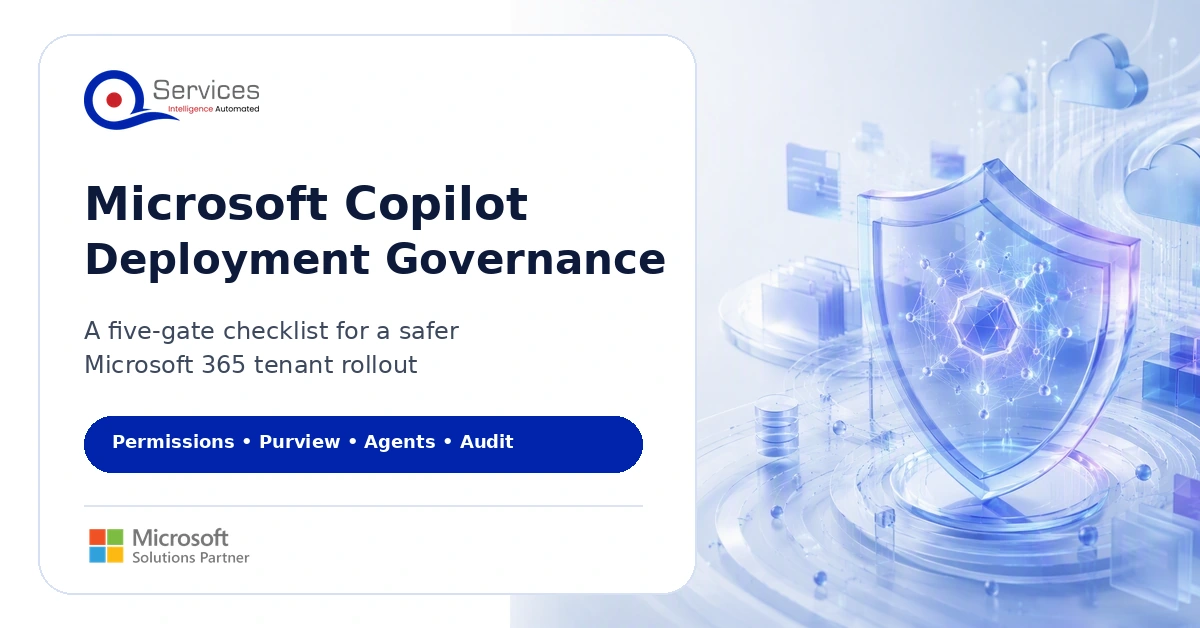
Microsoft Copilot deployment governance starts with fixing the access people already have, then adding information-protection controls, agent change control, human approval, audit readiness, and measured rollout gates. Copilot respects Microsoft 365 permissions, so the safest deployment is not a single settings exercise: it is a repeatable operating model that proves the right users can reach the right data and that consequential actions remain under accountable human control.
This checklist gives CIOs, CISOs, and IT directors a practical path from tenant discovery to production operations. It separates Microsoft-documented product behavior from QServices deployment recommendations, because a licensed capability is not the same thing as a configured, tested, and owned control.
Copilot can improve search, drafting, meeting follow-up, analysis, and everyday Microsoft 365 work. The same grounding that makes it useful can also make forgotten oversharing easier to discover. The core risk is rarely that Copilot bypasses an access rule. The risk is that an old rule, broad group, sharing link, or unowned site already permits more access than the organization intended.
In This Article, You’ll Learn
Why permission-trimmed responses can still expose inappropriately shared information
How to run five deployment gates for scope, data, controls, agents, and operations
Which SharePoint, Purview, audit, eDiscovery, connector, and reporting capabilities Microsoft documents
How to build a practical M365 Copilot governance checklist with evidence at every gate
Where human-in-the-loop Copilot approval belongs and which actions should never run unattended
How to pilot, expand, measure, and review Copilot without treating governance as a launch-day project
In This Article, You'll Learn
Why Microsoft Copilot deployment governance starts with existing access
The five-gate M365 Copilot governance checklist
Gate 1: Define scope, accountability, and license dependencies
Gate 2: Establish the Copilot data exposure baseline
Gate 3: Configure durable access and information-protection controls
Eager to discuss about your project?
Share your project idea with us. Together, we’ll transform your vision into an exceptional digital product!
Why Microsoft Copilot deployment governance starts with existing access
Microsoft states that Microsoft 365 Copilot grounds responses through Work IQ in organizational content that the signed-in user is already permitted to access. It works within the Microsoft 365 permission model. That is an important security property, but it does not decide whether the permission itself remains appropriate. Microsoft’s guidance for a secure and governed data foundation directs administrators to find overshared, ownerless, inactive, and sensitive SharePoint and OneDrive content.
A useful distinction is permission-trimmed versus appropriately authorized. A response can be permission-trimmed and still reveal information through an Everyone except external users grant, an organization-wide sharing link, a nested group, direct access assigned years ago, or broken inheritance nobody currently owns. Copilot may reduce the effort required to find and combine that information.
For rollout planning, treat Copilot tenant readiness as an authorization and information-lifecycle review, not a license-assignment checklist. Inventory the content available to each proposed pilot persona. Rank findings by sensitivity, audience breadth, and business impact. Put an accountable owner and next review date on every production site in pilot scope. Do not grade readiness by the number of sites reviewed alone; grade it by whether critical exposure paths have been closed or explicitly accepted.
This makes readiness measurable through data-access reports, owner attestations, sharing-link reviews, negative permission tests, sensitivity-label coverage, and approved exceptions.
Five evidence-based gates keep Copilot deployment decisions visible and reversible.
The five-gate M365 Copilot governance checklist
QServices recommends five decision gates: scope and accountability, data exposure, durable controls, agents and actions, and production operations. These gates are an operating practice, not a Microsoft product feature. They apply a human-in-the-loop governance model to Copilot so every expansion has a named approver, evidence packet, and rollback decision.
Gate
Decision
Minimum evidence
Primary owner
1. Scope and accountability
Do we know what is being enabled, for whom, and under whose authority?
Is the pilot population’s reachable data acceptably authorized?
Permission baseline, site ownership, sharing review, critical finding closure
Data protection and SharePoint owners
3. Durable controls
Do labels, DLP, access boundaries, retention, and monitoring behave as designed?
Simulation results, positive and negative tests, exception register
Security and compliance owners
4. Agents and actions
Can every agent, connector, tool, action, identity, cost, and approval path be accounted for?
Inventory, risk assessment, action tests, approval packet, rollback plan
Agent owner and architecture owner
5. Operate and improve
Can support, audit, incident response, adoption, and recurring review sustain the service?
Runbooks, drill results, usage baseline, review calendar, sign-off
Service owner and incident-response owner
A gate is not a meeting. It is a decision backed by artifacts. “Security reviewed it” is not sufficient evidence. A useful gate record names the reviewed scope, lists unresolved findings, links to test output, records who accepted residual risk, and states what would trigger rollback. That paper trail matters when licensing, preview behavior, connectors, agents, or business use changes after launch.
Gate 1: Define scope, accountability, and license dependencies
Microsoft describes the Copilot Control System as a framework with three pillars: security and governance, management controls, and measurement and reporting. The associated controls are distributed across the Microsoft 365 admin center, SharePoint admin center, Microsoft Purview, Power Platform admin center, and Copilot Studio. There is no single governance switch that configures the entire system.
Microsoft also distinguishes foundational capabilities associated with A3, E3, and G3 plans from optimized Purview and Defender capabilities associated with A5, E5, and G5 plans. Individual features can have further license and cloud limitations. For example, organizations with at least one Microsoft Copilot license receive access to a defined subset of SharePoint Advanced Management capabilities, while the SharePoint sensitivity-label report requires E5 or G5. Worldwide, GCC, GCC High, and DoD availability can differ.
Before making a control commitment to the steering committee, build a control-to-license-to-role matrix. For each requirement, identify the Microsoft capability, prerequisite subscription, administrative role, configured policy, test method, evidence location, owner, and fallback. A checkbox that says “Purview” hides too much. Specify whether you mean DLP for Copilot prompts, sensitivity labels, Audit, eDiscovery, retention, Insider Risk, or another capability.
Then define deployment boundaries. Record the business units, pilot users, apps, agents, connectors, grounding sources, data regions, external sharing conditions, and action types in scope. Include what is explicitly out of scope. Copilot Chat, licensed Microsoft 365 Copilot experiences, metered agents, and custom agents can have different capabilities and cost paths. Governance must follow the exact scenario rather than the Copilot brand name.
Assign five accountable roles
Executive sponsor: owns the business case, risk appetite, and final go or no-go decision.
Service owner: owns configuration, support, change management, adoption, and the operating backlog.
One person may hold more than one role in a smaller organization, but no responsibility should be implicit. The gate passes when the charter, RACI, matrix, scope register, risk tiers, and review schedule are approved. It fails when the organization cannot say who can pause an agent, revoke a connector, approve a high-impact action, or accept an unresolved exposure.
Gate 2: Establish the Copilot data exposure baseline
Start with the people who will receive licenses, then work outward to the data they can reach. A tenant-wide inventory is useful, but the first deployment decision depends on the effective access of the pilot cohort. Test realistic personas such as a finance analyst, sales manager, HR partner, executive assistant, contractor, and recently transferred employee. Include both expected access and access they must not have.
SharePoint Data Access Governance includes snapshot reporting for permission state and sensitivity-label distribution, plus activity reports for sharing links and content shared with Everyone except external users. Microsoft recommends combining baseline snapshots with recurring activity review. Site access reviews can delegate remediation to site owners. The reporting and remediation depth depends on licensing, so verify the current Microsoft documentation and your subscriptions before treating a report as available.
For the baseline, collect and prioritize the following:
Sites and OneDrive locations exposed through Everyone, Everyone except external users, large groups, anonymous links, organization links, or broad guest access
Ownerless and inactive sites, stale teams, departed owners, unmanaged archives, and content without a defensible retention purpose
Broken inheritance, nested security groups, direct user grants, and group membership that no longer matches job function
Sensitive business content without item-level labels, including payroll, legal matters, acquisitions, customer records, intellectual property, health information, and credentials
Content reachable through connectors, shared mailboxes, group mailboxes, Teams, and agent knowledge sources
Do not remediate by popularity. A rarely visited acquisition site with broad permissions may carry more risk than a busy portal with routine material. Score findings by sensitivity, exposure breadth, business consequence, and ease of containment. Resolve critical findings affecting pilot users before license assignment. Otherwise, exclude the affected users or data domain from the pilot, or record time-limited risk acceptance.
Site-owner attestation should be specific. Ask owners to confirm the site’s purpose, membership, sharing model, sensitive-data categories, external participants, retention need, and next review date. A generic “looks good” response does not prove authorization. Sample the result centrally, because owners may misunderstand group nesting or link behavior.
Copilot risk is managed as a control stack, beginning with source permissions and ending with accountable decisions.
Gate 3: Configure durable access and information-protection controls
The exposure baseline finds problems. Gate 3 proves that the controls used to prevent recurrence work in the actual Copilot experiences being enabled.
Correct source permissions before suppressing discovery
Microsoft is retiring Restricted SharePoint Search, and Microsoft blocked new enablement beginning July 31, 2026. Existing configurations use an allow list of no more than 100 SharePoint sites. Microsoft described it as a temporary measure for Copilot deployment, not a scalable security boundary. It also does not revoke access to content that a user owns, received directly, or previously accessed.
Key Insight Microsoft is retiring Restricted SharePoint Search, and Microsoft blocked new enablement beginning July 31, 2026.
Do not design a new rollout around Restricted SharePoint Search, and never describe search suppression as access control. Repair memberships, links, inheritance, ownership, and sharing defaults at the source. Where a firm group-based SharePoint boundary is required, evaluate Restricted Access Control. Where temporary discoverability reduction is useful during remediation, evaluate Restricted Content Discovery against current Microsoft guidance, document the limitation, and set an expiry date.
Label content, not only containers
Copilot and agents recognize organizational sensitivity labels. Microsoft documents that encrypted content generally requires the user to have both VIEW and EXTRACT rights before Copilot can return its contents. A label on a Team, Microsoft 365 Group, or SharePoint site does not automatically apply that label to every file, page, list, email, or chat inside it.
Inspect item-level classification coverage in pilot data. Define which content requires encryption, what extraction rights are appropriate, and how unlabeled sensitive content will be discovered. Test labels in every enabled workload because behavior and limitations can differ. A well-labeled site with unlabeled files is not complete coverage.
Use Purview DLP with tested rule intent
The Microsoft 365 Copilot and Copilot Chat DLP location can block a response when a prompt contains configured sensitive information types, block external web search for such a prompt while allowing approved internal grounding, prevent Copilot from processing files or emails with selected sensitivity labels, and exclude email received from external senders from grounding, summarization, and citation.
Microsoft documents important caveats. Sensitive-information-type and sensitivity-label conditions cannot be combined in the same DLP rule. Label-based email processing support applies to emails sent on or after January 1, 2025. Calendar invitations are not supported by that control. An item blocked from processing may still appear as a citation even when its contents are not used.
Start in simulation where appropriate, review matches with business and privacy owners, tune false positives, and test enforcement with positive and negative personas. Record the prompt, expected policy match, expected user experience, actual result, alert evidence, and remediation owner. Build an exception process with a named approver and expiry date. A policy that exists but has never been tested in Copilot is an assumption.
Can your tenant prove it is ready before Copilot licenses are assigned?
Map permissions, controls, owners, tests, and rollout gates in a fixed-scope readiness blueprint.
Gate 4: Govern agents, connectors, and consequential actions
Microsoft 365 Copilot governance now extends beyond chat and document assistance. Agents can ground on shared tenant data, use connectors, and invoke actions. That expands the review from “What can a user read?” to “What can this agent retrieve, infer, create, send, change, or delete, using which identity?”
Inventory every agent and its operating context
Copilot Chat users can use enabled agents from the Agent Store that do not add cost. Agents accessing shared tenant data such as SharePoint or Copilot connector content may use metered consumption, and Microsoft says metered agents are off by default for Copilot Chat users. Licensed Microsoft Copilot users receive work-grounded chat, in-app experiences, and custom-agent capabilities. Specific roles and tenant permissions govern configuration, assignment, deployment, and management.
Maintain one tenant-wide register covering agent name, purpose, owner, publisher, environment, audience, license or metering model, budget owner, knowledge sources, connector dependencies, tools, actions, runtime identity, delegated permissions, DLP behavior, risk tier, test status, expiry, and emergency disable method. Block or retire agents that are unowned, duplicative, unsupported, unused, or outside policy.
Require an approval packet before production. It should show intended users, representative prompts, grounding boundaries, action definitions, authentication model, permission tests, data-residency considerations, threat findings, prompt-injection tests, cost limits, monitoring, support path, rollback steps, and reapproval date. Reassess after any material change to knowledge, tools, audience, permissions, model behavior, or billing.
Test connector identity and visibility separately
Copilot connectors ingest or reference data outside Microsoft 365 for Microsoft Search and Copilot. An AI Administrator can monitor connection state and control partner-connector visibility in Copilot and Copilot Search. Disabling visibility excludes that source from Copilot Chat and Copilot Search while crawling may continue. Microsoft notes that partner connections are visible by default and that this visibility setting does not affect declarative agents. Indexed content can remain searchable while a connector is paused or under some failure conditions.
Keep new connector exposure unavailable until access-control-list mapping and identity resolution pass positive and negative persona tests. Verify deletion propagation, stale-content behavior, crawl credentials, data residency, monitoring, and emergency disablement. Test Microsoft Search, Copilot Search, Copilot Chat, and each declarative agent separately. One successful visibility test does not prove every retrieval path follows the same rule.
Review before execution or risk-based sampled approval, with rollback
High
External sends, publication, access changes, deletion, payments, production changes, legal or employment decisions
Explicit approval by a named, authorized human who sees the target, data, effect, and rollback implications
This tiering is a QServices recommendation. Microsoft’s broader AI-agent shared-responsibility guidance assigns customers responsibility for human approval of high-impact actions and recommends gates around writes, deletes, payments, production changes, and external sends. Never make an agent the final decision-maker for consequential employment, legal, financial, medical, safety, or access decisions.
The approval screen must show the proposed action, target, recipients, material data, effect, and rollback method. Approval must be attributable and retained. Sampling moderate-risk activity is appropriate only with defined selection rules, escalation thresholds, and a rapid stop mechanism.
Gate 5: Prove audit, eDiscovery, incident response, and operations
A production service needs evidence after the prompt. Gate 5 tests whether the organization can reconstruct an event, contain it, support users, and distinguish adoption from security telemetry.
Know what Copilot audit records can answer
Microsoft Purview Audit records who interacted with an AI application, when and where the interaction occurred, and references to resources accessed. The AccessedResources field can include resource identifiers, SharePoint URLs, action type, success status, sensitivity-label identifier, policy details, and cross-prompt-injection detection. Audit can also indicate use of Bing web search.
Microsoft says audit data is for security and compliance, not the authoritative source for adoption measurement. Use Microsoft 365 admin-center usage reporting or the Microsoft Copilot Dashboard for adoption. This separation prevents investigators from weakening audit logic to satisfy business dashboards or treating raw prompt counts as evidence of value.
Key Insight Use Microsoft 365 admin-center usage reporting or the Microsoft Copilot Dashboard for adoption.
Rehearse discovery and authorized deletion
Supported Copilot prompts and responses are stored as items in the user’s Exchange Online mailbox and can be searched through Purview eDiscovery using the Copilot activity item class. Searching requires an eDiscovery role. Deletion requires the Search and Purge role and is constrained by Microsoft’s per-mailbox purge limits. Holds and retention policies can prevent permanent deletion until they are properly handled.
Rehearse a realistic Copilot data-spill investigation before broad rollout. Start with an alert or user report. Identify the interaction and account, collect audit evidence, determine accessed resources and web grounding, search the relevant Copilot items in eDiscovery, preserve evidence, contain accounts or agents, and obtain legal or records authorization before any purge. Record search criteria, reviewers, hold decisions, removal and reapplication of holds, deletion results, user notification, root cause, control change, and closure approval.
Define service operations before expansion
Publish a support route for inaccurate output, inaccessible content, suspected exposure, blocked prompts, label problems, agent failures, and unexpected cost.
Set alert ownership and service-level targets for sensitive-resource access, DLP incidents, risky agent actions, connector health, and unusual web grounding.
Document emergency steps for disabling an agent, removing assignments, hiding or pausing a connector, revoking credentials, and limiting the affected cohort.
Set retention periods for prompts, responses, audit records, agent output, action records, approvals, and incident evidence according to legal and records requirements.
Review open exceptions at a defined cadence. Every exception needs an owner, rationale, compensating control, expiry date, and renewal authority.
The gate passes when a tabletop drill demonstrates that the right teams can find evidence, make an authorized containment decision, and restore service safely. A policy document without a drill is not operational proof.
Copilot governance continues through sandbox, pilot, wave rollout, operations, and reassessment.
Run Copilot tenant readiness as a staged operating cycle
Microsoft’s setup guidance uses a Pilot, Deploy, and Operate sequence. It recommends beginning with selected early adopters, expanding license assignment after testing, and monitoring usage and adoption. The Microsoft Copilot Dashboard covers readiness, adoption, impact, and sentiment, although depth varies by subscription, license count, processing state, and cloud.
Microsoft documents that dashboard access requires an eligible Microsoft 365 or Office 365 business or enterprise subscription and an active Exchange Online account. Assigning at least one Copilot license starts Copilot data processing. Tenants with at least 50 Copilot licenses or 50 Viva Insights licenses receive additional agent, benchmark, group, and survey capabilities. Processing can take up to seven days, and national-cloud availability differs.
Place a sandbox before Microsoft’s Pilot, Deploy, and Operate lifecycle so risky configuration and agent behavior can be tested without normal production reach. Use four operational stages:
Sandbox
Validate administrative roles, policies, labels, DLP behavior, audit visibility, connector identity, action approval, cost controls, and rollback. Use synthetic or tightly controlled data. Test both permitted and denied cases. Record product limitations rather than forcing a pass.
Pilot
Select cross-functional users who represent real work but do not have unrestricted access. Include security, compliance, support, and records participants alongside business champions. Establish workflow baselines before use. Train users to verify sources, recognize sensitive content, report errors, and avoid treating generated output as authority.
Wave rollout
Expand by business unit or risk domain only after data, control, support, adoption, and incident thresholds pass. Avoid assigning all purchased licenses merely to improve utilization. A delayed cohort is less costly than an exposure whose cause cannot be reconstructed.
Operate and reassess
Review sharing activity, DLP events, agents, connectors, costs, adoption, support, and exceptions monthly. Each quarter, rerun permission baselines, attest site and agent ownership, test high-risk approvals, and examine retention. Trigger an out-of-cycle assessment when Microsoft retires or changes a control, a preview reaches production, licensing shifts, a connector changes, an agent gains an action, or a material incident occurs.
A practical 90-day rollout plan
This sample schedule is a QServices operating recommendation, not a Microsoft-mandated timeline. Adjust it for tenant size, regulatory obligations, content volume, technical debt, and the authority needed to remediate access.
Period
Focus
Key outputs
Exit condition
Days 1-15
Charter and discovery
RACI, scenario register, control-license matrix, pilot personas, site and agent inventory
Agent register, connector test matrix, action tiers, approval screens, cost and rollback controls
Every production component has an owner and approval
Days 66-80
Pilot
Training, support telemetry, workflow baselines, adoption observations, incident drill
Security, support, and outcome thresholds pass
Days 81-90
Wave decision
Executive evidence packet, residual risks, next cohort, operating calendar, license decisions
Named leaders approve expansion or pause
Do not compress exposure remediation to protect a launch date. If permission debt is extensive, narrow the pilot rather than redefining critical findings as acceptable. The schedule should make risk visible, not force a predetermined answer.
Measure adoption, value, risk, and cost separately
Copilot success cannot be reduced to active users or prompts. A user can be active without producing a better business result. A department can save time while creating unacceptable review burden. An agent can generate value but incur unpredictable metered cost. Keep four views:
Adoption: enabled users, active users, app and agent use, repeat use, training completion, and cohort progression.
Outcome: cycle time, rework, quality defects, response time, throughput, employee sentiment, and a workflow-specific baseline.
Risk: DLP blocks, oversharing findings, sensitive-resource access, support escalations, unsafe actions, approval rejects, policy exceptions, and incidents.
Economics: license utilization, metered agent use, support effort, remediation effort, connector cost, and cost per accepted business outcome.
Use the admin-center usage report or Copilot Dashboard for adoption. Use Purview audit and compliance tooling for security and investigation. Join those views only in a controlled management report. Do not use prompt volume as a productivity claim, and do not mine security audit records as if they were employee-performance telemetry.
Review by cohort and workflow. Compare invoice drafting with meeting summaries only if their baselines and acceptance standards are comparable. Reassign unused licenses after a fair enablement period. Retire agents that duplicate functionality, create continuing support debt, lack an owner, or fail to produce enough value for their risk and cost.
Seven governance shortcuts that fail in production
Copilot did not create the underlying permission problem
explain that Copilot uses existing access, then fix inappropriate access at the source. This keeps the technical diagnosis accurate and directs remediation toward permissions, ownership, sharing, labels, and lifecycle.
Permission trimming is not sufficient governance
test whether access is appropriate for each persona. Permission trimming enforces configured access. Governance establishes whether that configuration reflects current business authority.
Check control prerequisites before buying licenses
maintain a feature, license, role, configuration, and evidence matrix. A Copilot license includes access to some SharePoint Advanced Management capabilities, but it does not grant every SAM, Purview, Defender, or reporting feature.
Do not base a new rollout on Restricted SharePoint Search
do not. New enablement was blocked on July 31, 2026, and Microsoft is retiring it. Repair access and use durable controls suitable for the actual requirement.
Container labels do not classify every item
verify item-level classification and encryption rights. Container labels do not automatically classify all content within the container.
Review the agent, connectors, and actions as one system
examine knowledge, identity, ACL mapping, tools, consequences, cost, monitoring, and rollback as one system. Test each retrieval experience because a connector visibility setting may not govern declarative agents.
Make human approval an auditable control
identify the authorized approver, display the full proposed action, record the decision, test rollback, and audit the result. Human approval without context or authority is a delay, not a control.
Microsoft Copilot deployment governance checklist for executives
Use this condensed list at a steering review. The detailed evidence should remain in the operating repository.
Business purpose, pilot users, enabled experiences, data domains, agents, connectors, and action types are documented.
Executive sponsor, service owner, data-protection owner, agent owner, and incident-response owner are named.
Every promised control has a verified license, administrative role, configuration, test, owner, and evidence location.
Pilot users’ effective access has been tested, including broad groups, links, guests, nested membership, and broken inheritance.
Ownerless, inactive, overshared, and sensitive sites have been remediated or excluded from scope.
Production sites and agents have accountable owners, review dates, and retirement paths.
Source permissions have been corrected. Search suppression is not presented as access control.
Content-level sensitivity labels, encryption rights, and workload behavior have been tested.
Purview DLP rules have been simulated, tuned, enforced where approved, and tested with positive and negative cases.
External sharing and default-link behavior match the intended audience and have an exception process.
Every agent has an inventory record, risk tier, owner, permissions, cost model, tests, monitoring, expiry, and rollback plan.
Connector ACL mapping, identity resolution, stale content, deletion propagation, visibility, and emergency disablement have been tested.
High-risk actions require explicit approval by a named human with sufficient context and authority.
Copilot audit events are searchable by the security and compliance team.
eDiscovery and authorized purge procedures have been rehearsed with retention and hold requirements.
Users know how to verify sources, handle sensitive content, and report suspicious or incorrect output.
The help desk has categories, escalation routes, response targets, and current runbooks.
Adoption, outcome, risk, and cost measures are separate and baseline-driven.
Sandbox, pilot, wave, and operate gates have explicit pass, pause, and rollback criteria.
Monthly, quarterly, and material-change reviews are on the calendar.
If several items are “partly” complete, do not average them into a green status. Identify which missing evidence could cause material harm and hold that cohort at the current gate. Governance is useful because it permits a deliberate no-go decision.
Takeaway: deploy evidence before licenses
Microsoft provides meaningful controls across SharePoint, Purview, Microsoft 365 administration, Power Platform, and Copilot Studio. Those capabilities support governance, but they do not choose owners, repair every permission, classify every file, approve risky actions, or prove that your incident team can respond. Those are operating responsibilities.
A defensible Microsoft Copilot deployment governance program begins with effective access, proceeds through tested labels and DLP, covers every agent and connector, preserves human authority over consequential actions, and continues with audit, incident response, adoption, cost, and recurring review. The result is not a risk-free tenant. It is a tenant where known risks have owners, evidence, boundaries, and a decision path.
For a quick view of business use cases before building the governance plan, read seven ways Microsoft Copilot can reduce routine work. If the rollout also includes workflows, agents, or broader automation, QServices’ Power Platform development practice can connect the technical build to environment, DLP, identity, support, and change-control requirements.
Need a fixed-scope readiness plan for your tenant? Book a Blueprint Call to map the pilot scope, data exposure, control dependencies, agent inventory, evidence gates, and next 90 days.
Key Takeaways
Microsoft states that Microsoft 365 Copilot grounds responses through Work IQ in organizational content that the signed-in user is already permitted to access.
QServices recommends five decision gates: scope and accountability, data exposure, durable controls, agents and actions, and production operations.
Microsoft describes the Copilot Control System as a framework with three pillars: security and governance, management controls, and measurement and reporting.
Start with the people who will receive licenses, then work outward to the data they can reach.
Co-Founder and CTO, QServices IT Solutions Pvt Ltd
Rohit Dabra is the Co-Founder and Chief Technology Officer at QServices, a software development company focused on building practical digital solutions for businesses. At QServices, Rohit works closely with startups and growing businesses to design and develop web platforms, mobile applications, and scalable cloud systems. He is particularly interested in automation and artificial intelligence, building systems that automate routine tasks for teams and organizations.
No. Microsoft documents that Copilot grounds responses in organizational data the signed-in user is permitted to access. The material risk is inappropriate existing access that Copilot can make easier to find and combine.
The central structural risk is overshared Microsoft 365 content already reachable through broad groups, sharing links, stale guests, direct grants, or broken inheritance.
No. Microsoft blocked new enablement beginning July 31, 2026 and is retiring the feature. It was a temporary discoverability measure, not an access-control boundary.
Purview DLP can control prompts, web search, selected labeled files or emails, and externally received email, subject to documented conditions and workload caveats.
Require explicit named approval for high-impact actions such as external sends, publication, permission changes, deletion, payments, production changes, and consequential decisions.
There is no universal duration. Readiness depends on tenant size, permission debt, data sensitivity, enabled scenarios, and the time required to test controls and resolve critical exposure.
Business Intelligence Consulting Services for Mid-Market Rohit Dabra | Updated on September 13, 2026 Table of Contents Facebook-f Twitter Linkedin Summarize in: Get an instant AI summary of this article OpenAI Perplexity Claude Introduction Key Insight By Rohit Dabra, Co-Founder & CTO Updated on September 13, 2026 Business intelligence consulting services should give a mid-market company a governed way to make decisions. Attractive dashboards are only the visible part.
Microsoft Solutions Partner vs Microsoft Partner Rohit Dabra | Updated on September 13, 2026 Table of Contents Facebook-f Twitter Linkedin Summarize in: Get an instant AI summary of this article OpenAI Perplexity Claude Introduction In a Microsoft Solutions Partner vs Microsoft Partner comparison, the difference is validation. A company can participate in the Microsoft AI Cloud Partner Program without holding a customer-facing Solutions Partner designation. A designated Solutions Partner
Legacy Application Modernization Strategy for Azure Rohit Dabra | Updated on September 12, 2026 Table of Contents Facebook-f Twitter Linkedin Summarize in: Get an instant AI summary of this article OpenAI Perplexity Claude Introduction A legacy application modernization strategy assigns the right treatment to each workload, then sequences the work around business value, technical evidence, and operational risk. For Azure, that means choosing among retire, retain, rehost, replatform, refactor, rearchitect,
Eager to discuss about your project?
Share your project idea with us. Together, we’ll transform your vision into an exceptional digital product!