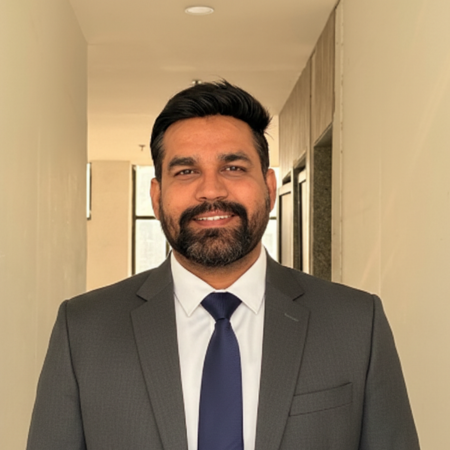
By Sahil Kataria, Chief Executive Officer, QServices
Updated June 13, 2026
Sahil Kataria is the CEO of QServices, a Microsoft Solutions Partner delivering AI agents and custom software for regulated industries. He leads enterprise AI strategy and FinTech delivery. LinkedIn ↗
Written from QServices' hands-on delivery work and reviewed by Rohit Dabra, Chief Technology Officer, QServices, before publishing.
We are not based in Dallas, but our mobile app development team works with Dallas companies across FinTech, Healthcare, Telecom, and Logistics, with 2 to 4 hours of daily CT overlap. QServices is a remote-first software consultancy serving Texas businesses on mobile projects from concept to App Store submission.
See our full services overview or jump to our mobile app development pricing guide.
What Dallas buyers typically need from mobile app development
Dallas concentrates FinTech companies, regional banks, healthcare providers, telecom carriers, and freight logistics operators. Apps in these sectors share specific requirements: regulated data handling, high transaction volume, and audiences that mix consumers with internal operations staff.
- FinTech and banking apps: Payment processing, account management, and peer-to-peer transfers. Companies handling personal financial data of Texas residents must account for the Texas Data Privacy Act (TDPSA). Apps tied to insurance products fall under the Texas Department of Insurance (TDI), which has its own technical requirements for consumer-facing tools.
- Healthcare patient apps: HIPAA-compliant appointment scheduling, telehealth, and secure messaging. Dallas health systems expect HIPAA technical safeguard documentation before a mobile app goes live.
- Telecom customer portals: Self-service billing, usage dashboards, and support flows. Telecom clients typically need both a consumer app and an internal technician tool sharing one backend.
- Logistics and fleet apps: Real-time tracking, dispatch management, and proof-of-delivery tools for carriers running routes across Texas and nationally.
If your app handles personal data of Texas residents, TDPSA compliance is scoped into the project from day one, not added after development. We document data handling practices in the scoping document before a single line of code is written.
How we work with Dallas clients
Our engineering team is in India (IST). Dallas runs on Central Time (CT). The difference is approximately 11.5 hours. That gives us 2 to 4 hours of real-time overlap each morning Dallas time, while our engineers are still in their evening hours.
Here is what a typical engagement looks like:
- Daily async updates: A written status note delivered each morning CT, before your team starts work. No meeting required to know where things stand.
- Weekly video standups: Scheduled at 8 to 10 AM CT, which is 7:30 to 9:30 PM IST for our team. Sprint reviews run at the same slot.
- Communication tools: Microsoft Teams or Slack, your choice. All decisions go into writing.
- On-site visits: Available for major milestones, such as design sign-off and user acceptance testing, if your team wants an in-person session.
All commits and pull requests are logged in UTC. Every code review, comment, and approval carries a timestamp both teams can verify independently. Code reviews are completed within 24 hours of submission.
Relevant work in similar markets
We do not yet have a published case study from a Dallas-based company. Our closest work is in mobile FinTech, which maps directly to Dallas's largest tech sector.
We built a React Native mobile payment platform for SomBank, an Islamic bank introducing digital payments in Somalia. The app reached 100,000 downloads with a 4.8-star rating at launch and handled P2P transfers, merchant QR payments, and international remittances over an Azure Service Bus and Azure B2C backend.
Case Study
Mobile Payment Platform for SomBank (Somalia)
Islamic bank, Somalia
100K+ downloads with 4.8-star rating on launch
First digital payment platform in a predominantly cash-based economy, enabling P2P transfers, merchant QR payments, and international remittances
React Native.NETMySQLAzure Service BusAzure B2C
We also shipped Chikwama, a digital wallet built with Xamarin Forms and Azure SQL, introducing real-time peer-to-peer transfers and QR merchant payments to a market with no prior digital payment infrastructure. Both projects dealt with regulated financial data, real-time transaction processing, and high user volume on mobile. Those are the same constraints Dallas FinTech and Logistics clients bring to mobile projects.
Case Study
Digital Wallet Mobile App (Chikwama)
Digital payments company, emerging market economy
Introduced real-time digital peer-to-peer transfers to a previously cash-dependent economy
QR code merchant payments and bank account top-ups with SignalR real-time transaction updates
Xamarin FormsASP.NET Web APISQL AzureAzureSignalR
For Dallas healthcare clients: our team has built apps in regulated environments and is familiar with HIPAA technical safeguard requirements. We do not have a published healthcare mobile case study to cite, and we say so plainly rather than invent one. See our mobile app development for FinTech page for more on our financial services delivery work.
What mobile app development costs for a typical Dallas project
All pricing is in USD. A typical mobile app engagement for a Dallas company falls in the $35,000 to $200,000 range depending on scope and compliance requirements.
- Small scope ($35K to $80K): Single-platform app (iOS or Android), core feature set, standard authentication, one backend API integration. Typical timeline: 12 to 16 weeks.
- Medium scope ($80K to $150K): Cross-platform React Native build, multiple API integrations, push notifications, in-app analytics and crash reporting from day one. Timeline: 16 to 20 weeks.
- Full platform ($150K to $200K+): Consumer app plus admin portal, offline capability, complex state management, App Store and Play Store submission handled end to end. Timeline: 20 to 24 weeks.
If your project falls under HIPAA or involves TDI-regulated insurance data, add 15 to 25 percent for compliance overhead. Each non-trivial system integration (EHR, payment gateway, logistics API) adds $3,000 to $12,000 to the estimate. See the full mobile app development pricing breakdown for a detailed scope guide.
How to start working with us
The process has three steps:
- Discovery call (30 minutes): We ask about your target users, platform preference, compliance requirements, and integration points. You leave with a clear sense of scope and timeline.
- Scoping document: Within five business days, we send a written scope covering features, tech stack, compliance items, and a fixed or time-and-materials estimate.
- Project start: Once the scope is approved and a deposit is placed, we begin with a sprint zero to finalize architecture and design direction before writing production code.
Use the contact form on this page to request a call. We respond within one business day.
Do you work with Dallas companies remotely?
Yes. All of our Dallas engagements are fully remote. Our team is in India on IST, and we schedule 2 to 4 hours of live overlap with your Central Time business hours each day. We communicate via Microsoft Teams or Slack. For data residency, apps serving Texas residents under TDPSA can be architected on US-based Azure regions (East US or South Central US), which we configure by default for regulated projects. Projects touching insurance products regulated by TDI include a TDI technical requirement review in the scoping phase.
Ready to discuss your project?
Share your requirements with QServices. Our engineers will give you a straight answer on fit, timeline, and cost — no sales scripts.
Book a Free Consultation
Frequently Asked Questions
Do you have an office in Dallas? +
No. QServices is remote-first and based in India. We serve Dallas clients across FinTech, Healthcare, Telecom, and Logistics through fully remote engagements. Our team schedules 2 to 4 hours of daily overlap with Central Time business hours, giving you a live window each morning to reach engineers directly.
What is the time difference between Dallas and your team? +
Dallas runs on Central Time (CT) and our team is in India (IST). The difference is approximately 11.5 hours. We schedule weekly standups and sprint reviews between 8 and 10 AM CT, which is 7:30 to 9:30 PM IST for us. Async written updates cover the remaining hours.
Have you worked with companies in Texas before? +
We do not have a published Texas case study yet. Our closest published work is in mobile FinTech: the SomBank React Native payment platform (100,000 downloads, 4.8-star rating at launch) and the Chikwama digital wallet, both in regulated financial environments with high transaction volume on mobile.
How do you handle Texas Data Privacy Act (TDPSA) compliance in mobile apps? +
TDPSA compliance is scoped during discovery, not retrofitted. For apps handling personal data of Texas residents, we architect data storage on US-based Azure regions by default, design consent and data subject request flows into the app from the start, and document all data handling practices in the scoping document before development begins.
What industries do you serve in the Dallas market? +
We work with Dallas companies in FinTech (payment apps, banking platforms), Healthcare (HIPAA-compliant patient apps), Telecom (customer portals and technician tools), and Logistics (fleet tracking, dispatch, proof-of-delivery). Each project is scoped individually based on your industry's regulatory and technical requirements.