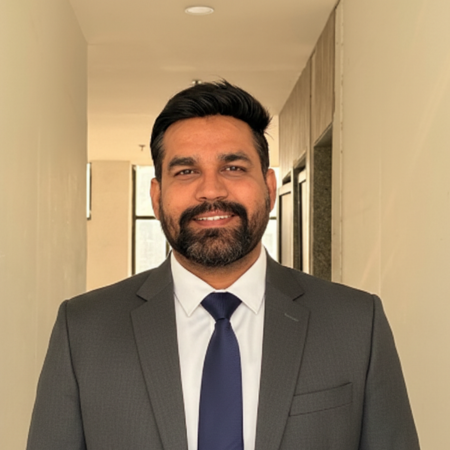
By Sahil Kataria, Chief Executive Officer, QServices
Updated June 13, 2026
Sahil Kataria is the CEO of QServices, a Microsoft Solutions Partner delivering AI agents and custom software for regulated industries. He leads enterprise AI strategy and FinTech delivery. LinkedIn ↗
Written from QServices' hands-on delivery work and reviewed by Rohit Dabra, Chief Technology Officer, QServices, before publishing.
QServices is not headquartered in Munich, but we deliver mobile app development for companies across Bavaria's manufacturing, automotive, and insurance sectors on remote engagements with four hours of CET morning overlap each day. We are a remote-first software consultancy serving Munich businesses on iOS, Android, and React Native. See our full services overview or jump to our mobile app development pricing guide.
What Munich buyers typically need from mobile app development
Munich's economy is shaped by manufacturing, automotive, and insurance. In those sectors, mobile apps typically solve operational problems rather than consumer-facing ones. Common project types we see from this market:
- Automotive supply chain apps for tracking parts, logistics, and production line status
- Field service and inspection apps for manufacturing operations
- Insurance agent portals and claims-handling apps on iOS and Android
- Internal tooling for warehouse, fleet, and maintenance teams
- GDPR-compliant customer apps for BaFin-regulated financial services
Any app handling personal data of users in Germany falls under EU GDPR. The Bavarian State Office for Data Protection Supervision (BayLDA) is the competent supervisory authority for private-sector companies headquartered in Bavaria. Apps in financial services or insurance also fall under BaFin operational requirements. We design data flows and storage choices to meet both frameworks from the start of a project, not as an afterthought.
How we work with Munich clients
Our team is based in India (IST, UTC+5:30). Munich operates on CET (UTC+1 in winter, UTC+2 in summer), giving us four hours of overlap each morning, roughly 9:00am to 1:00pm CET, for calls, reviews, and decisions.
A typical engagement runs like this: three 45-minute video standups per week during the overlap window, fortnightly sprint reviews via Teams or Zoom, a shared Jira board, and async Slack updates in between. All code is reviewed in GitHub with inline comments before merging. Staging environments are available continuously so your team can test between sprints.
We work in two-week sprints and deliver working software at the end of each one. Stakeholders in Munich approve scope at sprint boundaries rather than waiting for a waterfall delivery. For manufacturing or insurance projects with compliance review cycles, we can structure delivery around regulatory gates rather than calendar sprints.
For milestone reviews, scope sign-off, or acceptance testing, we can arrange on-site visits to Munich if the project budget supports it. Most clients find this unnecessary after the first sprint once the async rhythm is established.
Relevant work in similar markets
We have not built apps for Munich-based automotive or manufacturing clients. We will say that plainly.
The closest work we can point to is in regulated financial services. For SomBank, an Islamic bank in Somalia, we built a full mobile payment platform on React Native, .NET, Azure Service Bus, and Azure B2C. The app reached 100,000+ downloads with a 4.8-star rating at launch and introduced P2P transfers, merchant QR payments, and international remittances to a previously cash-based economy. That project required meeting strict identity and payment regulatory requirements, real-time transaction handling, and consumer-grade performance under regulatory scrutiny.
Those same requirements appear in BaFin-regulated insurance and financial apps. The tech stack, React Native on the front end, .NET APIs, and Azure for hosting, is also what we bring to automotive supplier portals or manufacturing operations apps. The regulated environments differ; the engineering discipline does not.
We also built Chikwama, a digital wallet on Xamarin Forms, Azure, and SignalR, delivering real-time peer-to-peer transactions in a similarly regulated context.
Case Study
Mobile Payment Platform for SomBank (Somalia)
Islamic bank, Somalia
100K+ downloads with 4.8-star rating on launch
First digital payment platform in a predominantly cash-based economy, enabling P2P transfers, merchant QR payments, and international remittances
React Native.NETMySQLAzure Service BusAzure B2C
Case Study
Digital Wallet Mobile App (Chikwama)
Digital payments company, emerging market economy
Introduced real-time digital peer-to-peer transfers to a previously cash-dependent economy
QR code merchant payments and bank account top-ups with SignalR real-time transaction updates
Xamarin FormsASP.NET Web APISQL AzureAzureSignalR
What mobile app development costs for a typical Munich project
Our rates are in USD. Most Munich engagements use our standard rate of $35/hr for mid-level engineers, or $65/hr for senior architects. Typical project brackets:
- Small scope ($8,000–$30,000): Single-platform MVP (iOS or Android), 200–600 hours, core features only
- Medium scope ($30,000–$120,000): Cross-platform React Native app with backend integrations, 600–2,000 hours
- Full platform ($120,000–$400,000): Multi-role app with admin portal and API integrations, 2,000+ hours
For apps subject to BaFin oversight or GDPR compliance review, add 15–25% for regulatory overhead. Third-party compliance reviews add $5,000–$20,000. Each ERP or manufacturing system integration adds $3,000–$12,000. Ongoing maintenance retainers run $2,000–$4,000 per month. Invoicing is in USD; your finance team handles EUR conversion.
See our full mobile app development cost breakdown for a detailed view by platform and feature set.
How to start working with us
Starting an engagement takes three steps:
- Discovery call: A 45-minute call to understand your app idea, target users, and business goals. No cost, no commitment.
- Scoping document: We send a written brief covering features, architecture, timeline (typically 12–24 weeks), and cost range in USD.
- Project start: Once scope is agreed, we assign a dedicated team and begin sprint one during the CET morning overlap window.
Can you work with Munich companies remotely?
Yes. We work with Munich clients entirely remotely. Our team is in India (IST, UTC+5:30), and Munich operates on CET, which gives us four hours of morning overlap (9:00am to 1:00pm CET) for calls and sprint reviews. We use Microsoft Teams or Slack, manage code in GitHub, and track work in Jira. For German clients, all personal data handling is GDPR-compliant, and we can discuss BaFin-specific requirements during the discovery call.
Ready to discuss your project?
Share your requirements with QServices. Our engineers will give you a straight answer on fit, timeline, and cost — no sales scripts.
Book a Free Consultation
Frequently Asked Questions
Do you have an office in Munich? +
No. We work entirely remotely from India. Munich operates on CET, and our team is on IST (UTC+5:30), giving us four hours of daily morning overlap from 9:00am to 1:00pm CET. We use Microsoft Teams or Slack for communication, GitHub for code reviews, and Jira for project tracking. On-site visits to Munich are possible for key project milestones if the budget supports it.
What is the time difference between Munich and your team? +
Munich is on CET (UTC+1) in winter and CEST (UTC+2) in summer. Our team is on IST (UTC+5:30). The difference is 4.5 hours in winter and 3.5 hours in summer. In practice, this gives us four solid hours of workday overlap in the CET morning, which is enough for standups, sprint reviews, and architecture decisions without scheduling heroics.
Have you worked with companies in Germany or Bavaria before? +
We have not had Munich or German clients to date. Our closest relevant work is in regulated financial services: a React Native mobile payment platform for an Islamic bank in Somalia that reached 100,000+ downloads with a 4.8-star rating, and a digital wallet app for an emerging market payments company. We are transparent about where our direct experience sits.
How do you handle GDPR and BaFin requirements for German clients? +
All apps we build for EU clients are designed with GDPR-compliant data flows from the start. For BaFin-regulated projects in insurance or financial services, we budget 15 to 25 percent regulatory overhead and recommend a third-party compliance review costing $5,000 to $20,000. For Bavarian companies, the BayLDA is the competent supervisory authority. We advise engaging a German Datenschutzbeauftragter for apps handling personal data at scale.
What industries do you serve in the Munich market? +
We target Munich's three primary sectors: manufacturing, automotive, and insurance. Typical use cases include field service and inspection apps, automotive supply chain tracking tools, insurance agent portals, and claims-handling apps. We also build internal mobile tooling for warehouse and logistics operations, and GDPR-compliant customer-facing apps for BaFin-regulated financial services.