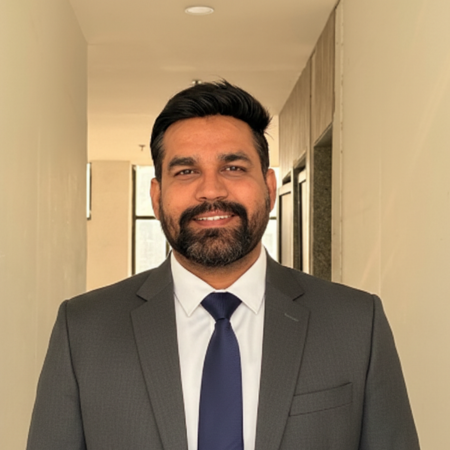
By Sahil Kataria, Chief Executive Officer, QServices
Updated June 13, 2026
Sahil Kataria is the CEO of QServices, a Microsoft Solutions Partner delivering AI agents and custom software for regulated industries. He leads enterprise AI strategy and FinTech delivery. LinkedIn ↗
Written from QServices' hands-on delivery work and reviewed by Rohit Dabra, Chief Technology Officer, QServices, before publishing.
We are not headquartered in New York, but we work with New York clients across FinTech, Insurance, Media, and Real Estate on remote engagements with full ET hours of daily overlap. QServices is a remote-first software consultancy serving New York businesses that need to move off aging .NET Framework, VB.NET, or monolithic codebases before those systems become a compliance liability. Learn more about our software development and modernization services.
What New York buyers typically need from legacy system modernization
New York's financial services and insurance sectors operate under some of the tightest technology compliance requirements in the country. When we talk with buyers here, the trigger is usually one of three things: an upcoming NY DFS Part 500 audit that the old codebase cannot pass, a SHIELD Act review that flags how legacy systems store personally identifiable information, or an SEC/FINRA examination that requires audit trails the existing architecture never produced.
- FinTech and wealth management: Replacing custom trading platforms, portfolio analytics tools, and broker-dealer back offices built on .NET Framework 2.x or 3.5, often with no documentation and one engineer who still understands the data model.
- Insurance: Modernizing policy administration and claims systems that have grown into VB.NET or early .NET monoliths, where adding a new product line means touching files across hundreds of modules.
- Media: Migrating content management and licensing platforms off end-of-life stacks to containerized .NET 8 services that can be deployed and scaled independently.
- Real Estate: Re-platforming property management, transaction, and tenant portals built pre-cloud that now block mobile access and API integrations with modern data providers.
NY DFS Part 500 (23 NYCRR 500) requires covered entities to maintain secure, auditable systems with specific encryption, access control, and multi-factor authentication requirements. Legacy codebases frequently fail these audits because security controls were retrofitted rather than designed in. For New York financial services firms, modernization is often the only path to compliance, not an optional upgrade. SHIELD Act obligations around PII protection apply equally to insurance carriers, media companies, and real estate platforms that handle New York residents' data.
How we work with New York clients
New York runs on Eastern Time. Our team works ET-aligned hours, which means you have access to engineers and architects during your business day. In practice, we overlap with your core hours from 9 am to 6 pm ET for standups, code reviews, and architecture decisions.
Our standard engagement cadence: a daily async written update in your team's Slack or Microsoft Teams channel, a 30-minute standup three times a week, a live architecture review at each sprint boundary, and a recorded demo at the end of every two-week sprint. Code reviews happen in your pull request tool, with comments and approvals from our engineers during your working hours.
For milestone reviews on larger engagements ($200,000 and above), we can arrange on-site visits to New York. Most clients find the async-plus-video cadence sufficient, but the option exists. All source code lives in your repository from day one, and we set up GitHub Actions or Azure DevOps pipelines your team can run without us.
Relevant work in similar markets
We have not yet completed an engagement specifically for a New York-headquartered company. We say this plainly because honesty about our client list builds more trust than vague references to unnamed local work.
The closest work in our portfolio is a stock market analytics platform we built for an investment management company. The existing system was a collection of spreadsheets and manual processes with no central data store. We replaced it with a role-authenticated dashboard on Azure, automated scraping pipelines, and real-time financial metrics including category-based stock classification (XLF, XLV, XLY) with P/E ratios and earnings schedule tracking. The client operates in wealth management, which is directly adjacent to the FinTech and financial services needs we see from New York buyers.
Case Study
Stock Market Analytics and Categorization Platform (StockScrapping)
Investment management and stock analytics company
Replaced scattered spreadsheets with a role-authenticated dashboard on Azure with automated scraping and real-time financial metrics
Category-based stock classification (XLF, XLV, XLY) with P/E ratios and earnings schedule tracking
ASP.NET MVC.NET CoreEntity FrameworkSQL ServerMicrosoft Azure
We have also run a complete VB.NET-to-.NET 8 modernization for a global EHS software company, converting a legacy monolith to a React and .NET 8 architecture on Azure. That engagement required migrating Management of Change, Incidents and Events, and Action Items modules with business logic and data integrity rules carried over intact, which is the hardest part of any modernization. The same pattern applies directly to New York insurance and real estate systems built on comparable vintage stacks.
Case Study
Global EHS Platform Modernization: VB.NET Monolith to .NET 8 and React
Global Environmental Health and Safety software company
Improved scalability, maintainability, and global performance after rewriting a legacy VB.NET monolith
Streamlined Management of Change, Incidents and Events, Action Items, LMS training, and automated scheduling in a single platform
.NET 8ReactAzureAxios REST Client
What legacy modernization costs for a typical New York project
All engagements are priced in USD. For New York projects, budget ranges typically fall into these brackets:
- Assessment and proof of concept ($8,000 to $30,000): Codebase audit, strangler-fig migration plan, one module migrated as a working proof. 200 to 600 hours. The right entry point if you need to validate approach before committing to a full re-platform.
- Module-by-module migration ($60,000 to $120,000): Full application modernized in phases, one service at a time. 600 to 2,000 hours. The most common starting point for FinTech and insurance clients who cannot risk a big-bang cutover.
- Platform-scale re-architecture ($120,000 to $500,000): Complete re-platform including data migration, CI/CD pipeline setup, and Azure infrastructure. 2,000 to 6,000 hours. For clients running core business systems on legacy stacks that now block new product development.
For New York financial services firms operating under NY DFS Part 500, add 15 to 25 percent for compliance overhead: audit logging design, encryption-at-rest configuration, and the documentation packages your compliance team needs before go-live. Each non-trivial system integration (trading APIs, policy engines, third-party data feeds) adds $3,000 to $12,000 per connection. Typical timelines run 16 to 52 weeks depending on scope.
For full pricing detail, see our legacy modernization pricing page.
How to start working with us
We follow three steps to get a New York engagement started:
- Discovery call (30 minutes): You describe the system, the pain point, and the timeline pressure. We ask about the codebase, integration surface, and any compliance obligations. No sales pitch.
- Scoping document (3 to 5 business days): We send a written scope covering approach, team composition, timeline, and a fixed or capped time-and-materials estimate.
- Project start: Once scope is agreed, we provision repository access, set up communication channels, and begin the codebase assessment in week one.
Use the contact form on this page to request a discovery call. We respond within one business day during ET hours.
Can you work with New York companies remotely?
Yes. We are a remote-first firm with no physical office in New York. Our team works ET-aligned hours, giving you full business-day availability for questions, reviews, and decisions. We use Slack or Microsoft Teams for daily communication, GitHub or Azure DevOps for code, and Zoom or Teams for standups and demos.
For data residency, New York's SHIELD Act requires that personal data of New York residents be protected with reasonable safeguards. We build on Microsoft Azure with data residency configured to US East regions by default. For clients under NY DFS Part 500, we provide the encryption documentation, access control design, and audit log specifications your compliance team needs before go-live. Your data lives in your Azure subscription from day one. We do not store it on our own infrastructure.
For related work in regulated industries, see our legacy modernization for FinTech page.
Ready to discuss your project?
Share your requirements with QServices. Our engineers will give you a straight answer on fit, timeline, and cost — no sales scripts.
Book a Free Consultation
Frequently Asked Questions
Do you have an office in New York? +
No. QServices is a remote-first firm based in India with no physical New York office. We work ET-aligned hours, giving New York clients full business-day access to our engineers and architects. Most clients run the entire engagement over Slack or Teams, GitHub, and twice-weekly video calls without any issues.
What is the time difference between New York and your team? +
Our team is in India on IST (UTC+5:30). New York runs on Eastern Time (EST UTC-5, EDT UTC-4), a 9.5 to 10.5 hour difference. We work ET-aligned hours so our engineers are available during your business day, not just overnight. You do not wait until the next morning for a code review or a decision.
Have you worked with companies in New York before? +
We have not yet completed an engagement for a New York-headquartered company and we say so plainly. Our closest portfolio work is a stock market analytics platform for an investment management firm, built on Azure and .NET with real-time financial data pipelines. That experience is directly relevant to New York FinTech and wealth management needs.
How do you handle NY DFS Part 500 and SHIELD Act requirements? +
We build on Microsoft Azure with US East data residency by default. For NY DFS Part 500 engagements, we design audit logging, encryption at rest, and access controls to meet 23 NYCRR 500 requirements and deliver the documentation packages your compliance team needs before go-live. Budget 15 to 25 percent above base project cost for compliance overhead on regulated scopes.
What industries do you serve in the New York market? +
We focus on New York's FinTech, Insurance, Media, and Real Estate sectors. These are the industries where aging .NET Framework and VB.NET systems most frequently hit compliance ceilings under NY DFS Part 500, the SHIELD Act, and SEC/FINRA requirements, and where the cost of delaying modernization is highest.