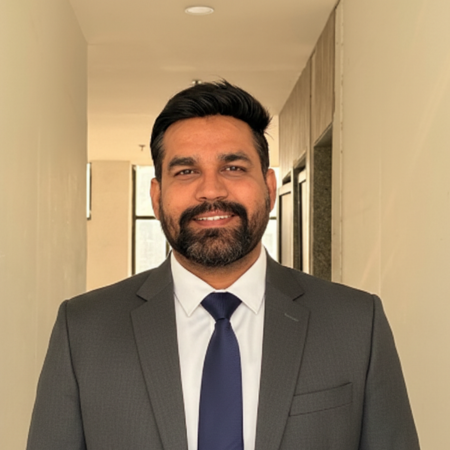
By Sahil Kataria, Chief Executive Officer, QServices
Updated June 13, 2026
Sahil Kataria is the CEO of QServices, a Microsoft Solutions Partner delivering AI agents and custom software for regulated industries. He leads enterprise AI strategy and FinTech delivery. LinkedIn ↗
Written from QServices' hands-on delivery work and reviewed by Rohit Dabra, Chief Technology Officer, QServices, before publishing.
QServices is not based in Washington DC. We are a remote-first software consultancy serving DC government agencies, consulting firms, nonprofits, and healthcare organizations on legacy system modernization projects. Our India-based team operates as a Microsoft Solutions Partner with team members aligned to ET hours for daily standups and code reviews.
What Washington DC Buyers Typically Need from Legacy System Modernization
DC's primary industries create compliance requirements that other US markets do not share. Government agencies and federal contractors procure technology work under the Federal Acquisition Regulations (FAR), which require specific documentation, audit trails, and vendor accountability structures. Any cloud migration involving federal data must also satisfy FedRAMP authorization requirements before a system can go live. These are not bolt-on additions. They shape the architecture, the migration sequence, and the testing approach from the first scoping call.
Within DC's market, we see four common modernization project types:
- Federal agency or contractor legacy systems: COBOL, older .NET Framework, or Access-based applications that need migration to .NET 8 on Azure, with FAR-compliant documentation throughout.
- Healthcare IT at HHS-adjacent organizations: Clinical or administrative systems subject to HIPAA technical safeguard requirements that must stay operational during migration.
- Nonprofit grant and program management platforms: Internal tools built a decade ago that create reporting bottlenecks and staff knowledge-concentration risk as teams turn over.
- Consulting firm internal tooling: Proprietary client-delivery systems from the early 2010s that can no longer support current workflow and headcount demands.
For any project touching federal cloud infrastructure, we scope FedRAMP requirements into the architecture from day one. Adding them after the fact increases cost and delays authorization timelines.
How We Work with Washington DC Clients
Our engineering team is based in India (IST, UTC+5:30). Washington DC operates on Eastern Time (UTC-4 in summer, UTC-5 in winter). That puts us 9.5 hours ahead of EDT and 10.5 hours ahead of EST. We bridge this by holding two windows each day: a morning standup at 8:00 AM to 9:00 AM ET (6:30 PM to 7:30 PM IST in summer), and a midday review at 12:00 PM ET (10:30 PM IST) for projects with tighter iteration loops. This is the practical reality of the timezone gap, and we plan around it rather than minimize it.
Outside those windows, we work async via Microsoft Teams or Slack. Every pull request gets a written review comment before the next standup. Every Friday, we send a one-page progress note covering what shipped, what is blocked, and the plan for the following week. Decision-makers do not need to attend every standup. We write up action items and share them the same day.
We do not travel to DC for regular project work. For milestone reviews, including architecture sign-off, UAT kick-off, and go-live readiness, we run extended video sessions with the full stakeholder group. We have not done on-site visits for US clients to date.
Relevant Work in Similar Markets
We do not have a published Washington DC client. The two modernization projects we can share are in adjacent industries. Neither is a federal government project, but both involved compliance requirements and audit continuity constraints similar to what DC's government and healthcare buyers typically face.
Our most relevant engagement is a global EHS platform modernization for an environmental health and safety software company. We migrated a VB.NET monolith to .NET 8 and React on Azure using a strangler-fig pattern, keeping the legacy system live until each module passed validation. The work required management-of-change documentation, incident tracking continuity, and role-based access controls that had to be preserved exactly through the migration. These are the same categories of requirement that federal contractors and healthcare IT teams in DC deal with.
Case Study
Global EHS Platform Modernization: VB.NET Monolith to .NET 8 and React
Global Environmental Health and Safety software company
Improved scalability, maintainability, and global performance after rewriting a legacy VB.NET monolith
Streamlined Management of Change, Incidents and Events, Action Items, LMS training, and automated scheduling in a single platform
.NET 8ReactAzureAxios REST Client
The second project replaced spreadsheet-based investment analytics for a wealth management firm with a role-authenticated Azure dashboard featuring automated data scraping and real-time financial metrics. The integration surface and data integrity requirements are comparable to what DC consulting firms and government contractors typically handle.
Case Study
Stock Market Analytics and Categorization Platform (StockScrapping)
Investment management and stock analytics company
Replaced scattered spreadsheets with a role-authenticated dashboard on Azure with automated scraping and real-time financial metrics
Category-based stock classification (XLF, XLV, XLY) with P/E ratios and earnings schedule tracking
ASP.NET MVC.NET CoreEntity FrameworkSQL ServerMicrosoft Azure
If you are evaluating us for a government or healthcare modernization project, we are happy to walk through the EHS engagement in detail on a discovery call.
What Legacy System Modernization Costs for a Typical Washington DC Project
Legacy modernization costs in DC follow our standard USD ranges, with a regulatory overhead factor applied for FAR, FedRAMP, or HIPAA scope. Typical project brackets:
- Medium scope ($8,000 to $30,000, 200 to 600 hours): Single-system migration, limited integration surface, no compliance overhead. Practical for nonprofit internal tools or small consulting firm platforms.
- Large scope ($30,000 to $120,000, 600 to 2,000 hours): Multi-module strangler-fig migration, database migration, and API gateway introduction. Typical for healthcare IT or mid-size contractor systems.
- Platform scope ($120,000 to $400,000, 2,000 to 6,000 hours): Full platform rebuild with parallel operation, broad integration surface, and compliance documentation. Relevant for federal agency or large consulting firm engagements.
Add 15 to 25 percent to any estimate if FAR compliance documentation, FedRAMP authorization steps, or HIPAA technical safeguards are in scope. Each non-trivial system integration adds $3,000 to $12,000 to the project cost. See the full breakdown on our legacy modernization pricing page.
How to Start Working with Us
Three steps to get a project moving:
- Discovery call (30 minutes): We review your current system, the pain points, and your timeline. A screenshot of the system and a plain-English description of what it does is enough to start.
- Scoping document: Within five business days, we deliver a written scope covering migration approach, milestones, risks, and a fixed or time-and-materials estimate.
- Project start: Once the scope is approved, we assign an engineer and begin the architecture assessment in week one.
Use the contact form on this page to book a discovery call. We respond within one business day.
Can You Work with Washington DC Companies Remotely?
Yes. Our India-based team works with US clients remotely. For Washington DC clients specifically, the time difference is 9.5 hours ahead of EDT in summer and 10.5 hours ahead of EST in winter. We schedule morning standups at 8:00 AM ET and a midday review window for projects that need it. That gives us two to three hours of live daily overlap.
For data residency, we provision all project infrastructure on Azure US regions (East US or US Gov) from day one. We do not move client data through Indian infrastructure unless explicitly agreed in writing. For projects requiring FedRAMP authorization, we scope the Authority to Operate process into the project timeline from the initial architecture review. If your procurement process requires FAR-compliant vendor documentation, we provide that as part of project kick-off.
Ready to discuss your project?
Share your requirements with QServices. Our engineers will give you a straight answer on fit, timeline, and cost — no sales scripts.
Book a Free Consultation
Frequently Asked Questions
Do you have an office in Washington DC? +
We do not have a physical office in Washington DC. We are a remote-first consultancy based in India. DC clients work with us through Microsoft Teams or Slack with standups scheduled at 8:00 AM ET. We are transparent about this from the first call because how the engagement runs matters more than a local address.
What is the time difference between Washington DC and your team? +
Our India team is 9.5 hours ahead of Eastern Daylight Time in summer and 10.5 hours ahead of Eastern Standard Time in winter. We schedule DC client standups at 8:00 AM ET (6:30 PM IST in summer) and a midday ET window for teams with tighter iteration cycles, giving us two to three hours of live daily overlap.
Have you worked with Washington DC companies or federal government clients before? +
We do not have a published Washington DC client. Our most relevant modernization work is a compliance-heavy EHS platform rewrite from VB.NET to .NET 8 on Azure, which required audit trail continuity and management-of-change documentation across multiple regulatory jurisdictions. We reference this engagement on every government or healthcare modernization evaluation call.
How do you handle FedRAMP or FAR compliance requirements? +
FAR and FedRAMP add 15 to 25 percent to project cost and require compliance documentation from day one. We recommend including your security and procurement teams in the initial scoping call so requirements shape the architecture before development starts. For FedRAMP, we scope the Authority to Operate timeline into the project plan from the first architecture review.
What industries do you serve in the Washington DC market? +
In the Washington DC market, we work with government agencies and federal contractors, healthcare organizations, nonprofits, and consulting firms. For government and healthcare work, we build FAR compliance documentation and HIPAA technical safeguard requirements into the project scope from the start rather than treating them as a final audit step.