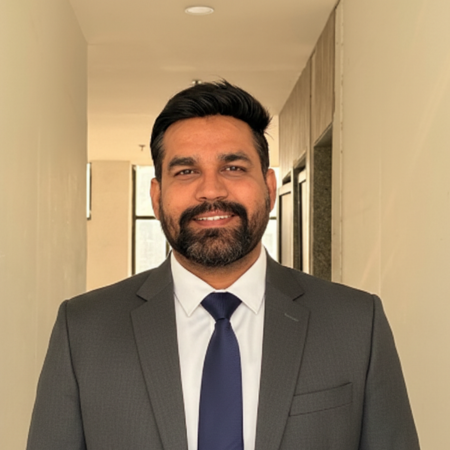
By Sahil Kataria, Chief Executive Officer, QServices
Updated June 13, 2026
Sahil Kataria is the CEO of QServices, a Microsoft Solutions Partner delivering AI agents and custom software for regulated industries. He leads enterprise AI strategy and FinTech delivery. LinkedIn ↗
Written from QServices' hands-on delivery work and reviewed by Rohit Dabra, Chief Technology Officer, QServices, before publishing.
QServices is a remote-first software consultancy based in India. We are not headquartered in Minneapolis, but we work with Minnesota companies in healthcare, retail, FinTech, and manufacturing on legacy system modernization engagements. Our engineering team overlaps with Central Time mornings for roughly 2 to 3 hours daily. Below is a direct account of how that engagement works and what it costs.
What Minneapolis buyers typically need from legacy modernization
Minneapolis concentrates several industries that built substantial technical debt on platforms from the 2000s and early 2010s. The most common modernization needs we see, mapped to the city's primary sectors:
- Healthcare (HITECH scope): Migrating patient-data platforms off aging ASP.NET or VB.NET codebases while preserving audit trails and encryption at rest. Minnesota's data breach notification law (Minn. Stat. § 325E.61) requires disclosure to affected residents whenever personal information is accessed without authorization, so any migration must document chain-of-custody at every step. HITECH extends HIPAA enforcement to third-party contractors handling protected health information, meaning any vendor involved must sign a Business Associate Agreement.
- Retail: Replacing monolithic inventory, order management, and POS systems with API-first services that support omnichannel operations without a full blackout window.
- Manufacturing: Rewriting end-of-life VB.NET or C++ production-floor software on .NET 8 with role-based access, Azure cloud connectivity, and automated data pipelines.
- FinTech: Extracting business logic from decade-old SQL Server stored procedures into independently deployable service layers, typically through a strangler-fig migration.
How we work with Minneapolis clients
Our engineers work on Indian Standard Time (UTC+5:30). Minneapolis runs on Central Time (UTC-5 in summer CDT, UTC-6 in winter CST), which puts our team 10.5 to 11.5 hours ahead of your working day. We address this with a fixed overlap window: 7:30 AM to 10:30 AM CT, which falls in our late afternoon. That window covers daily standups, code review walkthroughs, and any calls that need a live decision.
The week-to-week cadence:
- Daily standup at 7:30 AM CT via Microsoft Teams or Slack (15 minutes)
- Async sprint updates posted before the end of your CT business day, reviewed by our team the next morning
- Bi-weekly sprint demo, recorded and shared with any stakeholders who cannot attend live
- Monthly written progress summary tied to agreed milestones and budget spent to date
For engagements over $150K, or at key transition points such as architecture sign-off and UAT kickoff, we can arrange travel to Minneapolis. For most projects in the $60K to $200K range, fully remote has worked well across our North American client base.
Relevant work in similar markets
We have not delivered a project specifically in Minneapolis. The two case studies below cover manufacturing and FinTech, both primary industries in the Minneapolis market. We are noting this plainly rather than implying local experience we do not have.
Manufacturing, EHS platform modernization: We rewrote a global Environmental Health and Safety platform from a legacy VB.NET monolith to .NET 8 and React on Azure. The original system managed incidents, action items, LMS training, and automated scheduling across regions on a codebase that had become difficult to extend or deploy safely. After modernization, the client had improved scalability and a platform that could expand to new markets without re-engineering the core logic.
Case Study
Global EHS Platform Modernization: VB.NET Monolith to .NET 8 and React
Global Environmental Health and Safety software company
Improved scalability, maintainability, and global performance after rewriting a legacy VB.NET monolith
Streamlined Management of Change, Incidents and Events, Action Items, LMS training, and automated scheduling in a single platform
.NET 8ReactAzureAxios REST Client
FinTech/investment analytics: For an investment management firm, we replaced scattered spreadsheets with a role-authenticated Azure dashboard that automated stock scraping and surfaced real-time financial metrics including P/E ratios, earnings schedules, and sector classification across XLF, XLV, and XLY.
Case Study
Stock Market Analytics and Categorization Platform (StockScrapping)
Investment management and stock analytics company
Replaced scattered spreadsheets with a role-authenticated dashboard on Azure with automated scraping and real-time financial metrics
Category-based stock classification (XLF, XLV, XLY) with P/E ratios and earnings schedule tracking
ASP.NET MVC.NET CoreEntity FrameworkSQL ServerMicrosoft Azure
Both projects used a strangler-fig approach: incremental migration rather than a full stop-and-rewrite. That is the pattern we recommend for most Minneapolis clients as well. For more context on how we structure these engagements, see our legacy modernization service page.
What legacy modernization costs for a typical Minneapolis project
Our rates run from $20/hour (standard) to $65/hour (senior architect), billed in USD. Typical engagement brackets for a Minneapolis scope:
- Small ($2K-$8K, 80-200 hours): Single-module extraction, API wrapper around a legacy service, or proof-of-concept migration of one subsystem.
- Medium ($8K-$30K, 200-600 hours): Defined service boundary extracted from a monolith, with tests, documentation, and integration with one or two existing systems.
- Large ($30K-$120K, 600-2,000 hours): Multi-service strangler-fig migration of a core platform, including data migration, API gateway setup, and Docker containerization on Azure.
- Platform ($120K-$400K, 2,000+ hours): End-to-end modernization of a legacy product, typically 16 to 52 weeks from start to production.
For Minnesota healthcare clients, add 15 to 25 percent for HITECH compliance overhead and Business Associate Agreement scope. Each non-trivial system integration adds $3,000 to $12,000. Full pricing detail is on our legacy modernization pricing page.
How to start working with us
Three steps:
- Discovery call (30 minutes): We review your current stack, the drivers behind the modernization, and any compliance requirements under Minnesota law or HITECH.
- Scoping document: Within one week, we deliver a written scope with a recommended migration approach, a risk log covering common pitfalls (big-bang rewrites, data integrity gaps, underestimated integration surface), and a cost estimate tied to the brackets above.
- Project start: Once scope is agreed and contracts are signed, we begin the first sprint within two weeks.
Book the discovery call using the contact form below. We respond within one business day, Central Time.
Can you work with Minneapolis companies remotely?
Yes. We are India-based and do not have a Minneapolis or Minnesota office. The 10.5 to 11.5 hour time difference with Central Time is managed through the fixed morning overlap window (7:30 to 10:30 AM CT) described above, with async-first communication in Teams or Slack. Sprint reviews are recorded, decisions are documented in writing, and monthly summaries keep stakeholders current without requiring live calls outside the overlap window.
On data handling: all project work happens in your Azure tenant or in agreed US-based cloud environments. Our engineers do not store client data locally. For healthcare organizations under HITECH, we sign a Business Associate Agreement as a standard contract step. Minnesota's data breach notification requirement under Minn. Stat. § 325E.61 covers your organization; we document how we handle any personal information in scope to support your disclosure obligations if a security event occurs. For HITECH enforcement context, the HHS HITECH Act enforcement guidance sets out the contractor obligations that apply to any vendor in your modernization project.
Ready to discuss your project?
Share your requirements with QServices. Our engineers will give you a straight answer on fit, timeline, and cost — no sales scripts.
Book a Free Consultation
Frequently Asked Questions
Do you have an office in Minneapolis? +
No. QServices is based in India and operates fully remotely. We do not have an office in Minneapolis or anywhere in Minnesota. We work with Minneapolis clients through a fixed morning overlap window from 7:30 to 10:30 AM Central Time, with async communication in Teams or Slack outside that window. On-site visits to Minneapolis are available for large engagements at key milestones.
What is the time difference between Minneapolis and your team? +
Minneapolis runs on Central Time. Our team in India works on IST (UTC+5:30), which is 10.5 hours ahead of CDT in summer and 11.5 hours ahead of CST in winter. We schedule a fixed overlap window from 7:30 to 10:30 AM CT each morning. Outside that window, communication is async, with all sprint updates posted before the end of your CT business day.
Have you worked with companies in Minneapolis before? +
Not specifically in Minneapolis. Our closest relevant work includes a manufacturing platform modernization from a VB.NET monolith to .NET 8 and React on Azure for a global EHS software company, and a FinTech analytics dashboard for an investment management firm. Both manufacturing and FinTech are primary sectors in Minneapolis. We are transparent about this rather than fabricating local references.
How do you handle Minnesota data residency and HITECH requirements? +
All project work runs in your Azure tenant or agreed US-based cloud environments. Our team does not store client data locally. For healthcare clients, HITECH applies and we sign a Business Associate Agreement as a standard step. Minnesota's data breach notification law (Minn. Stat. § 325E.61) covers your organization; we document our data handling throughout the engagement to support your disclosure obligations.
What industries do you serve in the Minneapolis market? +
We have delivered work relevant to manufacturing, FinTech, and healthcare, which are three of the four primary sectors in Minneapolis. We do not yet have a retail modernization case study, though our API-first architecture experience applies directly to retail omnichannel work. All Minneapolis engagements are delivered remotely with CT morning overlap hours.