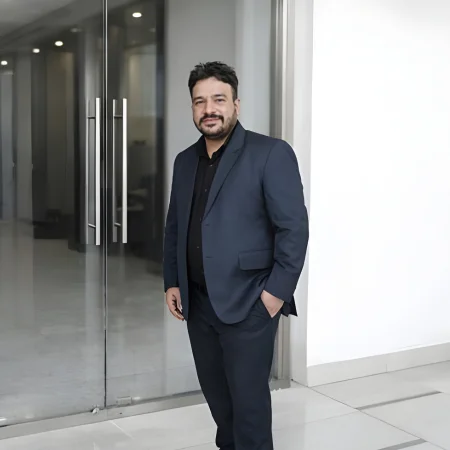
By Sahil Kataria, Chief Executive Officer, QServices
Updated June 13, 2026
Sahil Kataria is the CEO of QServices, a Microsoft Solutions Partner delivering AI agents and custom software for regulated industries. He leads enterprise AI strategy and FinTech delivery. LinkedIn ↗
Written from QServices' hands-on delivery work and reviewed by Rohit Dabra, Chief Technology Officer, QServices, before publishing.
QServices is a remote-first software consultancy offering legacy system modernization to Amsterdam businesses in FinTech, logistics, and tech. We are based in India, not Amsterdam, and work with Netherlands clients on remote engagements with four to five hours of daily CET morning overlap.
What Amsterdam buyers typically need from legacy modernization
Amsterdam's FinTech sector operates under dual regulatory pressure: EU GDPR governs data handling across all industries, and the DNB (De Nederlandsche Bank) adds specific requirements for financial institutions. Legacy systems built before these regimes create compliance exposure that a modernization project must address at the architecture level, not just the application surface.
Common project types from companies across Amsterdam's three main sectors:
- FinTech: Aging .NET Framework or Java monoliths that cannot meet DNB audit requirements or connect to modern payment rails. The typical approach for Amsterdam's FinTech companies is a strangler-fig migration to .NET 8 with clear API boundaries and GDPR Article 25 (data protection by design) built into each new service from day one.
- Logistics: On-premise warehouse management and routing systems that cannot expose APIs to partner platforms. Modernization usually means extracting core domain logic into API-first services behind an API gateway, with the legacy system running in parallel until each subdomain is fully replaced.
- Tech companies: Startup-era monoliths where the original engineers are leaving and business logic is concentrated in people rather than documentation. The immediate risk is knowledge loss, not just the tech stack.
For any Amsterdam project touching personal data, the Dutch Data Protection Authority (Autoriteit Persoonsgegevens) is the lead supervisory authority under GDPR. We factor data classification and retention rules into the migration architecture at the scoping phase, not retrospectively.
How we work with Amsterdam clients
Amsterdam runs on CET (UTC+1 in winter, UTC+2 in summer as CEST). Our India-based team works on IST (UTC+5:30). In practice, your 9 AM CET standup is 1:30 PM IST in winter and 12:30 PM IST in summer. We hold standups and live code reviews in that window, giving four to five hours of real-time collaboration before our team's evening.
Our standard cadence: a 30-minute standup three times per week at 9 AM CET, async updates on Microsoft Teams or Slack on the other days, and a bi-weekly demo call where Amsterdam stakeholders review working software against the sprint goal. Sprint retros and backlog grooming happen on the same call.
Data residency: for Netherlands clients we deploy to Azure's West Europe region (hosted in Amsterdam), which keeps all processing and storage within the EU and satisfies GDPR Article 44 restrictions on cross-border data transfers. For DNB-regulated clients we can provide change management documentation packages as part of each release cycle.
On-site visits to Amsterdam for architecture or milestone reviews are available. Most clients do not need them past the initial scoping workshop.
Relevant work in similar markets
We do not have a published Amsterdam client. The closest work we can show involves similar technical challenges in regulated and data-intensive industries.
The most directly relevant engagement is a VB.NET monolith-to-.NET 8 migration for a global Environmental Health and Safety software company. The client ran a legacy Visual Basic .NET monolith serving customers across multiple countries. We rewrote it to .NET 8 and React using a phased approach, preserving all business logic while separating concerns into distinct service modules. The outcome: Management of Change, Incidents, LMS training, and automated scheduling now run in a single maintainable platform, replacing a patchwork of aging VB modules.
Case Study
Global EHS Platform Modernization: VB.NET Monolith to .NET 8 and React
Global Environmental Health and Safety software company
Improved scalability, maintainability, and global performance after rewriting a legacy VB.NET monolith
Streamlined Management of Change, Incidents and Events, Action Items, LMS training, and automated scheduling in a single platform
.NET 8ReactAzureAxios REST Client
For Amsterdam FinTech buyers, the closest analogue is a stock analytics platform we built for an investment management company. The client had financial data scattered across spreadsheets with no structured audit trail. We migrated that to a role-authenticated Azure dashboard with automated data ingestion and real-time financial metrics, including P/E ratio tracking and earnings schedule categorization by sector (XLF, XLV, XLY).
Case Study
Stock Market Analytics and Categorization Platform (StockScrapping)
Investment management and stock analytics company
Replaced scattered spreadsheets with a role-authenticated dashboard on Azure with automated scraping and real-time financial metrics
Category-based stock classification (XLF, XLV, XLY) with P/E ratios and earnings schedule tracking
ASP.NET MVC.NET CoreEntity FrameworkSQL ServerMicrosoft Azure
Neither project was in Amsterdam. Both involved the same core problem Amsterdam clients face: replacing a system where business rules are embedded in code the current team did not write and cannot safely change.
What legacy modernization costs for a typical Amsterdam project
Legacy modernization with QServices ranges from $60,000 to $500,000, with timelines from 16 to 52 weeks. All engagements are scoped and invoiced in USD. See our full legacy modernization cost guide for detailed estimates by scope.
- Small scope ($60K–$120K, 16–24 weeks): Single-module extraction or an API layer over a legacy core. Suitable for Amsterdam logistics companies needing to expose one domain via API without a full platform rewrite.
- Medium scope ($120K–$250K, 24–36 weeks): Strangler-fig migration of a core monolith across 3–5 modules, replaced incrementally. Typical for FinTech firms moving off aging .NET Framework.
- Large scope ($250K–$500K, 36–52 weeks): Full platform modernization with multiple service boundaries. Applies to Amsterdam tech companies with complex integration surfaces or DNB-regulated systems requiring full architecture rework.
For Amsterdam engagements, add 15 to 25 percent for GDPR and DNB compliance overhead: data classification work, change management documentation, and audit logging at the service level. Each non-trivial third-party integration (payment rails, logistics APIs) adds $3,000 to $12,000 to the estimate.
How to start working with us
Three steps: a 45-minute discovery call, a written scoping document, and a project start. We can typically begin Sprint 0 within four weeks of a signed agreement.
- Discovery call (45 min, schedulable at 9–11 AM CET): We ask about your current stack, the main blocker (performance, compliance risk, knowledge concentration), and your timeline. No pitch.
- Scoping document (5 business days): Migration approach, API boundary decisions, data migration plan, and a fixed-price or time-and-materials estimate.
- Sprint 0: A two-week discovery sprint to map the existing system before writing new code. This is where we surface the surprises before they become mid-project blockers.
Use the contact form below to request a call. Our full services overview is at qservicesit.com/services.
Can you work with Amsterdam companies as a remote vendor?
Yes. All QServices engagements with Netherlands clients are fully remote. We do not have an office in Amsterdam. The CET morning window (9 AM to 1 PM your time) is our active collaboration slot: standups, live code reviews, and sprint demos all happen there. Communication tools are Microsoft Teams or Slack, per client preference. All data stays within Azure's West Europe region by default, covering GDPR data residency obligations. For DNB-regulated clients, we deliver change management documentation with each production release so your compliance team has what they need for internal audit.
Ready to discuss your project?
Share your requirements with QServices. Our engineers will give you a straight answer on fit, timeline, and cost — no sales scripts.
Book a Free Consultation
Frequently Asked Questions
Do you have an office in Amsterdam? +
No. QServices is a remote-first consultancy based in India with no physical office in Amsterdam or the Netherlands. We work with Amsterdam clients through a daily CET morning overlap window from 9 AM to 1 PM CET, using Microsoft Teams or Slack. On-site visits for key milestone reviews are available when the project requires them.
What is the time difference between Amsterdam and your India team? +
Amsterdam runs on CET (UTC+1 in winter). Our India-based team works on IST (UTC+5:30). The gap is 4.5 hours in winter and 3.5 hours in summer (CEST). Your 9 AM CET standup falls at 1:30 PM IST in winter, well within our core working hours, giving four to five hours of real-time daily overlap.
Have you worked with companies in the Netherlands or Amsterdam before? +
We do not have a published Netherlands client at this time. Our most comparable engagements are a VB.NET to .NET 8 platform migration for a global EHS software company and an Azure-based financial analytics platform for an investment management firm. Both involved legacy codebases with business rules embedded in code the current team had not written.
How do you handle GDPR and DNB requirements for Amsterdam clients? +
We deploy to Azure's West Europe region (Amsterdam data center) by default, keeping all data within the EU for GDPR Article 44 compliance. For DNB-regulated FinTech clients, we include change management documentation packages with each release. Data classification and protection-by-design controls are built into the architecture from the scoping phase, not added retrospectively.
What industries do you serve in the Amsterdam market? +
We work with Amsterdam clients in FinTech, logistics, and tech. In FinTech, we typically modernize aging .NET or Java monoliths to meet DNB audit requirements and GDPR data-handling obligations. In logistics, we extract core domain logic into API-first services so legacy systems can integrate with modern partner platforms and supply-chain APIs.