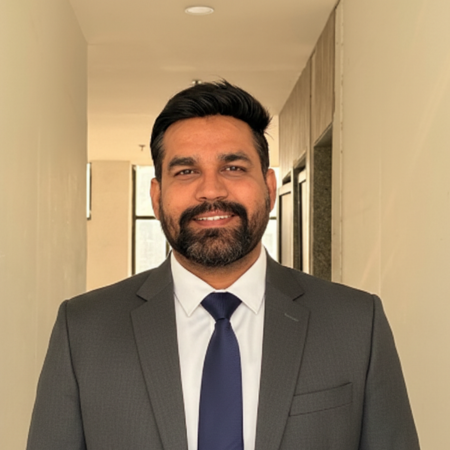
By Sahil Kataria, Chief Executive Officer, QServices
Updated June 12, 2026
Sahil Kataria is the CEO of QServices, a Microsoft Solutions Partner delivering AI agents and custom software for regulated industries. He leads enterprise AI strategy and FinTech delivery. LinkedIn ↗
Written from QServices' hands-on delivery work and reviewed by Rohit Dabra, Chief Technology Officer, QServices, before publishing.
QServices is a remote-first software consultancy serving Los Angeles businesses in Media, Healthcare, Real Estate, and Logistics. We are not headquartered in Los Angeles, but we build Azure AI Foundry applications for California companies with Pacific Time hours overlap, typically 9 AM to 1 PM PT, every business day. Learn more about our AI and software development services.
What Los Angeles buyers typically need from Azure AI Foundry
LA's four primary industries each have distinct AI application requirements that Azure AI Foundry is well positioned to address:
- Healthcare: Patient-facing knowledge bots and clinical documentation tools that must comply with HIPAA at the federal level and CCPA/CPRA under California state law. CPRA, which took full effect in 2023, grants California patients and consumers additional data portability, deletion, and opt-out rights beyond federal requirements. Any AI system processing California resident health data must be designed with those rights in scope from day one.
- Media and Entertainment: Content recommendation pipelines, automated metadata tagging, and rights-management AI that handles large asset libraries at scale using Azure AI Search and Azure OpenAI, both of which are native to Azure AI Foundry.
- Real Estate: Document intelligence for lease abstraction, property listing enrichment, and due diligence automation. Structured extraction from unstructured documents using Foundry-hosted models replaces manual review workflows that typically bottleneck deal timelines.
- Logistics: Dispatch optimization bots, shipment exception handling, and supplier communication tools that integrate with existing ERP and TMS systems via Azure Functions, a standard integration pattern in our Foundry builds.
California's CCPA and CPRA impose stricter consent, deletion, and data-sharing obligations than most US state laws. For companies subject to California DOI oversight, including insurers and financial services firms operating in the state, AI-driven underwriting or claims tools must produce audit trails that satisfy regulatory review. The evaluation and observability setup inside Azure AI Foundry produces those logs by default. Skipping it is one of the three most common and costly mistakes in Foundry projects, and one we flag explicitly in every scoping engagement.
On data residency: Azure US West 2 (Washington) and US West 3 (Arizona) are the nearest Azure regions to Los Angeles. If your CCPA or California DOI compliance posture requires data to stay within the continental US, both regions satisfy that requirement. We determine your deployment region during the initial architecture session, not after the build is done.
How we work with Los Angeles clients
Los Angeles runs on Pacific Time (PT). Our India-based engineering team works in IST, which is 12.5 hours ahead of PDT in summer and 13.5 hours ahead of PST in winter. Our team's late-evening IST hours overlap with 9 AM to approximately 1 PM PT daily. That four-hour window covers standups, design reviews, sprint demos, and most live decision points without anyone working outside a reasonable schedule on either side.
A typical engagement week runs like this: Monday morning PT is a 45-minute standup on Microsoft Teams or Zoom covering the previous sprint and current blockers. Our team posts async daily updates in a shared Teams channel: what shipped, what is blocked, what comes next. Code reviews happen in Azure DevOps pull requests, which you can read and comment on at any time. For milestone reviews at sprint end or at an architecture decision point, we schedule a longer session and share screen recordings if a live slot does not work for all stakeholders.
On-site visits to Los Angeles are not part of our standard engagement model. For engagements over 12 weeks, some clients have requested an in-person check-in for final user acceptance testing. We accommodate those on a case-by-case basis.
Relevant work in similar markets
We have not worked with a Los Angeles-based client on Azure AI Foundry. Our completed Foundry engagements have been with SaaS companies outside California. We are noting this plainly rather than stretching the connection. The architecture patterns from those projects apply directly to what Media, Healthcare, and Real Estate buyers in LA are typically evaluating.
Case Study
AI Project Management Bot for Azure DevOps and MS Teams (Smart PM)
IT services company
Automated meeting transcript capture and backlog creation in Azure DevOps with Fibonacci story point assignment and sprint capacity tracking
Real-time Power BI sprint velocity dashboards replacing manual meeting note capture and task allocation
This project automated meeting transcript capture, backlog creation in Azure DevOps, and Fibonacci story-point assignment using Azure AI Foundry, Azure AI Search, Power Automate, and the Fireflies.ai API. The result was real-time Power BI sprint velocity dashboards that replaced a manual weekly process. The pattern of pulling from multiple APIs into a Foundry pipeline with structured output applies directly to Media rights-management workflows and Healthcare clinical documentation pipelines.
Case Study
Enterprise Knowledge Management Bot (Copilot Studio + Azure AI Foundry)
Enterprise software company
Accurate, prompt responses for both document-specific queries and broader general knowledge questions from a unified AI assistant
Microsoft Copilot StudioAzure AI FoundryAzure AI SearchGPT-4o
This project used Microsoft Copilot Studio on top of Azure AI Foundry and Azure AI Search to deliver accurate responses to both document-specific and general knowledge queries from a single interface. That architecture applies directly to Real Estate firms managing large lease and due diligence document repositories. Full details: Enterprise Knowledge Bot case study.
If you need references from a vendor who has shipped Foundry work for a Los Angeles client in your specific vertical, raise that in the discovery call. We will give you an honest picture of fit rather than a polished non-answer.
What Azure AI Foundry costs for a typical Los Angeles project
Azure AI Foundry implementations for Los Angeles clients range from $25,000 to $120,000, billed in USD. The range depends on scope, integration count, and compliance requirements:
- Pilot ($25,000–$45,000): Single use case, one or two Azure service integrations, basic evaluation harness. Typical timeline 8–10 weeks.
- Mid-scope production build ($45,000–$80,000): Two to four integrations, production-grade observability, CCPA-compliant data handling built into the architecture. 10–14 weeks.
- Full platform ($80,000–$120,000): Multiple workflows, California DOI or HIPAA compliance review, multi-tenant architecture. 14–16 weeks.
Cost modifiers relevant to California clients: add 15–25% for HIPAA or California DOI regulatory scope. Each non-trivial system integration, such as an EHR, TMS, or media asset management system, adds $3,000–$12,000. A production-grade evaluation harness adds $5,000–$15,000 if not included in base scope. Azure consumption costs at scale are separate from our fees and are among the most consistent budget surprises on Foundry projects. We flag projected Azure spend during scoping, not after go-live.
See full pricing breakdown at Azure AI Foundry implementation pricing.
How to start working with us
Starting an engagement takes three steps:
- Discovery call (30 minutes): We learn what you are building, your current Azure setup, and your compliance requirements. You get a direct read on whether Azure AI Foundry is the right fit and roughly what scope looks like.
- Scoping document: Within five business days, we send a written scope covering architecture, team, timeline, and cost. Everything in and out of scope is explicit before any work begins.
- Project start: On agreement, we schedule sprint zero within the week. First deliverable within two weeks of contract signature.
Can you work with Los Angeles companies remotely?
Yes. All of our US client engagements run remotely. For Los Angeles specifically, Pacific Time gives us a usable morning overlap window. Our IST afternoon aligns with 9 AM to roughly 1 PM PT daily, covering standups, reviews, and live demos without scheduling strain on either side.
We use Microsoft Teams and Azure DevOps as our primary collaboration tools, which means your engineers work in the same environment as the code being built. Client data stays in your Azure subscription in the US region you specify. We do not copy client data to India-based systems. For CCPA compliance, data processed through Azure AI Foundry can be scoped to US-only Azure regions, with full data flow documentation produced during architecture design. The California Privacy Protection Agency publishes current guidance on what CCPA and CPRA require from technology vendors processing California resident data.
Ready to discuss your project?
Share your requirements with QServices. Our engineers will give you a straight answer on fit, timeline, and cost — no sales scripts.
Book a Free Consultation
Frequently Asked Questions
Do you have an office in Los Angeles? +
No. QServices is remote-first and India-based. We work with Los Angeles clients entirely remotely. Our IST afternoon hours overlap with 9 AM to 1 PM PT daily, which covers standups and live reviews without anyone working unreasonable hours on either side. On-site visits to LA are available on request for milestone reviews on engagements longer than 12 weeks.
What is the time difference between Los Angeles and your team? +
Los Angeles is 12.5 hours behind IST in summer (PDT) and 13.5 hours behind in winter (PST). A 10 AM PT standup falls at 10:30 PM or 11:30 PM IST. Our team works a late-evening IST block specifically to cover this overlap. We schedule all standing meetings within the 9 AM to 1 PM PT window.
Have you worked with companies in Los Angeles before? +
Not yet on Azure AI Foundry. Our completed Foundry projects have been with SaaS companies outside California. We say this plainly on the page rather than claiming local references we do not have. The architecture patterns from those projects apply directly to Media, Healthcare, and Real Estate workflows common in LA.
How do you handle CCPA and CPRA data requirements for California clients? +
We scope data residency and consent handling during architecture design, before any code is written. Client data processed through Azure AI Foundry stays in your Azure subscription in a US region you specify. We document data flows, build in deletion pathways for CCPA compliance, and do not store or process client data on India-based infrastructure.
What industries do you serve in the Los Angeles market? +
Based on LA's primary industries, we are most relevant to Healthcare (CCPA-compliant knowledge bots, clinical documentation), Media and Entertainment (content pipelines, metadata AI), Real Estate (document intelligence, lease abstraction), and Logistics (dispatch bots, exception handling). We do not yet have existing clients in any of these LA verticals and say so honestly.