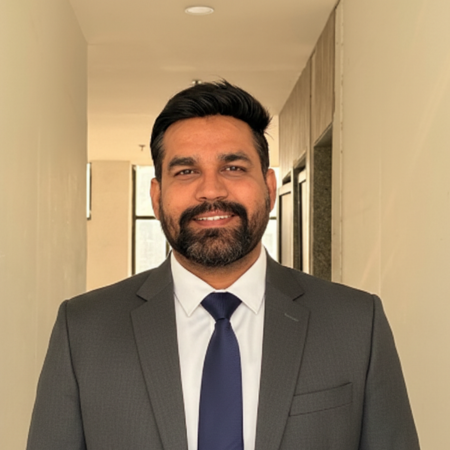
By Sahil Kataria, Chief Executive Officer, QServices
Updated June 13, 2026
Sahil Kataria is the CEO of QServices, a Microsoft Solutions Partner delivering AI agents and custom software for regulated industries. He leads enterprise AI strategy and FinTech delivery. LinkedIn ↗
Written from QServices' hands-on delivery work and reviewed by Rohit Dabra, Chief Technology Officer, QServices, before publishing.
We are not headquartered in Los Angeles, but we build iOS and Android apps for LA businesses in media, healthcare, real estate, and logistics, with 2 to 3 hours of Pacific Time morning overlap for live sync. QServices is a remote-first software consultancy serving Los Angeles companies that need production-ready mobile apps. See our full software development services.
What Los Angeles buyers typically need from mobile app development
LA's four primary industries each generate different mobile app requirements. Before we scope any project, we ask which category applies, because the compliance and integration work changes significantly depending on the answer.
- Media and entertainment: Streaming apps, content delivery platforms, and creator tools. LA production companies often need custom video player SDKs, subscription billing, and DRM. CCPA/CPRA consent flows are required for any app collecting California user data.
- Healthcare: Patient portals, telehealth apps, and appointment scheduling tools. Apps handling patient data must satisfy both CCPA/CPRA and applicable HIPAA requirements. California's health insurance market is overseen by the California Department of Insurance (DOI), which affects insurance-adjacent app scope. Compliance overhead adds 15 to 25 percent to base project costs.
- Real estate: Property search apps, virtual tour tools, and agent-client communication platforms. California real estate apps typically require MLS data integrations and careful CCPA location-permission consent handling.
- Logistics: Driver tracking, dispatch, and last-mile delivery apps. These involve background location permissions, push notifications, and real-time data sync, standard on React Native with Firebase or Azure Mobile Apps.
For any app distributed to California users, CCPA/CPRA compliance is mandatory. The California Privacy Protection Agency enforces these requirements, covering in-app privacy disclosures, opt-out flows for data sale, and deletion request handling.
How we work with Los Angeles clients
Our engineering team works on IST (UTC+5:30). Los Angeles runs on Pacific Time, UTC-7 in summer (PDT) and UTC-8 in winter (PST). When your team starts at 8am PT, it is 9:30pm to 10:30pm IST for our engineers. We maintain a dedicated overlap window from 7am to 10am PT (8:30pm to 11:30pm IST) for all live calls.
In practice, that means one 45-minute standup per week falls in your morning, with async updates covering the rest. We use Slack for day-to-day questions, GitHub for code reviews with written comments your team can read at any hour, and Loom videos for sprint demos so you can watch build walk-throughs on your own schedule. Sprint reviews run every two weeks via Teams or Zoom in the PT morning window.
The engagement is fully remote, with no on-site visits as a default. For milestone reviews such as design sign-off, UAT, and App Store submission, we schedule extended calls in the overlap window. Code ownership, CI/CD pipelines, and repository access are transferred to you at project end.
Relevant work in similar markets
We do not have a published case study from a Los Angeles client. The two mobile projects we can point to are in financial services, not media, healthcare, real estate, or logistics, but the delivery challenges around compliance, real-time data, and cross-platform parity have direct parallels.
SomBank mobile payment platform (T-Plus): We built a React Native app for an Islamic bank in Somalia. It launched with over 100,000 downloads and a 4.8-star rating. The app introduced the first digital payment infrastructure in a predominantly cash-based economy, covering P2P transfers, QR merchant payments, and international remittances, running on Azure Service Bus, Azure B2C, and an Ocelot API Gateway.
Case Study
Mobile Payment Platform for SomBank (Somalia)
Islamic bank, Somalia
100K+ downloads with 4.8-star rating on launch
First digital payment platform in a predominantly cash-based economy, enabling P2P transfers, merchant QR payments, and international remittances
React Native.NETMySQLAzure Service BusAzure B2C
Chikwama digital wallet: A cross-platform digital wallet built with Xamarin Forms and ASP.NET Web API on SQL Azure, with real-time transaction updates via SignalR and QR code merchant payments for an emerging-market payments company.
Case Study
Digital Wallet Mobile App (Chikwama)
Digital payments company, emerging market economy
Introduced real-time digital peer-to-peer transfers to a previously cash-dependent economy
QR code merchant payments and bank account top-ups with SignalR real-time transaction updates
Xamarin FormsASP.NET Web APISQL AzureAzureSignalR
If you are building a healthcare, real estate, or logistics app and want technical references, we share those under NDA on the scoping call. You can also read the full SomBank case study on our site.
What mobile app development costs for a typical Los Angeles project
Our rates run from $20 to $65 per hour depending on seniority. A full mobile app engagement for an LA client typically falls in the large or platform bracket. All pricing is in USD.
- Medium scope ($8,000 to $30,000): 200 to 600 hours. A focused MVP on one platform (iOS or Android), core features, basic analytics, and App Store submission.
- Large scope ($30,000 to $120,000): 600 to 2,000 hours. Cross-platform React Native build, backend API, third-party integrations, QA, and Store submission.
- Platform scope ($120,000 to $200,000+): Complex apps with multiple user roles, real-time data, CMS, and compliance requirements. Our published range for mobile projects is $35,000 to $200,000.
CCPA/CPRA compliance work adds 15 to 25 percent to the base estimate. Each non-trivial third-party integration (MLS feeds, EHR systems, logistics APIs) adds $3,000 to $12,000. See our full mobile app development pricing breakdown.
How to start working with us
Our process for new Los Angeles engagements has three steps:
- Discovery call (45 minutes): We discuss your app concept, target users, platform choice, and budget range. This call is scheduled in our 7am to 10am PT overlap window.
- Scoping document: We send a written scope covering feature list, tech stack recommendation, timeline estimate, and cost range within 3 business days.
- Project start: Once scope is agreed, we set up the repository, communication channels, and sprint cadence. The first sprint begins within two weeks of contract signing.
Can you build our app remotely from Los Angeles?
Yes. Our 7am to 10am PT window (8:30pm to 11:30pm IST) covers weekly standups and milestone reviews. Code reviews and sprint demos are async-first, shared via GitHub and Loom, so your team is not blocked by the time gap.
For CCPA/CPRA compliance, we build in-app privacy notices, consent management, opt-out flows, and deletion request handling into the architecture from the start. We do not store California user data on our systems. Data residency stays with your chosen cloud provider, whether Azure, AWS, or GCP, which keeps you within California's data handling requirements enforced by the California Privacy Protection Agency.
Ready to discuss your project?
Share your requirements with QServices. Our engineers will give you a straight answer on fit, timeline, and cost — no sales scripts.
Book a Free Consultation
Frequently Asked Questions
Do you have an office in Los Angeles? +
No. QServices is a remote-first consultancy based in India with no physical office in Los Angeles. We work with LA clients through a structured remote model: a 7am to 10am PT overlap window for live calls, async code reviews via GitHub, and sprint demos via Loom. The lack of a local office has not affected delivery quality on any of our shipped projects.
What is the time difference between Los Angeles and your engineering team? +
Los Angeles runs on Pacific Time (UTC-7 in summer, UTC-8 in winter). Our engineers work on IST (UTC+5:30). The gap is 12.5 to 13.5 hours. We schedule all live calls, including standups, milestone reviews, and design sign-offs, in a 7am to 10am PT window, which falls at the end of our engineers' working day.
Have you built mobile apps for Los Angeles companies before? +
We do not have a published case study from an LA-based client. Our two shipped mobile apps are in financial services: SomBank (100,000+ downloads, 4.8-star rating on launch) and the Chikwama digital wallet. We share technical references relevant to healthcare, real estate, or logistics under NDA on a scoping call.
How do you handle CCPA/CPRA compliance for California app users? +
We build CCPA/CPRA compliance into the app architecture from the start: in-app privacy notices, consent management for data collection, opt-out flows for data sale, and deletion request handling. This work adds roughly 15 to 25 percent to the base project estimate and follows the published requirements of the California Privacy Protection Agency.
What industries do you serve in the Los Angeles market? +
We serve clients in media and entertainment, healthcare, real estate, and logistics, the four sectors where LA mobile app demand is strongest. Healthcare apps subject to California Department of Insurance oversight require additional compliance scoping. We are direct about the limits of our local experience and point clients to relevant technical references.