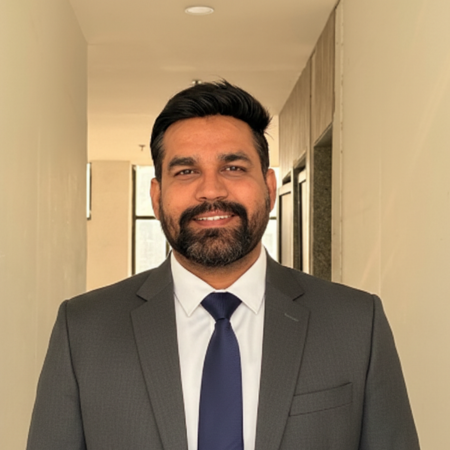
By Sahil Kataria, Chief Executive Officer, QServices
Updated June 12, 2026
Sahil Kataria is the CEO of QServices, a Microsoft Solutions Partner delivering AI agents and custom software for regulated industries. He leads enterprise AI strategy and FinTech delivery. LinkedIn ↗
Written from QServices' hands-on delivery work and reviewed by Rohit Dabra, Chief Technology Officer, QServices, before publishing.
QServices is an AI agent development company serving Los Angeles clients in media, healthcare, real estate, and logistics. We are India-based, not California-based. Our remote model gives LA clients 3 to 4 hours of daily Pacific Time morning overlap. See our full services catalog or read on for how LA engagements work in practice.
What Los Angeles buyers typically need from AI agent development
Los Angeles clients work across four industries that each carry distinct agent use cases and compliance obligations.
- Media and entertainment: content metadata tagging agents, rights clearance workflow automation, ad campaign performance monitoring agents that pull from multiple data sources in real time.
- Healthcare: patient intake and triage agents, prior authorization routing, clinical documentation assistants. Any agent handling patient data must comply with California's CCPA and CPRA, which govern how personal and health-adjacent data is collected, processed, stored, and deleted by California businesses.
- Real estate: lead qualification agents that score inbound inquiries, property data extraction from MLS feeds, automated lease document review workflows.
- Logistics: shipment exception agents, carrier communication bots, warehouse inventory reconciliation workflows that integrate with existing WMS and ERP systems.
CCPA and CPRA impose consent, deletion, and disclosure obligations on any AI system processing California resident data. The California Attorney General's CCPA guidance sets out the specific technical and organizational requirements. For insurance-adjacent deployments, the California Department of Insurance (DOI) adds audit trail and explainability documentation requirements. We build these controls into the agent design phase rather than retrofitting them after deployment.
How we work with Los Angeles clients
Our engineering team is in India (IST, UTC+5:30). Los Angeles runs on PT, which is UTC-7 in summer and UTC-8 in winter. That puts India 12.5 to 13.5 hours ahead of LA. We staff a late IST shift that creates a 3 to 4 hour daily overlap window in LA mornings, typically 7 AM to 11 AM PT on weekdays.
A typical engagement runs like this: you and your product owner join a 30-minute standup at 9 AM PT on Mondays and Thursdays. Sprint demos happen over Teams or Google Meet in the same window. Code reviews are async on GitHub, with responses from our team by your afternoon. For go-live decisions or architecture reviews, we schedule a 60-minute session during the overlap window. Everything else runs async on Slack or Teams.
On-site visits to Los Angeles are possible for project kickoffs or major milestone reviews. They require advance scheduling and carry additional travel costs. Most of our LA engagements run fully remote without them.
Relevant work in similar markets
We do not have a published case study from a Los Angeles client. We are stating that directly because accuracy matters more than a confident-sounding sales page. Our closest relevant work comes from two production AI agent deployments that involved compliance-sensitive data and multi-system integration.
For a SaaS and IT services company, we built the Smart PM assistant on Azure AI Foundry, Azure AI Search, Power Automate, and Microsoft Teams. The agent automated meeting transcript capture, created Azure DevOps backlog items with Fibonacci story point assignment, and replaced manual sprint tracking with real-time Power BI dashboards. The orchestration patterns from that project map directly to what LA healthcare and logistics companies typically need for multi-system workflow automation.
For an investment and legacy planning platform, we built the Melegacy chatbot in Microsoft Copilot Studio, connecting Nasdaq historical data for ML-powered stock predictions alongside a legacy beneficiary and charity management flow. The compliance sensitivity of that work, financial data, nominee consent flows, audit trails, is comparable to what CCPA-regulated healthcare and real estate workflows require in California.
For regulated-industry deployments specifically, see our AI agents for healthcare page for additional context on how we approach compliance-first agent design.
What AI agent development costs for a typical Los Angeles project
Our engagements are priced in USD. Typical AI agent development projects run $15,000 to $85,000 depending on scope and integration complexity.
- Small scope ($15,000 to $30,000): Single-task agent with one or two system integrations, 6 to 8 week delivery. Covers agent design, human-in-the-loop guardrail configuration, and a basic evaluation framework.
- Medium scope ($30,000 to $55,000): Multi-step agent with three to five integrations, 8 to 12 week delivery. Includes a production-grade evaluation framework and staged rollout plan.
- Larger scope ($55,000 to $85,000): Platform-level agent orchestration, custom connectors, full QA cycle, and documentation for compliance review.
CCPA and CPRA compliance design, consent flows, data deletion pipelines, audit logging, typically adds 15 to 20 percent to the base estimate. A production evaluation framework adds $5,000 to $15,000. Third-party compliance review adds $5,000 to $20,000 if required. See our AI agent development pricing page for a full breakdown.
How to start working with us
Three steps: book a 30-minute discovery call to describe your use case and name the systems your agent will connect to. We ask about data types and compliance constraints at this stage, not as an afterthought. Within 5 business days we deliver a scoping document: proposed architecture, tech stack, timeline, and a fixed-price or time-and-materials estimate. On agreement, the project starts within 2 weeks.
Use the contact form on this page to request a call, or reach us through our contact page.
Can a remote, India-based team work effectively with Los Angeles companies?
Yes, with the right structure. The 12.5 to 13.5 hour gap between IST and PT is real, and we do not pretend otherwise. What makes it workable is a deliberate late-IST shift that places our engineers online during LA mornings, bi-weekly standups at a fixed PT time, and async-first communication so nothing waits on a synchronous call.
For data residency, we configure Azure deployments to US regions (East US or West US 2) when California clients require it. Data processing agreements are aligned to CCPA requirements. We have operated this model across FinTech and software platforms; the same approach applies to media, healthcare, real estate, and logistics workloads in Los Angeles.
Ready to discuss your project?
Share your requirements with QServices. Our engineers will give you a straight answer on fit, timeline, and cost — no sales scripts.
Book a Free Consultation
Frequently Asked Questions
Do you have an office in Los Angeles? +
No. QServices is a remote-first company headquartered in India with no physical offices in the United States. We work with Los Angeles clients through a structured remote model: 3 to 4 hours of Pacific Time morning overlap daily, async communication on Slack or Teams, and bi-weekly video standups. Most LA engagements run fully remote.
What is the time difference between Los Angeles and your team? +
Our team works in IST (UTC+5:30). Los Angeles runs on PT, which is UTC-7 in summer (PDT) and UTC-8 in winter (PST). The gap is 12.5 to 13.5 hours. We staff a late IST shift that creates a 3 to 4 hour overlap window in LA mornings, typically 7 AM to 11 AM PT on weekdays.
Have you worked with companies in Los Angeles before? +
We do not have a published case study from a Los Angeles client. Our closest work includes an Azure AI Foundry agent for an IT services company and a Microsoft Copilot Studio investment chatbot. Both involved compliance-sensitive data workflows similar to what CCPA-regulated industries in California require.
How do you handle CCPA and CPRA compliance for California clients? +
We build CCPA and CPRA controls into the agent design phase: consent flows, data deletion pipelines, audit logging, and purpose-limitation documentation. For insurance-adjacent agents, we address California DOI requirements where applicable. Compliance overhead typically adds 15 to 20 percent to the base project estimate.
What industries do you serve in the Los Angeles market? +
We focus on Los Angeles industries with strong AI agent ROI: media and entertainment, healthcare, real estate, and logistics. All four carry active compliance requirements under CCPA and CPRA. Healthcare and insurance-adjacent deployments also involve California DOI guidelines, which we account for in the agent design and audit trail requirements.