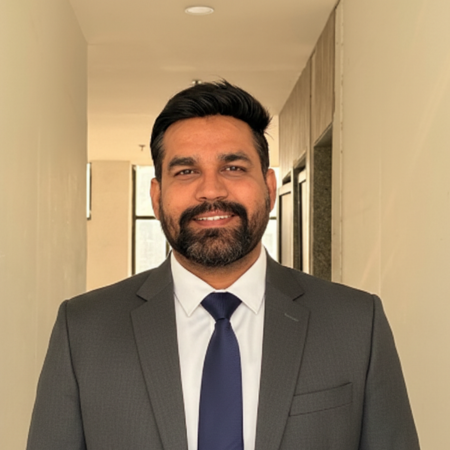
By Sahil Kataria, Chief Executive Officer, QServices
Updated June 12, 2026
Sahil Kataria is the CEO of QServices, a Microsoft Solutions Partner delivering AI agents and custom software for regulated industries. He leads enterprise AI strategy and FinTech delivery. LinkedIn ↗
Written from QServices' hands-on delivery work and reviewed by Rohit Dabra, Chief Technology Officer, QServices, before publishing.
QServices is not based in Denver, but we work with Colorado companies in aerospace, telecom, energy, and tech through remote engagements with Mountain Time overlap hours. We are a remote-first Microsoft Solutions Partner and Azure AI Foundry implementation team serving Denver businesses.
What Denver buyers typically need from Azure AI Foundry
Denver's economy spans aerospace and defense contractors, regional telecom providers, energy operators, and a growing tech sector. The Azure AI Foundry use cases we see most often across these industries:
- Aerospace and defense: Document intelligence for engineering specifications and maintenance records, where data stays inside your Azure tenant and does not leave your Colorado infrastructure.
- Energy: Operational data analysis and predictive asset management built on your existing Azure data estate, without a separate AI platform contract.
- Telecom: AI-assisted network operations and customer support agents on Azure AI Foundry's orchestration layer, integrated with existing CRM and ticketing systems.
- Tech and SaaS: Internal knowledge management, developer productivity agents, and product analytics, the work we shipped in our Enterprise Knowledge Bot engagement.
Colorado's Privacy Act (CPA), effective July 2023, applies to businesses that process personal data of 100,000 or more Colorado consumers per year, or 25,000 or more consumers if the business earns revenue from selling that data. If your Azure AI Foundry application processes customer records, employee data, or user profiles, CPA obligations around consent, opt-out rights, and data subject access requests apply. We scope CPA technical controls, consent capture APIs, audit logging, deletion workflows, into the project from day one rather than treating compliance as a post-launch fix. Details on scope are at the Colorado Attorney General's CPA page.
How we work with Denver clients
Mountain Time is UTC-6 in summer (MDT) and UTC-7 in winter (MST). Our team works in IST (UTC+5:30), which puts us 11.5 hours ahead of Denver in summer and 12.5 hours ahead in winter. That gap is real and we account for it structurally rather than glossing over it.
Our engineers shift part of their working day so that 6:00 to 9:00 PM IST, 6:30 to 9:30 AM MDT, is live overlap time. Denver teams can run morning standups, do live sprint demos, and get questions answered in real time during those three hours. Work that does not need live discussion moves through structured async: a written daily update in Microsoft Teams, a shared Azure DevOps board visible to both sides, and recorded sprint demo walkthroughs posted before each scheduled review.
We use Microsoft Teams as the primary collaboration channel, which most Denver enterprise teams already have. Code reviews happen in Azure DevOps pull requests with written comments. On-site visits to Denver for milestone reviews are available on larger engagements, though most clients find the async-first model sufficient once the first sprint cadence is established.
Relevant work in similar markets
We do not have a published case study from a Denver or Colorado company. The two Azure AI Foundry engagements below are from the SaaS and enterprise software sector, which overlaps with Denver's tech segment. Neither covers aerospace or energy directly, and we are not going to pretend otherwise.
Case Study
AI Project Management Bot for Azure DevOps and MS Teams (Smart PM)
IT services company
Automated meeting transcript capture and backlog creation in Azure DevOps with Fibonacci story point assignment and sprint capacity tracking
Real-time Power BI sprint velocity dashboards replacing manual meeting note capture and task allocation
In the Smart PM engagement, we built an AI project management agent on Azure AI Foundry, Azure AI Search, Power Automate, and Microsoft Graph API for an IT services company. The system automated meeting transcript ingestion from Fireflies.ai, created backlog items in Azure DevOps with Fibonacci story point assignment and sprint capacity tracking, and pushed real-time sprint velocity data to Power BI, replacing manual note-taking and task allocation entirely. Read the Smart PM case study.
Case Study
Enterprise Knowledge Management Bot (Copilot Studio + Azure AI Foundry)
Enterprise software company
Accurate, prompt responses for both document-specific queries and broader general knowledge questions from a unified AI assistant
Microsoft Copilot StudioAzure AI FoundryAzure AI SearchGPT-4o
In the Enterprise Knowledge Bot engagement, we built a unified assistant using Microsoft Copilot Studio and Azure AI Foundry that returned accurate responses for both document-specific queries and general knowledge questions from a single interface for an enterprise software company. Read the Enterprise Knowledge Bot case study.
For Denver's aerospace and energy companies, data residency and potential export-control requirements come up in nearly every scoping conversation. Those constraints shape the Azure region choice and the Foundry configuration. We raise them in the discovery call, not as an afterthought after the contract is signed.
What Azure AI Foundry costs for a typical Denver project
Our Azure AI Foundry pricing page covers the full cost breakdown. For a Denver engagement, typical brackets:
- Small scope ($25,000-$45,000 | 8-10 weeks): Single AI agent or internal tool, one data source integration, basic evaluation setup.
- Medium scope ($45,000-$80,000 | 10-14 weeks): Multi-agent orchestration, two to three system integrations, production evaluation harness, staging environment.
- Large scope ($80,000-$120,000 | 14-16 weeks): Enterprise deployment with Azure AI Search, custom observability, compliance documentation, third-party review support.
For projects that touch Colorado Privacy Act obligations, consent flows, data subject request handling, or audit logging, add 15 to 25 percent for compliance overhead. A production-grade AI evaluation harness, which we recommend for any Foundry deployment beyond a prototype, adds $5,000 to $15,000. Underestimating Azure consumption costs at scale is one of the most common mistakes on first Foundry deployments; see the Azure AI Foundry documentation for consumption model details. All pricing is in USD.
How to start working with us
Three steps from first contact to project start:
- Discovery call (30 minutes): You describe the business problem. We ask about your Azure environment, data sources, compliance requirements, and timeline. No pitch, just the questions needed to scope the work.
- Scoping document (3 to 5 business days): We send a written scope with milestone breakdown, technology decisions, timeline estimate, and cost range. You can share it internally without us on a follow-up call.
- Project start: On agreement, we provision the Azure DevOps board, onboard your team to the shared workspace, and run a kickoff session during MT overlap hours.
Do you work with Denver companies remotely?
Yes. We have no office in Denver and all our Colorado engagements are fully remote. Work runs on Microsoft Teams and Azure DevOps. Live overlap sits in the 6:30 to 9:30 AM MDT window, which fits a normal Denver morning schedule without requiring your team to work outside standard hours.
For data residency, Azure resources are provisioned in the region you specify, US East or US West 2 are the most common choices for Colorado clients. Data does not leave your Azure subscription. Under the Colorado Privacy Act, your organization is the data controller and we act as a data processor; we build the technical controls that make your compliance obligations achievable, but the legal obligations remain with you.
Ready to discuss your project?
Share your requirements with QServices. Our engineers will give you a straight answer on fit, timeline, and cost — no sales scripts.
Book a Free Consultation
Frequently Asked Questions
Do you have an office in Denver? +
No. QServices has no physical office in Denver or anywhere in Colorado. All our work with Denver clients is fully remote. We hold live overlap hours between 6:30 and 9:30 AM MDT so morning standups and sprint reviews fit into a standard Denver workday without requiring after-hours effort from your team.
What is the time difference between Denver and your team? +
Our engineers work in IST (UTC+5:30). Denver runs on Mountain Time: UTC-6 in summer (MDT) and UTC-7 in winter (MST). That puts us 11.5 to 12.5 hours ahead of Denver depending on the season. We shift part of our working day to create a 6:30 to 9:30 AM MDT live overlap window each business day.
Have you worked with companies in Denver or Colorado before? +
We do not have a published case study from a Denver or Colorado company. Our closest relevant work covers Azure AI Foundry in the SaaS and enterprise software sector, AI project management tooling and enterprise knowledge management. For aerospace or energy clients, we discuss those specific requirements in the discovery call and are direct about what we have shipped versus what we would be designing with you.
How do you handle Colorado Privacy Act requirements for AI projects? +
We scope CPA technical controls into every project from day one: consent capture APIs, audit logging, data subject access request workflows, and deletion mechanisms. Your organization is the data controller under CPA; our role is to build the technical layer that makes your obligations achievable. Projects with CPA scope add 15 to 25 percent to the base engagement cost.
What industries do you serve in the Denver market? +
We serve companies in tech, telecom, energy, and aerospace where Azure AI Foundry delivers the clearest value. Our published case studies are from the SaaS sector. For aerospace or energy clients with specific data residency, export-control, or Colorado Privacy Act constraints, we address those in the initial scoping conversation rather than applying a generic project template.