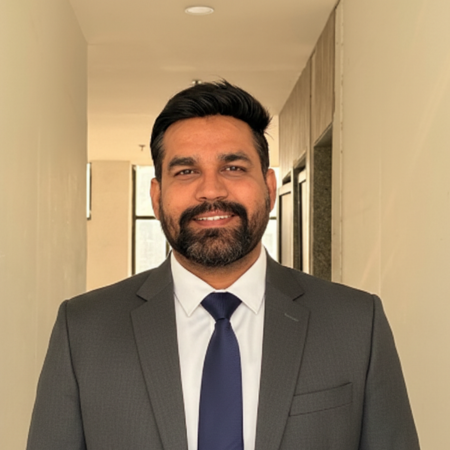
By Sahil Kataria, Chief Executive Officer, QServices
Updated June 12, 2026
Sahil Kataria is the CEO of QServices, a Microsoft Solutions Partner delivering AI agents and custom software for regulated industries. He leads enterprise AI strategy and FinTech delivery. LinkedIn ↗
Written from QServices' hands-on delivery work and reviewed by Rohit Dabra, Chief Technology Officer, QServices, before publishing.
QServices builds React Native mobile applications for Houston companies in energy, healthcare, and logistics. We are not based in Houston. Our engineering team is in India. We work with Texas clients on remote engagements with Central Time hours overlap each workday. See our full services overview to understand what we cover beyond mobile development.
What Houston buyers typically need from React Native development
Houston's three primary industries each generate distinct mobile requirements:
- Energy companies need field technician apps: inspection checklists, offline-capable workflows for well sites with unreliable connectivity, and audit trails to satisfy Texas energy sector regulations.
- Healthcare providers need HIPAA-compliant apps. React Native handles clinical and patient-facing use cases well when the architecture is right: encryption at rest and in transit, role-based access, session timeouts, and documented key management.
- Logistics and 3PL operators need driver and dispatcher apps with real-time order tracking, proof-of-delivery capture, and integrations with dispatch and invoicing systems.
Texas-specific compliance adds a layer for any consumer-facing app. The Texas Data Privacy and Security Act (TDPSA) applies to apps collecting personal data from Texas residents and requires documented data subject rights, a published privacy policy, and clear data processing practices, regardless of where the developer is based.
Three pitfalls we flag before every project: React Native is the wrong choice for graphics-heavy rendering such as 3D energy visualization tools; skipping platform-specific UX work produces apps that feel foreign on iOS or Android; and underestimating App Store and Play Store review cycles, which typically run two to four weeks for initial app approval.
How we work with Houston clients
Houston runs on Central Time. Our India-based team is 10.5 hours ahead in summer (CDT) and 11.5 hours ahead in winter (CST). We shift part of the team to an extended evening schedule in India so that your 8 to 10 AM CT window overlaps with our active hours. You get 2 to 3 hours of live, synchronous time each day.
Within that overlap window we run standups, design reviews, and sprint demos. Everything outside that window, including code reviews, pull request feedback, and async questions, goes through Slack or Microsoft Teams with a same-day response commitment before your next morning starts.
Our Human-in-the-Loop (HITL) governance model means a senior engineer reviews every deliverable before it moves to staging. For energy and healthcare clients with audit requirements, that review is built into our standard process, not added on request.
On-site visits are available for milestone reviews if the project scope justifies it. Most engagements run 10 to 28 weeks fully remote without requiring travel.
Relevant work in similar markets
We have not built apps for Houston-based clients. The two closest case studies by industry match Houston's primary sectors directly.
Last-Mile Delivery Management (My Delivery): A logistics operator needed end-to-end delivery management with real-time order tracking, proof-of-delivery capture, driver assignment via the eLogi API, and Zoho-powered invoice generation with two-factor authentication. We built both the React Native driver app and the web-based dispatcher interface on .NET and Vultr Cloud. Read the case study.
Personalized Nutrition Platform (Equalution): A health and nutrition startup needed a React Native client app and a React.js dietician portal backed by ML-driven calorie and macro targets based on body metrics. We handled dual-platform delivery where the mobile app and web admin interface shared a Node.js and MySQL data layer. Read the case study.
Neither project was in Houston or Texas. We do not have an energy sector case study. If your project is in oilfield services, upstream energy, or industrial IoT, we can speak to architecture and integration patterns from first principles. We will not manufacture a reference client we do not have. For React Native development in healthcare, the Equalution case study is the closest reference we can point to.
What React Native development costs for a typical Houston project
Most projects we take on fall in the $30,000 to $180,000 range, billed in USD. The brackets below map to typical scope:
- Small ($30K to $50K): Single-platform MVP, 3 to 5 screens, one backend integration, no compliance overhead. Typically 10 to 14 weeks.
- Medium ($50K to $100K): iOS and Android from one codebase, 8 to 15 screens, 2 to 3 system integrations. 14 to 20 weeks.
- Large ($100K to $180K): Full cross-platform app with offline support, complex integrations, admin portal, and a Fastlane CI/CD pipeline. 20 to 28 weeks.
For healthcare apps touching patient data, add 15 to 25 percent for HIPAA compliance scope. For non-standard API integrations such as energy dispatch systems or custom logistics platforms, budget $3,000 to $12,000 per integration. See the full breakdown on our React Native development pricing page.
Do you have an office in Houston?
No. QServices is remote-first. Our engineers are in India. We have no Houston office, Texas co-working presence, or local subcontractors. If your procurement policy requires a locally incorporated vendor, we are not the right fit and you should know that before we talk.
For data residency: the Texas Data Privacy and Security Act applies to any app processing Texas resident data regardless of where the developer is located. We implement your data architecture requirements, whether that means US-region Azure deployments, specific encryption standards, or documented data processing agreements, as part of scope.
How to start working with us
Three steps: a 45-minute discovery call to understand your app requirements and constraints, a written scoping document with timeline and cost range, and a project kickoff once scope is agreed. We respond within one business day, CT hours.
Ready to discuss your project?
Share your requirements with QServices. Our engineers will give you a straight answer on fit, timeline, and cost — no sales scripts.
Book a Free Consultation
Frequently Asked Questions
Do you have an office in Houston? +
No. QServices is a remote-first consultancy based in India. We have no Houston office, Texas presence, or local subcontractors. We work with Texas clients through remote engagement, with our team adjusting to Central Time hours for daily live overlap. If your vendor requirements call for a locally incorporated company, we are not the right fit and you should know that upfront.
What is the time difference between Houston and your team? +
Houston is on Central Time and our team is in India on IST. The difference is 10.5 hours in summer (CDT) and 11.5 hours in winter (CST). We adjust team schedules to create 2 to 3 hours of live overlap during your morning, typically between 8 and 10 AM CT, for standups and demos.
Have you worked with Houston or Texas companies before? +
Not directly. Our two most relevant case studies are in logistics, a last-mile delivery app built with React Native, and healthcare-adjacent work, a nutrition platform with a React Native client app. Neither is a Texas or Houston client. We are transparent about that and apply the same engineering standards regardless of the client's location.
How do you handle Texas Data Privacy and Security Act compliance for mobile apps? +
The TDPSA applies to any app collecting personal data from Texas residents, regardless of where the developer is based. We implement data subject rights workflows, documented data processing practices, and privacy policy requirements as part of project scope. For healthcare apps, HIPAA requirements are layered on top and scoped upfront, not added later.
What industries do you serve in the Houston market? +
Our work is most relevant to Houston's three dominant sectors: energy, healthcare, and logistics. We have delivered logistics and healthcare-adjacent React Native apps in prior engagements. We do not have an energy sector case study but can speak to field technician app architecture, offline data sync for remote sites, and audit trail requirements from first principles.