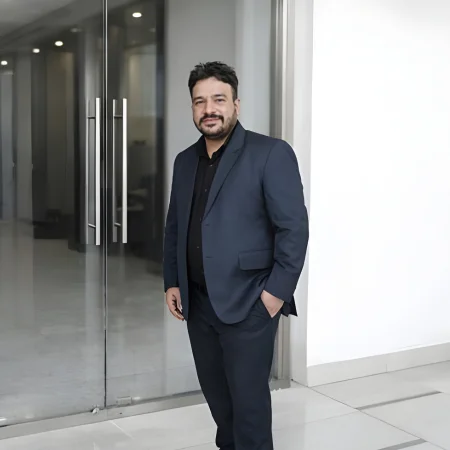
By Sahil Kataria, Chief Executive Officer, QServices
Updated June 12, 2026
Sahil Kataria is the CEO of QServices, a Microsoft Solutions Partner delivering AI agents and custom software for regulated industries. He leads enterprise AI strategy and FinTech delivery. LinkedIn ↗
Written from QServices' hands-on delivery work and reviewed by Rohit Dabra, Chief Technology Officer, QServices, before publishing.
QServices provides React Native development for Miami companies in FinTech, real estate, logistics, and healthcare. We are not headquartered in Miami; our team is remote-first, based in India, and covers Eastern Time overlap hours with Spanish-language client services available for Florida engagements.
What Miami buyers typically need from React Native development
Miami's four primary industries have distinct mobile app requirements, and React Native is a good fit for most of them.
- FinTech: Trading dashboards, payment apps, and client portals for Miami's financial services companies. Florida's Information Protection Act (FIPA) governs how personal financial data is collected and stored, so data handling architecture needs to be scoped before development starts, not retrofitted after launch.
- Real estate: Property search apps, agent communication tools, and listing management platforms. Miami's real estate market requires fast experiences on both iOS and Android, which a single React Native codebase delivers without maintaining two separate native projects.
- Logistics: Driver management, real-time order tracking, proof-of-delivery capture, and dispatch tools. A shared iOS and Android codebase cuts feature delivery time significantly compared to two native apps maintained in parallel.
- Healthcare: Patient apps, nutrition platforms, and appointment scheduling tools. HIPAA applies to any app handling protected health information in Florida. Add 15 to 25 percent to your budget estimate if HIPAA is in scope.
One honest caveat: React Native is the wrong choice for graphics-intensive applications. For the data-driven use cases common across Miami's FinTech, logistics, real estate, and healthcare sectors, it is the right tool.
How we work with Miami clients
Our engineering team maintains hours that overlap with Eastern Time, so Miami clients get direct access during normal Florida business hours. You do not need to schedule calls at unusual hours to reach us.
A typical engagement runs like this: weekly video standups on Teams or Slack, async updates in a shared channel throughout the week, and a recorded sprint demo every two weeks. Code reviews happen on GitHub with written comments, so your product owner can review at any time rather than attending a synchronous session. We offer Spanish-language communication for Miami teams that work in Spanish, which is not something most India-based vendors can provide.
On-site visits to Miami for kickoffs or major milestone reviews can be arranged for larger engagements. We agree on that during scoping, not as an afterthought. Contracts and invoices are in USD, and we work under US-style Statements of Work. We sign NDAs before any technical discussion begins.
Relevant work in similar markets
We do not have a Miami-based client on our public case study list. What we do have is React Native delivery in two of Miami's primary industries: logistics and healthcare.
For a last-mile delivery business, we built the My Delivery logistics app using React Native, .NET, and Vultr Cloud. It handles real-time order tracking, proof-of-delivery capture, Zoho-powered invoice generation, two-factor authentication, and eLogi driver assignment. A Miami logistics operator would recognize this feature set immediately.
For a health and nutrition coaching startup, we built the Equalution platform in React Native and React.js. It includes ML-driven personalized calorie and macro targets, a React Native mobile client, and a parallel dietician web app. HIPAA-adjacent data handling was part of the design from the start, which is the same groundwork a Miami healthcare app requires.
Both projects used React Native with TypeScript and a .NET or Node.js backend, the stack we bring to new Miami engagements.
What React Native development costs for a typical Miami project
All pricing is in USD. Most React Native projects for Miami businesses fall into one of these brackets:
- Small scope ($2,000–$8,000 / 80–200 hours): A focused MVP, a single-feature app, or a proof of concept with one or two core screens.
- Medium scope ($8,000–$30,000 / 200–600 hours): A full-featured app with authentication, a backend API, and basic analytics. Most logistics or real estate apps start here.
- Large scope ($30,000–$120,000 / 600–2,000 hours): Production-grade platforms with multiple user roles, third-party integrations, and an admin dashboard. Most FinTech and healthcare apps fall in this range.
- Platform scope ($120,000–$400,000 / 2,000–6,000 hours): Multi-tenant SaaS or heavily integrated enterprise platforms.
Add 15 to 25 percent if HIPAA or Florida's Information Protection Act is in compliance scope. Each non-trivial integration (payment gateway, CRM, logistics API) adds $3,000 to $12,000. For a complete production-ready React Native app, the typical range is $30,000 to $180,000. Our hourly rates run from $20 to $65 depending on seniority. See the full breakdown on our React Native development pricing page.
How to start working with us
Three steps: a 30-minute discovery call to understand what you are building and flag any early risks; a scoping document with a fixed-price estimate and delivery timeline; and a project kickoff once you are comfortable with the scope. For most project sizes, we can start within two to three weeks of the first call.
Visit our services overview for the full list of what we build, or go directly to the React Native pricing page for a detailed cost breakdown before the call.
Can you work with Miami companies remotely?
Yes. We have worked with US-based clients remotely since QServices was founded in 2010. For Miami specifically: our team covers Eastern Time overlap hours, so standups, demos, and code reviews happen within Florida business hours. You are not adjusting your schedule to accommodate ours.
On data residency: Florida's Information Protection Act (FIPA) requires businesses to protect personal information about Florida residents and report data breaches within 30 days. We address data handling requirements in the architecture specification before development begins. For US-hosted apps, data residency is controlled by your cloud provider's regional settings (AWS, Azure, or Google Cloud US regions), which we specify in the Statement of Work. For healthcare apps subject to HIPAA, we include a compliance scope at project start.
Communication defaults to whatever your team uses: Microsoft Teams, Slack, or email. No proprietary portal required.
Ready to discuss your project?
Share your requirements with QServices. Our engineers will give you a straight answer on fit, timeline, and cost — no sales scripts.
Book a Free Consultation
Frequently Asked Questions
Do you have an office in Miami? +
No. QServices is a remote-first consultancy based in India. For Miami clients, we maintain Eastern Time overlap hours and offer Spanish-language services. All standups, demos, and code reviews happen during Florida business hours. On-site visits for major milestones can be arranged for larger engagements.
What is the time difference between Miami and your team? +
QServices engineers are based in India (IST). We maintain Eastern Time overlap hours specifically for US clients, which means your project lead and engineers are available during Miami business hours without requiring you to adjust your schedule. Exact overlap windows are confirmed at project kickoff.
Have you worked with companies in Florida or the US before? +
Yes. We have delivered React Native projects for US-based clients in logistics and healthcare, two of Miami's primary industries. Our My Delivery logistics app and Equalution health platform are publicly available case studies. We do not have a Miami-specific client on our public list, but the work is directly relevant.
How do you handle Florida's data protection requirements? +
Florida's Information Protection Act (FIPA) requires personal data safeguards and breach notification within 30 days. We address data handling in the architecture specification before development begins. For HIPAA-covered healthcare apps, we include a compliance scope that typically adds 15 to 25 percent above base project cost.
What industries do you serve in the Miami market? +
We build React Native apps for Miami companies in FinTech, real estate, logistics, and healthcare, which are Miami's four primary industries. Our case study work in logistics (My Delivery) and healthcare (Equalution) directly parallels what Miami operators typically need. We also support Spanish-language engagement for Miami's bilingual business environment.