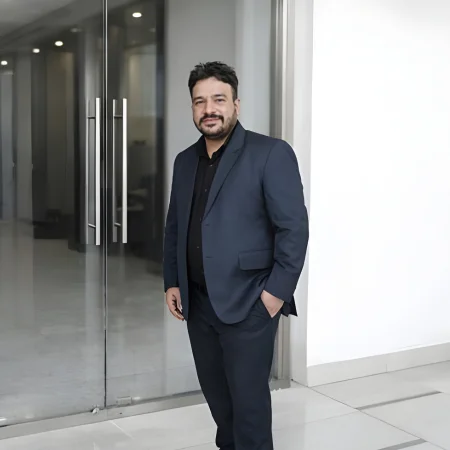
By Sahil Kataria, Chief Executive Officer, QServices
Updated June 12, 2026
Sahil Kataria is the CEO of QServices, a Microsoft Solutions Partner delivering AI agents and custom software for regulated industries. He leads enterprise AI strategy and FinTech delivery. LinkedIn ↗
Written from QServices' hands-on delivery work and reviewed by Rohit Dabra, Chief Technology Officer, QServices, before publishing.
QServices is a .NET development company working with Berlin clients in Tech, FinTech, and Manufacturing. We are not headquartered in Berlin, but we run engagements with four hours of live CET morning overlap daily. Our India-based engineering team is active 2:30 pm to 6:30 pm IST, which maps to 9 am to 1 pm CET. QServices is a remote-first software consultancy serving German businesses on .NET and custom software projects.
What Berlin buyers typically need from .NET development
Berlin's technology companies, FinTech startups, and manufacturing firms share a common set of .NET project patterns:
- API-first backend platforms for FinTech products that must pass BaFin regulatory review and integrate with payment networks, KYC providers, or core banking systems.
- Internal tooling for manufacturing operations including production scheduling, inventory management, and ERP integrations on .NET 8 and Entity Framework.
- GDPR-compliant data handling designed in from day one. Under the EU General Data Protection Regulation, Berlin-based companies must demonstrate data minimization, right-to-erasure, and audit trails at the application layer, not only at the database layer.
- Cloud-native deployment on Azure with data residency in EU regions (West Europe or Germany West Central) to meet both GDPR territorial requirements and BaFin operational resilience expectations for financial services firms.
- Legacy .NET Framework to .NET 8 migrations for established Berlin companies running older codebases that block Azure App Service adoption or modern CI/CD pipelines.
FinTech projects under BaFin scope carry additional work: audit logging, transaction reporting, and operational resilience documentation. We include this in the scoping estimate. See our .NET development for FinTech page for more context.
How we work with Berlin clients
Our team is in India (IST, UTC+5:30). Berlin runs on CET (UTC+1) in winter and CEST (UTC+2) in summer. That puts 3.5 to 4.5 hours between us. From 9 am to 1 pm CET, our engineers are at 2:30 pm to 6:30 pm IST. That window covers standups, design reviews, and sprint demos without either side working off-hours.
How a typical engagement runs:
- Daily async update posted before 9 am CET covering what shipped the day before and what is next.
- Weekly 60-minute video call in the CET morning window via Microsoft Teams or Slack for sprint review and planning.
- Pull request reviews with 24-hour turnaround. You have full access to a shared GitHub or Azure DevOps repository from day one.
- On-site milestone visits available for larger engagements (discovery workshop, go-live support) with advance notice.
All code and documentation is in English. Contracts can be denominated in EUR. Data stays in EU-region cloud infrastructure unless you specify otherwise.
Relevant work in similar markets
We do not have a Berlin or German client on our public case study list. Our closest work is in FinTech payments, which maps to one of Berlin's primary industries.
Case Study
Cross-Border Payment Gateway Aggregator (Varipay / CoolPay)
International payments and remittance business, Jamaica
Reduced transaction fees by approximately 30 percent through optimized gateway routing
Cut settlement times from 3-5 days to under 24 hours with a unified reconciliation engine and audit trail
Microservices ArchitectureStripePayPalWiseRegional Gateways
For Varipay in Jamaica, we built a cross-border payment gateway aggregator on microservices using REST APIs, Stripe, PayPal, Wise, and regional gateways. The result was a 30 percent reduction in transaction fees through optimized gateway routing, and settlement times cut from three to five days down to under 24 hours. The reconciliation engine and audit trail architecture from that project applies directly to BaFin-regulated builds that require traceable transaction records.
Case Study
Mobile Payment Platform for SomBank (Somalia)
Islamic bank, Somalia
100K+ downloads with 4.8-star rating on launch
First digital payment platform in a predominantly cash-based economy, enabling P2P transfers, merchant QR payments, and international remittances
React Native.NETMySQLAzure Service BusAzure B2C
For SomBank in Somalia, we delivered a mobile payment platform on .NET, Azure Service Bus, Azure B2C, and Ocelot API Gateway. It reached 100,000 downloads with a 4.8-star rating on launch. The Azure B2C identity configuration and API gateway pattern from that project applies to GDPR-scoped identity management for EU financial applications.
What .NET development costs for a typical Berlin project
Engagements are priced in USD. Typical brackets for a Berlin .NET project:
- Small ($2,000 to $8,000 / 80 to 200 hours): A single API service, a targeted .NET Framework to .NET 8 upgrade, or one external system integration.
- Medium ($8,000 to $30,000 / 200 to 600 hours): A full backend service or admin portal, multi-system integrations, documented API contracts, and a CI/CD pipeline on Azure DevOps.
- Large ($30,000 to $120,000 / 600 to 2,000 hours): A multi-service platform with custom reporting, role-based access control, and production monitoring.
- Platform ($120,000 to $400,000 / 2,000 to 6,000 hours): Full product build from discovery to launch with embedded QA and DevOps.
For BaFin-scoped FinTech projects, add 15 to 25 percent for regulatory overhead. Each non-trivial integration (payment gateway, KYC provider, core banking system) adds $3,000 to $12,000 to scope. Full breakdown in our .NET development pricing guide.
How to start working with us
Three steps to get started:
- Discovery call (30 minutes): You describe the project and we ask about your stack, timeline, and compliance requirements.
- Scoping document: We send a written scope, timeline, and cost range within three business days.
- Project start: After sign-off, we configure the shared repository, set up communication channels, and begin the first sprint.
Use the contact form on this page to book a discovery call. We respond within one business day.
Can a remote vendor deliver .NET development for a Berlin company?
Yes. A remote India-based vendor works well for Berlin companies when the engagement model is structured: daily async updates, a shared codebase with full visibility, and weekly live reviews in the CET morning window. The four-hour daily overlap between CET and IST is enough for real-time design decisions without requiring off-hours work on either side.
For GDPR compliance, we deploy to EU-region Azure infrastructure by default, either West Europe (Netherlands) or Germany West Central, keeping your data within the EU. For BaFin-regulated FinTech projects, audit logging and transaction record retention are designed in from the architecture phase, not added at the end. For BaFin licensing questions specific to your business model, we recommend engaging a German legal or compliance advisor. BaFin's guidance on digital business models is published at bafin.de.
Ready to discuss your project?
Share your requirements with QServices. Our engineers will give you a straight answer on fit, timeline, and cost — no sales scripts.
Book a Free Consultation
Frequently Asked Questions
Do you have an office in Berlin? +
No. We are a remote-first consultancy based in India. We work with Berlin clients through daily async updates and weekly video calls in the CET morning window (9 am to 1 pm CET). On-site visits for milestone reviews are available with advance notice for larger engagements.
What is the time difference between Berlin and your team in India? +
India Standard Time (IST, UTC+5:30) is 4.5 hours ahead of CET (UTC+1) in winter and 3.5 hours ahead of CEST (UTC+2) in summer. Our team's afternoon, 2:30 pm to 6:30 pm IST, overlaps with 9 am to 1 pm CET. We schedule standups and sprint reviews inside that window.
Have you worked with companies in Berlin or Germany before? +
We do not have a published Berlin or German client. Our closest relevant work is in FinTech payments: a cross-border payment gateway for Varipay in Jamaica and a mobile banking platform for SomBank in Somalia, both on .NET and Azure. The architecture patterns from those engagements apply to GDPR and BaFin-scoped builds in Germany.
How do you handle GDPR and data residency for German clients? +
We deploy to EU-region Azure infrastructure by default, specifically West Europe (Netherlands) or Germany West Central, keeping data within the EU under GDPR territorial rules. Application-layer controls including data minimization, right-to-erasure APIs, and audit logs are designed into the architecture from the start, not added at the end.
What industries do you serve in the Berlin market? +
Berlin's primary tech, FinTech, and manufacturing sectors. For FinTech, this includes payment platforms, API gateways, and BaFin-compliant backend systems. For tech and manufacturing companies, this includes internal tooling, ERP integrations, and .NET migration projects. We adjust scope and compliance overhead to match the regulatory context of each project.