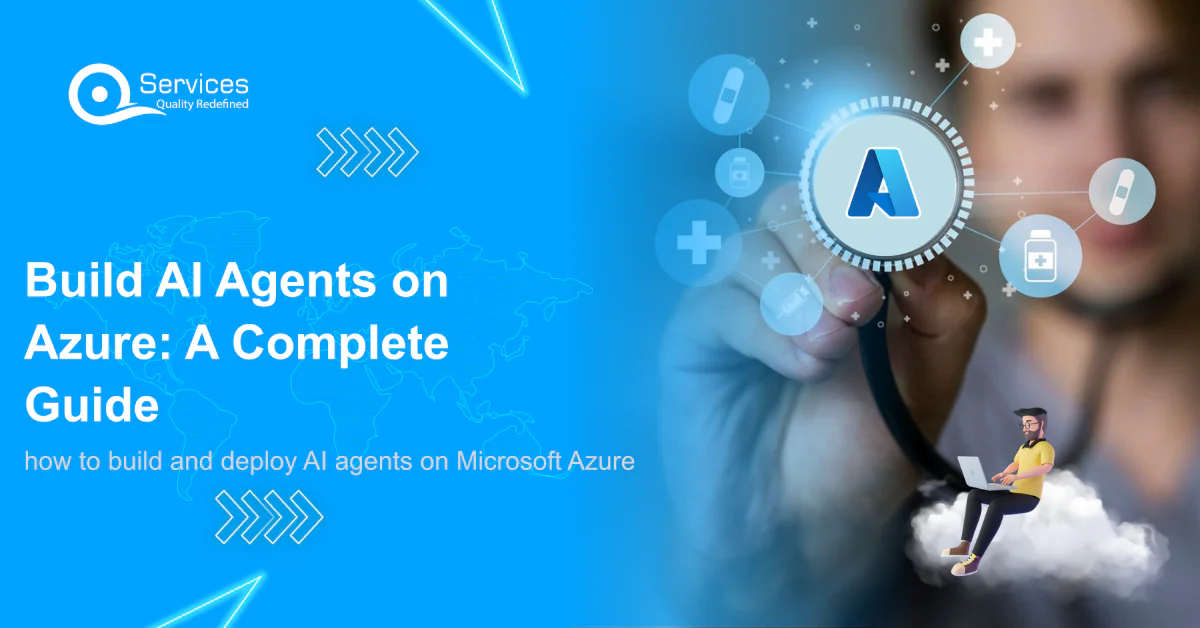
Learning how to build and deploy AI agents on Microsoft Azure is quickly becoming a practical priority for startups and SMBs, not a distant future project. Azure AI Foundry, Microsoft's unified agent-building platform, has seen rapid adoption since its 2024 launch, and by 2026 the tooling is mature enough for teams without dedicated ML engineers to get real agents into production. For fintech startups, regional banks, and growing SMBs, this means genuine workflow automation is within reach, at a cost that makes sense.
This guide walks through the entire process: from understanding what Azure AI agents actually are, to picking the right services, building your first agent, and keeping it compliant. No hype, just steps.
What Is an AI Agent and How Does It Work on Azure?
An AI agent is a software program that perceives its environment, makes decisions, and takes actions to achieve a defined goal, without requiring a human to guide every step.
Unlike a traditional chatbot that follows a scripted decision tree, an AI agent can reason through multi-step problems, call external tools (like APIs or databases), and adapt its behavior based on context. On Azure, agents are typically built through Azure AI Foundry, which provides a managed environment for orchestrating large language models (LLMs), memory systems, and callable tools.
Here's a practical way to think about it: a chatbot answers questions. An AI agent answers questions and then does something about them, like updating a CRM record, triggering a payment, or escalating a flagged transaction to a compliance officer.
For SMBs, this distinction matters a lot. You're not adding a Q&A widget to your website. You're building something that handles real business processes.
Core Azure Services for Building AI Agents
You don't need every service in the Azure catalog. These are the ones that actually matter for an agent project:
Azure AI Foundry is your home base. It brings together model selection, prompt management, tool integration, and observability in one workspace. For teams starting in 2026, this is where you build and test everything before deployment.
Azure OpenAI Service gives you access to GPT-4o, o1, and other models through a managed Azure endpoint. For most business use cases, including summarization, document processing, and customer support, GPT-4o is the right starting model.
Azure Logic Apps and Power Automate handle workflow orchestration. When your agent needs to trigger an action in an external system, create a support ticket, or send an approval email, these services carry that action across systems. Power Platform's no-code automation capabilities make this accessible to teams without dedicated backend developers.
Azure Cognitive Search is how you build a retrieval-augmented generation (RAG) layer, so your agent can answer questions based on your own company documents and knowledge base, not just general training data.
Azure Bot Service is the managed hosting layer for deploying your agent across channels: Microsoft Teams, web chat, WhatsApp, and others. It handles authentication, channel routing, and scaling automatically.
Azure Key Vault and Microsoft Entra ID are your security essentials. Key Vault stores secrets and API keys. Entra ID manages identity and access control for everyone interacting with your agent.
For a more detailed breakdown of these services from an SMB perspective, see our post on building AI agents on Microsoft Azure for small businesses.
How to Build and Deploy AI Agents on Microsoft Azure: Step by Step
Here is a practical sequence for getting an AI agent from idea to production:
Define the agent's scope. Resist the urge to build a general-purpose agent first. Pick one business process with clear inputs and outputs. A document review agent, an invoice approval agent, or a customer FAQ handler are all solid starting projects.
Set up Azure AI Foundry. Create a new project in AI Foundry and connect it to an Azure OpenAI Service deployment. This workspace holds your model configurations, prompt definitions, and agent logic.
Build and test your prompt flow. Use AI Foundry's Prompt Flow feature to design the conversation logic. Define the system prompt (what the agent knows and how it should behave), the tools it can call, and how it handles edge cases. Test with real examples from your own business data.
Connect external tools. An agent without tool access is just a chatbot. Use Azure Functions or Logic Apps to create callable actions: database lookups, CRM updates, API calls to third-party services. Register these as tools in AI Foundry using OpenAPI specifications.
Add memory if needed. For agents that need to remember context across sessions, like a relationship banking assistant, connect Azure Cosmos DB or Azure Cache for Redis to persist conversation history.
Deploy via Azure Bot Service. Package your agent and deploy it through Azure Bot Service. Teams integration works well for internal tools. Web chat suits customer-facing deployments.
Monitor and iterate. Connect Azure Application Insights to track agent performance. Watch for high fallback rates (cases where the agent fails to complete a task) and refine your prompts and tool definitions based on real usage data.
You can find full technical reference material in the official Azure AI Foundry documentation.
Eager to discuss about your project?
Share your project idea with us. Together, we’ll transform your vision into an exceptional digital product!
Book an Appointment now
Integrating AI Agents with Existing Business Workflows on Azure
The real value of an AI agent comes when it connects to the systems you already use. Standalone agents are interesting proofs of concept. Agents wired into your operations are a genuine productivity investment.
Power Automate integration lets you trigger agent workflows based on business events: a new form submission, an incoming email, a status change in Dynamics 365. The agent processes the event, decides what to do, and Power Automate executes the downstream action. For fintech teams, this pattern works well for automating KYC and AML compliance checks without requiring manual reviews for every standard case.
Dynamics 365 integration lets agents read and write CRM records directly. A sales agent might pull up a customer's deal history before a call and suggest talking points. A support agent can automatically log case notes and update ticket status.
SharePoint and Teams are natural homes for internal knowledge agents. The RAG architecture, using Azure Cognitive Search over SharePoint content, lets your agent surface relevant policies, procedures, or contract clauses on demand. Teams integration means employees can query the agent in their existing workflow without switching tools.
For a deeper look at these patterns in financial services, our post on the future of banking with Power Platform and generative AI covers several specific automation workflows in detail.
How Much Does It Cost to Build AI Agents on Microsoft Azure?
Cost is where SMBs often hesitate, and it's a fair concern. Here's an honest breakdown of what you're likely to spend:
| Cost Component |
Typical Monthly Range |
Notes |
| Azure OpenAI Service (GPT-4o) |
$50 – $800 |
Scales with token volume |
| Azure AI Foundry |
Usage-based |
No flat fee; pay for compute and storage |
| Azure Bot Service |
Free – $0.50 per 1,000 messages |
Free tier covers moderate usage |
| Azure Logic Apps |
~$0.000025 per action |
Very low for most automations |
| Azure Cognitive Search |
$73 – $300+ |
Depends on index size and query volume |
| Azure Functions / App Service |
$10 – $100 |
For tool hosting and API endpoints |
A realistic starting budget for a single agent with moderate traffic is $200 to $600 per month. Multi-agent architectures or high-volume deployments will cost more, but most SMBs start well within this range.
One area teams consistently overlook: prompt optimization. Shorter, more precise prompts consume fewer tokens. An agent using 400 tokens per interaction costs roughly three times less than one using 1,200 tokens for the same task. Small investments in prompt engineering translate to real savings at scale.
For a broader strategy on managing Azure costs as your AI workloads grow, our guide to optimizing Azure cloud costs tier by tier covers the budget management approaches that work best for SMBs and startups.
Eager to discuss about your project?
Share your project idea with us. Together, we’ll transform your vision into an exceptional digital product!
Book an Appointment now
Security, Compliance, and Governance for Azure AI Agents
Most build guides skip this section. For businesses in banking, fintech, or any regulated industry, it's the most important part.
Identity and access control should be your first concern. Every agent interaction should be authenticated through Microsoft Entra ID. Role-based access control (RBAC) should define precisely which systems the agent can read from or write to. If your agent has write access to a database, that permission scope should be as narrow as the task requires.
Data residency and privacy matter for GDPR-compliant deployments. Azure AI services let you specify the geographic region where data is processed. Deploying in EU regions (West Europe, North Europe) ensures data stays within the jurisdiction. Review Microsoft's Azure OpenAI data privacy documentation before any live deployment.
Content filtering is built into Azure OpenAI Service at the model deployment level. For financial services agents, consider adding custom filters for topics outside the agent's intended scope, like unsolicited investment advice, if your compliance team requires it.
Audit logging is essential for both debugging and regulatory review. Azure Monitor and Application Insights capture interaction logs by default. If you're subject to PCI DSS requirements, our Azure PCI DSS payment automation guide covers the specific logging and control requirements in detail.
AI governance is becoming a legal requirement, not just best practice. The EU AI Act places obligations on organizations deploying AI in high-risk categories, which includes most financial services applications. Before going live, document your agent's purpose, data sources, and decision logic. Microsoft's Responsible AI Standard provides a structured framework for exactly this kind of documentation.
For SMBs without a dedicated compliance team, the practical approach is a limited rollout first. Observe how the agent behaves in real conditions, refine your controls, and expand from there.
Azure AI Agents vs Traditional Chatbots: Which Should You Build?
The distinction matters when you're deciding how to invest your development budget.
| Feature |
Traditional Chatbot |
Azure AI Agent |
| Logic type |
Rule-based / scripted |
Reasoning-based / dynamic |
| Can take actions |
Limited (preset only) |
Yes (any callable tool or API) |
| Handles ambiguity |
Poorly |
Well (within model limits) |
| Requires ML expertise |
No |
No (with AI Foundry) |
| Maintenance burden |
High (manual script updates) |
Lower (prompt and tool tuning) |
| Best for |
Simple FAQ, menu routing |
Complex workflows, decision support |
The honest answer: if your use case is a simple FAQ or basic triage routing, a traditional chatbot is cheaper and simpler to maintain. If you need something that can reason across documents, trigger downstream actions, and adapt to changing context, an Azure AI agent is the better long-term investment.
How Azure AI Agents Stack Up Against AWS and Google Cloud
Azure is not the only platform offering AI agent capabilities. Here's where it stands in 2026.
AWS Bedrock Agents use models like Claude and Titan through Amazon Bedrock, with similar tool-use capabilities. AWS has strong ML infrastructure, but the enterprise workflow integration story is less cohesive than Azure's combination of Power Platform, Dynamics 365, and Teams.
Google Cloud Vertex AI Agents are technically strong, particularly if you're building with Gemini models. Vertex AI has solid MLOps tooling, but the business application integration layer is less mature for SMB deployments that need out-of-the-box connectors.
The Azure advantage for SMBs comes down to what you already use. If your business runs on Microsoft 365, Dynamics 365, or Teams, your identity layer (Entra ID) is already in place and your Power Platform connectors cover most business applications without custom code. That reduces the integration overhead considerably compared to starting fresh on another cloud platform.
For businesses already on the Microsoft stack, the case for staying on Azure is clear. If you're starting from scratch with no existing vendor, do an honest assessment of which platform your development team already knows, since migration overhead compounds over time.
Conclusion
Knowing how to build and deploy AI agents on Microsoft Azure is no longer a skill reserved for large enterprises with dedicated AI teams. The tooling is accessible, the costs are workable for SMBs, and the integration with Microsoft's business application stack gives teams already in that environment a real head start.
The organizations moving first on this have a genuine window to automate high-effort processes, from compliance checks and customer support queues to document review and fraud screening, before competitors close the gap. Start narrow: pick one process, build a focused agent using Azure AI Foundry, connect it to your existing systems through Power Automate, and put proper governance in place before you scale. That's a realistic six-to-ten week project for most SMBs working with an experienced partner.
If you're ready to start building and want a team that has already done this for SMBs and financial services clients, explore our outsourcing and development services for startups or reach out for a scoping conversation.
Q
Written by QServices Team
Technology & Digital Transformation Experts
QServices is a global IT consulting and software development company specializing in cloud solutions, enterprise applications, and digital transformation. Our team of certified experts helps businesses innovate faster and operate smarter.
Talk to Our Experts
Frequently Asked Questions
Related Topics
Eager to discuss about your project?
Share your project idea with us. Together, we’ll transform your vision into an exceptional digital product!
Book an Appointment now