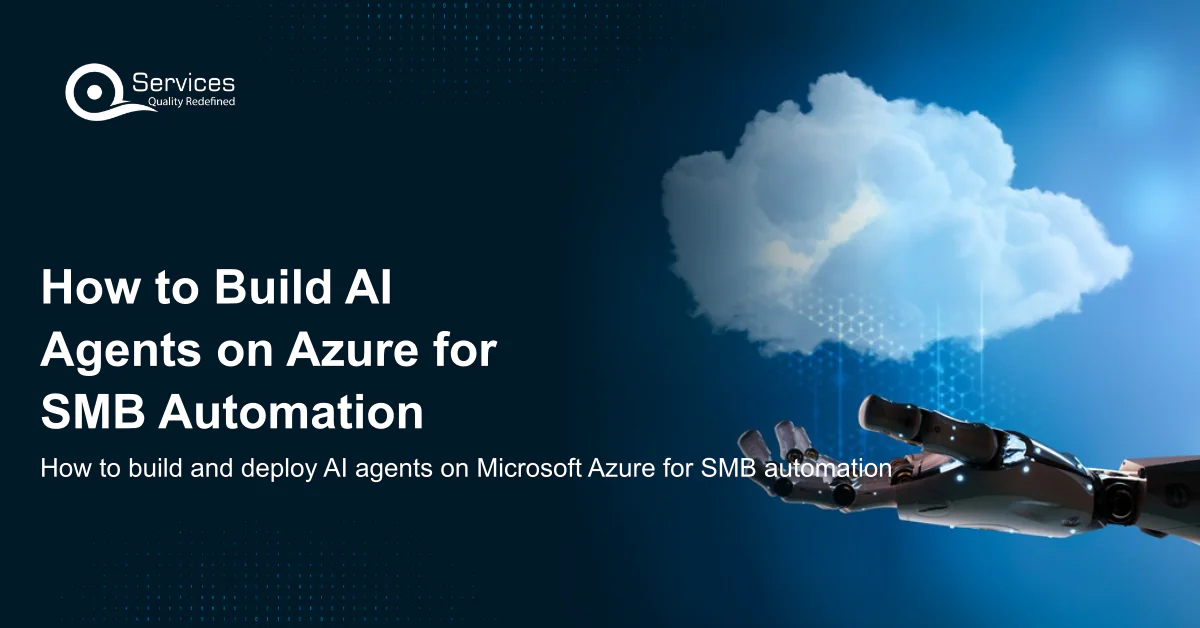
If you're looking to understand how to build and deploy AI agents on Microsoft Azure for SMB automation, you're in the right place. Small and medium businesses are increasingly turning to Azure's AI capabilities to automate repetitive workflows, reduce operational costs, and compete with larger players. Whether you're a startup founder juggling a dozen tasks or a mid-size operations team looking to scale without adding headcount, Azure's AI tools offer a realistic path forward. The challenge for most SMBs isn't awareness. It's knowing where to start and which services actually make sense for a business without a dedicated AI team. This guide answers both questions.
What Are AI Agents and How Do They Work on Microsoft Azure?
AI agents are software programs that perceive their environment, make decisions, and take actions to complete a goal, often without requiring human input at every step. Unlike basic rule-based scripts, they can adapt to new data, call external services, and operate across multiple systems simultaneously.
On Microsoft Azure, AI agents are typically powered by Azure AI Services, including Azure OpenAI Service, Azure Cognitive Services, and Azure Bot Service. These components let agents understand natural language, process documents, and communicate across channels like email, Teams, or customer portals.
The key difference from older automation tools is reasoning capability. An AI agent on Azure can receive a customer inquiry, look up order data, decide whether to escalate or resolve the issue, and send a response, all without a human touching the workflow.
Why SMBs Are Turning to Azure AI Agent Automation in 2026
Three years ago, most small businesses could not afford the infrastructure needed to run AI at scale. Azure changed that. Pay-as-you-go pricing and pre-built AI models have made it possible for a ten-person team to automate processes that once required a dedicated IT department.
The business case is straightforward. According to McKinsey's research on the economic potential of generative AI, companies adopting AI-powered automation see productivity gains of 20-40% in targeted workflows. For SMBs operating on thin margins, that kind of efficiency matters.
Beyond cost savings, Azure AI agents help small businesses compete with larger players. A regional bank can automate KYC checks. A logistics startup can track shipments without manual intervention. A professional services firm can handle client intake and scheduling automatically.
For most SMBs starting out, the combination of Azure OpenAI Service, Logic Apps, and either Copilot Studio or Power Automate covers 80% of common automation scenarios. As your needs grow, you can layer in Azure Functions and Cognitive Search for more complex agent behaviors.
Step-by-Step: How to Build and Deploy AI Agents on Microsoft Azure
Here's a practical walkthrough for getting your first Azure AI agent running.
1. Define the automation goal clearly. Before touching any Azure console, write down exactly what the agent should do, what data it needs, and what a successful outcome looks like. Vague goals produce vague agents.
2. Set up your Azure environment. Create an Azure account if you don't have one. Set up a resource group to keep your services organized. If budget is a concern, our guide on Azure cost optimization for SMBs covers how to keep spending under control from day one.
3. Choose your development path. For non-technical teams, start with Microsoft Copilot Studio. For teams with a developer available, Azure Bot Service combined with Azure OpenAI gives you more flexibility and control.
4. Connect your data sources. AI agents need data to act on. Use Azure Logic Apps or Power Automate to pull data from your CRM, ERP, or database. Azure Cognitive Search can index your documents so the agent can retrieve relevant information on demand.
5. Build the agent logic. Configure the decision tree or prompt chain that guides the agent's behavior. If you're using Azure OpenAI, this means crafting your system prompts carefully and testing edge cases thoroughly before launch.
6. Test in a sandbox environment. Always test before going live. Create a staging version of your agent and run it against real-world scenarios. Document where it fails so you can refine the logic.
7. Deploy and monitor. Use Azure Monitor and Application Insights to track agent performance after launch. Set up alerts for errors or unexpected behavior so problems are caught early.
The full end-to-end process can take anywhere from two days for a simple chatbot to several weeks for a multi-system automation agent. It depends largely on the complexity of your workflows and the availability of clean, structured data.
Eager to discuss about your project?
Share your project idea with us. Together, we’ll transform your vision into an exceptional digital product!
AI Agents vs. Traditional RPA: What SMBs Need to Know in 2026
This comparison trips up a lot of small business owners. Robotic Process Automation (RPA) follows fixed rules. It clicks buttons, fills forms, and moves data between systems, but only in the exact way it was programmed. If something changes in the interface or the data structure, RPA breaks.
AI agents reason about tasks. They can interpret unstructured data like emails or PDFs, handle exceptions, and decide what to do next without being explicitly programmed for every scenario.
Here's a practical way to think about the split:
Use RPA when: your process is highly structured, repetitive, and rarely changes (payroll processing, data migration)
Use AI agents when: your process involves variable inputs, natural language, or judgment calls (customer support, document review, lead qualification)
For many SMBs, the right answer is a hybrid approach. RPA handles the mechanical steps; AI agents handle the thinking. Azure supports both through Power Automate (which includes RPA capabilities) and Azure AI Services.
Power Platform vs. Custom Azure AI Agents: Choosing the Right Approach for SMBs
For most SMBs, this is the most important decision in the entire project. The answer depends on three factors: technical capability, budget, and complexity.
Power Platform (Power Automate and Copilot Studio) is the right starting point if:
Custom Azure AI agents built with Azure OpenAI, Bot Service, and Azure Functions are the better choice if:
You need deep integration with proprietary systems
Your data is complex or sensitive (financial records, healthcare data)
You want full control over the agent's behavior and security posture
You're building something you plan to scale significantly
The honest answer for most SMBs starting out: begin with Power Platform, prove the concept, and upgrade to custom development once you know exactly what you need. This approach keeps costs low and reduces risk during the learning phase.
Eager to discuss about your project?
Share your project idea with us. Together, we’ll transform your vision into an exceptional digital product!
Real-World SMB Use Cases for Azure AI Agent Automation
Knowing the theory is useful. Seeing what's actually working for businesses your size is better.
Customer support automation. A mid-size e-commerce company deploys an Azure-based AI agent to handle order tracking, returns, and FAQs. The agent resolves 65% of tickets without human involvement, freeing the support team for complex cases that actually need judgment.
Financial compliance and document processing. Small banks and credit unions use Azure AI agents to review loan applications, flag missing documents, and check entries against compliance rules automatically. Our post on automating banking compliance on Azure goes deep on this use case and the specific Azure services involved.
Sales pipeline management. A B2B software company uses an agent connected to their CRM to qualify inbound leads, send follow-up emails, and schedule demos, all without a sales rep touching the contact until they're ready to buy.
HR and employee onboarding. New employee onboarding involves dozens of repetitive steps: account creation, document collection, training assignments. An Azure agent can coordinate all of these across Active Directory, SharePoint, and HR software automatically.
Supply chain and logistics. Startups running logistics operations use Azure-connected agents to track shipments, alert teams to delays, and reroute deliveries based on real-time conditions.
Cost Breakdown: Deploying AI Agents on Azure for Small Business
One of the most common questions we hear: what does it actually cost to build and deploy AI agents on Microsoft Azure? The answer varies by scale and complexity, but here's a realistic breakdown.
Azure OpenAI Service: Costs are based on tokens processed. For a moderate-volume agent handling a few thousand interactions per month, expect $20-$150/month depending on model selection.
Azure Bot Service: Pricing starts at around $0.50 per 1,000 messages for the standard tier. A small business with moderate usage might spend $10-$50/month here.
Logic Apps and Azure Functions: These are largely consumption-based and very affordable at SMB scale. Many businesses spend under $20/month on these components.
Development costs: This is the bigger variable. A simple chatbot built with Copilot Studio can be set up in a day for minimal cost. A custom multi-system Azure AI agent built by a developer could require a $5,000-$25,000 initial investment.
Total monthly operating costs for a typical SMB Azure AI agent setup: $50-$300/month. For tips on keeping Azure costs manageable as you scale, see our guide on reducing cloud costs with Microsoft Azure.
How to Build AI Agents on Azure Without a Large IT Team
This is the concern we hear most from SMB owners. The good news is that Microsoft has invested significantly in making Azure AI accessible to non-technical teams.
Copilot Studio is genuinely usable by business analysts and operations staff. It has a drag-and-drop interface, pre-built templates, and connects to Microsoft 365 data out of the box. A motivated non-technical person can build and deploy a functional AI agent in a few days.
Power Automate handles the workflow side with a similar low-code experience. You can trigger automations based on emails, form submissions, calendar events, and more, without writing a single line of code.
For SMBs that want developer expertise for the initial build, the most cost-effective approach is engaging a specialist for the setup phase rather than hiring full-time. Many SMBs work with a Microsoft Solutions Partner to get their first agent deployed, then manage it internally from that point forward.
The key is starting small. Pick one repetitive process, automate it, and measure the result. That first win builds internal confidence and shows you exactly what else is worth automating next.
Conclusion
Learning how to build and deploy AI agents on Microsoft Azure for SMB automation does not require a large IT team, a massive budget, or months of planning. Azure provides the tools, the pricing model, and the support ecosystem to make this achievable for businesses of any size. Start with a clear use case, pick the right Azure services for your needs, and take an incremental approach. The businesses seeing the best results are not the ones that tried to automate everything at once. They picked one process, proved the value, and scaled from there. If you're ready to move from concept to implementation, reach out to our team to discuss your specific situation and get a practical deployment plan.
QServices is a global IT consulting and software development company specializing in cloud solutions, enterprise applications, and digital transformation. Our team of certified experts helps businesses innovate faster and operate smarter.
AI agents are software programs that perceive input, reason about it, and take actions to complete a goal without continuous human oversight. On Microsoft Azure, they are built using services like Azure OpenAI Service, Azure Bot Service, and Azure Logic Apps, which together give the agent the ability to understand language, access data, and trigger actions across business systems.
Microsoft has made this increasingly accessible through low-code tools like Copilot Studio and Power Automate. These platforms allow business analysts or operations staff to build and deploy functional AI agents using visual interfaces without writing code. For more complex deployments, many SMBs engage a Microsoft Solutions Partner for the initial build and manage the agent internally afterward.
Traditional RPA follows fixed, rule-based instructions and works best on structured, repetitive tasks. If the data format or interface changes, RPA typically breaks. AI agents can interpret unstructured data like emails or documents, handle exceptions, and make judgment calls. For many SMBs, a hybrid approach works best: RPA for mechanical tasks and AI agents for tasks involving language or reasoning.
Monthly operating costs for a typical SMB Azure AI agent range from $50 to $300, covering Azure OpenAI Service, Azure Bot Service, and Logic Apps. Development costs vary: a simple Copilot Studio chatbot can be set up in a day for minimal cost, while a custom multi-system agent may require a $5,000-$25,000 initial development investment.
The core services most SMBs need include Azure OpenAI Service for language understanding, Azure Bot Service for conversational interfaces, Azure Logic Apps for workflow automation, and either Power Automate or Copilot Studio for low-code development. Azure Functions and Azure Cognitive Search are added for more complex scenarios involving custom logic or document retrieval.
Yes. Microsoft’s Power Platform, specifically Copilot Studio and Power Automate, is well-suited for SMBs that want to build AI agents without in-house developers. Copilot Studio provides a no-code interface for building conversational agents, while Power Automate connects those agents to business data and systems. For standard automation scenarios, Power Platform can have a working agent deployed within days.
The most effective use cases for Azure AI agents in SMB automation include customer support ticket resolution, financial document processing and compliance checks, sales lead qualification and follow-up, employee onboarding coordination, and logistics tracking and alerting. Financial services companies also use Azure AI agents to automate KYC verification, loan document review, and regulatory reporting.
When PDF text extraction drops the spaces between words, AI agents can’t find facts that are right there. How we found it in Azure AI Foundry and fixed it.
Pint AE explained for UAE finance teams with one sample invoice: see which fields come from your ERP, which go missing, and how to test before go-live.
Days sales outstanding explained for CFOs: the formula, worked examples, named industry benchmarks, and why seasonal sales distort DSO. See what moves it.
Follow one payment through the cash application process, step by step, and see the exact moment it stalls so your AR team can clear unapplied cash faster.
When PDF text extraction drops the spaces between words, AI agents can’t find facts that are right there. How we found it in Azure AI Foundry and fixed it.
Pint AE explained for UAE finance teams with one sample invoice: see which fields come from your ERP, which go missing, and how to test before go-live.
Days sales outstanding explained for CFOs: the formula, worked examples, named industry benchmarks, and why seasonal sales distort DSO. See what moves it.
Follow one payment through the cash application process, step by step, and see the exact moment it stalls so your AR team can clear unapplied cash faster.
QServices Inc. undertakes every project with a high degree of professionalism. Their communication style is unmatched and they are always available to resolve issues or just discuss the project.
Turn the Microsoft Licenses
You Already Own Into an AI Workplace
Join our live webinar on Sept 24 and see five ways to automate meetings, approvals, and