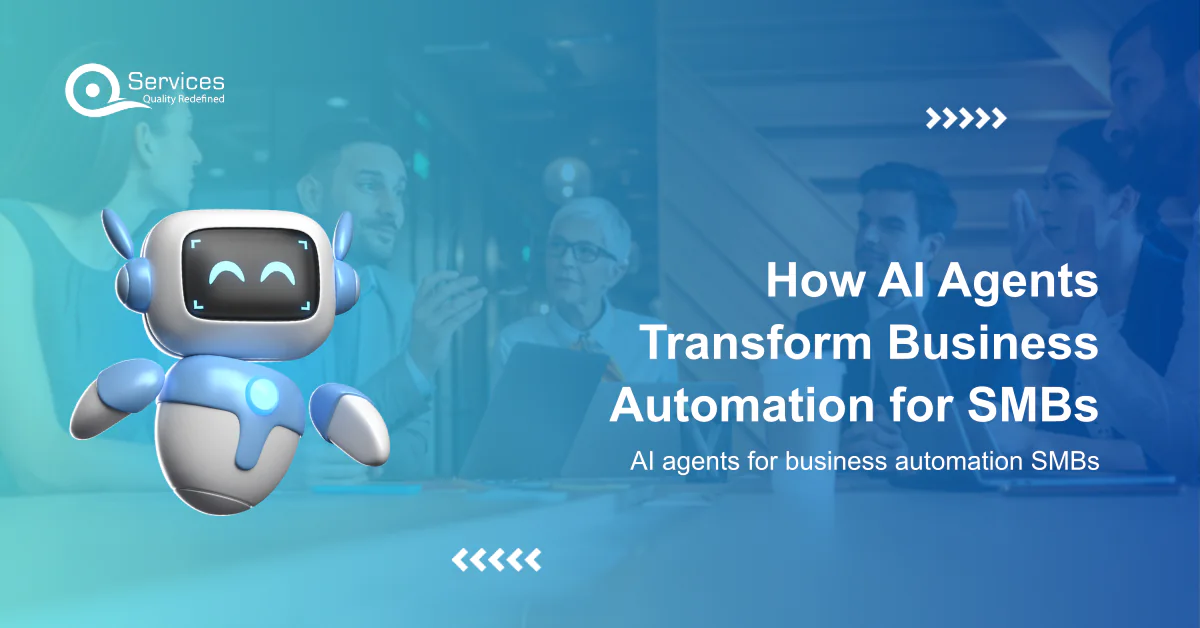
AI agents for business automation SMBs are reshaping how small and mid-sized companies operate, and the shift is happening faster than most business owners expected. A few years ago, automating a complex workflow meant hiring developers, buying expensive software licenses, or waiting months for an IT project to deliver results. Now, with Microsoft Azure AI services and low-code tools like Power Automate, a business with 20 employees can deploy intelligent automation that would have cost a Fortune 500 company six figures just three years ago. This guide walks through what AI agents actually do, how they compare to older automation approaches, and how your team can start using them today, even without a dedicated data science team.
What Are AI Agents and How Do They Work?
An AI agent is a software program that perceives its environment, makes decisions, and takes actions to complete a goal, without needing a human to approve each step. Unlike a simple chatbot that answers questions or a basic script that runs on a schedule, an AI agent can read context, handle exceptions, and adapt its behavior based on what it encounters.
In a business setting, this means an agent can:
- Receive an email from a customer, extract the relevant data, check your CRM, and create a support ticket
- Monitor incoming invoices, validate them against purchase orders, and route exceptions to the right team member
- Watch for low inventory levels, check supplier catalogs, and draft a purchase order for human review
The underlying technology combines large language models (LLMs) for reasoning, APIs for connecting to business software, and orchestration frameworks that define what the agent is allowed to do. Microsoft's Azure AI Foundry platform gives developers a structured way to build, test, and deploy these agents at scale.
What makes modern AI agents different from previous automation tools is their ability to handle unstructured inputs. Traditional automation breaks when it encounters an invoice in a slightly different format. An AI agent reads the context, figures out what the document contains, and processes it correctly regardless.
AI Agents for Business Automation: How SMBs Are Using Them in 2026
AI agents for business automation among SMBs have moved well beyond pilot projects. According to McKinsey's research on the economic potential of generative AI, automation technologies have the potential to transform how companies operate across every function, with knowledge work seeing some of the most significant gains. For SMBs specifically, the most common production use cases right now include:
Customer-facing automation: Agents handle initial customer inquiries, gather information, update records, and escalate only when human judgment is required. In financial services, digital onboarding automation has already cut new account opening times from days to minutes at community banks and credit unions.
Back-office processing: Accounts payable, HR onboarding, and compliance document reviews are being handled by agents that work through queues faster than any human team while logging every action for audit purposes.
Operations monitoring: SMBs in distribution and retail are using agents to track supply chains, flag delays, and update customers automatically, without anyone manually checking dashboards.
The key point is that these are production systems processing real transactions at companies with fewer than 100 employees. This is not experimental technology reserved for well-funded enterprises.
Eager to discuss about your project?
Share your project idea with us. Together, we’ll transform your vision into an exceptional digital product!
Book an Appointment now
AI Agents vs. Traditional RPA: What SMBs Need to Know
Robotic Process Automation (RPA) was the dominant automation technology for the past decade. Tools like UiPath and Automation Anywhere record clicks and keystrokes, then replay them to automate repetitive computer tasks. RPA works well for stable, rule-based processes, but it has real limitations.
| Feature |
Traditional RPA |
AI Agents |
| Handles unstructured data |
No |
Yes |
| Adapts to process changes |
Minimal |
Yes |
| Requires technical setup |
High |
Medium to Low |
| Reasons across context |
No |
Yes |
| Cost to maintain |
High (fragile) |
Lower over time |
RPA breaks when a screen layout changes, a form adds a new field, or an input arrives in an unexpected format. Every change requires a developer to update the bot. AI agents read context and adapt, making them a better fit for tasks involving documents, emails, or anything that doesn't follow a perfectly rigid structure.
That said, RPA still makes sense for highly stable, pixel-perfect processes, especially where you need to interact with legacy systems that expose no API. Many SMBs end up running a hybrid approach: RPA for legacy system interactions and AI agents for everything requiring judgment. For a practical look at how RPA has been applied in regulated industries, the RPA use cases for community banks, credit unions, and regional institutions post covers the real-world tradeoffs well.
Business Processes You Can Automate with AI Agents Right Now
The practical question most SMB owners ask is: "What can I actually automate today?" Here is a realistic list based on what is currently in production at businesses similar to yours.
Customer Onboarding
Collecting documents, verifying identity, running credit or compliance checks, and sending welcome communications can all be handled by an agent. In financial services, KYC (Know Your Customer) verification, once a bottleneck requiring days of manual review, now runs in minutes with AI-assisted document processing.
Invoice and Accounts Payable Processing
An agent reads incoming invoices whether delivered by PDF, email, or scanned image, extracts line items, matches them to purchase orders in your ERP or accounting system, and queues exceptions for human review. Error rates drop significantly and processing time shrinks from days to hours.
HR and Employee Onboarding
When a new hire is confirmed, an agent can provision system accounts, send welcome materials, schedule orientation sessions, assign training modules, and notify relevant team members. No one needs to manage a manual checklist or remember which steps come next.
Compliance Monitoring and Reporting
For businesses in regulated sectors, agents monitor transactions or communications for policy violations, generate required reports, and flag anything needing human review. The automated compliance framework used in banking provides a strong model that translates directly to other regulated industries including insurance, healthcare administration, and professional services.
Customer Support Triage
First-line support agents handle common questions, look up account information, and resolve simple issues without human involvement. Complex cases get routed to a human with full context already gathered, so the handoff is smooth rather than frustrating for the customer.
How SMBs Can Implement AI Agents for Business Automation Without a Data Science Team
AI agents for business automation no longer require a team of ML engineers or a custom model training pipeline. Microsoft Azure has made this genuinely accessible to businesses with limited technical staff.
Here is a practical starting path:
Identify one high-volume, repeatable process that currently takes significant manual time. Invoice processing, email triage, and new customer onboarding are the most common starting points because they have clear inputs, consistent steps, and measurable outcomes.
Audit your data and systems. What software does the process touch? Does it have an API or a Power Automate connector? Most major business apps, including Salesforce, QuickBooks, Microsoft 365, and Dynamics 365, do.
Start with Power Automate and AI Builder. Microsoft Power Automate includes AI Builder, which provides pre-built AI models for document processing, sentiment analysis, and form recognition. No coding is required for many common scenarios. Our guide to Power Platform's no-code automation explains how to get started quickly and where the boundaries of the low-code approach sit.
Graduate to Azure AI Foundry for custom agents. When your needs outgrow what low-code tools can handle, Azure AI Foundry lets you build agents with specific tools, memory, and decision logic. You orchestrate existing capabilities rather than training models from scratch.
Build incrementally. Start with one agent handling one process. Measure it carefully. Expand only after you have confidence in output quality and error handling.
For a detailed technical walkthrough of building on Azure, the guide to building AI agents on Microsoft Azure for SMBs covers the architecture decisions you will face at each stage of the journey.
Eager to discuss about your project?
Share your project idea with us. Together, we’ll transform your vision into an exceptional digital product!
Book an Appointment now
Microsoft Azure AI Services for SMB Automation
Microsoft Azure offers a set of services that SMBs can use without building everything from scratch. The most relevant ones for intelligent process automation include:
Azure OpenAI Service: Access to GPT-4o and other models through a secure, enterprise-grade API. Use this for language understanding, document summarization, and generating structured outputs like formatted emails or compliance reports.
Azure AI Document Intelligence: Extracts structured data from invoices, contracts, forms, and identity documents. This is the engine behind most document automation workflows and requires minimal configuration for standard document types.
Azure AI Foundry: The orchestration layer for building multi-step AI agents. It defines what tools an agent can use, how it reasons through problems, and how it hands off to humans when needed.
Microsoft Power Automate with AI Builder: The low-code entry point. Hundreds of pre-built connectors plus AI models you can add to flows without writing code. This service handles the majority of SMB automation needs without custom development.
Azure Cognitive Search: Lets agents search and retrieve information from your business documents, SharePoint libraries, or internal knowledge bases, which is essential for customer service and compliance use cases.
According to Microsoft's Azure AI documentation, these services are designed to work together and carry enterprise security certifications including SOC 2, ISO 27001, and HIPAA compliance where applicable. The cost structure is consumption-based, which is a real advantage for SMBs who pay for what they use rather than committing to a fixed platform license.
Measuring ROI from AI-Powered Business Automation for SMBs
ROI from AI-powered business automation for SMBs shows up in three categories: cost reduction, time savings, and error rate reduction.
Cost per transaction is the most direct metric. If processing one invoice manually costs your team $8 in labor (time multiplied by salary rate), and an AI agent handles the same invoice for $0.15 in compute costs, the savings scale significantly with volume.
Time-to-completion matters most in customer-facing processes. If your customer onboarding takes 3 days manually and 20 minutes with an AI agent, the impact includes customer experience and competitive positioning, not just labor cost savings.
Error rates are often where the biggest hidden value sits. Manual data entry errors in financial processes trigger compliance issues, customer disputes, and expensive rework cycles. Agents maintain consistent accuracy without fatigue.
A simple framework for building your business case:
| Metric |
Before Automation |
After Automation |
| Time per transaction |
Hours |
Minutes |
| Cost per transaction |
$8-15 |
$0.10-0.50 |
| Error rate |
2-5% |
Less than 1% |
| Staff time freed per month |
0 hours |
40-200 hours |
Multiply the per-transaction savings by monthly transaction volume and you have a concrete monthly ROI figure. Most SMBs see payback within 6 to 12 months on well-scoped automation projects, with ongoing savings compounding as volume grows.
Compliance and Security for AI Agents in SMB Environments
Deploying AI agents introduces questions about data handling, auditability, and regulatory compliance that SMBs need to address before going to production.
The EU AI Act, which came into full effect in 2026, classifies AI systems by risk level. Most business automation agents fall into the "limited risk" or "minimal risk" categories, but applications in HR screening, credit assessment, or identity verification face higher compliance requirements. If you operate in the EU or process EU citizen data, documented risk assessments and human oversight mechanisms are required for higher-risk applications. The EU's official AI regulatory framework guidance outlines the classification criteria in detail.
Data residency is a concern for SMBs in financial services. Azure's regional deployment options let you keep data within specific geographies, which matters for GDPR compliance and some sector-specific regulations.
Audit trails should be non-negotiable. Every action an AI agent takes should be logged with timestamps, inputs, outputs, and the decision path. Azure AI Foundry includes built-in observability tools, and connecting agent logs to your existing monitoring infrastructure adds the accountability layer that regulators and auditors expect.
Human-in-the-loop checkpoints are worth building into any high-stakes workflow, at least initially. An agent that processes invoices and queues them for human review before payment carries significantly lower risk than one that initiates payments autonomously. Start with humans in the loop and remove them selectively as you build confidence in the system's outputs over time.
Conclusion
AI agents for business automation SMBs represent one of the most accessible and practical technology investments available in 2026. The barriers that once made this territory exclusive to large enterprises, including the need for data science teams, custom model training, and expensive platforms, have largely been removed. Microsoft Azure's toolchain makes it possible to start small, prove value quickly, and scale incrementally as your confidence grows.
The most important first step is identifying the right process: something your team handles repeatedly, follows consistent rules, and consumes time that could be spent on higher-value work. Start there, measure carefully, and build from what works. When you are ready to move from concept to production, an experienced Azure solutions partner can help you avoid the false starts that come with building AI automation for the first time.
Q
Written by QServices Team
Technology & Digital Transformation Experts
QServices is a global IT consulting and software development company specializing in cloud solutions, enterprise applications, and digital transformation. Our team of certified experts helps businesses innovate faster and operate smarter.
Talk to Our Experts
Frequently Asked Questions
Related Topics
Eager to discuss about your project?
Share your project idea with us. Together, we’ll transform your vision into an exceptional digital product!
Book an Appointment now