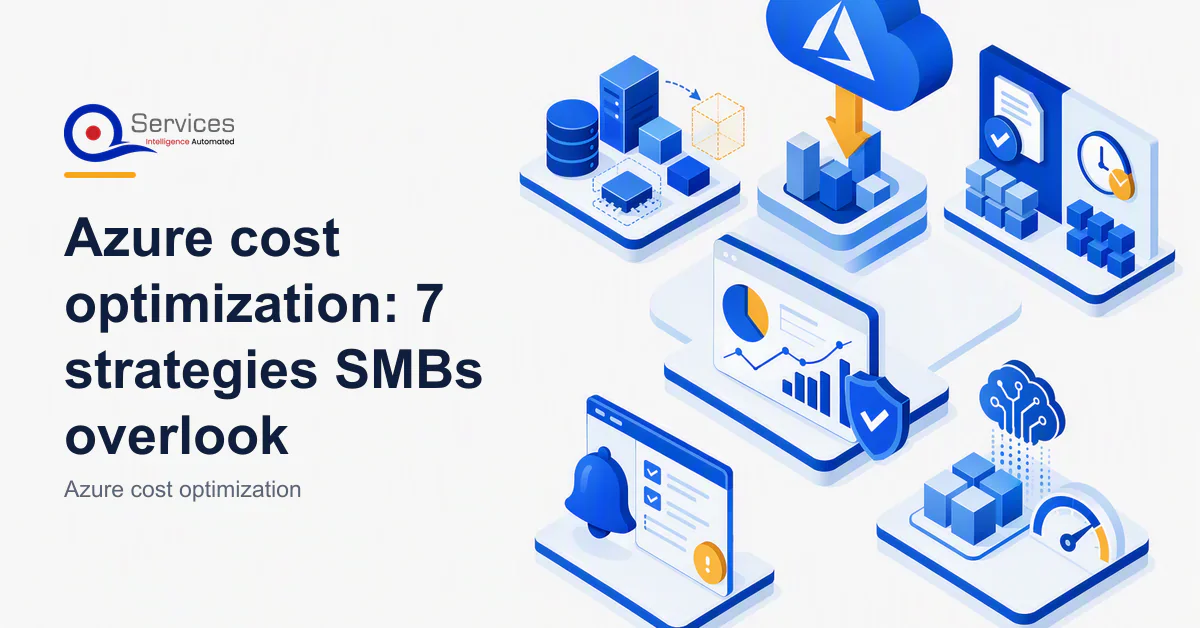
Azure cost optimization is the difference between a cloud investment that pays off and one that quietly drains your budget every month. Most SMBs start on a pay-as-you-go plan, spin up a few virtual machines, connect a database, and assume the costs will sort themselves out. Six months in, the bill has doubled, and no one can explain exactly why. This post breaks down seven specific strategies that SMBs consistently overlook. The same principles apply at $500/month as they do at $50,000/month, and most of the steps below can be completed in under a day.
Key Insight The same principles apply at $500/month as they do at $50,000/month, and most of the steps below can be completed in under a day.
In This Article, You'll Learn
Why Azure Cost Optimization Trips Up SMBs
Strategy 1: Right-Size Resources Before Reserving Anything
Strategy 2: Reserved Instances vs. Pay-As-You-Go
Azure Cost Optimization With Built-In Microsoft Budget Tools
Managing Azure AI Pricing Before It Scales Out of Control
Eager to discuss about your project?
Share your project idea with us. Together, we’ll transform your vision into an exceptional digital product!
Azure has over 200 distinct services, each with its own pricing model. Compute is billed by the second. Storage is billed by the gigabyte-month. Networking charges appear for outbound data transfer that no one thought to budget for. AI services charge by token. This complexity is manageable for enterprises with dedicated FinOps teams, but for an SMB with a two-person IT function, it becomes overwhelming fast.
The issue isn't that Azure is expensive by default. The issue is that default settings favor flexibility over cost efficiency. When you provision a virtual machine, Azure gives you what you asked for and keeps it running until you say otherwise. There is no built-in nudge to scale down a VM you provisioned for a one-time migration and then forgot about.
Many SMBs also copy infrastructure patterns from larger organizations. Running three-tier applications on dedicated VMs made sense in 2015. In 2026, that same workload can run on Azure Container Apps or serverless functions at a fraction of the cost. The seven strategies below address the most common places where SMB cloud budgets bleed unnecessarily.
Strategy 1: Right-Size Resources Before Reserving Anything
Right-sizing means matching your VM size, database tier, and storage performance tier to actual workload demand, not a theoretical peak. This is the first strategy SMBs skip, and it delivers the fastest payback.
Azure Advisor, which is free inside every Azure subscription, runs continuous analysis and surfaces specific right-sizing recommendations. A typical SMB running three to five virtual machines will find at least one downsize recommendation within the first 30 days. Moving from a Standard_D4s_v3 (4 vCPUs, 16 GB RAM) to a Standard_D2s_v3 (2 vCPUs, 8 GB RAM) cuts that VM's hourly cost by roughly 50%.
Before acting on any recommendation, pull 30 days of CPU and memory utilization data from Azure Monitor. If average CPU utilization is below 20% and memory rarely exceeds 50%, the downsize is safe. Check the 95th percentile, not just the average, because some workloads spike unpredictably and you don't want to trigger a performance incident to save $30/month.
Database tiers are often right-sizing territory too. Azure SQL Database and PostgreSQL Flexible Server both offer multiple compute tiers. Moving from General Purpose to the Burstable tier for a dev or staging database can cut that database's monthly cost by 60-70%. Most dev databases sit idle 80% of the time anyway.
Reserved instances let you commit to a specific VM size in a specific Azure region for one or three years in exchange for a significant discount. The savings are real: one-year reservations typically save 30-40% compared to pay-as-you-go, and three-year reservations can reach 60-72% on some VM families.
The tradeoff is commitment. If your workload changes and you need a different VM size, you can exchange reserved instances, but there is administrative overhead involved. This is exactly why right-sizing comes first. Reserve the correct size, not the size you happen to be running today.
The decision rule is straightforward: if a resource has been running at consistent utilization for 30 or more days and you expect it to continue for at least 12 months, a reservation makes financial sense. Common candidates include production web servers, database servers, and integration middleware that runs continuously.
Pay-as-you-go remains the right choice for variable, experimental, or short-lived workloads. Dev and test environments, batch jobs, and AI inference workloads that spike at unpredictable intervals should stay on consumption pricing until they stabilize.
Workload Type
Recommended Pricing Model
Typical Savings vs. Pay-As-You-Go
Production web server (24/7)
1-year Reserved Instance
35-40%
Production database (24/7)
1-year Reserved Instance
30-45%
Dev/test environment
Dev/Test pricing or shutdown schedule
50-80%
Batch processing
Spot instances
60-90%
AI inference (variable)
Pay-as-you-go
Baseline
Azure Cost Optimization With Built-In Microsoft Budget Tools
Microsoft provides a full cost management suite inside Azure at no additional charge. Most SMBs either don't know these tools exist or set them up once and never look at the alerts.
Azure Cost Management + Billing is the primary dashboard. It shows spending by service, resource group, subscription, and custom tag. The built-in forecasting feature projects your next 30-day spend based on current usage patterns, so you're not guessing at month-end.
Budget alerts are where the real operational value sits. You can create a budget at the subscription, resource group, or individual resource level, and configure email alerts at 80%, 90%, and 100% of the threshold. You can also create action groups that automatically trigger an Azure Automation runbook when a threshold is breached, which can shut down non-critical resources without any human intervention.
Key Insight You can create a budget at the subscription, resource group, or individual resource level, and configure email alerts at 80%, 90%, and 100% of the threshold.
Azure Advisor surfaces cost, security, and reliability recommendations in one dashboard. Cost recommendations include specific dollar-amount savings estimates, so you can prioritize by financial impact rather than guessing which fix matters most.
Anomaly detection in Azure Cost Management flags spending spikes that deviate significantly from your historical baseline. This catches runaway deployments, forgotten test resources, and misconfigured auto-scaling rules before they compound into a large month-end surprise. Most SMBs who enable anomaly alerts catch at least one unexpected cost event within the first 60 days.
How to Set Up Your First Azure Budget Alert in 10 Minutes
Most SMBs never open the budget alert form because it sounds like it needs a finance background. It doesn't. In the Azure portal, go to Cost Management, select Budgets, and click Add. Pick a scope (a subscription or a resource group works best for a first budget), set a monthly amount based on your trailing 30-day spend, and add three alert thresholds: 80%, 90%, and 100%. Enter the email addresses that should receive the alert, save it, and you're done.
For a second budget, scope one to a single resource group tied to a specific project or client. That way, when a project runs over, the alert tells you which one instead of just flagging that overall spend is up. Pair this with an action group if you want Azure to automatically stop a VM or scale set when spend crosses 100%, rather than relying on someone reading the email in time.
Set this up once and it keeps working. We've seen SMBs catch a misconfigured auto-scaling rule within hours of it starting to run up costs, simply because the 80% alert fired on a Tuesday afternoon instead of showing up as a surprise on the monthly invoice.
Managing Azure AI Pricing Before It Scales Out of Control
Azure AI pricing surprises SMBs more than any other service category in 2026. Unit costs look small: GPT-4o is priced at approximately $2.50 per million input tokens and $10 per million output tokens as of 2026. Token volumes at even modest usage scales add up quickly.
A customer service chatbot handling 200 conversations per day, with an average conversation length of 2,000 tokens, generates roughly 400,000 tokens daily. At GPT-4o pricing, that is $30-50 per day before output tokens, meaning $900-1,500 per month for a single use case. Add retrieval-augmented generation with 10,000-token context windows and the cost multiplies further.
Key Insight At GPT-4o pricing, that is $30-50 per day before output tokens, meaning $900-1,500 per month for a single use case.
Four strategies that actually control Azure AI spend:
Set token budgets per request. Define a maximum context window and output length in your API calls. Most business queries don't need 4,000-word responses, and hard limits prevent runaway costs from edge-case inputs.
Use semantic caching. Store embeddings and responses for common queries. Azure Cache for Redis can serve cached AI responses for semantically similar questions. In our client engagements, this has cut repeat API calls significantly on FAQ-style use cases.
Match the model to the task. GPT-4o is not always necessary. For classification, routing, or structured data extraction, gpt-4o-mini costs meaningfully less and performs comparably on structured inputs. If you're deciding between Azure OpenAI Service and Azure AI Foundry for these workloads, our breakdown of Azure AI Foundry vs Azure OpenAI Service covers the cost and capability differences.
Track token usage per user, not just in aggregate. Per-user monitoring identifies outlier usage patterns that inflate bills before they become a compounding problem.
Azure Cost Optimization Through Cloud Native Development
How your applications are built has a larger impact on Azure costs than most SMBs realize. Monolithic applications running on dedicated VMs carry a fixed cost baseline regardless of actual demand. Cloud native applications built on serverless functions, containers, or event-driven microservices pay for actual execution rather than standby capacity.
Azure Functions charges only for executions. At one million executions per month, the cost is effectively $0.20; even at 100 million executions, you're looking at approximately $20 (as of 2026). Compare that to a VM running continuously at $70-200/month whether it handles one request or a million.
Azure Container Apps provides managed container hosting with scale-to-zero. When your application has no traffic, it scales to zero instances and costs nothing. This works particularly well for internal tools, APIs with variable traffic patterns, and batch processing jobs that run a few times per day.
The honest limitation: rewriting a legacy monolith to cloud native is not a fast project, and if you're weighing a full rewrite against incremental change, our guide on connecting legacy systems to modern APIs without a full rewrite lays out the tradeoffs. The practical approach is to build new features and services cloud native while decomposing the monolith incrementally. A multi-tenant SaaS architecture on Azure built cloud native from the start will cost significantly less to operate at scale than one assembled from dedicated VMs.
According to the Cloud Native Computing Foundation, organizations that fully adopt cloud native patterns report 20-30% reduction in infrastructure costs within the first year compared to traditional VM-based deployments.
Strategy 6: Automate Scaling to Stop Paying for Idle Resources
Idle resources are the largest category of wasted Azure spend for SMBs. An SMB running five VMs that are actively used only during business hours (9 hours/day, 5 days/week) is paying for roughly 130 idle compute hours per VM per month. At standard VM pricing, that means 60-65% of compute costs going to zero-value runtime.
Scheduled start/stop automation addresses this directly. Azure Automation, combined with a simple runbook, can stop VMs at 6 PM and restart them at 8 AM on weekdays. The setup takes about 30 minutes and typically cuts VM costs by 50% or more for non-production workloads. This is one of the few Azure optimizations where the ROI is immediate and the risk is essentially zero.
Auto-scaling rules handle variable production workloads. Azure Virtual Machine Scale Sets and App Service auto-scaling let you define rules like "add one instance when CPU exceeds 70% for 5 minutes" and "remove one instance when CPU drops below 30% for 10 minutes."
A common mistake: SMBs configure scale-out rules but skip scale-in rules, out of concern for performance issues during traffic spikes. The result is a system that grows during peak traffic and never shrinks back down. Set both directions explicitly, test scale-in behavior during a low-traffic window, and let the Azure Monitor data drive the decision rather than intuition.
Teams running Azure DevOps CI/CD pipelines should also automate the shutdown of self-hosted build agents and deployment slots outside of active deployment windows. A self-hosted agent running 24/7 shows up in compute bills without an obvious label, and it's easy to miss until you specifically look for it.
Strategy 7: Tag Resources and Build a Governance Habit
Tagging is the foundation of every effective cloud cost management practice for SMBs. Without tags, Azure Cost Management tells you what you're spending but not which team, project, or environment is responsible. With consistent tagging, you can allocate costs to specific departments, identify which projects are over budget, and have conversations that actually change behavior.
cost-center: for finance and accounting allocation
Azure Policy can enforce tag requirements at resource creation time. A deny policy that blocks deployment of any resource missing required tags eliminates orphaned untagged resources within a sprint cycle.
The broader principle here is FinOps: treating cloud spend as a shared financial responsibility across engineering, product, and finance, rather than an IT bill that arrives once a month and surprises everyone. The same discipline applies across the Microsoft stack: our cost decision guide on Power Platform premium connectors vs. standard walks through a similar cost tradeoff for low-code spend. The FinOps Foundation publishes free best-practice guides specifically for organizations with smaller cloud spends, including frameworks designed for teams managing under $50,000/month.
Azure has over 200 distinct services, each with its own pricing model.
Right-sizing means matching your VM size, database tier, and storage performance tier to actual workload demand, not a theoretical peak.
Reserved instances let you commit to a specific VM size in a specific Azure region for one or three years in exchange for a significant discount.
Microsoft provides a full cost management suite inside Azure at no additional charge.
Azure AI pricing surprises SMBs more than any other service category in 2026.
Conclusion
Azure cost optimization for SMBs doesn't require a dedicated FinOps team or enterprise contracts. It requires consistent attention to seven specific areas: right-sizing resources before reserving them, choosing the right pricing model for each workload type, using Microsoft's built-in budget and advisory tools, controlling AI token spend before it scales, building new services cloud native, automating idle resource shutdown, and enforcing tagging governance from day one.
The SMBs that get this right treat cloud spending as a product decision, not just an IT overhead line. Every service running in Azure should justify its cost on a value basis, and the data to evaluate that is already sitting inside your Azure subscription, waiting to be used.
Open Azure Advisor today, sort the cost recommendations by estimated monthly savings, and resolve the top three this week. That single habit, repeated monthly, compounds into tens of thousands of dollars in recovered budget over a year.
Co-Founder and CTO, QServices IT Solutions Pvt Ltd
Rohit Dabra is the Co-Founder and Chief Technology Officer at QServices, a software development company focused on building practical digital solutions for businesses. At QServices, Rohit works closely with startups and growing businesses to design and develop web platforms, mobile applications, and scalable cloud systems. He is particularly interested in automation and artificial intelligence, building systems that automate routine tasks for teams and organizations.
The most effective Azure cost optimization strategies for SMBs are right-sizing VMs and database tiers using Azure Advisor, switching stable workloads to reserved instances for 30-40% savings, setting budget alerts in Azure Cost Management, controlling AI token spend through caching and model selection, and automating shutdown of idle resources outside business hours. Together, these five actions can reduce typical SMB Azure bills by 30-50% without affecting application performance.
SMBs should manage Azure AI costs by setting maximum token limits per API request, implementing semantic caching with Azure Cache for Redis to avoid repeat API calls, using smaller models like gpt-4o-mini for structured tasks where GPT-4o is not required, and tracking token consumption per user rather than just in aggregate. Setting these controls before scaling prevents AI costs from growing faster than the business value delivered.
Azure reserved instances reduce cloud spending by letting you commit to a specific VM size and region for one or three years in exchange for a discount of 30-72% compared to pay-as-you-go pricing. They are most effective for production workloads that run continuously and have stable, predictable resource requirements. The key is to right-size the resource first so you reserve the correct size rather than locking in an oversized configuration.
Microsoft provides Azure Cost Management + Billing for spend visibility and forecasting, Azure Advisor for right-sizing and cost recommendations with dollar-amount savings estimates, budget alerts with configurable email and action-group triggers at defined thresholds, and anomaly detection that flags spending spikes deviating from historical baselines. All of these tools are included in every Azure subscription at no additional charge.
To set up Azure budget alerts, navigate to Azure Cost Management + Billing in the portal, select Budgets, and create a new budget scoped to your subscription or a specific resource group. Set alert conditions at 80%, 90%, and 100% of the budget threshold and specify email recipients. For automated responses, configure an action group that triggers an Azure Automation runbook to stop non-critical resources when the 100% threshold is reached.
An SMB should move to reserved instances when a workload has been running at consistent utilization for at least 30 days and is expected to continue for 12 months or more. Good candidates include production web servers, application databases, and integration middleware that runs 24/7. Dev and test environments, batch jobs, and variable AI inference workloads should stay on pay-as-you-go until their usage patterns stabilize.
Cloud native development reduces Azure costs by replacing always-on virtual machines with serverless functions (Azure Functions) and containerized apps with scale-to-zero (Azure Container Apps) that charge only for actual execution. Azure Functions costs approximately $0.20 per million executions versus $70-200/month for a dedicated VM running the same workload. Organizations that adopt cloud native patterns typically report 20-30% infrastructure cost reductions within the first year compared to VM-based deployments.
Business intelligence consulting services should give a mid-market company a governed way to make decisions. Attractive dashboards are only the visible part. The useful outcome is a system in which source data, metric definitions, access, releases, ownership, and support still work after the consultants leave.
In a Microsoft Solutions Partner vs Microsoft Partner comparison, the difference is validation. A company can participate in the Microsoft AI Cloud Partner Program without holding a customer-facing Solutions Partner designation. A designated Solutions Partner has met Microsoft’s current threshold in a specific solution pathway: at least 70 out of 100 partner capability points, with more than zero points in every required metric, based on performance, skilling, and customer success data recorded in Partner Center.
Business intelligence consulting services should give a mid-market company a governed way to make decisions. Attractive dashboards are only the visible part. The useful outcome is a system in which source data, metric definitions, access, releases, ownership, and support still work after the consultants leave.
In a Microsoft Solutions Partner vs Microsoft Partner comparison, the difference is validation. A company can participate in the Microsoft AI Cloud Partner Program without holding a customer-facing Solutions Partner designation. A designated Solutions Partner has met Microsoft’s current threshold in a specific solution pathway: at least 70 out of 100 partner capability points, with more than zero points in every required metric, based on performance, skilling, and customer success data recorded in Partner Center.