Software delivery governance doesn't have to mean a 40-page policy document, a compliance committee, or a quarterly review process nobody reads. In many of the most successful projects we've run, the single most effective governance mechanism was a 30-minute weekly demo with the client. Not a status email. Not a Jira board walk-through. An actual working demo, in front of the stakeholders who approved the budget.
Most teams treat demos as a communication ritual. That undersells them significantly. A well-run weekly demo creates accountability in real time, without the overhead that formal governance processes typically carry. It keeps scope honest, catches AI implementation drift early, and produces a record trail your auditors will actually find useful.
In This Article, You'll Learn
What Software Delivery Governance Actually Needs
Why Software Projects Fail Without Visible Progress
How Human Oversight Connects to Your Demo Cadence
What a Good HITL Workflow Automation Demo Looks Like
Making Your Delivery Governance Audit-Ready
Eager to discuss about your project?
Share your project idea with us. Together, we’ll transform your vision into an exceptional digital product!
Most governance conversations start in the wrong place. Teams reach for process documentation, change request forms, and steering committee calendars before they've answered a simpler question: how does the client know if things are on track?
The answer isn't a report. It's a demonstration.
Software project governance works best when it's grounded in observable reality, not recorded activity. A RAID log tells you what people worried about. A working demo tells you what was actually built.
Why Documentation Alone Falls Short
Governance documentation has its place. You need decision logs, change records, and audit trails. But documentation is retrospective by nature. It records what happened after the fact. A demo surfaces problems before they harden into expensive mistakes.
In a typical six-month enterprise project, there are roughly 24 weekly demo opportunities. Each one is a checkpoint where the client can say "that's not what I meant" before the team spends another sprint going the wrong direction. Miss those checkpoints, and you're relying on your requirements document to be perfect. Requirements documents are never perfect.
The Accountability Signal Nobody Talks About
There's a behavioural element to weekly demos that governance frameworks almost never acknowledge. When a team knows they're showing working software to the client every Friday, they stop making excuses and start making decisions. The demo is coming whether the team is ready or not. That pressure is genuinely useful.
It also changes how clients behave. Stakeholders who attend weekly demos make faster decisions because they have context. Stakeholders who only see milestone reports make slower decisions because they're reconstructing what happened from a slide deck.
Why Software Projects Fail Without Visible Progress
According to McKinsey research on digital transformations, roughly 70% of large-scale transformation programs fail to meet their stated goals. The root cause is rarely technical. It's almost always a breakdown in alignment between what was built and what was needed.
Key Insight According to McKinsey research on digital transformations, roughly 70% of large-scale transformation programs fail to meet their stated goals.
That alignment breakdown is a software project governance failure.
The Real Reason Digital Transformations Stall
Digital transformations stall when the team and client are working from different mental models. The team executes the requirements as written. The client imagines the system as they pictured it. These two things diverge over time, silently, until someone shows up to a UAT session and says the build is wrong.
Weekly demos compress that feedback loop from months to days. They don't prevent misalignment entirely, but they catch it while it's still cheap to fix. We've seen this pattern across healthcare, logistics, and financial services clients. The projects that struggled most were the ones with the least visible progress during delivery, not because the teams were incompetent, but because there was no mechanism to surface misalignment in real time.
How Visible Progress Strengthens Project Governance
Delivery governance frameworks work best when they operate on current information. A steering committee that meets quarterly is making decisions based on data that's 90 days old. A governance process anchored to weekly demos operates on data that's seven days old.
That's not a small difference. In an AI-augmented development project, where the output of one sprint directly influences the direction of the next, 90-day governance cycles are dangerously slow. Good intentions about oversight don't help when the mechanism to exercise that oversight arrives too late to change anything.
How Human Oversight Connects to Your Demo Cadence
Human oversight in AI systems isn't just a compliance checkbox. It's the difference between AI in software delivery that creates real value and AI that quietly accumulates technical debt while looking productive on a reporting dashboard.
The weekly demo is one of the most practical implementations of human-in-the-loop AI governance that most teams already have access to. They just don't frame it that way.
What Human in the Loop AI Governance Looks Like in Practice
Human in the loop AI governance means keeping a qualified human in the decision path for outputs that matter. In software delivery, that means code review before merge, prompt review before deployment, and output review before the next sprint begins.
The weekly demo integrates naturally into this. When the team demos an AI-generated feature, the stakeholder isn't just checking whether it looks right. They're validating that the AI-augmented software development process produced an output that matches business intent. That's a governance checkpoint, whether you call it one or not.
For enterprise clients in regulated industries, this matters legally. NIST's AI Risk Management Framework explicitly calls for human review mechanisms at key decision points. A documented weekly demo record, attached to specific build versions, is evidence of that review.
Human Oversight AI Systems: The Practical Minimum
The honest answer about human oversight AI systems is that most teams are underinvesting here. They've added AI tools to their workflow without adding corresponding review checkpoints. The demo fills part of that gap, but it needs to be structured to count.
A governance-grade demo for an AI-augmented project should confirm four things: what AI generated, what a human reviewed, what was approved, and what the approval criteria were. Most teams capture zero of those data points. For a deeper look at how HITL practices fit into sprint-level governance, our guide on Sprint Governance: Where Human Checkpoints Fit in Agile Delivery covers this in detail.
What a Good HITL Workflow Automation Demo Looks Like
HITL workflow automation presents a specific challenge in demos: the interesting part often isn't visible in the UI. The AI made a recommendation. A human reviewed it. The system moved forward. None of that shows up on screen unless you structure the demo to make it visible.
Showing the Decision Points, Not Just the Outputs
A good HITL workflow automation demo walks the client through the decision path, not just the result. This means showing the input data the AI processed, the output the AI produced, the review interface the human used, and the final decision that was logged.
This is more work than a standard feature demo. But it's also more valuable, because it lets the client verify that the human oversight layer is actually functioning, not just claimed to exist. Clients in healthcare and financial services, where human oversight AI systems carry direct regulatory implications, almost always want to see this level of detail. They just rarely ask for it explicitly because they don't know to ask. Showing it proactively builds trust that no amount of documentation can replicate.
AI Augmented Software Development and the Demo Cycle
AI augmented software development moves faster than traditional development, which makes the weekly demo even more important. When a developer writes code, the review-merge-deploy cycle is visible and traceable. When AI generates code that a developer reviews, the traceability depends entirely on the tooling and process you build around it.
The weekly demo creates a natural point to confirm that AI-generated work has been reviewed and approved. It's not a substitute for proper code review. It's a second-order check that the governance process is functioning at the feature level, not just the line-of-code level. The difference between HITL and fully automated AI is exactly this human checkpoint. For a detailed breakdown of why that matters in enterprise projects, our post on HITL vs Fully Automated AI: Why the Hybrid Approach Wins for Enterprise covers the tradeoffs in depth.
Making Your Delivery Governance Audit-Ready
There's a real gap between running weekly demos and running audit-ready demos. Most teams are on the wrong side of that gap without realising it.
What Audit Ready Software Delivery Actually Requires
Audit ready software delivery requires that governance events leave evidence. A meeting happened, a decision was made, an approval was granted. For demos to qualify as governance evidence, they need to connect the approval to the artifact being approved.
At minimum, this means a brief written record of what was demonstrated, who attended, what feedback was given, and whether the feature was approved to proceed. For regulated industries like healthcare and finance, you also want version control records tying the demo to a specific build. A 150-word summary per demo, stored in your project management system and tagged to the sprint, is usually sufficient. The bad news is most teams don't do it, because nobody told them it counts as governance.
Connecting Demo Records to Immutable Audit Trails
The most defensible posture combines demo records with an immutable audit trail at the infrastructure level. If someone reviews your demo notes and wants to verify that what was deployed matched what was demonstrated, they should be able to trace from the demo record to the deployment log.
This is especially important for AI in software delivery, where model outputs may vary between runs even with identical inputs. A demo record tied to a specific model version and dataset hash is meaningful evidence. A record that just says the AI feature was shown and the client approved is not. Our post on Building Immutable Audit Trails for Every Software Project explains how to set up the infrastructure layer. The demo practice described here is the human-facing layer that sits on top of it.
How Software Project Governance Prevents Scope Creep
Scope creep is a software project governance failure, not a client relationship failure. It happens when there's no mechanism to make the cost of a change visible at the moment the client asks for it. Weekly demos fix this, but only if you use them correctly.
The Blueprint Sprint Methodology and Scope Anchoring
The blueprint sprint methodology establishes a scoped, agreed-upon set of deliverables before development begins. Our 5-Day Blueprint Sprint process is how we scope projects before writing a single line of code. This creates a baseline that every subsequent demo measures against.
When the client sees the week-three demo and asks to add a dashboard, the governance response becomes factual: that's a scope change, here's what it costs, here's what would need to be deferred. That conversation is only productive if everyone agrees on what is in scope. The blueprint sprint creates that shared definition. Without it, scope discussions are just arguments about whose memory of a planning meeting is correct.
How Responsible AI Implementation Handles Feature Requests
Responsible AI implementation adds a layer to scope management that clients often miss. When a client asks to expand an AI feature, the cost isn't just development time. It also includes model evaluation, bias testing, human review design, and compliance validation. Those costs are invisible to a client who only sees the user interface.
The weekly demo is the right moment to make those costs visible. That conversation, held at the demo rather than buried in a change request document, lands more effectively and gets faster decisions. For practical techniques on preventing scope creep through governance, see our post on Scope Creep Kills Projects: How Governance Prevents It.
When a Delivery Governance Framework Needs More Than Demos
Weekly demos are a strong foundation for delivery governance, but they're not a complete AI governance framework on their own. There's a ceiling to what a client review can catch, especially in projects involving complex AI behaviour or regulated data.
What an AI Governance Framework Adds Beyond Demos
A full AI governance framework includes model documentation, bias evaluation records, data lineage tracking, and formal approval processes for model changes. These aren't things a client demo can replace. They're the foundation that demos operate on top of.
The NIST AI Risk Management Framework structures AI risk across four functions: Govern, Map, Measure, and Manage. Weekly demos address the Govern function partially, specifically around accountability and transparency expectations. The other three functions require dedicated tooling and process. For enterprise clients building AI-augmented systems on Azure, responsible AI implementation means combining demo-level governance with platform-level controls: Azure AI Content Safety, model versioning in Azure ML, and role-based access logs. The demo tells the client what the system does. The platform controls ensure the system only does what it's supposed to.
Adding Formal Governance Without Slowing Down
The honest concern most agile teams have about governance is that it will slow delivery. That concern is valid when governance is designed badly, with too much ceremony and too little practical value. It disappears when governance is embedded in work that's already happening.
A weekly demo with a 150-word summary, linked to a sprint record and a specific build version, adds about 20 minutes to a sprint cycle. That's the minimum viable governance layer for most projects. You can build on top of it as regulatory requirements grow, but for many mid-market clients, this is enough to satisfy internal audit, external review, and client accountability requirements simultaneously.
The teams that resist governance have usually experienced it as bureaucracy rather than structure. The demo practice described here is structure. It supports the work rather than interrupting it.
Key Takeaways
Most governance conversations start in the wrong place.
According to McKinsey research on digital transformations, roughly 70% of large-scale transformation programs fail to meet their stated goals.
Human oversight in AI systems isn't just a compliance checkbox.
HITL workflow automation presents a specific challenge in demos: the interesting part often isn't visible in the UI.
There's a real gap between running weekly demos and running audit-ready demos.
Conclusion
Software delivery governance works best when it's visible, frequent, and directly connected to the work being delivered. Weekly client demos hit all three marks. They create a cadence of accountability that formal governance processes often fail to produce, without the overhead that makes teams treat governance as an obstacle.
For AI-augmented projects specifically, demos are where human oversight becomes real rather than theoretical. They're the mechanism through which human in the loop AI governance gets exercised in practice, not just described in policy documents. Whether you're building on Azure for a healthcare client or deploying workflow automation for a financial services firm, responsible AI implementation requires that humans review what AI produces before it ships, and that those reviews leave a record.
If you're already running weekly demos, the shift to governance-grade practice is small: add a brief written record, attach it to the build, and make the human review process visible during the demo itself. If you're not running weekly demos yet, starting there is the most practical step toward a mature delivery governance framework. We'd be glad to walk through how we structure this in practice.
Co-Founder and CTO, QServices IT Solutions Pvt Ltd
Rohit Dabra is the Co-Founder and Chief Technology Officer at QServices, a software development company focused on building practical digital solutions for businesses. At QServices, Rohit works closely with startups and growing businesses to design and develop web platforms, mobile applications, and scalable cloud systems. He is particularly interested in automation and artificial intelligence, building systems that automate routine tasks for teams and organizations.
Human-in-the-Loop (HITL) governance in software delivery means placing qualified humans at key decision points in the build and review process, especially where AI generates outputs. In practice, this includes code review before merge, output validation before sprint sign-off, and documented approval at each demo checkpoint. NIST’s AI Risk Management Framework requires these human review mechanisms for AI systems operating in regulated environments. A structured weekly demo, where stakeholders review AI-generated features before they advance to the next sprint, is one of the most accessible ways to implement HITL governance without adding dedicated process overhead.
Most digital transformations fail because of alignment breakdown between the delivery team and the business stakeholders, not because of technical shortcomings. Teams execute requirements as written while clients imagine the system differently, and those two mental models diverge silently over months without a visible progress mechanism. McKinsey research consistently points to governance and communication gaps as the primary driver of the roughly 70% failure rate in large transformation programs. Weekly demos address this directly by creating a real-time alignment checkpoint every sprint, catching misalignment while it’s still inexpensive to correct.
A blueprint sprint is a structured 5-day scoping process completed before development begins. It produces a detailed, agreed-upon definition of scope, technical approach, and deliverables that all stakeholders have reviewed and signed off on. This baseline becomes the reference point for every subsequent demo, making scope change conversations factual rather than interpretive. Without a blueprint sprint, teams often spend the first several sprints negotiating what was actually agreed in discovery, which is a common cause of early project delays.
Audit-ready AI development requires four things working together: documented records of what AI generated in each sprint, evidence of human review and approval for each AI output, version control records linking demos to specific build versions, and model documentation covering training data, evaluation criteria, and known limitations. Weekly demos structured to capture these four data points provide the core of an audit trail for AI in software delivery. Pairing demo records with an immutable infrastructure-level audit trail creates the most defensible governance posture for regulated industries.
In a fully automated AI system, the model processes inputs and produces outputs without any human review step in the active workflow. In a HITL (Human-in-the-Loop) approach, a qualified human reviews AI outputs at defined checkpoints before those outputs influence subsequent decisions or are deployed. For enterprise software delivery, HITL is the standard for any output that affects compliance, financial decisions, or patient safety, because it provides accountability, catches model errors before they compound, and satisfies regulatory requirements that fully automated systems cannot meet on their own.
Adding governance to agile delivery works best when governance is embedded in existing rituals rather than layered on top as separate meetings. Weekly demos become governance checkpoints when you add a brief written record of what was shown, who attended, and what was approved. Sprint reviews become audit events when they’re linked to build versions. The goal is to create evidence of oversight without creating additional ceremony. Most teams can achieve a workable minimum governance layer by adding 15-20 minutes of documentation work per sprint to rituals they’re already running.
A complete AI governance framework includes model documentation (training data sources, evaluation metrics, known limitations), bias evaluation records, data lineage tracking, formal approval processes for model changes, human review mechanisms at key decision points, and ongoing monitoring logs. Frameworks like the NIST AI Risk Management Framework organise these requirements across four functions: Govern, Map, Measure, and Manage. Weekly client demos address the Govern function by creating structured human accountability checkpoints. The remaining functions require dedicated tooling such as model version registries, automated bias monitoring, and data lineage platforms.
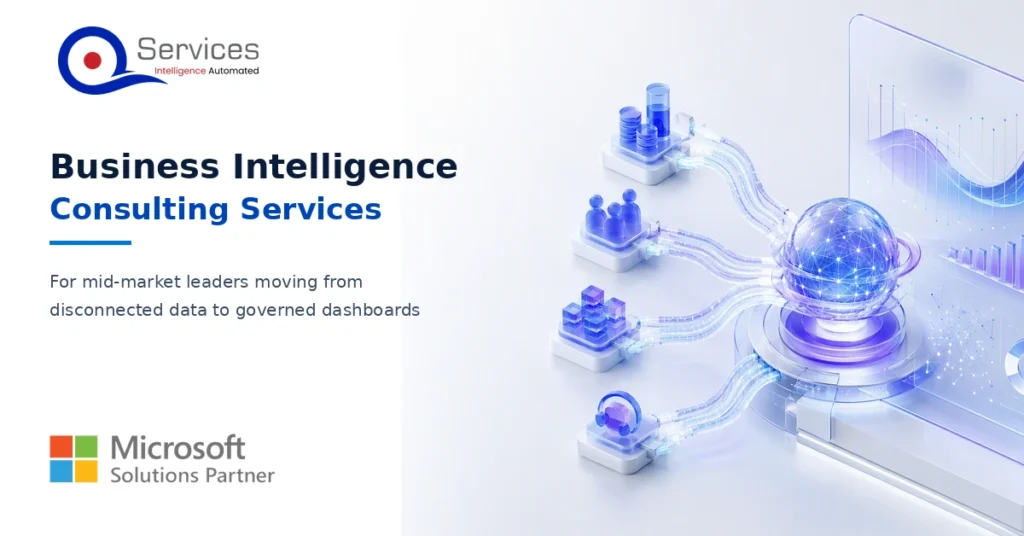
Business intelligence consulting services should give a mid-market company a governed way to make decisions. Attractive dashboards are only the visible part. The useful outcome is a system in which source data, metric definitions, access, releases, ownership, and support still work after the consultants leave.
In a Microsoft Solutions Partner vs Microsoft Partner comparison, the difference is validation. A company can participate in the Microsoft AI Cloud Partner Program without holding a customer-facing Solutions Partner designation. A designated Solutions Partner has met Microsoft’s current threshold in a specific solution pathway: at least 70 out of 100 partner capability points, with more than zero points in every required metric, based on performance, skilling, and customer success data recorded in Partner Center.
Business intelligence consulting services should give a mid-market company a governed way to make decisions. Attractive dashboards are only the visible part. The useful outcome is a system in which source data, metric definitions, access, releases, ownership, and support still work after the consultants leave.
In a Microsoft Solutions Partner vs Microsoft Partner comparison, the difference is validation. A company can participate in the Microsoft AI Cloud Partner Program without holding a customer-facing Solutions Partner designation. A designated Solutions Partner has met Microsoft’s current threshold in a specific solution pathway: at least 70 out of 100 partner capability points, with more than zero points in every required metric, based on performance, skilling, and customer success data recorded in Partner Center.